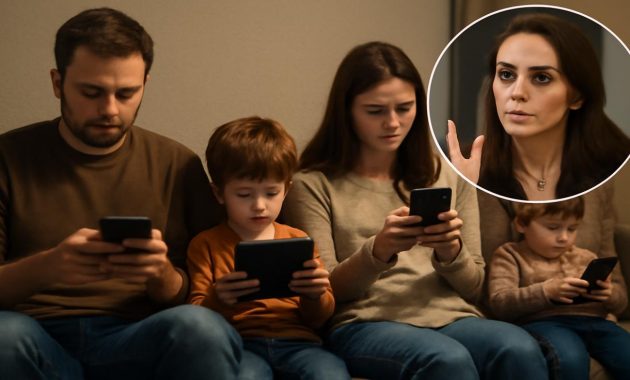
The café was full, every table claimed by parents and children, by couples and colleagues. Mugs clinked, milk foam hissed, soft music hung in the air. And yet, if you glanced around, the loudest presence in the room glowed silently: a constellation of screens. A toddler in a high chair stared at an animated tiger dancing on a phone. A boy of nine hunched over a game on a tablet, thumbs tense, shoulders curled. At the next table, a teenage girl scrolled with the slow, practiced flick of someone half-listening, half-drifting somewhere far from here. Their parents sat right beside them—physically together, drinks sharing the same condensation-slick table—but their attention drifted in separate digital currents. It felt like sitting inside the very sentence that recently rippled through headlines around the world, spoken by Catherine, Princess of Wales: “We are together physically but not together mentally.”
The Moment the Room Went Quiet
When Kate Middleton uttered that line during one of her early childhood initiatives, it hummed with a kind of quiet alarm. She wasn’t saying anything parents hadn’t felt in their bones. She was giving words to an uneasy truth most of us live with every day: we can be in the same room as our children, watching the same sunset from the same window, and yet be miles apart in our minds.
Her warning about children’s screen time didn’t come like a scolding. It landed more like a sigh—half worry, half plea. In interviews and speeches focused on the early years, she keeps returning to presence, to connection, to the invisible threads that form between adults and children long before those children can articulate what they need. She talks about it like something living and fragile, something that can be strengthened through eye contact and conversation—or slowly thinned when one or both faces glow behind glass.
Picture the most ordinary evening in your home. Maybe the television murmurs in the background, a familiar series looping its way through another season. One child stands in the kitchen, half dancing, half asking for a snack. Another sits on the couch, face washed in blue, tapping through a game. Your phone, heavy with unread notifications, waits within arm’s reach. No one is shouting. No one is upset. But underneath the surface calm, there’s a subtle distance, like fog settling between people who love each other.
“We are together physically but not together mentally.” It hits home because it is not about monsters lurking on the internet, or some cartoon villain of technology. It’s about absence—quiet, distracted, well-intentioned absence—settling into the tiny spaces where presence is supposed to live.
The Hum of the Digital Tide
If you close your eyes and listen in almost any modern household, there is a particular soundscape: the soft buzz of a notification, the rustle of a tablet cover opening, the laugh track from a cartoon tumbling through a bedroom door. Screens aren’t an intrusion anymore; they’re woven into the fabric of family life like the hum of a refrigerator or the tick of a clock used to be.
There is no return to a mythical unplugged past, and Kate Middleton is not calling for one. Children video call grandparents oceans away; they discover music their parents loved at thirteen; they explore documentaries about coral reefs and black holes and ancient forests, all from their bedrooms. Screens can open windows. The question, she keeps nudging us to ask, is: what are they closing?
Childhood used to be measured in scraped knees, muddy socks, and the slow boredom of long afternoons. Now, it’s punctuated by pings and streaks, algorithms that learn what makes a young brain lean closer, not look away. Neuroscientists describe childhood as a time when the brain is sculpted by whatever it encounters again and again. Stories, faces, voices, trees, rivers, arguments, laughter—these used to be the primary tools. Increasingly, pixels are chiseling away too.
Spend enough time with teachers, pediatricians, or early childhood experts and you hear echoing concerns: shorter attention spans, rising anxiety, sleep disturbed by late-night scrolling, an uneasy dependence on the next digital hit of interest or affirmation. Kate’s warning about screen time lives inside this chorus, but it adds something else: an almost painful tenderness for the small, quiet moments we’re losing without even noticing.
The Invisible Cost of “Just a Minute”
Think of how often a child tugs on a sleeve: “Look at this.” “Watch me.” “Listen.” These invitations are the tiny doors through which connection enters the room. A toddler lining up toy animals. A six-year-old learning to whistle. A fourteen-year-old, standing on the edge of sharing something that hurts, then turning away when they see your eyes fixed on your phone.
It’s not just children’s screen time that concerns Kate—it’s ours. Because presence is a duet. Many parents limit their kids’ hours online while living tethered to their own devices. The message a child receives isn’t measured in minutes; it’s felt in priorities.
“Just a minute,” we say, thumbing replies, checking news, half-listening. The minutes stack up into habits, the habits into a family rhythm in which it slowly becomes normal not to have each other’s full attention. No meltdown, no shouting, just a steady lowering of expectations on all sides: this is how togetherness looks now.
Kate Middleton’s simple sentence pierces that illusion. It draws a line between bodies sharing a space and minds sharing a moment. It asks: When your child looks around the room, what do they see more often—your face turned toward them, or toward a screen?
Measuring the Minutes That Matter
Parents often whisper the same question in late-night conversations: How much is too much? Where is the line between healthy digital curiosity and harmful digital dependence? There is no single number that fits every child, every family. But there are patterns. There are rhythms that either foster connection or erode it.
Imagine tracking a single ordinary weekday. Morning to night, how long are your children’s eyes locked onto a screen? And then, harder question: how long are yours? Beneath the numbers lies something more important: what did those minutes replace? Were they held in place of boredom, or in place of conversation? In place of exploration, or in place of sleep?
Kate’s focus on the “early years” keeps circling back to this: the first five years of life are not a rehearsal. They’re the main act in building a child’s inner world—their capacity for empathy, creativity, resilience, trust. Human faces, real voices, the grainy imperfection of daily life together: these are the raw materials. Screens aren’t villains, but they can be deceptively greedy, quietly feeding on minutes most of us don’t realize we’ve surrendered until they’re gone.
Sometimes it helps to see the daily pattern clearly, laid out not in theory but in a rough sketch of time. Consider a simple example:
| Part of the Day | Common Screen Use | Possible Connection Swap |
|---|---|---|
| Early Morning | Cartoons during breakfast | Shared breakfast, talking about the day ahead |
| After School | Gaming or scrolling to “unwind” | Walk, playground visit, simple chores done together |
| Evening | TV while parents catch up on phones | Board game, story time, shared cooking |
| Before Bed | Last check of messages or videos | Quiet reading, talk about “best and worst” of the day |
This isn’t a prescription; it’s a mirror. For some families, the numbers will look different. For others, the screen-free swaps might already be happening. What matters is seeing how easily the hours slip away to a glow we’ve stopped questioning, and how powerfully a single protected hour of full attention can shift the tone of an entire day.
When the Forest Is Replaced by a Feed
Modern nature writers often describe childhood as a kind of ecosystem. In a healthy one, there are wild spaces—parks, rivers, trees, even the humble weeds pushing through pavement. There are unstructured hours in which nothing is scheduled and everything is possible. There is boredom, that underrated doorway into imagination.
Kate’s concern about screen time is not only about blue light in dark bedrooms; it’s also about the shrinking of that inner wilderness. When a child’s first impulse in any quiet moment is to reach for a device, what happens to their ability to wander—through thoughts, through books, through backyards and side streets and imaginary worlds built from sticks and stones?
Close your eyes and recall your own childhood. The texture of it. Maybe the smell of wet grass after rain, the dusty light of late summer afternoons, the click of a bicycle chain, the cool relief of shade under a tree. These memories aren’t just sentimental; they are proof that human beings are made of their environments. When Kate speaks about nurturing the early years, she’s also talking about nurturing the settings in which those years unfold.
If the primary landscape of a child’s life becomes a curated scroll of images, edited and polished and endlessly updated, we should ask: what kind of soil is that for a growing mind? Does it teach patience? Does it teach how to be alone with one’s thoughts? Does it teach how to read another person’s expression across a table, to sit through awkwardness, to tolerate silence, to notice the way sunlight crawls slowly across a room?
None of this means handing your child a backpack and sending them into the woods unsupervised. It can be as small as a nightly walk, phones left at home, listening for birdsong or distant traffic or the dog two houses down who barks at everything that moves. It can be as small as asking your child, “What did you notice today?” and then staying with their answer, even if it meanders, even if it takes longer than the quick-hit pace of a social feed.
The Courage to Be Bored Together
There is a particular kind of courage required now: the courage to create moments that don’t instantly entertain. When Kate Middleton points to screen time as a threat to mental togetherness, she is also quietly inviting families into the awkward, sometimes restless space of unplugged time.
Sit for ten minutes in a room with a child and no screens, and you can almost feel the itch start. Hands twitch toward pockets. Minds glance toward notifications. The room feels too quiet, too slow. But if you stay—if you outlast that first fidgety wave—something softer often arrives. A question from your child you didn’t expect. A story about school that would never have been shared in the shadow of a TV. A game invented on the spot, using nothing but couch cushions or spoons or the way your voices can echo off the walls.
Experts warn about the overstimulation of constant digital input, how it can make real life feel flat by comparison. But the flip side is also true: when we re-learn how to sit in unpolished, unscripted moments, they slowly become richer. The scent of dinner simmering on the stove, the slow unwinding of a bedtime story, the soft questions that surface in the dark when the lights go out but conversation hasn’t yet—these are the places where a child’s sense of safety and belonging quietly root themselves.
Kate’s message is not about strict rules or moral judgment. It’s about noticing the texture of your own evenings. Do you share eye contact, long and unhurried? Do you laugh at something entirely offline—a mispronounced word, a kitchen disaster turned inside joke? Do you have rituals that cannot be interrupted by a buzz or ping? These are not luxuries. For a child, they are lifelines.
Small Shifts, Deep Roots
The idea of “fixing” screen time all at once can feel overwhelming, almost doomed to fail. But most change in family life happens not through grand declarations, but small, repeated gestures—a phone left in another room, a weekly “device-free Sunday morning,” a car ride where the only soundtrack is conversation and the passing scenery.
Consider a few gentle experiments:
- Declare one meal a day to be screen-free, for everyone, every day.
- Turn off all devices an hour before your child’s bedtime and protect that time as sacred.
- Replace one show or game a week with a shared activity: baking, drawing, fixing something around the house.
- Model what you ask: when your child speaks, put your phone down, face down, and meet their eyes.
- Create a small family ritual—a weekly walk, a Friday night story circle, a Saturday morning pancake ritual—where screens simply do not belong.
Individually, these shifts feel almost trivial. Collectively, they weave a new rhythm. Over weeks and months, a child learns something vast and quiet: that when they are near you, they are not in competition with a device. That their voice, their stories, their existence, are not background noise in a room lit by other people’s lives.
This is the heart of Kate Middleton’s warning. Screen time is not a technical issue to be solved with timers alone. It is relational. It is about what children come to believe about their own worth and the reliability of the adults around them.
Being Where Our Feet Are
In nature writing, there is a phrase that circles again and again: “Be where your feet are.” It’s a reminder that real life is always happening in one place only—where you are, right now. The smell of the room you’re in. The weight of the child leaning against your shoulder. The sound of their breathing as they fall asleep.
Kate Middleton’s voice joins that chorus, but points it toward family life. We are, she suggests, scattering our attention so thinly that our bodies and minds rarely line up in the same place at the same time. The cost of that scattering is paid most heavily by those who cannot name it yet—the very young, whose sense of self is being built from the reflections they find in our faces.
There will always be emails unanswered, messages unseen, headlines unscrolled. There will not always be this version of your child, on this particular evening, at this specific stretch of their growing-up. Their questions will change. Their need to tug on your sleeve will change. There is a bittersweet urgency in recognizing that mental togetherness is a fleeting, renewable resource—a thing we either choose to cultivate, or quietly allow to erode.
Someday, perhaps, that same child will sit alone in a café, phone on the table, watching other families navigate the dance of screens and conversations. Maybe they will remember the rules you made, the fights you had, the compromises you found. Maybe they will remember the nights when everything was turned off except the lamp and your voice reading one more chapter than you planned.
In that future room, the loudest presence might still be a glow of screens. But somewhere in the way they look up, in the way they listen, in the way they offer their own attention to others, there will be traces of what you practiced together: the art of being not just side by side, but truly, fully, mentally together.
Frequently Asked Questions
How much screen time is safe for young children?
There is no single “perfect” number, but many pediatric organizations suggest avoiding screens (other than video calls) for children under 18–24 months, keeping preschoolers to around an hour a day of high-quality content, and focusing on balance for older children. Just as important as duration is context: what they’re watching or doing, and whether screens replace sleep, outdoor play, or family connection.
Is all screen time equally harmful?
No. Passive, endless scrolling or fast-paced entertainment tends to be more draining, while interactive, creative, or educational use can be more positive. Co-viewing—watching or playing together and talking about it—also changes the impact. The main concern Kate Middleton highlights is when screens consistently displace real-world connection and presence.
What if my child needs screens for schoolwork?
School-related screen use is a normal part of modern education. The key is to distinguish between required tasks and open-ended digital wandering. You can support your child by creating clear start and end times for homework, adding short offline breaks, and making leisure screen time a conscious choice rather than a default habit.
How can I reduce my own screen use without feeling cut off from work or friends?
Try setting gentle boundaries rather than rigid bans. For example, keep your phone in another room during meals, turn off non-essential notifications, and choose a nightly “digital sunset” after which you’re offline unless there’s a true emergency. Let friends and colleagues know your preferred response windows so you feel less pressure to be constantly available.
What if my child resists when I try to limit their screen time?
Resistance is common, especially if screens have become a primary source of fun. Expect some pushback and stay calm and consistent. Involve your child in creating new routines, offer attractive alternatives (games, outings, projects), and model the changes yourself. Over time, as new habits form, the emotional intensity usually eases and other forms of play and connection begin to feel more natural again.