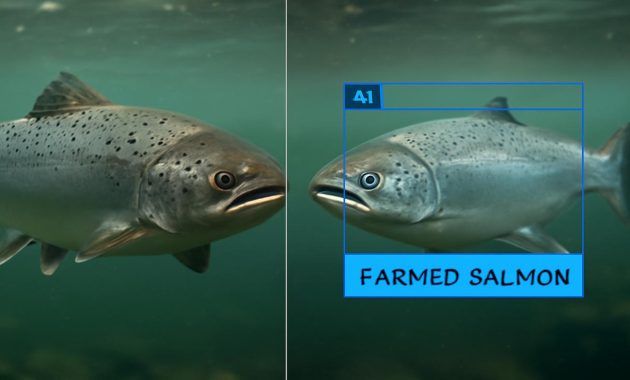
The river looks wild enough at first glance. Meltwater rushes over fist-sized stones, alder branches dip their leaves into the current, and something silver flares beneath the surface, gone before your eyes can focus. To anyone standing on the bank, that quick flash of muscle and light is just a salmon doing what salmon have always done—running the gauntlet from sea to spawning grounds. But today, on this particular river, the story is more complicated. What looks wild is not always wild. And, for the first time, an invisible observer knows the difference.
When the Net Breaks
Somewhere miles downstream, beyond the last bend you can see, ocean swells push against a line of net pens the size of city blocks. Inside them, hundreds of thousands of Atlantic salmon circle in tight loops, scales rubbing scales, a whirl of captive energy waiting for harvest. These fish have been bred for fast growth, thick fillets, and a temperament that tolerates confinement. They are fed with the regularity of factory shifts, their lives measured out in pellets and quarterly reports.
But the ocean doesn’t read management plans. Storms hit harder than predicted. A mooring chain corrodes faster than the engineer’s best guess. A boat misjudges its distance. And all at once—sometimes in a single night—there’s a tear in the net and a tide that does what tides do best: it moves living things from one world into another.
Escaped farmed salmon do not look lost. They surge into the coastal current with a powerful kick, sliding past kelp forests and sea lion rookeries as if they’ve trained for this their whole lives. To a gull riding the wind above, they are just more fish in the blue. To us, for decades, they were almost invisible too. When they showed up in rivers, they were counted as wild, folded into statistics that determined fishing quotas, conservation plans, and the fate of endangered runs.
Now, that invisibility is cracking. And the chisel is artificial intelligence.
The River That Tells on Its Guests
Not far from one of those net pen operations, a research team stands in waders along a narrow riverbank. Their gear is unromantic: coolers, sample tubes, a small pump rigged to a floating intake. But they’re after something more elusive than the shimmering backs of salmon—they’re here for what the fish shed and forget.
Every creature that passes through this river leaves a biological breadcrumb trail: bits of skin, mucus, scales, stray cells, stray strands of DNA. To the naked eye, it’s just water, cold and clear. To a filter and a centrifuge, it’s a library. This is environmental DNA, or eDNA, and over the last decade it’s become one of ecology’s quiet revolutions. You no longer need to catch a fish to prove it was here. You just need a bottle of the right water, and the right tools to read it.
The problem used to be that reading the water was like trying to decipher a book after it had gone through a blender. Yes, salmon DNA is in there—but so is everything else: algae, insects, bacteria, bears, even the scientists themselves. You can detect “salmon,” but not easily tell which salmon, from where, or whether it’s a hatchery-raised fish, a farmed escapee, or a member of the last struggling wild run in the watershed.
This is where a new breed of artificial intelligence has stepped in. Fed with mountains of genetic data and trained to see what human eyes, or standard statistical methods, could not, it has learned to pick out a new kind of signal from this molecular noise. In a sense, it’s learning to recognize an accent in an otherwise familiar language. Wild salmon and farmed salmon belong to the same species, but decades of breeding in cages have given farmed fish a distinct genetic cadence—and the AI has learned to hear it in the river.
Teaching a Machine to Smell Like a Salmon
Behind this quiet revolution is an unglamorous process that looks, from the outside, like weeks of fluorescent-lit repetition. In a university lab, far from the wind and smell of fish, a team of biologists and computer scientists sifted through tissue samples drawn from farms and wild rivers across a rugged coastline. Each sample was sequenced—its DNA reduced to long strings of letters: A, T, C, G, the alphabet of life.
In the old days, researchers would look for a few key genetic markers that differed between farmed and wild salmon. Helpful, but blunt. Farmed strains had been mixed and remixed, shipped between countries, crossed with local stocks, selected for traits like fast growth and disease resistance. Wild populations, for their part, carry signatures of their home rivers—ancient lines of adaptation etched over thousands of spawning seasons. The genetics are messy, overlapping, never fully one or the other.
So the team tried something different. They fed whole genetic profiles into a machine-learning model, not telling it which parts to focus on. From thousands of fish—known farmed individuals, known wild individuals—it learned complex patterns that no single human brain could comfortably hold. Subtle shifts in the frequency of certain gene variants. Odd combinations that showed up again and again in farmed stocks but rarely in river-born fish. The model began to draw an invisible border between “farmed” and “wild” in a multidimensional landscape of DNA.
Then they took a risk. Instead of clean tissue samples, they fed the AI the equivalent of river noise: broken fragments of DNA from water samples where nobody had netted a single fish. Could their trained algorithm still recognize, inside that slurry of life, the distinct signature of a farmed salmon gone rogue?
To their quiet astonishment, it could. Not perfectly—nothing in ecology ever is—but with an accuracy high enough to redraw how we see salmon rivers. Formerly anonymous fish, counted only as “present,” were suddenly tagged with an origin story.
The Numbers Hidden in the Current
The first time the new system lit up on a field laptop beside a river, the air was already cooling into autumn. Leaves scratched at the waders. Far up the watershed, the first wild fish were nosing into gravel, turning on their sides to cut redds where they would lay and fertilize the next generation. On a graph gliding across a screen, bars rose and fell, translating sequences of letters into probabilities.
Farmed. Wild. Wild. Farmed.
There, embedded in the river’s chemical memory, were unmistakable traces of escapees pushing upriver. Some would never make it far; farmed fish, bred in dense, predictable pens, are often ill-suited to the rigors of the wild. But some do survive, and some spawn. Their genes bleed into wild populations, bringing traits that helped in captivity but can spell trouble in the river: slower reactions to predators, altered timing of migration, vulnerabilities to disease.
For managers and conservationists, this new clarity feels like a door opening onto a room they always sensed but could never enter. For years, they have debated how serious a threat farmed salmon pose to wild populations. Studies based on tagging and visual identification gave partial answers. Now, with AI-assisted eDNA analysis, they can begin to see the problem in fine detail, river by river, season by season.
How many escapees are making it into this watershed after last winter’s storm? How far upstream do they penetrate? Are they still showing up years later, a ghost of an earlier net pen failure? The river, under this gaze, becomes a ledger.
| Factor | Traditional Monitoring | AI + eDNA Monitoring |
|---|---|---|
| Effort Required | High: nets, traps, crews on the water | Moderate: water sampling with fewer site visits |
| Stress on Fish | Can be invasive and stressful | Non-invasive, fish remain undisturbed |
| Origin Detection | Often limited to visual or tag-based guesses | Genetic-level identification of farmed vs wild |
| Spatial Coverage | Sparse, based on accessible sites | Dense, many sites sampled quickly |
| Response Time After Escapes | Slow; depends on catching physical fish | Fast; detects DNA signal soon after escape |
In meeting rooms far from the river—governments, industry boardrooms, conservation NGOs—the implications ripple rapidly. Fines for escapes can now be tied to hard data on where those fish went and how long they persisted. Farmers can no longer argue that escape numbers are exaggerated when the river’s own DNA diary contradicts them. Conservation plans can finally be tailored with confidence, separating real wild population trends from the artificial pulse of farmed newcomers.
The Ethics of Seeing Too Clearly
Of course, no new eye on the world arrives without discomfort. For salmon farmers already facing public pressure over sea lice, antibiotic use, and pollution under the pens, the idea of an AI system that can track their mistakes into the most remote tributaries feels like another spotlight. Some see in it the potential for unfair blame—what if a few stray sequences are misread? What if wild fish carrying farmed genes from long-ago escapes are now counted as a fresh failure?
On the other side stand Indigenous nations and coastal communities whose cultures, diets, and economies have followed wild salmon for millennia. For many of them, the stakes are not abstract. A failed salmon run means empty smokehouses, broken ceremonies, elders explaining to children why a river once full of shimmering backs is now mostly silence and gravel. The ability to pinpoint exactly how and when farmed salmon are infiltrating their traditional waters is not just a scientific victory; it is a reclamation of clarity in decisions that affect their lives.
So the debates begin. Who owns the data produced by these AI analyses—the labs, the governments that funded them, or the communities whose waters are being tested? Should the raw genetic information be guarded to protect both human and ecological privacy, or made open to keep industry honest? How should uncertainty be handled in policy when an algorithm, not a human observer, is doing much of the initial interpreting?
There is another, quieter ethical question, too: how much do we want to know? A river that once offered mystery and story now returns a dizzying cascade of concrete numbers. The romantic part of us might prefer the days when a glint of silver at dusk was just that, not a data point with a likelihood score of “87 percent farmed origin.” Yet it is precisely that clarity that may give wild salmon their best chance at survival in a century of upheaval.
From Hidden Guests to Managed Neighbors
One of the understated powers of this AI breakthrough is not just in exposing problems, but in offering tools to fix them more intelligently. Suppose a particular farm is shown to be the source of repeated large escapes over several years, with the errant fish detected in critical spawning tributaries. Regulators, now armed with high-resolution escape maps, can require engineering upgrades, limit stocking densities, or even close and relocate operations away from the most sensitive watersheds.
Conversely, farms that invest in stronger infrastructure and better monitoring can demonstrate, with the same AI-assisted data, that their escapes are rare or minor. Instead of sweeping condemnations of all aquaculture, we get a more nuanced, river-by-river picture—where some farms may prove to be relatively benign neighbors, while others fall under justified scrutiny.
There is room, too, for collaboration. Some forward-looking salmon farmers are already partnering with researchers, offering reference samples of their stock to fine-tune the AI’s pattern recognition. If the algorithm knows exactly what a given farm’s salmon look like at the DNA level, it can more quickly and accurately flag those individuals in the wild, and even distinguish one company’s escapees from another’s.
Out of these uneasy alliances emerges a new way of thinking about responsibility. Escaped salmon stop being a vague “cost of doing business” and become traceable liabilities. Wild rivers, instead of being open sinks for industry mistakes, are recognized as spaces where someone is always counting, even if they stand invisibly in the form of code running on a small black box in a lab.
What the River Whispers About the Future
It is tempting, standing on the bank watching the water twist around your boots, to see this as a story about a single clever technology. A triumphant moment when AI, often blamed for divorcing us from nature, instead helps us listen to it more closely. And that’s part of the truth. The system that flags farmed salmon in the wild is part of a broader wave of tools that turn messy ecological data into usable insight—models that predict where invasive species will spread next, satellites that map deforestation in near-real time, algorithms that listen for the last calls of endangered birds hidden in hours of rainforest soundscapes.
But the deeper story, like the current under this river’s surface, runs more slowly and steadily. AI has not magically made farmed salmon less likely to escape, or wild runs more robust. What it has done is strip away one more layer of ignorance. It has taken something that was happening unseen—genetic mingling, subtle changes in population makeup—and pulled it into the light where humans must decide what to do with it.
In the years to come, the same techniques might spread beyond salmon. Other farmed fish, from sea bass to tilapia, could be similarly tracked as they slip into neighboring ecosystems. Aquaculture operations might be zoned not just by water depth and currents, but by the genetic vulnerability of nearby wild stocks. Entire coastlines could be managed with a complexity that matches the biological reality, rather than the blunt zoning maps of the past.
And still, on evenings like this one, a single salmon will break the surface downstream, leaving a ring of ripples that glows gold in the lowering light. Someone watching from the bank might wonder: wild or farmed? Ancestral traveler or recent escapee, following an instinct coded in captivity? Human senses, alone, will not answer. But a bottle dipped quietly into the river, shipped overnight to a lab, and processed by an AI that has learned to hear subtle differences in the language of life—that will tell us.
Whether we listen, and what we do with what we hear, remains our old, enduring responsibility.
Frequently Asked Questions
How can AI actually tell farmed salmon from wild salmon?
The AI is trained on large genetic datasets from known farmed and known wild salmon. Instead of looking at just a few genetic markers, it analyzes complex patterns across many parts of the genome. When it sees DNA from a river sample, it compares those patterns to what it has learned and estimates the likelihood that the DNA came from a farmed or wild fish.
What is environmental DNA (eDNA), and why is it important here?
Environmental DNA is genetic material that organisms shed into their surroundings—skin cells, mucus, scales, waste. By filtering water from rivers and coastal areas, scientists can collect this DNA and identify which species have been present, without catching or even seeing them. In this case, eDNA lets researchers detect escaped farmed salmon simply from water samples.
Does this technology harm the salmon or their habitat?
No. Collecting eDNA involves taking small volumes of water and filtering them, which does not disturb fish or damage habitat. The analysis happens entirely in the lab, using the DNA fragments captured on those filters.
How accurate is AI-based identification of farmed salmon?
Accuracy varies depending on how good the training data are, how distinct local farmed strains are from wild populations, and the quality of the water samples. In tests, models can distinguish farmed from wild salmon with high probability, but there is always some uncertainty. That uncertainty is usually expressed as a confidence score rather than a simple yes-or-no answer.
Can different salmon farms be distinguished from each other?
Often, yes. If farms provide reference samples of their stock, AI models can learn farm-specific genetic signatures. That can make it possible not only to detect an escapee, but also to infer which operation it likely came from. This level of detail depends on cooperation from farms and the genetic uniqueness of their breeding lines.
What does this mean for wild salmon conservation?
The technology gives managers and communities a clearer picture of how many farmed salmon are entering wild rivers, where they go, and how long they persist. That helps separate the true status of wild populations from the “noise” created by escapees, and supports more targeted rules on where and how salmon farms operate.
Is this kind of AI monitoring being used anywhere else yet?
Similar AI and eDNA approaches are starting to be used to track invasive carp, rare amphibians, endangered whales, and even disease organisms in water. The application to farmed salmon is one of the more high-profile examples because of the economic and cultural importance of these fish, but the broader toolkit is spreading across many branches of conservation biology.