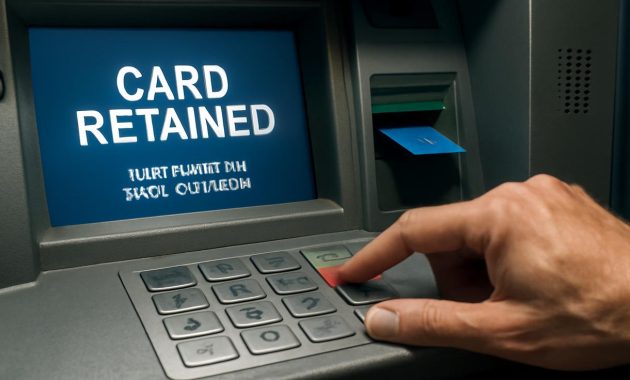
The first time a machine swallowed my bank card, the sound it made reminded me of a door locking from the inside. A soft whir, a tiny mechanical sigh, and then a silence that felt unreasonably final. I stood there in the glow of the ATM screen, fingers still hovering in the air, like I’d just tried to feed a wild animal and it had stolen my hand instead of the food. The sidewalk around me smelled like rain on old concrete, exhaust from a passing bus drifting by and mixing with the faint scent of bakery sugar from the shop across the street. People moved around me, heads bent to their own worries, and I was left staring at a blinking message: “Your card has been retained. Please contact your bank.”
The Moment the Machine Turns on You
You never really think about an ATM until you need it. It’s just a metal box in the wall, humming away in the background of your errands and late-night emergencies. You slide in the card, type in the numbers, grab the cash, move on with your life. Until the day it doesn’t give your card back.
It always happens faster than your brain has time to catch up. One second the card goes in, the next it vanishes. Maybe you took a second too long to decide how much to withdraw. Maybe the card reader glitched. Maybe the machine has quietly decided your card looks suspicious. The reasons are invisible, buried in circuits and software and a security algorithm you will never meet.
Your body knows before your mind does that something is wrong. Your stomach tightens. Your hand taps the empty slot as if the card might still be hiding just inside. You jab random buttons. You stare at the screen, willing it to reconsider. That thin rectangle of plastic suddenly holds the weight of your life—your money, your sense of control, your plans for the rest of the day.
And then another thought arrives, half-panicked, half-practical: Is there anything I can do right now, before I call anyone, before I just stand here like a stranded animal in front of a metal predator?
The Fast Technique Nobody Tells You
There is one surprisingly simple thing you can try the instant you realize the ATM is keeping your card—a fast, physical “reset” that sometimes works before the machine fully decides to lock it inside. It’s not magic, and it doesn’t override bank security. But in that tiny window of time—those few seconds when the machine is still thinking, still processing—it can be enough.
First, you need to picture what’s happening inside the machine. When you insert your card, it’s not just sitting there like toast in a toaster slot. It’s being pulled along a track, scanned by a magnetic reader and a chip reader, then held in place by small internal clamps. If the ATM system decides to keep the card—maybe because it detects a fraud alert, the session timed out, or you entered the wrong PIN too many times—it doesn’t simply push the card back. It retracts it fully into a secure box, a kind of metal vault inside the machine.
But there’s a brief moment, a sliver of time, when the machine is in transition—between regular operation and full “card captured” mode. The card may still be in the feeder mechanism instead of locked in the deposit box. That’s the window this technique tries to catch.
Here’s how it works, step by step, in the most practical way:
- Stay at the machine—do not walk away. The instant you realize your card hasn’t come out, your best tool is speed. The longer you wait, the more likely the card is already moved to the safe compartment.
- Look for any on-screen option. Some ATMs show a “Cancel” or “Stop” button on the screen, or alert messages like “Session timed out.” If you see anything resembling “Cancel” or “Return card,” tap it repeatedly.
- Press the physical “Cancel” button continuously. On most machines, this is a red or yellow button. Don’t just hit it once—press and hold it for several seconds, then release and press again quickly. Sometimes this makes the ATM abort the process and spit the card back if it hasn’t fully retracted it yet.
- Keep your fingers near the slot. While you’re pressing cancel, keep your hand just in front of the card slot—not blocking it, but close enough that if the machine starts to eject the card even slightly, you can catch it and pull it out in one smooth motion.
- Listen. ATMs talk in mechanical whispers: clicks, whirs, little motor sounds. If you hear faint machinery moving and the screen is still lit, the machine may be trying to make up its mind. Keep pressing cancel and watching the slot.
In some cases, this quick, almost instinctive combination of holding “Cancel” and staying alert at the slot is enough to interrupt a pending capture and force the machine to return the card. It’s like tugging gently on a rope just before someone knots it permanently.
But there are limits. If your bank has already flagged that card for security, or if the machine’s software has reached the point of no return, nothing you push or press will override it. That’s the line that separates a helpful fast reaction from a dangerous attempt to force the machine physically, which you should never do.
What You Should Never Do in Panic
Panic makes people inventive in all the wrong ways. When your card doesn’t come back, you might feel an urge to do things that, in the clear light of logic, are terrible ideas: yank at the slot, hit the screen, jam another card in, or try to pry open some mysterious hidden panel.
Resist every one of those impulses.
The moment you start treating an ATM like a stubborn door instead of a secure financial terminal, a quiet line gets crossed. The machine doesn’t know that you’re just desperate and frustrated. But the cameras above it—because there are always cameras—will see one thing very clearly: someone trying to tamper with a cash-dispensing device.
Here’s where the divide sits between smart, immediate action and risky behavior:
| Do This | Avoid This |
|---|---|
| Press and hold the “Cancel” button repeatedly. | Hitting the screen, keypad, or casing. |
| Watch the slot closely, ready to pull the card if it moves. | Inserting tools, cards, or fingers into the slot. |
| Wait calmly for 1–2 minutes for any response. | Walking away and leaving the machine without a record of what happened. |
| Take a photo of the ATM and screen if the card isn’t returned. | Sharing your PIN or personal data with strangers who “offer help.” |
Your goal in those first few moments is twofold: try the legitimate, fast technique that might free your card, and then—if that fails—shift instantly into protecting yourself from whatever happens next.
When the Machine Wins: Safeguarding Yourself
Sometimes, despite your best timing and your quickest reflexes, the ATM decides to keep your card. No second chances, no partial ejection, just a locked-in verdict. The hum fades, the screen resets, and you’re standing there empty-handed, feeling oddly betrayed by a steel box.
This is where your mindset has to pivot from “How do I get my card back right now?” to “How do I make sure no one can misuse it if something goes wrong?”
Step away just enough from that animal panic to take control of the story. The air may feel heavier, your heart may be racing, but you are still not helpless. You just need to work in layers, like you’re slowly building a protective shell around your financial life:
- Stay right there, in full view of the ATM. Don’t let anyone step between you and the machine. If someone offers to “pull a trick” or “force it open,” politely but firmly refuse.
- Note the exact time and location. Look for a small label or sticker on the ATM with an ID number or the bank’s name. If you can, take a quick photo of the machine, the screen (if it’s still displaying any message), and the surroundings. These details will matter later.
- Call your bank immediately. Use the number on your banking app or a statement—not on the ATM itself, just in case. Tell them your card was retained. Ask them to block the card right away and log a record of the incident.
- If it’s a standalone ATM (not at a branch), be extra cautious. These are more frequently targeted by card-trap scams. In some cases, criminals place a thin device over the card slot that holds your card just outside the machine so they can retrieve it after you leave. If your bank tells you the machine didn’t log a captured card, tell them that and ask for a rapid block and replacement.
- Watch your account over the next 24–48 hours. This is the quiet aftermath where fraud, if it’s going to happen, often appears. The moment you see anything strange, report it.
The irony is that, in most legitimate “card retained” situations, your bank may eventually recover the card from the ATM and keep it for you to pick up—or they may simply destroy it and issue a new one. But at the moment it happens, it feels like being cut out of your own life, even if only for a few days.
So while that fast “cancel button” technique can sometimes give you a last-second reprieve, the deeper skill is learning how to keep your cool when the machine wins, and turn that moment into a trail of evidence and protection instead of chaos and risk.
Reading the Subtle Warnings Before Trouble Starts
Machines rarely speak in full sentences, but they do send signals—little hints that things aren’t quite right. Long before your card disappears into an ATM, there are often clues that this might not be the best place, or moment, to trust it.
Picture another scene: It’s late, the streetlights paint the sidewalk in uneven orange patches, the only sound is the buzzing of a neon sign and the far-off murmur of traffic. You approach an ATM tucked into the side of a convenience store. The screen flickers a little. The card slot looks slightly crooked, like someone pressed on it too hard. You smell stale cigarettes and spilled beer. There’s no one else around.
Your body, if you’re listening, whispers: Maybe not here.
Some of the most useful habits around ATMs are small, almost invisible decisions you make before you ever insert your card:
- Look closely at the slot. If there’s an extra plastic piece, tape, or something that looks added on—don’t use it. Card “traps” and skimmers often look just a little off-center or bulkier than the rest of the machine.
- Gently wiggle the card reader frame. Real ATM parts are usually solid. If something moves or snaps, step away.
- Check the keypad. If it feels like there’s a loose or raised cover over it, that can be a sign of a fake keypad designed to steal your PIN.
- Trust the surroundings. ATMs inside bank branches, busy malls, or well-lit public places are generally lower risk than isolated street machines late at night.
- Listen to your hesitation. That small pause before you put the card in is worth honoring. If something feels off, try another machine.
What does this have to do with retrieving your card? Everything. Because the best way to “get your card back” is to avoid losing it to a rigged or malfunctioning machine in the first place. The fast technique helps in the moment, but the quiet skill of reading your environment helps you long before the crisis.
The Human Side of a Cold Machine
We like to think of ATMs as precise, unemotional machines—perfect calculators in metal bodies. But the way we interact with them is deeply human, sometimes painfully so. When the screen flickers, when the card doesn’t come back, it isn’t just an inconvenience. It taps into a primal fear: being cut off from your resources, your ability to act, your sense of safety.
Money, for better or worse, is woven into how we move through the world. An ATM that suddenly misbehaves can feel like the forest floor giving way under your feet on a quiet walk—you thought you knew the terrain, but now it’s shifting without warning.
That’s why these small techniques matter. Holding the “Cancel” button, keeping your hand near the slot, listening to the machine’s sounds—these are more than mechanical tricks. They are small anchors of control in a moment when you feel helpless.
Imagine this: You’re traveling alone in a new city, the air smells like spice and car fumes and something fried. You find an ATM, you put in your card, and it vanishes. For a breathless second, your world narrows to that slot. But this time, instead of freezing, you know what to do. Thumb slams the cancel button, firm and continuous. Eyes on the slot. You hear a faint clack. A millimeter of plastic appears. You grab it, pull, and suddenly your card is back in your hand, warm from the machine’s internal light, like something rescued from under dark water.
You step away. The city opens up around you again. The air feels bigger. Your day continues.
Questions & Answers About ATMs Keeping Your Card
Why do ATMs keep cards in the first place?
ATMs retain cards for security or technical reasons: multiple wrong PIN attempts, suspected fraud, card expiration, a system error, or a session timeout where the user didn’t take the card in time. Sometimes it’s a safety measure; other times it’s just a glitch.
Does pressing “Cancel” really help get my card back?
It can, but only in a small window of time. If the machine hasn’t yet retracted your card into its secure vault, repeatedly pressing “Cancel” and watching the slot can sometimes prompt it to eject the card instead of capturing it. If the card is already stored internally, this won’t work.
How long should I wait at the ATM after my card is taken?
Wait at least 1–2 minutes to see if the machine resets and returns the card. During that time, try the cancel technique. If nothing happens, assume the card is retained and immediately contact your bank while you’re still there.
If my card is trapped, can ATM staff or security open the machine for me right away?
Usually no. ATMs are tightly controlled, and even branch staff often don’t have immediate, direct access. Typically, specialized technicians or cash-handling teams service them on scheduled visits. Most banks will cancel your card and issue a new one rather than hand it back on the spot.
What if someone nearby offers to help “get my card out”?
Decline and protect your PIN. Never let a stranger touch the keypad or your card. Some scams rely on fake “helpers” distracting you, copying your card details, or watching your PIN so they can use a second card later.
Can my card still be misused after the ATM has kept it?
If the card was genuinely captured and logged by the machine, it’s usually moved into a secure compartment. In that case, misuse is unlikely—especially if you report it quickly. But if the card was trapped by a criminal device attached to the machine, it might not be inside the ATM at all, so blocking the card immediately is critical.
Is it safer to use ATM machines inside bank branches?
Generally yes. Indoor ATMs, especially inside bank premises and well-lit, staffed locations, are less likely to be tampered with and are better monitored. While no machine is perfectly safe, your risk is usually lower than at isolated, outdoor units.
Should I keep using a card that was once almost trapped?
If your card was returned and your bank finds no issue, you can keep using it. But if the incident felt suspicious—strange noises, odd delays, faulty screen—it’s reasonable to ask your bank for a replacement card and to log a note on your account.
In the end, an ATM is just a machine. It doesn’t know your plans or your worries. But you do. Knowing that quick, simple technique—the pressing of “Cancel,” the watchful hand at the slot—gives you back a little of what a malfunctioning machine tries to snatch away: not just your card, but your sense of being quietly, calmly in charge of your own story.