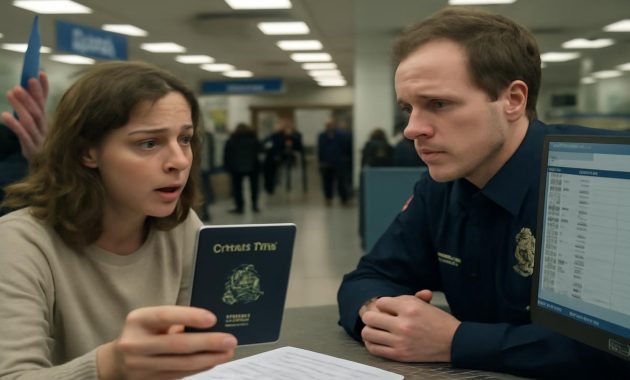
The woman at the passport counter kept her smile steady, but her fingers stalled on the keyboard. Fluorescent lights hummed overhead, and somewhere behind the glass a printer coughed out pages for someone else’s routine renewal. But for Amir—his shoulders tense, his palms damp on the worn folder of documents—the air seemed to thicken. The clerk’s eyes flicked from the screen to his face and back again. Then, in a tone that tried and failed to sound casual, she said the words that would rearrange the next year of his life: “I’m… unable to process this update right now. Your name seems to be… under review.”
The Moment a Name Becomes an Obstacle
If you’ve never watched a computer decide your future in a fraction of a second, it’s hard to imagine the quiet violence of it. There’s no dramatic sound, no flashing red error message—just a subtle hesitation, a longer pause, and then the gentle bureaucratic refusal that lands like a stone in your stomach.
In offices across the United States, this scene plays out with eerie sameness. People walk in assuming they’re doing something simple: updating a passport after a marriage, a divorce, a move, renewing an expired document. They bring birth certificates, old passports, printouts of appointment confirmations, and perhaps a sense of mild annoyance at bureaucratic hassle—but not fear. Fear usually arrives later, when they learn that their name has quietly tripped a wire in a massive, largely invisible system.
US authorities do not need a dramatic reason to stop a passport update. Sometimes it’s a matter of an administrative flag; sometimes something more serious. Increasingly, it is something simpler and yet more sinister: the way a name, divorced from its bearer, drifts through government databases and lands in the same column as the wrong person. The computer doesn’t know who you are. It only recognizes a pattern of letters that, somewhere in some file, was once tied to suspicion.
The Silent List Behind the Glass
There is no sign on the wall that says, “Warning: Certain Names May Be Automatically Blocked.” There is no pamphlet explaining what happens when your name resembles that of someone on a watchlist or a sanctions list, or when an old investigation, a clerical error, or a stray data entry links your identity to someone else entirely. The lists themselves live behind digital walls: databases of suspected terrorists, sanctioned individuals, people flagged for fraud, fugitives, and more. Many are compiled by different agencies, all feeding into a single reality you meet at the counter.
To the human eye, the connection can feel almost absurd. Maybe your name is common in another part of the world. Maybe you share it with someone who once ran afoul of an investigation in a city you’ve never visited, or failed to pay a fine you’ve never heard of. But to automated systems—designed to err on the side of caution, to flag first and ask questions later—there is no absurdity. There is only the match.
And so, an algorithm quietly nudges a digital switch from “approve” to “hold.” Your record is no longer a simple application; it is now a case. Behind the counter, the clerk sees less than you might imagine: perhaps a vague “refer to supervisor,” or an internal code that means this one goes into the slow lane, indefinitely.
When Routine Becomes Suspicion
What makes this process so unsettling isn’t just that it happens—it’s how it feels to be caught inside it. Most people walk into a passport office expecting a transaction. They don’t expect to become a question. The mood in the room shifts in ways that are more sensed than spoken. The clerk lowers their voice. A supervisor is called over quietly. You start to wonder if the people in line behind you are noticing, if they’re guessing at what you did wrong. You did nothing wrong, but suspicion, once it touches you, doesn’t ask permission.
Authorities will often tell you calmly that some additional review is required, that it “may take some time.” They may not be able to say how long. What they rarely explain is that for a certain cluster of names—often associated, fairly or not, with particular regions, religions, or political histories—this is not a rare glitch. It is a pattern.
You step back from the counter with a politely worded receipt or an email confirming that your case is pending. The room returns to its normal rhythm. People shuffle forward. Babies cry. A printer whirrs. You walk out into the open air feeling strangely lighter and heavier at once, aware of the sky above you but unsure when, or if, you’ll next see it from the window of an airplane.
Names That Trigger the System
We tend to think of names as intimate, personal things: gifts from our parents, echoes of grandparents, saints, poets, places. Yet in the age of databases, a name is also a key, or sometimes a lock. It can open a record of your school enrollment, your credit history, your medical file. But for some, it opens a door they never knew existed—a backroom of security checks and “enhanced screening” where your identity is deconstructed and measured against shadows.
Certain names, or close variants of them, appear again and again in these backrooms. Often they carry the weight of geopolitics: surnames common in countries under sanctions or conflict; names transliterated from scripts that don’t map neatly onto English, spawning multiple spellings; names shared by both ordinary citizens and people who once found themselves on the wrong side of a law, a border, or a classification they might not have agreed with.
Authorities insist that they do not profile in the way the public imagines—that they do not simply ban names. Technically, that’s true. The system doesn’t read culture; it reads characters. Yet people with certain kinds of names, from certain kinds of backgrounds, feel the impact in a way that’s hard to dismiss as coincidence. The pattern is not just statistical; it’s lived—in missed funerals, postponed weddings, lost jobs abroad, and family members stranded on the wrong side of an ocean because a passport update died in a digital queue.
A Quiet Geography of Delay
You can map the impact of these blocks not just by who is affected, but by where they find themselves stuck. In airport lounges staring at departure boards they’ll never see light up with their flight. In cramped apartments scrolling through government portals that say only “In Process.” In kitchen conversations where partners calculate whether to delay the move, the program, the new job, the semester abroad.
The geography is psychological, too. A line is drawn in your sense of self between before the block and after the block. Before, you may have thought of yourself as a citizen, more or less like any other. After, you realize that your name has a life in government systems that you cannot see, only feel when it brushes against you like a cold current beneath the surface of calm water.
What Happens After the “Hold”
The process that unfolds after a passport update is blocked is rarely transparent and almost never swift. From the outside, it looks like silence. Inside the system, though, your name is now traveling—quietly—through layers of review.
An officer may compare your information against multiple databases, looking for discrepancies or matches. Your date of birth. Your previous addresses. Your travel history. Does anything line up with a record they already have—someone under investigation, someone on a list, someone whose file was never properly closed? The safer answer, from a bureaucratic point of view, is always to take more time.
You might be asked for more documents: proof of employment, school records, naturalization certificates, copies of old passports. You send them in, thinking that surely this, finally, will clear things up. Often it does not—not quickly. The machine has already done the most important thing it was designed to do: convert a straightforward case into a cautious one.
| Stage | What You Experience | What May Be Happening Internally |
|---|---|---|
| Application Submitted | You hand in forms or apply online, expecting a normal processing time. | Your name and details are checked against multiple government databases. |
| Automatic Flag | No visible change yet; you might just see “processing.” | A match or near-match with a watchlist or restricted record triggers a hold. |
| Additional Review | You’re told there will be a delay or that “further review is needed.” | Officials compare data points and may request more documents. |
| Outcome | Your passport is approved, delayed indefinitely, or—rarely—denied. | A decision is made whether you are cleared, remain flagged, or need further action. |
Days stretch into weeks. For some, weeks stretch into months. Friends and family ask for updates, and you find yourself repeating the same vague phrases the officials use with you. “They’re still reviewing.” “It’s still pending.” “They don’t know how long it will take.” Each repetition rubs the words thinner.
The Human Cost of a Frozen Document
Passports are not just little blue books filled with stamps; they’re time. Time with aging parents in another country. Time with children starting school elsewhere. Time with opportunities that have expiration dates—jobs that can’t be held open indefinitely, scholarships that begin in the fall whether you’re there or not.
When the update is blocked, life rearranges itself around that absence. Suitcases are unpacked. Employers renegotiate or quietly move on. Partners have difficult conversations that start with, “What if this doesn’t come through?” The cost is measured in intangibles: trust, momentum, belonging. You start to question not just the system, but your place in the country whose emblem is stamped on the front of the document you’re not allowed to renew.
How It Feels to Be Reduced to Data
There is a strange dissonance in realizing that to the authorities, you are both very specific and somehow interchangeable. They have your fingerprints, your photo, your signatures over the years. They may have records of your travels, your entries and exits, traces of your life scattered across forms and screens. And yet, when it matters most, you are a line in a database that can be confused with another line.
It can feel like walking through a forest and discovering that, in the official map of the land, you are not a person but a tree that looks like many other trees. One of them, somewhere, was struck by lightning, and now every tree with roughly the same shape is marked as “potentially hazardous.” No one steps back to see you standing there, waving, saying, “It’s me. I’m here. I’m not the storm you’re looking for.”
For those whose names are most often swept into this net, the message—however unintended—lands with a familiar sting: your name, your culture, your story carry an added tax. Not just the tax of curiosity (“Where are you from, really?”), but the tax of suspicion, quietly levied at the border of every new beginning.
The Thin Line Between Safety and Excess
No one seriously argues that nations should ignore real threats, or that documents should be handed out without scrutiny. The world is complicated, and harm can travel on a booked ticket like anyone else. The hard question is not whether we screen, but how we do it—and what we are willing to risk in the process.
In the abstract, an extra check, an automated hold, a delayed approval sounds harmless, even prudent. On a chalkboard, it’s just a small added step. But step into the story of a single person whose life is rerouted by that “small added step,” and the trade-off looks different. Multiply that by countless others whose names ring similar bells in the system, and you begin to see not just isolated inconvenience, but a quiet architecture of inequality.
Trying to Navigate an Opaque System
People caught in these automatic blocks eventually become reluctant experts in a language they never wanted to learn. They trade notes in hushed online forums and living rooms: Who did you call? What did they say? Is there a form for this? Does a congressperson help? Do lawyers make a difference? How long did yours take?
They discover that persistence sometimes helps: calling passport agencies, politely requesting escalations, asking for status updates. Some find relief by involving elected representatives, who can occasionally nudge a file forward. Others consult attorneys familiar with travel and identity restrictions, who can at least translate the silence into possibilities: Is this more likely a watchlist mix-up, a lingering investigation, a sanctions issue, or something else entirely?
What everyone discovers, sooner or later, is that the process offers very little narrative. Systems that can assign you to a list in seconds are not nearly as eager to tell you a story about how to get off it. There’s no shared script for repair, no clear path for saying, “You’ve confused me with someone else” and having that statement move smoothly through the same channels that carried suspicion.
Living With a Name That Carries Luggage
Eventually, many do get their passports updated. The book arrives in the mail with no apology, just the familiar insignia, the crisp pages waiting to be stamped. Life starts again, more or less where it left off. Tickets are rebooked, semesters rescheduled, plans remade.
But even with success, something lingers. The next time they fill out a form or approach a border, they brace themselves. Will the system remember whatever shadow once fell across their name? Will it all happen again? They carry this awareness like invisible luggage—heavier for being unseen.
For some, the experience sparks a quiet determination: to talk about what happened, to push for more transparency, to insist that security measures consider not only the worst-case scenario they seek to prevent, but the very real lives they disrupt along the way. For others, it breeds a cautious silence. They move on, but the memory remains in the background, a faint echo whenever they hear the word “processing.”
FAQs
Does the US really block passport updates based on names alone?
Authorities do not openly describe it as “blocking based on names,” but automated systems routinely compare names against watchlists, sanctions lists, and other databases. When a name or close variant matches a record of concern, that can trigger an automatic hold or additional review, effectively blocking or delaying a passport update.
What kinds of names are more likely to be flagged?
Names that are common in regions associated with conflict, terrorism investigations, or sanctions tend to appear more often in flagged records. Names with multiple spellings due to transliteration (for example, from Arabic, Russian, or other non-Latin scripts) can also be at higher risk of near-matches in databases.
If my passport update is delayed, does that mean I’m under investigation?
Not necessarily. A delay can result from many factors: a simple clerical issue, missing documents, or an automated name match that needs to be cleared. While some holds may be tied to active investigations, many are the result of overly cautious or imprecise matching rather than specific suspicion about you personally.
Is there anything I can do if my passport update is stuck in “processing” for a long time?
You can contact the passport agency to ask for a status update, request an appointment at a regional office if you have urgent travel, and consider reaching out to your congressional representative for assistance. In complex cases, consulting an attorney familiar with travel and security restrictions may help clarify your options.
Can people find out if they’re on a watchlist?
Access to most security and watchlists is restricted, and agencies typically do not confirm or deny an individual’s watchlist status. However, people sometimes infer that their name is connected to a list when they repeatedly encounter unexplained travel delays, extra screening, or blocked passport updates.
Does this only happen to non-citizens or naturalized citizens?
No. Both US-born citizens and naturalized citizens can experience automatic blocks or delays if their names match or closely resemble those in security or sanctions databases. Citizenship status can influence how certain checks are handled, but it does not completely shield anyone from automated name-based flags.
Will changing my name solve the problem?
Changing your name might reduce the chance of future automated matches, but it can also introduce new complexities, since your previous name remains part of your record. It’s not a guaranteed solution and is a major personal decision that should be weighed carefully against the potential benefits and drawbacks.