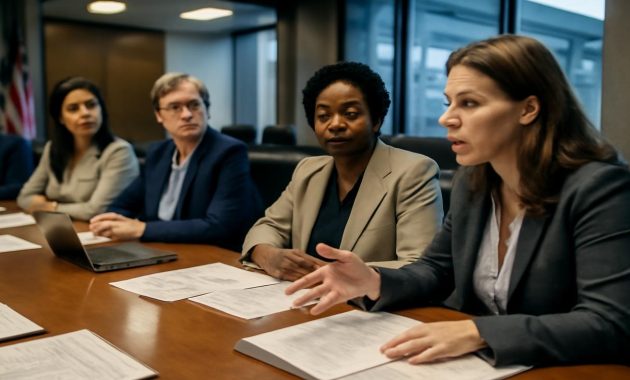
The room was still waking up when the question arrived: “What if no student in this county ever had to worry about affording a pad or tampon again?” It drifted over the polished wood of the Montgomery County Council chamber like something both fragile and stubborn. Staff shuffled papers, a councilmember clicked their pen, and a few high school students in the back row leaned forward as if they’d been waiting years to hear those words out loud. Outside, school buses hummed along the rainy streets, their yellow bodies reflecting in puddles. Inside, in this bright room of microphones and nameplates, something quietly radical was about to be discussed: the simple, human promise that menstruation should not be a barrier to learning, dignity, or participation.
When Policy Meets the Most Ordinary of Needs
The agenda listed it in plain, bureaucratic language: a review of menstrual hygiene policy, state legislation, and budget plans. It sounded dry on paper, as policy items often do. But if you followed the thread beneath the jargon, you’d find yourself standing in a school bathroom beside a teenage girl silently panicking over the spreading stain on her jeans.
In Montgomery County, Maryland—one of the country’s wealthiest and most diverse counties—that girl might come from a family that never talks about periods. She might be the oldest daughter, the one who translates bills and medical forms for her parents. Maybe there’s enough money for groceries, usually, but never quite enough left over for that bulky “feminine care” line item. You can’t buy pads with SNAP. You can’t ask for a line of credit at the pharmacy. So she folds toilet paper into improvised pads and prays it holds until the final bell.
This is the gap the Council is staring into: the invisible, daily scramble to manage a completely ordinary biological function in a system that still treats pads and tampons as optional luxuries rather than basic infrastructure, like soap or toilet paper. The review isn’t only about shelves and budgets; it’s about a quiet transformation of what schools, public buildings, and local government choose to care about.
The Long Walk to a School Bathroom
Picture a hallway in a Montgomery County middle school at 10:17 a.m. Lockers slam, sneakers slap against the linoleum, and somewhere in the stream of students, one kid walks with that strange, stiff carefulness that only those who’ve leaked through their pants understand. They’re calculating: How many minutes until lunch? Which friend has a sweater they can tie around their waist? Will the nurse’s office have supplies, or the same dim apology—“We’re out again”—they heard last month?
“I started carrying extra pads in a pencil case,” one student would later tell a community group. “Not just for me, for anyone. Because you never know when the dispenser will be empty.” She said it with the ease of someone describing extra pencils or gum. But behind that calm, there’s a quiet indictment: the adults have not caught up to a reality students live with every month.
That reality has a name now: period poverty. It’s not just about money; it’s about what happens when cost, shame, and infrastructure failures collide. Nationally, surveys show that a significant portion of students who menstruate have missed class because they didn’t have the supplies they needed. In a high-performing district obsessed with test scores and attendance rates, that absence is a form of educational sabotage hiding in plain sight.
The County Council’s review is, in part, an attempt to drag this daily drama out of the shadows and onto the meeting agenda. Menstrual hygiene is suddenly not just a “women’s issue,” not just a topic for health class, but a line item, a legislative focus, a budget priority. For the people whose lives it shapes, that shift matters.
Inside the Council Chamber: Numbers, Stories, and the Quiet Power of Data
When the Council meets to examine menstrual hygiene policies, they don’t start with poetic language. They start with spreadsheets. How many schools? How many restrooms? What does a pad cost in bulk compared to retail? How will dispensers be installed, maintained, refilled? How does this interact with new or proposed state laws requiring free menstrual products in certain facilities?
But even in a room ruled by numbers, stories sneak in.
A school nurse might testify about the steady stream of students arriving at her office between second and third period, holding their backpacks close, speaking in low voices. Teachers might describe keeping an informal stash of pads and tampons in desk drawers, funded out of pocket. Parents might talk about deciding between a bus pass refill and a box of pads that week.
The conversation oscillates between the lived and the quantified. A public health official might present data on how access to menstrual products improves attendance. A budget analyst might lay out the projected cost over five years. A councilmember could ask whether these products should be in all restrooms, including those labeled “men’s” and “all-gender,” nodding to the reality that not everyone who menstruates is a girl or woman, and not everyone with a uterus uses the “right” bathroom, according to old norms.
It’s in these details that a county’s values show themselves. Is menstrual care something only students must figure out on their own, or is it a shared responsibility, as basic to public life as clean water and working locks on doors?
| Focus Area | What the Council May Consider | Why It Matters |
|---|---|---|
| School Restroom Access | Free pads and tampons in student restrooms, not just nurses’ offices. | Reduces missed class time, panic, and embarrassment. |
| Alignment with State Legislation | Matching or exceeding statewide standards on menstrual equity. | Ensures consistency, compliance, and stronger legal backing. |
| Budget and Procurement | Negotiating bulk rates, planning multi-year funding, installing dispensers. | Makes programs sustainable instead of pilot projects that fade. |
| Public Buildings and Libraries | Extending free products beyond schools to county facilities. | Supports residents of all ages, not just students. |
| Education and Stigma | Pairing products with clear communication and health education. | Turns a quiet crisis into an open, problem-solving conversation. |
Following the Thread to Annapolis: State Legislation in the Background
While councilmembers in Rockville sift through testimony and budget lines, another conversation hums along in Annapolis. State lawmakers in Maryland have been flirting with a bigger, bolder idea: that access to menstrual products is not just good policy, but a right that should be guaranteed in schools, maybe even in prisons, shelters, and other state-funded facilities.
State legislation often moves like a tide—slow, persistent, and bigger than any single county shoreline. It can require schools to stock restrooms with free products, mandate clear signage, set minimum standards for how many restrooms must be covered, or define how often supplies must be checked and refilled. It might push beyond schools to cover college campuses, health departments, and detention centers.
Montgomery County’s review doesn’t happen in a vacuum. If the state sets a floor, the county may decide to build a second story on top of it. Maybe state law will say “middle and high schools must provide free menstrual products.” The county could decide that’s not enough and extend access to elementary students who start earlier, or to adult education centers, or to public buildings where residents often find themselves caught off guard.
Sometimes, the script flips: local action pushes the state forward. When counties and cities begin to treat menstrual equity as a standard part of governance, they create proof of concept. Look, they can say: the world did not collapse. The budget survived. Attendance nudged upward. Complaints went down. The sky stayed in the sky. That evidence can fuel bigger statewide moves, lifting the baseline for everyone.
Budget Lines and Invisible Lives
On a spreadsheet, menstrual equity might appear as a small percentage of a massive county budget—a few hundred thousand here, a pilot program there. The figures sit nestled among road resurfacing, library renovations, and staff salaries. But each digit in that line carries real texture.
Behind “$X for menstrual hygiene supplies” are the small, personal moments that never get attached to the invoice. The student who stops skipping first period every month. The homeless woman who steps into a county building on a cold morning and finds, for once, what she needs without having to ask. The parent who quietly crosses pads off the grocery list one week because they know their kid can get them at school.
Budget plans are where values collide with constraints. Councilmembers will have to weigh competing priorities: transit improvements, climate initiatives, housing, public safety—and in that crowded room of needs, menstrual hygiene stands up and clears its throat. It isn’t the most expensive thing on the list. It just might be one of the most quietly transformative.
There will be questions: How do we measure success? Do we track absenteeism before and after implementation? Do we survey students on whether supplies are actually stocked, actually usable, actually placed in the restrooms they frequent? How do we train custodial staff so resupplying these items is as routine as restocking toilet paper? Can we build flexibility for emergencies and unexpected spikes in demand?
In those questions is a lesson about how dignity is administered—not just promised. The budget becomes less an abstract ledger and more a blueprint for intimate, often invisible forms of care.
Culture Shift in the Aisles Between Soap and Paper Towels
If the Council reaches consensus and the money is found, the work doesn’t end with a line in the budget. That is only the beginning of a cultural shift that trickles down from committee reports to hallways and stall doors.
Imagine walking into a school restroom where the metal box on the wall is not a coin-operated relic, always empty, but a clean, clearly labeled dispenser offering pads and tampons for free. No quarters, no nurse’s pass, no awkward request. Just take what you need. The dispenser sits there like the soap dispenser or the paper towel roll—mundane, dependable, unremarkable in the best possible way.
In classrooms, teachers might mention the policy at the start of the year: “If you need menstrual products, they’re in every restroom. If you ever have trouble finding them, tell me or another adult.” That simple sentence does quiet work, stripping away layers of shame. School newsletters might include a line about menstrual product availability alongside reminders about lunch balances and immunization records.
This is where policy seeps into culture. When periods are treated as normal, logistics become easier. Students who do not menstruate learn that pads are not mysterious contraband but everyday items some of their classmates rely on. Boys might grab an extra pad for a friend without snickering. Teachers stop treating a student’s sudden request to leave class as suspicious and begin to see it as an expected part of life.
And then there’s the staff behind the scenes: the custodians who check dispensers during their rounds, the office managers tracking shipments, the vendors adjusting their supply runs. For them, menstrual care becomes another box on their daily checklist, no more exotic than checking the soap level. It’s in that ordinariness that true change takes root.
Listening to the People Who Live the Policy
No policy about periods is complete without the voices of those who actually menstruate. Montgomery County’s review has the potential to become not just a top-down decree, but a conversation, if leaders choose to listen.
Student councils might survey their classmates: Are the products comfortable? Are they in the right locations? Do they run out too quickly? Some may ask for organic or fragrance-free options; others will emphasize discretion in packaging. Transgender and nonbinary students may remind adults to stock all-gender restrooms and not assume who needs what, where.
Community groups and parents can speak to gaps beyond school walls. A parent working two jobs might ask: “Will there be supplies at the recreation center where my daughter spends her afternoons?” A shelter resident might suggest better distribution in facilities where people often arrive with nothing but the clothes they’re wearing.
When those perspectives make their way into council hearings, policy gains texture. It stops being a generic “menstrual hygiene program” and becomes a woven fabric of actual lived needs, failures, and desired futures. The council chamber then becomes what democracy always promises to be at its best: a place where the quietly urgent parts of daily life finally get a microphone.
The Quiet Future This Policy Could Build
If you zoom out far enough, the Council’s review of menstrual hygiene, legislation, and budgets becomes part of a larger story unfolding across cities, states, and countries: the slow, steady reimagining of what counts as public infrastructure.
For generations, the intimate work of managing periods has been delegated to individuals and families, wrapped in silence and cost. Now, brick by brick, stall by stall, that burden is being shared. When a county government asks, “How do we build menstrual equity into our systems?” it’s really asking, “What kind of place do we want this to be, at the deepest, most everyday level?”
In one imagined future, a child growing up in Montgomery County won’t remember a time when school bathrooms lacked free pads and tampons. They’ll think of them the way they think of lights coming on when you flip a switch: ordinary, expected, almost invisible. They won’t know the particular dread of bleeding through a pair of pants and calculating how far the nurse’s office is. They will simply go to the restroom, reach for what they need, and get on with the messy, complicated, beautiful task of becoming who they are.
Some will argue about cost, or claim that people will “abuse” the free supplies. Others will wonder why, in a world drowning in crises, this relatively small issue is getting so much attention. But those who have lived a different reality—who have sat in a classroom counting minutes and hoping the blood doesn’t spread—will understand. They know that sometimes justice looks less like a sweeping speech and more like a small, white pad in a metal box on a bathroom wall, waiting quietly for the moment it’s needed.
On the day the Montgomery County Council finishes its review, the sky outside will look like any other sky. Buses will still line up at curbs, teachers will still fuss with projectors, students will still scroll through their phones between classes. No fireworks. No parade.
But in restrooms and offices and public buildings, something will have shifted—slightly, almost imperceptibly—toward a world where no one’s education, workday, or sense of self is held hostage by a cycle as old as humanity itself. And in that subtle shift, in that nearly invisible act of care, a quieter kind of revolution will be underway.
Frequently Asked Questions
Why is the Montgomery County Council reviewing menstrual hygiene policy now?
The review reflects a broader recognition that access to menstrual products affects school attendance, public health, and basic dignity. Growing public awareness, student advocacy, and evolving state legislation have all pushed menstrual equity from the margins into the center of policy discussions.
What kinds of changes could come from this review?
Possible changes include providing free pads and tampons in more school restrooms, expanding access in county buildings such as libraries and recreation centers, aligning local rules with state mandates, and creating stable budget lines to support long-term programs rather than short-term pilots.
How does state legislation influence the county’s decisions?
State laws can set minimum standards for menstrual product access in schools and other facilities. The county must at least meet those requirements, but it can choose to go further. The Council’s review helps ensure local policies are not only compliant with state law but tailored to the specific needs of Montgomery County residents.
Will these policies only help students?
No. While schools are a major focus, the review may also affect access in public buildings, shelters, and community centers. That means residents of all ages—people experiencing homelessness, low-income families, and anyone caught off guard in a public space—could benefit from better access to menstrual products.
How will the county pay for expanded menstrual hygiene programs?
Funding would come through the regular budget process. Councilmembers and staff analyze costs for products, dispensers, and maintenance, then weigh those against other priorities. Because menstrual products are relatively inexpensive in bulk, many advocates argue that the benefits—reduced absenteeism, improved well-being, and greater equity—far outweigh the costs.