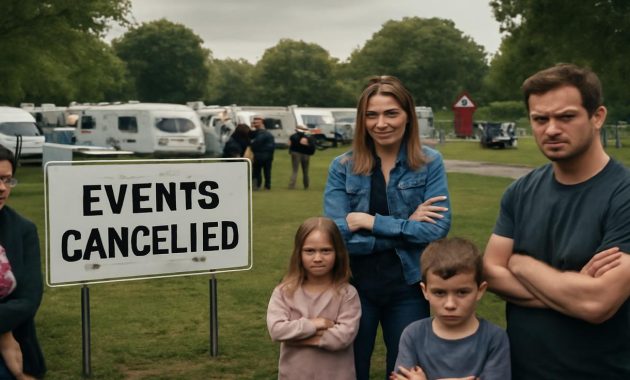
The first caravan rolled in just after sunrise, white sides catching the low gold of the morning as dog walkers blinked in surprise and children swung their feet on damp park benches. By nine o’clock, the playground at the heart of the town’s most popular family park was ringed not by bunting and food stalls, but by steel-towed homes on wheels—thirty, then forty, then more—nose to tail like a slow, determined tide. Where there should have been the scent of popcorn and hot doughnuts for the weekend’s family festival, there was diesel, cigarette smoke, and the distinctive tang of wet grass pressed flat beneath unfamiliar tyres.
A park that was meant to be a party
If you’d walked through the gates that Friday, you would have seen the ghosts of plans still sketched across the landscape. Faded chalk arrows pointed the way to “Face Painting” and “Story Tent.” Metal crowd barriers waited in stacked clusters. A banner, half-tied to a lamp post, flapped lazily: “Summer in the Park – Family Fun Weekend.” It creaked a little each time the wind caught it, as if trying to remind everyone what was supposed to be happening.
The park itself sits in the crook of a lazy river, a broad green bowl edged with oaks and plane trees, the kind of place that has soaked up decades of birthday parties, first bike rides, and picnics where fruit juice tips over in the grass. Parents know every path here by heart. Kids can navigate from skate ramp to ice-cream van blindfolded. On summer weekends, it’s less a park and more a familiar living room without walls.
That weekend, however, the script flipped. Instead of funfair lorries and garish rides humming into life at dawn, locals woke to the rhythmic crunch of caravan wheels. One by one, a convoy of Travellers’ caravans turned off the main road and through the park gate that had somehow been left unlocked overnight. Cars reversed, engines revved, voices called out brief instructions over the thud of doors: “Back a bit… whoa… hold it there!”
Within an hour, the grassy centre that had been marked out with spray paint and cable ties for inflatable slides and a puppet theatre had become a compact, improvised village. Caravans formed neat defensive rows. Vans idled while children spilled from open doors, trainers sinking into the soft ground, squinting in the thin sunshine of an English morning that hadn’t yet decided if it was going to rain.
The sudden silence of cancelled plans
By mid-morning, the notices appeared in the park’s two main entrances. A council officer, hair whipped by the wind, fixed laminated sheets to railings with bright blue cable ties. “Due to unforeseen circumstances, the Summer in the Park event has been cancelled. We apologise for any disappointment.” The phrase “unforeseen circumstances” has a way of sliding over specifics like a polite shrug, but the specifics were unmissable: a solid white wall of caravans where the bouncy castle should have been.
Word spread the way it always does in small towns: a text from a friend, a photo in the group chat, an indignant post on a local Facebook page. Some parents, children already zipped into raincoats and clutching pocket money in hot little hands, turned on their heels at the notice and marched home, frustration tight in their steps. Others walked further in anyway, drawn by the sheer strangeness of it all.
Close up, the site felt oddly domestic. Washing lines appeared almost immediately, pegged with football shirts and small, bright socks that fluttered over the trampled clover. A woman in a dressing gown stepped down from a caravan with a mug of tea, steam curling against the cool air. Two men wrestled with a generator, the oily cough of its engine breaking the morning hush. Kids—some local, some from the new arrivals—tested each other out from a distance, eyeing scooters and footballs, edging closer in that unspoken choreography of childhood curiosity.
Two ways of seeing the same field
Standing there, it was impossible not to feel the friction of competing expectations rubbing against one another like rough cloth. For families who see the park as an extension of their back garden—a safe, predictable space for their children—this felt like an intrusion. Their calendar had been circled around the event for weeks. The park was supposed to be full of music, stalls, and the sweet, sticky promise of candy floss, not diesel fumes and unfamiliar vehicles.
But for the Travellers, this was just another stop in a long chain of temporary homes, a rare patch of flat, open land in a world that seems to grow more fenced-off and hostile every year. To their eyes, the field was first and foremost a place of function: level enough to keep a caravan steady, close enough to water and roads, big enough for several families to park together and keep an eye on the kids. In their experience, staying quiet and out of the way doesn’t guarantee welcome; sometimes, claiming visibility feels safer than invisibility.
Neither group had woken up that morning with the intention of colliding. The park simply happened to be the one piece of ground they both needed at the same time.
Inside the stand‑off
By lunchtime, the park was a study in controlled tension. On the path nearest the car park, a small knot of residents hovered near the council officers, arms folded, voices layered with frustration.
“We booked time off work for this,” one man said, pushing a buggy back and forth, its tiny occupant asleep to the rhythm. “You can’t just cancel and shrug.”
A woman beside him added, “This is our kids’ park. Why can’t they go somewhere else? What about those spare fields out by the bypass?”
The council officer, caught between regulations and human disappointment, spoke in careful phrases. “We’re working with the police and our legal team. We have a duty of care to everyone on site, including the families who have arrived. We can’t just move them on without due process.” She glanced toward the caravans, where a dog barked sharply at a passing jogger. “We’re assessing options.”
On the other side of the invisible line, a Traveller man leaned on the tow bar of his caravan, watching the discussion with a tired, wary expression. He wore a baseball cap and a hi-vis vest, as if he’d come straight from work.
“They think we broke in here to cause bother,” he muttered to another man beside him. “We just needed somewhere flat for a few days. Every lay-by’s got height barriers now. Every bit of ground’s got a gate and a lock.”
The other man lit a cigarette, cupping the flame from the breeze. “They don’t see that. They only see what they’ve been told to see.”
A closer look at the living, breathing camp
Step over the invisible border of suspicion and the encampment resolves into something far more ordinary than the alarmed social media posts suggest. On a patch of grass between two caravans, three children knelt with chalk, drawing hopscotch grids and uneven hearts on the tarmac of the path. A woman pushed a pushchair with one hand and balanced a laundry basket on the other hip. Somewhere, a radio played a chart song just loud enough to hum through the air.
The smells here are the same as anywhere families gather: fried onions in a pan from an open caravan door, fabric softener on clothes, tobacco on the breeze, the underlying, damp sweetness of the park’s soil. A teenage boy in a tracksuit whistled for a stocky terrier, who dashed obediently to heel, tongue lolling. He nodded politely at a passing couple, who weren’t sure whether to nod back.
It doesn’t fit the headline-friendly image of chaos, but neither does it erase the legitimate concerns locals carry, shaped by past experiences and stories that get told and retold. Rubbish, noise, damage to pitches or pathways—these anxieties gather quickly, like dark clouds on an otherwise mild day.
The truth, as ever, is messier and more human than either side’s worst fears or best hopes. Some encampments leave behind little more than flattened grass. Others leave scars that take months to mend. It depends on the people, the place, the conversations that happen—or don’t—during those tense first hours.
A weekend rewritten in real time
As the afternoon unfolded, you could almost see the town collectively recalibrating. Ice-cream vans that had planned to park inside the gates circled aimlessly on nearby streets, chimes muted. A food truck idled at the roundabout for a while, then gave up and drove away. The volunteer choir that had been rehearsing ABBA songs for a sing-along in the bandstand quietly cancelled their lift-share.
Parents improvised. Some turned the trip into simple park time, steering scooters around the edge of the encampment as if skirting a puddle. Others detoured to a smaller green space across town, already packed to an unusual density with prams and picnic blankets, a spillover festival without the festival.
For the Travellers, the day was no festival either. A visit from the council’s legal team, then another from the police, meant papers, reference to court orders, the careful recital of rights and responsibilities. Children hovered, listening from caravan steps, their faces trying on expressions too serious for their years. Where most local kids grow up knowing that home is an address, these children learn early that home is a shape on wheels, and that shape is not always welcome wherever it lands.
In the late afternoon, a brief summer shower swept across the park. Raindrops pinged on tin roofs and plastic skylights, darkening the dust on cars and leaving the grass smelling sharp and alive. For a few minutes, everyone retreated under some kind of shelter: gazebo, caravan awning, the skeletal frame of what should have been a craft tent. The park sighed with the wet patter, a reminder that underneath the argument, the land itself simply drinks the rain and waits.
Who owns a view, really?
One of the strangest things about situations like this is how quickly a public space begins to feel like private territory in dispute. On paper, the park belongs to the council, managed on behalf of the community. In the minds of those who have grown up sliding down its hills on cardboard in the snow, or learning to wobble along on bikes with stabilisers, it belongs to them in a more intimate way.
But the Travellers have their own, different kind of claim—not of ownership, but of long history. Long before local councils were drawing up park bylaws, their ancestors moved through landscapes by necessity: following seasonal work, avoiding hostile landowners, seeking safer ground. The right to roam and stop, briefly and respectfully, sits deep in their culture, even as modern laws squeeze those options ever tighter.
Whose story does the park tell when a convoy arrives? Is it the story of disruption, of cancelled events and anxious families forced to change plans? Or is it also the story of a society that has gradually pushed a nomadic people to the edges of visibility, until even a temporary presence feels like an invasion?
The uncomfortable answer is that both stories exist at once. A parent explaining to a disappointed seven-year-old why the fair’s been cancelled is not imagining that moment of loss. A Traveller mother, bracing for the inevitable eviction notice and the cycle of packing up to move again, is not imagining her exhaustion either.
When conversations actually happen
By Sunday morning, something quieter had settled over the park. The initial spike of outrage on social media had burned off a little, replaced in some corners by more measured posts and genuine questions: How long can they legally stay? What facilities are being provided? Is there any way to salvage parts of the event elsewhere?
In a corner near the bandstand, an unlikely little knot of people stood talking: a youth worker who’d helped organise the festival, a Traveller father, a local councillor, and two teenagers—one from town, one from the camp. The conversation began stiffly, each side wary of saying the wrong thing, then gradually loosened into something like honesty.
“You have to understand,” the youth worker said, glancing at the rides that never were, “for a lot of kids round here, this weekend was a big deal. There isn’t much free stuff for families. This was it.”
The Traveller father nodded. “I get that. My kids were excited too. Not about the fair, about stopping. Sleeping more than one night in the same place. Being able to kick a ball about without worrying someone’s going to bang on the window tellin’ us to move.” He looked out over the damp grass. “We don’t land in places to upset folk. We land because there’s nowhere else.”
One of the teenagers, a local lad in a football top, shifted his weight. “Do you, like… know ahead where you’re going?” he asked, curiosity outweighing caution.
The Traveller boy shrugged. “We know the roads. Lay-bys. Some places we used to stop, they’ve got them barriers now. This place… it was open.”
They stood together for a moment, unified by something as simple as shared boredom. The youth worker promised to see if some of the festival’s sports equipment could be salvaged for an informal kickabout later in the week, on the smaller field across town. The Traveller father nodded again, half-grateful, half-resigned; he doubted they’d still be here by then.
How a weekend leaves its marks
By midweek, the caravans were gone, as quietly as they had arrived. Early commuters watched tail-lights snake onto the main road, the park slowly exhaling into its original shape. The grass, where tyres had pressed deep tracks, lay flattened and mud-streaked. A few bin bags sat beside overflowing litter bins, and in one corner, someone had abandoned a broken camping chair. But there was no mountain of rubbish, no apocalyptic scene—just the unmistakable evidence that, for a brief time, many people had lived here very close together.
The cancelled event was harder to tidy away. Volunteers met to add up costs, to talk about rescheduling, to navigate the maze of paperwork and public feeling. Some residents wrote furious emails demanding stronger barriers, harsher penalties, and legal changes. Others, having walked through the camp and seen the children playing hopscotch and the laundry flapping in the rain, found their anger had shifted shape, becoming a more complicated knot of questions.
What would it look like, they wondered quietly, if the town had a designated, serviced place where Traveller families could stop without turning a community hub into a flashpoint? What if events had built-in contingencies for a world where public land is contested and communities overlap in messy, human ways?
The park itself will recover. Grass grows back, tyre tracks fill with new clover, chalk drawings wash away with the next downpour. The deeper question is whether understanding, too, can grow in the wake of the disturbance—or whether each such incident will simply harden lines, reinforcing an old, weary dance of arrival, outrage, eviction, repeat.
A brief snapshot of a complicated weekend
If you could lay those days out side by side, like snapshots on a table, the contrasts would be stark: the bright poster promising “Fun for All the Family” next to the handwritten sign in a caravan window reading “NO ENTRY – PRIVATE”; the sticky-fingered joy that was meant to colour the park versus the wary glances traded between strangers.
Somewhere between those images is the uneasy truth of shared public space in a crowded country. People need places to gather, to celebrate, to feel safe. People also need places to simply exist when they move outside the neat rectangles of permanent addresses. A convoy of caravans in a family park is not an ideal solution for anyone. But it is, undeniably, a signal—of unmet needs, of planning gaps, of cultures rubbing along the edges of one another without quite knowing how to speak.
On a damp bench a few days after the caravans left, an elderly dog walker put it this way, shrugging into his coat: “The park’s seen worse. Kids’ll be back on the swings by next weekend. But if we don’t start talking properly about where people are supposed to live, and where kids are supposed to play, we’ll just keep reliving this same story, over and over.” His spaniel tugged on the lead, eager to chase the faint smell of diesel that still lingered in the flattened grass.
For now, the birds have reclaimed the morning soundtrack, the squeal of swings has returned, and the banner for “Summer in the Park” has been rolled away into a council store room, its corners already curling. Somewhere down the road, on another patch of contested ground, another set of wheels will roll to a stop. The story of who belongs where—of travellers and stayers, of events planned and plans undone—will continue to write itself, one field at a time.
Quick snapshot of the weekend’s impact
Here’s a brief overview of how the encampment and cancellation played out for different groups:
| Group | Immediate Experience | Lasting Impact |
|---|---|---|
| Local families | Event cancelled, disappointment, change of weekend plans | Mixed memories: frustration, curiosity, and new questions about shared spaces |
| Traveller families | Temporary security and space, but under scrutiny and threat of eviction | Yet another reminder of being unwelcome and legally vulnerable |
| Event organisers | Logistical chaos, financial loss, urgent communication with public | Need to rethink contingency plans and how to use public spaces |
| Council & services | Legal and practical scramble, mediation between groups | Pressure to develop clearer policies and potential stopping sites |
FAQ
Why was the event in the park cancelled?
The event was cancelled because the main area earmarked for stalls, rides, and activities was occupied by a large encampment of caravans. Organisers and the council decided they couldn’t guarantee safety, access, and facilities for the planned numbers of visitors, so they called it off.
Did the Travellers have permission to be in the park?
In many such cases, Travellers move onto public land without formal permission, relying on gaps in security such as open gates. Whether they are legally allowed to stay depends on local bylaws, national legislation, and whether the council has provided suitable alternative sites.
Could the event have gone ahead in a reduced form?
Sometimes events can relocate or scale down, but this depends on time, resources, and alternative venues. In this instance, the short notice and the central area being taken up by caravans made it difficult to safely host crowds, so organisers opted to cancel outright.
Why do Traveller groups choose popular parks instead of more remote areas?
Level ground, access to water, proximity to services, and the absence of barriers all play a part. Remote areas may be unsafe, inaccessible for larger vehicles, or privately owned with stricter enforcement. Public parks, while controversial, can be among the few remaining open spaces where a large group can physically fit.
Who is responsible for cleaning up after an encampment leaves?
Responsibility is officially shared between the people who have stayed on the land and the landowner—in this case, usually the local council. In practice, councils often arrange clean-up operations after any large gathering, formal or informal, to return the park to regular use.
How long can a convoy stay before being moved on?
The length of stay varies widely. Councils typically conduct welfare checks and legal assessments, then may seek a court order to evict if there are no authorised stopping places available. This process can take days or, in some cases, longer, depending on local capacity and the specifics of the encampment.
Is there a better way to handle situations like this?
Many advocates—from both settled and Traveller communities—argue for designated, serviced stopping places that reduce pressure on parks and car parks while providing safer, more predictable options for Traveller families. Clearer planning, better communication, and a willingness to see the human stories on both sides all help reduce conflict when public space becomes contested.