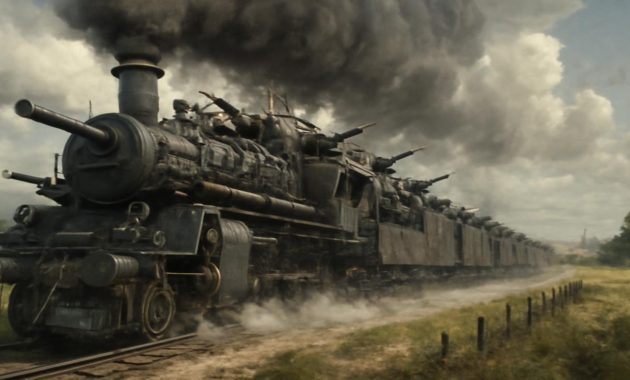
The drawing was little more than a smudge of pencil on yellowing paper, curling at the corners in a forgotten folder of a French archive. Yet the longer you stared, the more the lines resolved into something borderline insane: a squat, hulking train, plated in armor like a medieval beast, crawling forward on a track that wasn’t really a track at all. There were gun ports where windows should be, reinforced plates over what looked like locomotive wheels, and—scribbled in the margin in spidery French handwriting—something that translated roughly to “mobile fortress of 60 tons.” It was less like an engineering proposal and more like a fever dream scribbled after a bad night’s sleep in 1915.
The Man Who Wanted to Turn a Train into a Monster
His name has slipped into the murk at the edges of history, one of those minor inventors and dreamers who orbit the great wars but never quite land in the books. Let’s call him, as some archival notes do, Monsieur L.—a French engineer and veteran of the early months of the First World War. In the fall of 1914, he had seen what modern artillery did to human bodies and stone walls, how men advancing across open ground were cut down like wheat. The romance of cavalry, the panache of bayonet charges—those died in him somewhere on a muddy hillside, under a sky smeared with smoke.
Back in the rear lines, reassigned to logistics and railway planning, Monsieur L. became obsessed with a single question: what if the advance could be wrapped in steel? Not just a tank—those early ideas were only just beginning to whisper in British and French circles—but a whole moving fortress. Something that didn’t crawl like a beetle, but rolled with the implacable weight of industry itself. Something that merged the nervous, fragile human body with heavy machinery and rails, so that bullets pinged harmlessly off metal and the machine itself spat fire back.
And if you were a railway engineer in 1915, your imagination naturally gravitated to what you knew: trains.
The Birth of a 60‑Ton Daydream
What he sketched was not a standard armored train—those already existed in sketchy, improvised forms in several armies. They were usually ordinary locomotives and wagons wrapped in boilerplate and sandbags, bristling with machine guns and small cannons, used to patrol rail lines, escort supply trains, or give mobile fire support. Monsieur L. wanted something far more radical and far less practical: an armoured assault train that didn’t just patrol rails but attacked positions like a land battleship.
In his plan, the train would weigh around 60 tons—an enormous figure at the time—its exterior plated in thick steel armor that could shrug off machine‑gun fire and shell fragments. The locomotive itself would be buried deep inside the armored hull, almost like the beating heart of some iron animal. Around it, compartments for troops, ammunition, and gun crews. He envisioned turrets or sponsons along the sides, each with machine guns or small artillery pieces. The nose of the train would be shaped like a battering ram, capable, in his dreams at least, of smashing through hastily built barricades or barbed wire entanglements.
But the truly wild part wasn’t the guns or the armor. It was the tracks—or the lack of them. Because Monsieur L. wanted his armored train to go where no train had any right to go.
A Train That Brought Its Own Rails
Digging deeper into the scribbles of his proposal, you find a recurring phrase: “voie portative,” portable track. He knew that the trench lines on the Western Front had fractured the landscape into a nightmare of craters and mud. Existing rail networks ended abruptly miles behind the front. A normal train could never just roll up to the enemy lines and disgorge troops practically at the enemy’s doorstep. So he devised a solution that feels staggeringly ambitious, and almost comical, in hindsight.
The train, he proposed, would move on sections of prefabricated rails that it carried with it. Teams of engineers—also sheltered inside the armored hull and emerging only when the guns kept enemy fire suppressed—would manually lay down short lengths of track in front of the train, piece by heavy piece. Once the rails were in place, the armored monster would grind forward a few dozen meters. Then the process would repeat. Rails lifted from behind, hauled forward, laid down again. The train would, in theory, inch its way across no‑man’s‑land, a creeping steel barricade that was at once transport, cover, and gun platform.
You can almost picture the scene as he described it to skeptical officers in some smoke‑filled meeting room: the rhythmic clank of metal rails, the sharp chemical smell of cordite as guns barked from armored slits, the shriek of incoming shells bursting against the steel carapace. Inside, soldiers sheltered from the chaos, emerging only once the beast had crept close enough to the enemy trench that they could storm out, supported by a storm of machine‑gun fire from behind them. The train wouldn’t just bring them to the battle; it would be the battle.
When Engineering Meets Fantasy
On paper, it has a strange, hypnotic logic. The First World War was a war of logistics as much as bullets; railways were the arteries that kept whole armies alive. Why not push that artery to the very front? Why not turn supply into spearhead?
But the further you follow the idea into its details, the more its seams begin to fray. Sixty tons is a heavy promise in 1915. Metal had to be rolled, shaped, riveted. Armor plating wasn’t infinitely available, nor cheap. Locomotives capable of hauling such loads already strained permanent rail infrastructure, let alone portable sections of track laid in the middle of churned mud and shell holes.
The portable rails themselves raised headaches. They would need to be strong enough to bear the weight of the train yet light enough that human crews could drag and position them under fire. Too short, and the process would be miserably slow; too long, and they’d be impossible to maneuver. Every meter gained would be a small engineering battle fought under the gaze of enemy artillery spotters.
Then there was the pesky matter of terrain. No‑man’s‑land was not a flat field waiting politely for steel. It was cratered, flooded, twisted with the exploded roots of trees, scattered with the uncollected dead and tangles of wire. Laying straight, stable rails across that chaos would have demanded not just bravery but a kind of delusional optimism. One unlucky shell in the foreground, and your freshly laid track would twist uselessly, your 60‑ton monster stuck and helpless—an armored coffin full of very real, very mortal men.
The Numbers Behind the Madness
Later analysts who stumbled across projects like Monsieur L.’s sometimes tried to translate them into cold numbers. How fast could such a thing truly advance? How many rails would it need? How many men to operate it, to lay track, to fight from its gun ports?
Imagine, for a moment, a reconstruction of what one planner might have drawn up:
| Component | Estimated Requirement | Practical Concern |
|---|---|---|
| Total weight | ~60 tons | High axle load, fragile on improvised track |
| Crew (internal) | 30–40 men | Ventilation, heat, and space under armor |
| Track‑laying team | 20–30 engineers | Exposure to enemy fire while handling rails |
| Portable rail length | 8–12 m sections | Too heavy for rapid manual movement |
| Guns | 4–6 machine guns, 1–2 light cannons | Limited firing arcs, smoke and noise inside |
Even on a quiet training ground, with no shells falling and no mud to swallow your boots, the dance of laying rail, inching forward, lifting rail, and repeating would likely crawl along at the speed of a walking man, if not slower. Under enemy observation, every pause would invite bombardment. The romance of the mobile fortress began to look more like an expensive, slow‑moving target.
Why This Beast Never Left the Page
In some alternate universe, perhaps, there exists a grainy black‑and‑white photograph of a prototype of Monsieur L.’s armored assault train, parked on a test track, a row of officers standing in front of it in stiff uniforms and stiff expressions. But in our world, none has turned up. Every trail leads back to sketches, descriptions, and the briefest mentions in correspondence between departments that had more urgent things to worry about.
The First World War had a bottomless appetite for material, but not for every idea. Feasibility, speed, and industrial capacity were hard gods, and they chewed up dreams ruthlessly. When French and British planners looked at where to pour their limited steel, labor, and fuel, they began to lean toward something similar in spirit but far more flexible: the tank.
Tanks weren’t born fully rational either; many early models were lumbering, clumsy, and prone to breaking down at precisely the wrong moment. But their promise was immediate: they needed no rails. They could cross trenches and churn through rough ground, their tracks distributing weight in ways no train wheel could. When set beside the idea of a 60‑ton rail‑bound giant that had to lay its own path as it went, tanks looked—if not elegant—then at least plausible.
In documents from the period, projects like Monsieur L.’s increasingly appear with a note in the margin that might as well be history’s shrug: “Interesting, but impractical under current conditions.” It’s the soft bureaucratic equivalent of a mercy killing.
The Strange Allure of the Over‑Engineered
There is something deeply human in these doomed designs. Each war seems to summon them: schemes that mix genuine insight with an almost childlike disregard for constraints. They’re like the baroque flourishes in the margins of a serious manuscript—extravagant, unnecessary, but revealing.
What did Monsieur L.’s idea say about the world he inhabited? It spoke first of industrial faith: the belief that steel and steam, applied in sufficient quantity and cleverness, could simply overpower mud, fear, and shrapnel. It hinted at a deep revulsion toward the vulnerability of the human body in modern warfare. Wrap it, his train seemed to say. Hide it. Fence it in with armor and let the machine take the blows.
It also revealed a kind of lingering romance with the railroad itself. Trains were still, in the early 1900s, both mundane and magical. They shrank distances, connected cities, and hauled unimaginable loads of goods and men. Turning a train into a weapon was, in a way, just an extension of what railways had already become: instruments of national will, metal lines along which war itself traveled.
Ghosts of Iron in the Landscape
If you walk along old rail beds in parts of northern France today, you’ll find their remains half‑swallowed by weeds and time. There are places where the rails have been lifted but the ballast still forms a raised scar through the fields, a line of rough stones and compacted earth pointing toward former front lines. In your mind’s eye, you can imagine the armoured assault train that never was, crawling along those invisible paths, its armor plates streaked with mud, its interior hot and stinking of oil, sweat, and powder.
Listen long enough to the wind hissing through the grass and the faint grind of an imaginary locomotive seems to join it: a low, steady rumble, punctuated by the clang of rails being dropped into place, the shouted orders of engineers, the distant thunder of guns. It’s all a fiction, of course. No such sound ever rolled across those fields. But the phantom persists because the idea itself was so tangible to its maker.
In some small room, perhaps with a single dusty window and a coal stove ticking as it cooled, Monsieur L. must have hunched over his desk, measuring and sketching and recalculating, leafing through tables of steel thicknesses and locomotive outputs, writing and rewriting his justifications. On certain evenings, it may have seemed almost within reach—a prototype, a trial, an inspection by officers who would, finally, see what he saw.
Then, slowly, the replies must have grown cooler. The letters fewer. Other projects took precedence. His monster of steel faded from urgent proposal to archived curiosity. The war moved on without it. Men died by the thousands anyway, under skies streaked with artillery, without the dubious shelter of his moving fortress.
What Remains of an Idea That Never Lived
History tends to favor things that actually happened: the tanks that did roll, the guns that did fire, the trenches that did fill with rain and blood. Yet the fossils of unrealized ideas tell their own stories about what could have been—and, importantly, what almost was.
In the interwar years and even into the Second World War, armies continued to experiment with armored trains, though never quite in the way Monsieur L. proposed. These trains remained bound to fixed rails, used mostly for patrol, defense, or partisan hunting. They were powerful, in a narrow sense, but inflexible. When air power expanded and roads improved, they too became relics, quickly vulnerable to bombing and sabotage.
Seen from that vantage point, Monsieur L.’s assault train looks like an evolutionary dead end, a branch of the weapons family tree that never sprouted leaves. But that doesn’t make it meaningless. It lives on as an artifact of a particular mindset—a crossroads moment when warfare was trying to decide whether it belonged to the rail, the road, or the air.
Had resources been infinite, perhaps he would have gotten his prototype. Perhaps it would have crashed spectacularly on its first attempt to cross a muddy depression, its rails twisting like licorice, its armor plates buckling. Or perhaps it would have lurched forward a few hundred meters, terrifying everyone who saw it, before a battery of artillery zeroed in and turned it into a smoldering hulk. Either way, it almost certainly would have died young.
Instead, it died cleanly on paper—no scorched metal, no photographs, just a sheaf of drawings and dry text in a language of engineering and hope.
Questions We Still Ask, in Different Forms
The war machines of our own era are sleeker and far more lethal, guided by satellites and built of composites and electronics rather than just riveted steel. Yet the questions that shaped Monsieur L.’s extraordinary daydream have not vanished. How do you protect the fragile human body in war? How much armor is enough before the cost and complexity become their own enemies? At what point does the search for safety turn into a blind faith in technology?
His armored assault train is a reminder that genius and folly are often separated only by context and timing. In another conflict, on different terrain, some cousin of his idea might have dominated. Instead, his 60‑ton monster remains a ghost that haunts the narrow space between necessity and imagination, between what engineers can draw and what the world will actually bear.
Somewhere, in a quiet archive in France, those drawings still sleep. On certain days, when the light hits the paper just right, the pencil lines darken, and the train seems almost ready to move.
FAQ
Did any country actually build a 60‑ton armored assault train like this?
No. While several countries built armored trains, none constructed a self‑advancing, portable‑rail assault train of the kind described here. The concept remained on paper, largely due to its technical and logistical impracticality.
Were armored trains used in real combat?
Yes. Armored trains saw use in World War I, the Russian Civil War, the Polish‑Soviet War, and World War II. They typically patrolled existing railway lines, escorted convoys, and provided mobile artillery and machine‑gun support, but they were limited to fixed tracks.
How was this idea different from a regular armored train?
Conventional armored trains relied on permanent railway infrastructure. Monsieur L.’s proposal envisioned a heavily armored train that carried and laid its own portable tracks, allowing it to advance into areas without existing rails—especially toward enemy trench systems.
Why was the concept considered impractical?
The design demanded massive amounts of armor, powerful locomotion, and crews to lay heavy rail sections under hostile fire. The terrain of no‑man’s‑land was too uneven and cratered to support such portable tracks reliably. Progress would have been extremely slow, making the train an easy target for artillery.
Did this idea influence the development of tanks?
There is no clear evidence that this specific project directly influenced tank design. However, it belongs to the same family of early‑war ideas: armored, mobile platforms intended to protect advancing troops. Tanks ultimately proved far more practical because they didn’t depend on rails and could traverse rough ground.
Are any designs or blueprints of this armored assault train preserved?
Archival references and surviving sketches suggest that some documentation exists in French military or technical archives. These documents have mainly attracted interest from historians of technology and railway warfare rather than mainstream audiences.
Could modern technology make such a concept viable today?
Modern engineering could solve some historical issues—lighter armor, stronger materials, automated track‑laying—but the fundamental limitation remains: anything tied to a narrow, predictable path is highly vulnerable. Today’s military doctrines favor flexibility and dispersion, making a modern “assault train” more of a curiosity than a practical weapon.