The first thing you notice is the silence.
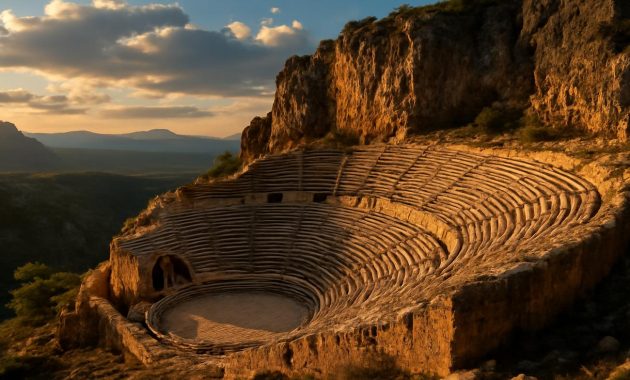
High above the modern Turkish town of Aizanoi, the wind moves along the cliff like a slow, deliberate breath. Down in the valley, life hums in its familiar rhythms—motorbikes, shop doors, voices bouncing off concrete. But up here, where the cliff edge opens its weathered jaw to the sky, sound thins out. It stretches. It disappears. And in that thinness, shapes begin to emerge: long arcs of stone, rows carved into rock, a hollowed-out bowl facing a horizon that has watched two thousand years of history pass by.
You are standing at the lip of a Roman stadium that very nearly vanished.
The Stadium the World Forgot
The stadium doesn’t reveal itself all at once. It’s not a grand, free-standing colossus like the Colosseum, shouting its presence from every direction. This one seems to grow from the land itself. Its rows are etched into the cliff, as if the earth decided to sit down and watch something. Grass pushes between blocks. Ancient steps crumble into dust fine enough to coat your fingers. If you run your palm along the stone, you feel more than age; you feel labor—chisels, mallets, sweat, the invisible geometry of Roman engineering.
For centuries, this place slipped into the background. Aizanoi, once a thriving Roman city in western Anatolia, faded with the empire that built it. Villages moved. New roads bypassed the old heart. The cliffs that held the stadium grew rough with shrubs and the slow creep of soil. Earth slid down and covered what people no longer remembered how to name. The arena where crowds once roared became a rumor: broken stones on a hill, some said, a quarry, a memory without a story.
And then, in the late 20th and early 21st century, archaeologists came back with shovels, brushes, drones, and questions. They had seen hints—odd lines in old survey maps, fragments in local lore, strange curvatures in the land. When the dust began to clear, the scale of what lay beneath the cliff edge startled even them.
Carved partly into the rock face and partly built out with masonry, this stadium stretches across the slope like a sleeping animal. Nearly two thousand years old, it is one of the most unusual surviving Roman stadiums in Anatolia. It isn’t just a ruin. It’s a revelation, stepping into the light after centuries of half-sleep.
Where Rock Becomes Architecture
Stand at the highest surviving tier and look down. Your eyes follow the steep fall of the rows, then the curve of the arena floor, like a riverbed of stone. The cliff behind you feels close, like a back wall in a very old theater. You can still trace the logic of the design: how the Romans used the natural slope of the cliff to cradle thousands of spectators; how the carved steps transition almost seamlessly into constructed seats; how gravity, geology, and human ambition were fused into a single space.
The stadium is long—Roman-long, built to host footraces and possibly chariot events, though scholars still debate exactly which spectacles played out here. Gladiatorial contests? Ceremonial parades? Athletic games in honor of the emperor or a local deity? The details shift as new inscriptions and fragments are unearthed. What does not shift is the feeling that this place was meant to gather people on a massive scale.
Walk down one of the remaining stairways and the wind drops away. The stone begins to block it, trapping warmth. Down closer to the arena floor, the air feels different—more intimate, almost domestic, despite the size. You can picture vendors squeezing through stands with baskets, the clatter of sandals, the swift hush that falls across a crowd when the first athlete steps into view.
Much of the original seating has collapsed or been pulled apart by time, earthquakes, and reuse of stone. Yet enough remains that your imagination doesn’t have to strain. The cliff-side rows cling to the rock, some half-swallowed by soil. The arena outline is clear. At the far end, a jumble of blocks suggests where an entrance tunnel once yawned dark and dramatic.
Here, the earth itself served as scaffolding. Rather than building a fully freestanding bowl, Roman engineers in Aizanoi took what the cliff gave them and edited it into form—cutting into the rock to shape stands, then extending outward with masonry where the ground dropped away. It is both grand and pragmatic, monumental and deeply responsive to the landscape.
| Feature | Details |
|---|---|
| Estimated Age | Approximately 2,000 years (1st–2nd century CE) |
| Location | Ancient city of Aizanoi, western Turkey (Anatolia) |
| Type | Roman stadium partly carved into a cliff edge |
| Primary Use | Athletic contests, public gatherings, and ceremonies |
| Construction Technique | Combination of rock-cut seating and masonry extensions |
| Current Status | Active archaeological excavation and restoration in progress |
Echoes of a City that Refused to Disappear
To understand why a stadium like this existed at all, you have to zoom out from the cliff and let the rest of Aizanoi come into focus. Down-slope from the stadium lie the bones of a Roman city that once stood shoulder to shoulder with better-known names: Ephesus, Pergamon, Aphrodisias. Aizanoi was not just a dot on the imperial map. It was a regional center, a place of processions and politics, trade and taxes, worship and wonder.
The city’s temple of Zeus rises not far away, its colonnades still gripping the sky. A theater, baths, a market complex, and a bridge over the Penkalas River all weave a picture of urban life under Roman rule. Grain may have flowed out from here, along with marble, livestock, and good stories. Soldiers passed through. Officials counted coins. Priests read omens. Children played in alleyways under the weight of history that had not yet become “history.”
The stadium was part of that fabric. It was a civic instrument as much as an entertainment venue. Public games were political—funded by elites keen to display their generosity, endorsed by emperors eager to project order and magnificence to even the empire’s distant corners. In those carved rows, people of all classes sat more or less side by side, their reactions rising together in a wave. For a few hours, at least, the vertical hierarchy of Roman society flattened itself into a circle of faces turned toward the arena.
Then, as the centuries shifted, so did everything else. Earthquakes struck. Trade routes moved. The empire fractured. Christianity reshaped religious life, then Islam arrived and layered new meanings over old places. Aizanoi did not vanish in a single dramatic collapse; it faded through slow, ordinary processes—stones repurposed for houses, inscriptions worn smooth by weather, grand spaces turned into fields and orchards.
Yet the city never truly died. A modern village grew among its ruins, its streets skirting columns and foundations, its life quietly threaded through Roman layouts the way roots find old walls and wrap themselves around them. Children played on toppled blocks without knowing which emperor’s name had been carved into their sides. Farmers ploughed past buried rooms and never saw the mosaic floors a few feet below. The stadium waited, patient, just beneath the cliff’s skin.
When the Ground Gives Up Its Secrets
Archaeological work in Aizanoi began in earnest more than a century ago, but attention was often drawn toward the most photogenic ruins: the temple, the bridge, the theater. The half-buried lines on the cliff edge were easy to dismiss. Then technology caught up with curiosity. Aerial photography, satellite imagining, and simple persistence began to sketch a different story.
From above, the subtle curve of the arena stood out. Soil that once looked like mere hillside resolved into layered fills. Local accounts of “old stones up there” took on new weight. Teams began to clear the surface carefully, peeling back modern accumulation to reveal ancient intention. What they found confirmed a hypothesis and triggered a quiet kind of astonishment.
The stadium emerged piece by piece: curved rows, steps anchoring the spectator entrances, drainage channels to handle rainwater pouring down the slope, retaining walls gripping loose soil. Every new season added another segment to the puzzle. In some sections, the preservation was impressive. In others, time had been less kind, grinding stone into suggestion rather than form. But the outline of the whole was unmistakable.
Work here moves slowly by necessity. Each stone might bear inscriptions. Each layer of fill could hide coins, pottery, the smallest of clues that pin events to a timeline. There are questions about when the stadium was first built, whether it was expanded in later centuries, how often it was used, who paid for it. Excavation does not just reveal; it interprets. Archaeologists must read the earth like a palimpsest, deciphering decisions made by people whose names are mostly lost.
The process is as physical as it is intellectual. On summer days, the cliff bakes. Dust hangs in the air and coats everything—tools, notebooks, lungs. Workers shade their eyes with hats and scarves, pausing often to drink water, then returning to the systematic, stubborn act of brushing history free from its crust. On windier days, gusts rush along the cliff and send loose soil swirling, as if the hill is reluctant to give itself up.
Yet the shape grows clearer every year, and with it, the sense that this is not simply another Roman ruin. It is a unique dialogue between human theater and natural geography, between the desire to shape spectacle and the stubbornness of stone.
Walking the Line Between Past and Present
Visiting the stadium today feels like stepping into a conversation mid-sentence. You see tape lines marking excavation zones, tools stacked by the cliff, a fresh square of soil cut open beside an untouched slope. You also see wildflowers asserting themselves in cracks between seats, birds claiming vantage points on high blocks, lizards darting across the arena floor where runners once thundered past.
The question of what to do with such a place is not straightforward. Leave it buried and it will be protected but invisible, its story muted. Unearth it entirely and you expose fragile surfaces to rain, frost, and human traffic. Stabilize it just enough for visitors, and you must walk a fine line between preservation and presentation.
Conservation teams in places like Aizanoi live in this tension every day. They shore up a cracked wall with discreet supports. They fill gaps where water might leak and undermine foundations. They record everything as they go: measurements, material analysis, before-and-after photographs, notes in multiple languages and increasingly in digital databases. They know that future research might overturn today’s best guesses.
The stadium, for now, is not a fully polished tourist product, and that may be part of its power. It feels raw, in transition, like a photograph developing in a tray of chemicals. You become part of that process simply by standing there, eyes following the rows, brain flipping between now and then.
Some visitors prefer their ruins grandly restored, with reconstructions and sound-and-light shows. This stadium will likely never be that. Its magic lies in its partialness, its visible scars, the way the cliff still presses close, as if reminding everyone that it was here first.
In a world that often smooths the past into easily digestible stories, this place resists simplification. It asks questions instead: Who sat here? What did they feel when a favorite athlete stumbled or triumphed? How did sound move through this space when filled to the brim? How many languages murmured in these stands—Greek, Latin, early forms of Turkish, local dialects now extinct?
A Stadium for the 21st-Century Eye
There is a particular irony in watching a two-thousand-year-old stadium enter the era of social media. As news spreads about Aizanoi and its cliff-edge arena, more travelers arrive, smartphones in hand. They frame shots from the top row, arena stretching below like a stone ellipse. They pose against the cliff, the valley behind them glowing in late light. In seconds, the stadium jumps to screens thousands of miles away—a place that spent centuries out of sight now spreading in pixels faster than any imperial messenger could have imagined.
Yet digital attention can be a double-edged sword. On one side lies visibility: more awareness, more support, more pressure to protect and study the site. On the other side lies strain: more foot traffic, more wear, more risk of damage born of curiosity and carelessness. A stadium built to host crowds must now be carefully measured against the fragility that time has imposed on it.
Local communities feel these changes keenly. For residents whose grandparents treated Roman stones as part of the everyday landscape, the sudden influx of visitors can be both thrilling and disorienting. Cafes adjust their menus. Guesthouses hang new curtains. Guides polish stories they used to tell only to neighbors. At the same time, there’s a sense of guardianship—a belief that the stadium, like the temple and theater, belongs to the people who have quietly lived beside it for generations.
What does it mean, then, for the world to “discover” a place that was never truly lost to those who share its horizon every day? Perhaps it means re-framing discovery not as possession, but as recognition. The stadium is not a newly minted attraction; it is an old truth finally given broader attention. The job of the 21st-century visitor is to listen carefully, step lightly, and allow complexity to remain intact.
Why This Cliff-Edge Arena Matters Now
Beyond its scenic drama and archaeological intrigue, this stadium carries a subtler message about how we live with the past. It reminds us that history is often buried not by malice, but by accumulation—of soil, of new buildings, of different priorities and stories. What is hidden today may well be the foundation for someone else’s revelation tomorrow.
It also confronts us with continuity. The idea of gathering in a shared space to watch bodies in motion, to cheer for skill and spectacle, is hardly ancient history. From football arenas to Olympic stadiums, we still carve out enormous bowls of attention where our focus converges. We still design our seating to amplify reaction, to let waves of sound roll and echo. The materials have changed; the impulse has not.
Standing in the cliff-edge stadium of Aizanoi, you feel that continuity in your body. Your feet know what to do on the worn steps. Your eyes naturally seek the best vantage point. Even the urge to take a seat, look around, and imagine a program about to begin comes unbidden. The centuries between Roman cheers and your own quiet presence thin, not into some grand illusion of “time travel,” but into a simpler realization: people then were not so different from people now.
And then there is the matter of resilience. This structure has endured earthquakes, political upheavals, climate shifts, and sheer neglect. It has cracked but not collapsed, faded but not vanished. It was carved into the cliff in a gesture of confidence—confidence in an empire, a city, a set of values about public life. The empire is gone. The city has changed. The values have evolved. The stone remains, altered yet legible.
As the light shifts along the rows, you might think of all the other things buried in the landscapes we move through every day—stories, structures, choices. Not all of them will be as spectacular as a Roman stadium emerging from a hillside. But each has the potential to change how we understand where we stand.
When you finally turn to leave and trace your way back down the path, the modern town noises swell again: an engine starting, a dog barking, the clink of dishes from an open window. You glance back one last time. Up on the cliff edge, the stadium holds its quiet, sun catching on stone that has learned, at last, to glow again in open air.
Frequently Asked Questions
How old is the Roman stadium at Aizanoi?
The stadium is estimated to be around 2,000 years old, likely built in the 1st or 2nd century CE during the height of Roman influence in the region. Ongoing excavations and material analysis continue to refine this dating.
Why is this stadium considered unusual?
Unlike many Roman stadiums that were fully freestanding, the Aizanoi stadium is partly carved directly into a cliff edge. Engineers used the natural slope to shape the seating tiers, then added masonry to complete the structure. This fusion of rock-cut and built architecture makes it particularly distinctive.
What kinds of events took place in the stadium?
Scholars believe it hosted athletic contests, footraces, and public ceremonies, possibly alongside other spectacles such as local festivals tied to imperial or religious celebrations. Evidence is still being uncovered, and interpretations may shift as new inscriptions and artifacts are found.
Can visitors access the stadium today?
Yes, the site of Aizanoi is open to visitors, and the stadium area can be viewed, though access may be partially restricted in active excavation zones for safety and preservation reasons. Conditions can change seasonally, so local guidance is important when visiting.
How is the stadium being preserved?
Archaeologists and conservation experts are working to stabilize remaining structures, manage water runoff, and carefully excavate without overexposing fragile stone. Documentation, including detailed mapping and photography, supports both current preservation and future research.
Why did the stadium remain buried for so long?
Over centuries, natural processes like erosion, landslides, vegetation growth, and human reuse of stone gradually obscured the structure. As urban life shifted and the Roman city declined, the stadium lost its function and attention, slipping under layers of soil and everyday activity.
What does the stadium tell us about Roman life in Anatolia?
It shows that cities like Aizanoi invested heavily in public architecture and shared entertainment spaces, mirroring larger imperial centers. The stadium reflects local prosperity, civic pride, and the integration of regional communities into the broader cultural patterns of the Roman Empire.