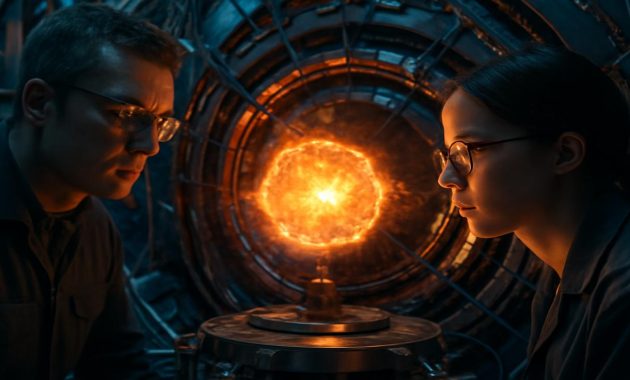
The first time you hear that scientists are making “fireballs” at CERN, your brain does a double-take. Fireballs? In a particle collider? It sounds like a headline from science fiction—some quiet alarm bell suggesting we might be tampering with the universe’s wiring. Yet down in that underground ring beneath the French-Swiss border, where protons race close to the speed of light, researchers have begun to glimpse something that could help solve one of cosmology’s most haunting puzzles: why there’s less light in the universe than there should be.
A darkness that shouldn’t be there
If you step outside on a crisp, clear night and look up, the sky feels full—crowded with stars, streaked with wisps of the Milky Way, peppered with faint smudges that are galaxies so distant their light has traveled for billions of years to meet your eyes. It feels like everything is shining. But for astronomers, the universe actually looks strangely dim.
For decades, they’ve been tallying up all the sources of light they can find: stars in galaxies, glowing clouds of gas, blazing quasars powered by black holes, the afterglow of the Big Bang itself. They compare this grand inventory with how much starlight and other radiation should exist, based on how much matter is out there and how it evolves over cosmic time.
The result? A mismatch. A kind of cosmic shortfall. The universe seems to be missing a significant portion of its expected light—particularly in the background glow that should quietly bathe intergalactic space. It’s as if someone dimmed the lights after the party and then misplaced the switch.
This “missing light” problem isn’t just a bookkeeping error. Light carries information about how matter behaves, how galaxies grow, how gas clouds heat and cool. If the universe is darker than it should be, something fundamental about our picture of how energy moves through space is incomplete. Somewhere, light is being lost, hidden, or transformed.
Where the mystery meets the machine
To chase this missing light, you might imagine astronomers turning bigger telescopes toward the cosmos, searching for faint sources that might have slipped through the cracks. And they do. But the hunt has taken a surprising turn underground, into the realm of particle physics, where the universe is recreated not across light-years but inside a machine just 27 kilometers around: the Large Hadron Collider (LHC).
When protons collide at the LHC, they unleash energies similar to those that filled the young universe just moments after the Big Bang. For the briefest instant, conditions become so intense that protons and neutrons—usually tight bundles of quarks held together by gluons—melt into a kind of subatomic soup. Physicists call it quark–gluon plasma, or QGP.
The name sounds clinical. The reality, in human terms, is closer to conjuring a miniature star. In these events, temperatures soar to trillions of degrees, hotter than the cores of supernovae. Matter flickers into a state that hasn’t existed in nature since the cosmos was less than a microsecond old. In that hot, furious instant, the newborn plasma swells, cools, and solidifies back into the familiar particles we know.
To detectors like ALICE (A Large Ion Collider Experiment), this transformation appears as something almost poetic: a tiny, expanding “fireball” of plasma, blooming and fading faster than any camera could ever capture, but leaving fingerprints in the swirl of particles that spray outward. And somewhere in that bloom may lie a clue to the universe’s missing light.
Fireballs that whisper instead of shine
When most people imagine a fireball, they think of roaring flames, blinding heat, and a shocking brightness. But the plasma fireballs at CERN are strange. They burn at unimaginable temperatures, yet they don’t radiate light in a way that a campfire or even a star does. Their glow is subtle and mostly indirect, carried by particles rather than familiar beams of visible light.
In the early universe, however, seas of quark–gluon plasma likely filled the cosmos. For a short time, everything was an all-encompassing, searing medium of free quarks and gluons, endlessly colliding, merging, and splitting. In that violent chaos, a huge amount of energy sloshed around, much of it carried by electrically charged particles.
Now, wherever there are charged particles in motion—currents, spirals, collisions—there is electromagnetic radiation. It may be high-energy gamma rays or low-energy radio waves; it may scatter, be absorbed, re-emitted. Energy gets shuffled between forms, but the tally should add up. If we run the math forward from those early times, given the matter in the universe, we end up predicting a certain total “budget” of light across all wavelengths.
But the observations come up short. And that’s where these laboratory-made fireballs begin to speak in a language cosmologists care about. By recreating tiny patches of the infant universe, physicists can ask: how much light does this plasma really produce? How much gets trapped or transformed into other particles before it can ever travel freely through space?
Listening for light in a storm of particles
At CERN, the key to this question lies in the delicate art of reconstruction. The detectors surrounding the collision points are not cameras in any usual sense. They are layers of sensors that feel the passage of charged particles and record their tracks—minute scratches in an invisible glass.
From this chaos, physicists work backward. They measure the momentum, charge, and type of each emerging particle and infer the conditions at the moment the plasma first formed. Like tracking the ripples on the surface of a pond to understand the stone that fell into it, they read patterns in the data to reconstruct the lost moment of extreme density and heat.
Among the spray of particles, some are particularly valuable: photons and so-called “dileptons” (pairs of electrons and their antimatter twins, positrons). These are messengers of the electromagnetic force, born directly from the plasma or from the ruin of short-lived particles within it. Unlike quarks, they don’t get trapped by the strong nuclear force. They can slip out of the fireball and carry news of its inner life.
By counting and characterizing these messengers, physicists can estimate how much electromagnetic radiation the plasma produces. Then they can compare that with theoretical predictions—and, in turn, with the cosmic predictions for early-universe plasmas on vastly larger scales.
| Plasma “Fireballs” at CERN | Early-Universe Plasma |
|---|---|
| Microscopic, smaller than an atom | Cosmic, filling the young universe |
| Lives for less than a trillionth of a second | Persisted for a fraction of a second after the Big Bang |
| Created in high-energy particle collisions | Born from the Big Bang’s primordial energy |
| Measured via particle tracks and photons | Inferred from cosmic background light and structure |
| Offers a testbed for theory | Sets the initial conditions for cosmic evolution |
Over the past years, measurements have begun to suggest that quark–gluon plasma can be surprisingly “dark” in certain ways. Energy that might naïvely be expected to stream away as light can instead get funneled into other channels—locked up in massive particles, diffused, or delayed. At the scales of the LHC, the effects are subtle. But scale this behavior up to cosmic size and cosmic time, and the consequences could be profound.
Could dark plasmas hide the light?
Here’s where the story gets bolder—and more speculative, in the most productive sense of the word. Some theoretical work inspired by collider data hints that the early universe might have spent more time in exotic plasma-like states than we previously assumed, or that those states might have been less efficient at radiating light out into empty space.
Imagine a universe where vast regions are filled with a roiling, interacting medium that traps radiation briefly, like fog capturing the beams of distant cars. That trapped energy eventually makes its way out, but it might do so in forms we don’t easily see today—or at moments when the universe’s expansion has stretched it into wavelengths we barely detect.
Some researchers propose that the “fireballs” we create at CERN are small, controlled windows into this behavior. By understanding how energy becomes “hidden” inside a plasma—heat swallowed into the motion of quarks, or re-emitted as particles that decay out of view—we might trace new pathways by which the cosmos could have sequestered some of its light.
It doesn’t mean that quark–gluon plasma alone magically swallows all the missing photons. Instead, it suggests a richer menu of processes that could subtly dim the universe over billions of years. Heating and cooling of intergalactic gas, the birth and death of stars immersed in dense plasma environments, and the slow redshifting of high-energy light into faint, stretched-out whispers could all conspire to make the cosmos darker than we first calculated.
From subterranean tunnel to cosmic sky
There is a strange, almost poetic loop in this story. Deep beneath the ground, in a carefully engineered ring of magnets and vacuum chambers, humans accelerate protons to re-create conditions that existed long before any planet, tree, or curious observer. The collisions happen in silence; if you stood above them in a meadow, you’d hear only wind and birds, not the thunder of particles crashing together at nearly light speed.
Yet the data that trickle out—petabytes of bits and tracks and timings—feed into a conversation that stretches across the universe. A line drawn between the click of a detector in Geneva and the faint, almost immeasurable glow of photons drifting through the dark spaces between galaxies.
At some level, this is what modern science does best: it finds continuity across scales that feel impossibly distant. The same physics that governs a flicker of plasma no bigger than a proton’s width also governs the shape of galaxy clusters and the brightness of the cosmic web. When we say that plasma “fireballs” at CERN may explain the universe’s missing light, we’re not claiming that the lab is literally turning off some cosmic lamp somewhere. We’re saying that those tiny flashes of recreated Big Bang matter might be teaching us how the universe chose to shine—or not shine—as it grew up.
It’s a humbling thought: that the darkness between the stars might carry the imprint of processes we can test, in miniature, right here on Earth, in machines built by hands and minds that evolved beneath a modest sun on a small, rocky world.
Why the missing light matters to us
It’s easy to think of missing cosmic light as a remote problem, something removed from the textures of human life. After all, whether the background sky is a bit brighter or dimmer than expected doesn’t change the taste of your coffee or the way your feet feel in the sand at the edge of the ocean.
But the pursuit of this question is a measure of how deeply we care about understanding where we are. Light is one of the universe’s primary storytellers. It carries tales of exploding stars, quiet galaxies, newborn planets. If some of that story is missing, then our picture of cosmic history has pages torn out.
The plasma experiments at CERN are, in a sense, attempts to reconstruct a missing chapter. If they help us discover new ways that energy hides, transforms, and resurfaces across cosmic time, they won’t just patch a discrepancy in a data table. They’ll sharpen the narrative arc of the universe itself. They might refine our understanding of everything from the birth rates of stars to the mysterious behavior of matter in the densest corners of space.
And there’s a more intimate layer, too. We are, in part, creatures of light. Our biology is tuned to a star; our days and seasons dance to the rhythm of photons. The atoms in our bodies were forged in burning stars and blasted into space, where they cooled, condensed, and eventually joined to form beings capable of wondering where the universe’s light has gone. To trace that missing light is, indirectly, to trace one more thread in the story of how we came to be.
A future written in brighter detail
In the years ahead, the LHC and its successors will probe these plasma fireballs with increasing precision. Upgrades to detectors will allow physicists to catch more of the delicate photons and lepton pairs that slip away from the collisions, to map their energies with finer detail, and to compare them against ever more sophisticated simulations of how quark–gluon plasma behaves.
Meanwhile, astronomers are designing new instruments to measure the faint cosmic background light with unprecedented sensitivity—to capture the dim glow that lives in the gaps between galaxies, to weigh the total starlight across cosmic time, and to search for subtle fingerprints of plasma-era processes lingering in the sky.
If these terrestrial and celestial efforts converge, we may find that the universe’s “missing” light was not missing at all, merely miscounted, misdirected, or transformed along pathways we had not yet imagined. Or we may uncover evidence of entirely new physics, new particles, or new forces that shuffle energy around the cosmos with a deftness that challenges our current frameworks.
Either way, the story will deepen. And the fireballs at CERN—the ones blooming invisibly underground as you read this—will be part of the plot. They are not just violent spectacles of high-energy physics. They are carefully tuned questions, asked in the only language the early universe truly understood: particles, fields, and the subtle exchange of light.
Frequently Asked Questions
What exactly are the “plasma fireballs” at CERN?
They are extremely hot, tiny droplets of quark–gluon plasma created when particles such as protons or heavy ions collide at near light speed in the Large Hadron Collider. These droplets exist for a fraction of a trillionth of a second and briefly recreate conditions similar to those just after the Big Bang.
How could these fireballs relate to the universe’s missing light?
By studying how quark–gluon plasma produces and transforms electromagnetic radiation, physicists can refine models of how light was generated and propagated in the early universe. If plasma processes are less efficient at releasing light than once thought, they could help explain why the universe appears dimmer than predicted.
Does this have anything to do with dark matter or dark energy?
Indirectly at best. The missing light problem concerns ordinary (baryonic) matter and the radiation it should produce. Dark matter and dark energy are separate mysteries, though any improvements in our understanding of cosmic energy flows can help tighten constraints on those components as well.
Are these fireballs dangerous?
No. The energies are enormous on a microscopic scale but tiny compared with everyday amounts of energy. The fireballs are incredibly small and short-lived, and they cannot grow or persist. Similar or higher-energy particle interactions happen naturally in the atmosphere due to cosmic rays.
Will this research change how we see the night sky?
Visually, the night sky will look the same to us. What may change is our interpretation of what we see—the models behind how much light we expect from stars, galaxies, and intergalactic gas. In that sense, the research could reshape our mental picture of the universe, even if the stars overhead seem unchanged.