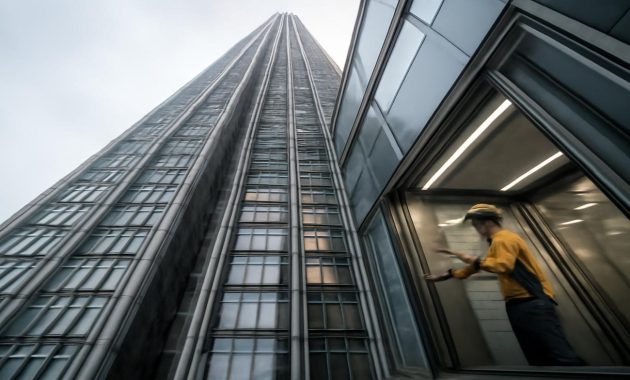
The first time you see it, you’re not sure where the ground ends and the sky begins. Glass and steel rise in such dense clusters that they seem to knit the clouds together, a vertical city stacked atop the horizontal one. Down at street level, scooters buzz like metallic bees, horns flicking sharp notes into the afternoon haze. A delivery rider in a yellow jacket pulls up, kills the engine, and glances once at the app on his phone. The destination: the 83rd floor. Not the building itself—no, that’s just the starting point—but a specific door suspended nearly half a kilometer above the asphalt.
Sky Towers and Stacked Lives
In cities like Shenzhen, Guangzhou, Shanghai, and Chongqing, you don’t just walk through a neighborhood; you move through layers of it. There are supermarkets on the 20th floor, clinics on the 35th, a kindergarten on the 12th, offices scattered like seeds from the 30th to the 90th. Corridors are perfumed with hot oil, detergent, and the faint tang of elevator grease. Somewhere up there, a programmer debugging lines of code waits for a box of noodles that began its journey on a street cart far below.
China’s megacities have been building upward for decades, but in the last ten years, “up” has taken on a new meaning. Towers now rise so high and hold so many people that an unexpected profession has quietly emerged: the skyscraper food runner, a person whose entire workday is spent shuttling meals between elevators, fire stairs, and glass-walled corridors in the sky.
They are the invisible middle link between the delivery rider who races through traffic and the office worker who taps “place order” on a lunch app. On the map, it looks simple: one pin on the restaurant, one on the building. In reality, the last 300 vertical meters can be more complicated—and more exhausting—than the entire ten kilometers before it.
The Vertical Relay
Listen closely in the lobby of a supertall tower at noon. Over the soft hum of air conditioning, you’ll hear a quiet tension: the hiss of sliding doors, the ding of elevators, snatches of conversation in dialects from every province. Delivery riders gather near a turnstile, balancing insulated bags heavy with plastic containers and cardboard boxes. Security guards check passes. Office workers streak by, badges swinging on lanyards. Somewhere in this rush, a slim figure with a simple satchel and a phone in hand glides through almost unnoticed.
He—sometimes she, but still more often he—is not here from the street. He hasn’t been dodging buses or weaving between cars. His shift began inside this building. The app has given him a list of floor numbers, company names, and vague instructions like “blue door at end of corridor” or “drop at reception, sign Liu.” He is a specialist in the last kilometer’s older, quieter cousin: the last hundred meters, taken vertically.
These skyscraper runners are employed directly by building management, outsourced service companies, or even the big delivery platforms themselves. A rider will hand off a bag at the lobby, snap a picture for proof, then pass it through a small window or over a counter. From there, a new race begins—one that trades scooter speed for elevator strategy.
“The hardest part is not how far you go,” one runner in Shenzhen explains, “but how long you wait.” He smiles and gestures at the column of elevator doors around him. “These are my traffic lights.”
The Art of Riding the Sky
In a tower with 80, 90, even 100 floors, elevator logistics verge on the arcane. Some cars only serve low levels; some only mid-range; some shoot straight to the sky lobbies on the 50th floor where people transfer like subway passengers changing lines. At noon, queues snake across marble floors. A six-minute wait for a 20-second ride can spell death for a delivery rating.
Runners learn to read the building the way cab drivers read traffic flow. They know which bank of elevators empties the fastest when lunch breaks stagger by department, which security guard turns a blind eye to a shortcut stairwell, which connecting corridor on the 30th floor saves two extra minutes during the rush.
On their phones, orders stack up in tiny glowing rows: 58F, 61F, 63F, 63F (again), 75F. They group them into little vertical routes, pairing floors that share elevators or hallways, mentally pruning inefficiencies the algorithm hasn’t quite accounted for. The building becomes a three-dimensional puzzle, reset every hour.
There’s a physical rhythm to it: hands gripping bags tightly during sudden stops; a foot wedged against the elevator wall when the car is so packed your body has nowhere else to expand; the tiny relief of the soft mechanical whoosh and weightlessness when the doors finally slide open and the car shoots upward. Stepping out onto the upper floors, the air feels just a shade different—cooler, drier, and tinged with the faint, constant hiss of HVAC ducts pushing conditioned air through miles of ceiling vents.
Lunch in the Cloud Belt
Up here, the city feels far away, like a memory playing quietly behind glass. On a clear day, you can see cranes on distant towers drawing new lines on the skyline. On a bad air day, the world below dissolves into a grainy gray wash, as if someone forgot to finish painting the ground. Yet the routines are ordinary and familiar: people hunched over keyboards, walls covered with sticky notes, potted plants clinging to life under fluorescent lighting.
The arrival of lunch is one of the rare predictable joys. At 11:45, someone’s phone buzzes. “The food runner is downstairs,” a message reads. In many offices, one person is delegated to go to the elevator lobby, greet the runner, sign off on the order. In others, the runner steps right through the door, weaving between desks to deliver soup, rice, coffee, milk tea. Sometimes he calls out a name into a sea of headphones: “Order for Li! Spicy noodles?” A hand goes up; a small break in the day opens like a window.
The items he carries tell their own story about the way people live in vertical cities. One hand holds a neatly packed bento-style lunch; the other, a bag of steaming dumplings. Strapped to his back, insulated like a tiny traveling fridge, are bubble teas beaded with condensation. An app notification might send him toward a law firm that always orders vegetarian salads, then moments later toward a construction office with a daily addiction to chili-flooded hotpot bowls.
All of this movement funnels through the same elevators, stairwells, and fire doors, giving the building its peculiar heartbeat. Down below, on the street, hundreds of riders roam. Up here, a handful of runners pace the sky, each step mapped onto a different layer of the same address.
A New Job for a New Shape of City
On paper, this is just another job in the explosive gig economy. In practice, it’s an occupation born from an architectural experiment. When you stack work, sleep, play, and shopping into single structures, you also stack demand. The usual model of one delivery rider racing from restaurant to office tower breaks down under the weight of security protocols and elevator bottlenecks.
The emergence of skyscraper runners is a quiet adaptation—a human buffer inserted into the gaps between platform logic and vertical reality. Tech companies can fine-tune their algorithms, design building-specific routes, even integrate elevator control systems into their apps. But sometimes, it’s still faster, cheaper, and more reliable to station a handful of humans inside the towers themselves.
Average earnings vary widely by city and building, but many runners take home a base salary topped up by per-delivery bonuses. It’s not glamorous work. The uniform is often just a lanyard, a company badge, and comfortable shoes. On hectic days, they may climb more stairs than a professional hiker, duck through more doors than a hotel bellhop, and say “hello” and “thank you” more times than they can count.
Yet there’s a subtle intimacy to the job. Unlike street riders, who might see nothing but license plates and traffic lights, skyscraper runners become minor characters in the daily stories of hundreds of people. They watch interns becoming managers, startups shrinking and expanding, office layouts changing as companies rise or vanish. They’re there when a floor goes dark because a tenant left, and there when a new logo appears, lit like a fresh constellation of backlit letters.
Between Speed and Gravity
Midway through the afternoon, the building quiets. Elevators empty out. The frantic lunch-time dings and clatters recede into a low, steady hum. Runners retreat to small back rooms that function as both break areas and staging zones: a table, a water dispenser, a couple of plastic chairs, perhaps a small counter for sorting orders just arrived from the lobby. Phones vibrate less often. For a moment, the building belongs only to the people working inside it and the few whose job is to haunt its passageways.
In these breaks, the physical toll becomes visible. Knees rubbed absently. Backs stretched, shoulders rolled. The body never quite forgets that it is challenging gravity for a living, even if the main enemy is time.
Yet there’s also a sense of vantage, an invisible privilege of knowing a place better than almost anyone who works there. Runners know which bathrooms are always empty, where the view from a rarely used conference room is particularly stunning at dusk, which companies order cake every time they close a deal. They know where the building leaks when a typhoon rolls in, and which side of the tower glows hot in late summer.
One runner in Chongqing describes the feeling this way: “The building is like a big body. The people at desks are the brain; the machines in the basement are the organs. We are the blood—taking energy to every part.” It’s a poetic metaphor for someone whose daily reality is more often spills, lost orders, and double-checking apartment numbers. But you can see why the comparison sticks. When a runner is missing, the building feels sluggish, its rhythms thrown off.
A Glimpse into the Near Future
Of course, in a world increasingly enamored with automation, the obvious question arises: why not drones? Why not delivery robots gliding silently along the corridors, routed by AI through every turn and doorway?
Inside buildings, especially the enormous and heavily regulated ones at the heart of Chinese megacities, the answer is both simple and complex. Regulations, safety, and sheer unpredictability make it difficult. Children dash in front of carts. Emergency drills lock down certain floors. A staffer leaves a dolly in a hallway. Someone’s lunch leaks soup across a polished tile and everything suddenly becomes a slip hazard.
For now, at least, human adaptability wins. A runner can step around a spilled drink, negotiate with a testy security guard, calm an impatient customer with a tired joke. They remember that the CFO on the 77th floor detests garlic and will send the whole order back if there’s a hint of it. They notice when a regular stops ordering coffee for a week and, in some small, human way, wonder if he’s all right.
Still, technology seeps in. Some buildings pilot “smart elevator” systems that give runners temporary priority access at peak times. Others test automated lockers on each floor, where runners can deposit meals for collection by staff later, thinning the congestion at certain choke points. Apps are updated to show not just building addresses but floor-by-floor delivery density, helping to distribute orders more evenly through the vertical maze.
Where the Sky Meets the Everyday
The job of the skyscraper meal runner is both utterly ordinary and quietly radical. At one level, it’s just another way for cities to feed people efficiently. At another, it’s a small but telling sign of how deeply architecture shapes labor.
China’s vertical boom has been framed in many ways: a symbol of economic power, a solution to land scarcity, a reflection of urban ambition. But in the shadow—and the glass glare—of these towers, lives are rearranged in more granular ways. Office workers time their hunger to elevator wait patterns. Restaurant owners design menus that will travel up 80 floors without turning to mush. Delivery apps rewrite their code to handle a new dimension: not just how far, but how high.
And in between, people like the runner in the yellow lanyard thread the whole system together. They are the ones who press the elevator buttons, literally and figuratively. They adapt when the 64th floor is under renovation and all orders must be rerouted through a temporary side entrance. They improvise when a power glitch stalls an elevator bank and they suddenly face a choice: thirty-two flights of stairs or a late delivery and a one-star review.
As cities worldwide grow taller, versions of this role may appear elsewhere, in Mumbai’s high-rises, in Dubai’s needle-thin towers, in the new spires reshaping Jakarta or Nairobi. For now, China is a kind of laboratory for the vertical city, and these runners are part of its quiet research: human test subjects exploring what everyday life looks like when the ground is only one of many possible floors.
| Aspect | Street Rider | Skyscraper Runner |
|---|---|---|
| Main Environment | Roads, traffic, weather | Elevators, corridors, offices |
| Key Challenge | Distance and traffic jams | Elevator waits and floor navigation |
| Tools of the Trade | Scooter, helmet, insulated box | Access card, phone, compact food bags |
| Risks | Accidents, weather extremes | Fatigue, repetitive strain, time pressure |
| Local Knowledge | Shortcuts, traffic patterns | Elevator schedules, floor layouts |
Even if the title sounds almost comic—“professional food deliverer to the 90th floor”—beneath it lies a serious question: how do we care for the bodies that keep our soaring cities running?
For now, many of these runners are young migrants, people who rode trains from inland provinces to coastal metropolises, looking for any foothold in the new economy. Their days are measured not in meetings or emails, but in trips up and down, in the slight ache of calves at night, in the flicker of the order counter on their phones. Their view of urban transformation isn’t from the window of a penthouse or a corporate boardroom; it’s from the threshold between elevator and office, between the humming core of the building and the people who inhabit its cells.
Inside those thresholds, something like a new kind of city is taking shape—not just one that stretches skyward, but one that depends on entire networks of quiet, vertical labor. The skyscraper runner is part courier, part guide, part living elevator algorithm. He or she is proof that as we build higher, the distance between us and our meals, our services, our comforts doesn’t simply vanish into the cloud. Someone still has to carry them the last few meters. Someone still has to press the button.
Frequently Asked Questions
Why does this job exist in Chinese skyscrapers?
Many Chinese towers are extremely tall, densely populated, and tightly secured. Street delivery riders often cannot access upper floors quickly because of security checks, complex elevator systems, and time-consuming navigation. Skyscraper runners bridge this gap by handling the internal delivery from lobby to specific floors and offices.
Are skyscraper runners employed by delivery platforms or buildings?
It varies. Some are hired by building management or property service companies; others are contracted by major delivery platforms that station staff inside high-demand towers. In some cases, a hybrid model exists where platforms partner with property managers.
How is this job different from ordinary food delivery?
Street riders focus on covering distance and dealing with traffic and weather. Skyscraper runners specialize in vertical movement: mastering elevator patterns, floor layouts, and office routines. Their main challenges are time pressure inside the building, long waits, and complex navigation rather than road safety.
Do skyscraper runners earn good money?
Income varies by city, building, and workload. Many receive a modest base salary plus performance-based bonuses per delivery or per shift. The work can be relatively stable compared to pure gig riding, but it is usually not high-paying and can be physically demanding.
Will robots or drones replace skyscraper runners in the future?
Automation may change parts of the job—such as locker delivery systems or smarter elevators—but full replacement is unlikely in the near term. Human flexibility, judgment, and social interaction still matter in crowded, unpredictable indoor environments, especially in high-security office towers.