The first time I heard that sound, I couldn’t place it. A high, silvery hiss that rose and fell like a whispering snake, weaving through the honks and shouts of an Indian street. I turned my head, and there he was: a wiry man in a faded shirt, sitting behind a spinning stone wheel fixed to the back of a bicycle. Sparks leaped in tiny orange constellations as he drew the blade across the wheel, his bare feet working the pedals, turning leg power into a bright river of sharpness. People walked by without a glance. For them, this was background noise. For me, it was a revelation.
The Man With the Moving Workshop
I’d been in India for only a few days, still blinking at the color and chaos, when I met the knife sharpener. He appeared in the lane outside the guesthouse around mid-morning, his arrival announced not by a shout or bell, but by that unmistakable metallic whisper. Curious, I wandered closer, drawn by the rhythm of the wheel and the flicker of sparks.
His “workshop” was a humble masterpiece of improvisation: a sturdy bicycle with a simple, belt-driven grinding wheel mounted over the rear tire. He sat sideways on the bike frame, one foot on a pedal, the other braced on the ground. When he pushed the pedal, the wheel spun fast and smooth. On a cloth beside him lay an assortment of lives: a chef’s knife with a chipped edge, a sickle stained green from cutting fodder, a vegetable knife as dull as a butter spreader.
I watched as he pressed the first blade against the stone. The angle of his hand never wavered—steady, sure, instinctive. Sparks flared and died as quickly as thoughts. His brow furrowed, but his shoulders stayed loose. Every few seconds he’d pause, run a thumb lightly across the edge, then return the steel to the spinning stone with the calm of someone who has done this thousands of times, on thousands of mornings just like this one.
Without quite meaning to, I sat down on a low step to stay longer. The street smelled of frying onions and dust, diesel and coriander. A woman appeared with a bundle of knives wrapped in a scarf, exchanged a few words with him in the local language, and placed them gently in his hands as if passing over something more precious than kitchen tools. By the time he’d finished, the knives didn’t just look sharper—they seemed transformed. They had a different kind of glint, a new intention.
“How long you do this?” I asked, when there was a lull.
He smiled, showing a row of teeth stained with betel nut. “Long time,” he replied, searching for the English. He pointed to his hands. “My father, my grandfather… all same work.”
The idea of a skill passed silently from generation to generation, carried not in books but in muscle memory, hooked itself into my mind and refused to let go.
The Lesson Hidden in the Sparks
The next day, when I heard that high, keening sound again, I went downstairs with one of the dull knives from the guesthouse kitchen in my hand. The caretaker laughed, but he waved me on. “Go, go. He will make it like new.”
The knife sharpener took the blade from me and turned it over in his fingers, testing its weight. He nodded, then gestured for me to come closer. His English was limited, my Hindi almost nonexistent, but somewhere between us lay a shared language of curiosity and steel.
He tapped the side of the grinding stone, then pointed to my eyes, then to his work. Watch, he was saying. Don’t just look—see.
First, he showed me the angle: the blade tilted just slightly, not flat against the stone, not sharply upright. He held it around 15–20 degrees from the wheel, an invisible geometry he had internalized. Then he drew the knife in a smooth, even stroke from heel to tip, never stopping, never jerking. Pressure: firm but not forceful. Contact: constant, but not lingering long enough in one spot to cook the steel with heat.
He motioned to me. My turn.
The bicycle pedal was heavier than it looked. I settled onto the makeshift seat and pressed down with my foot, feeling the resistance of the system: chain, belt, wheel, stone. Once the wheel was whirring, he placed his hand on mine, guiding the knife to meet the stone. My first attempt was clumsy. The blade skittered, chattered, too steep, then too shallow. Sparks spat in random directions, uncontrolled and embarrassed.
He shook his head gently, correcting my wrist, adjusting the angle by feel. Then he stepped back and let me try again.
This time, the sound changed. The chaotic scraping shifted into a smooth, shushing whisper, like wind over sand. I felt the contact, the vibration running up through the knife into my hand. It was wild, tactile, oddly intimate—like feeling a pulse under your fingertips.
We stayed like that for half an hour, trading brief words and long silences. He showed me how to pass the knife evenly along the wheel, how to switch sides without changing the angle, how to cool the blade if it felt too hot, dipping it quickly in a bowl of water beside him. My foot ached from pedaling, my forearms were tense, and yet, when he took the knife from me and tested the edge, he nodded with approval.
He plucked a stray hair from his arm, held it above the blade, and let it fall. The hair split cleanly in two.
He grinned. “Good,” he said. “Now very sharp.”
Bringing the Street Workshop Home
Back home, my own kitchen knives felt like an insult. They were functional, technically, but dulled by years of neglect and half-hearted passes over cheap pull-through sharpeners. I kept thinking of that bicycle, that spinning wheel, that quiet confidence. If a man pedaling down crowded lanes could turn battered tools into surgical instruments in a matter of minutes, what excuse did I have?
Of course, I didn’t have a bicycle grinding rig ready to bolt onto my wall. But the heart of what I had seen wasn’t the contraption—it was the method: angle, consistency, patience, and respect for the steel. I realized that what he did on a wheel, I could do at home with a simple sharpening stone, if I paid attention the way he did.
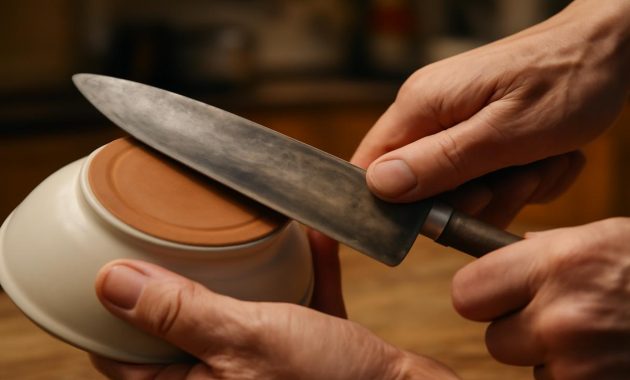
I started with the basics: a double-sided water stone I’d once bought and never really used. I took it out of its box, still smelling faintly of cardboard and oil, and remembered the rhythm of his motions. Before, I’d moved my knives across a stone like I was erasing chalk from a board—randomly, impatiently. Now, I pictured his hands, the glint of the edge, the unwavering angle.
I soaked the stone until it stopped releasing bubbles. As I held my first old chef’s knife, the one I’d almost given up on, I could almost hear the whisper of that Indian street, the soft shush of steel on stone and the faint jingle of bicycle bells in the distance.
Then, slowly, I began.
The Simple Routine That Changed Everything
The biggest shift wasn’t the tools I used; it was the way I thought about them. Instead of wondering how fast I could “get this over with,” I decided to treat sharpening as a small ritual—a conversation with the blade, rather than a chore to be checked off.
Here’s the routine I settled into, heavily inspired by that morning in India but adapted to my own, far quieter kitchen:
- Soak the stone. I drop my water stone into a bowl of water and leave it until the tiny bubbles stop rising. That’s the stone telling me it’s ready.
- Find the angle. I lay the knife flat on the stone, then lift the spine just a little—about the height of two stacked coins, 15–20 degrees. Not measured with a protractor, but felt.
- Set the rhythm. Instead of sawing frantically back and forth, I move the blade in long, even strokes, leading with the edge, from heel to tip. The sound tells me more than my eyes do. A smooth, even hiss means the angle is right.
- Equal respect for both sides. I count my strokes. Ten on one side, ten on the other, then fewer as I refine the edge. This mirroring keeps the blade balanced.
- Finish gently. Like polishing a thought, I use lighter and lighter pressure. Then I flip to the finer side of the stone to smooth out the microscopic teeth left by the coarse grit.
- Test, don’t guess. I don’t need to slice hairs in mid-air. A sheet of paper is enough. If the knife glides through without tearing, it’s ready.
The first time I followed this process with one of my most neglected knives—the one with the rounded, stubborn edge—I looked at the clock. I’d spent just under a minute on each side, another 30 seconds for refining. In less than three minutes, the blade transformed from a dull brute into something that could slice a tomato so cleanly the seeds stayed in place, undisturbed and glistening.
With a little more practice, I shortened the steps. For a knife that’s not completely abused, it now takes me about a minute to bring it back to razor sharpness. The key? Working with intention from the first touch of steel to stone.
What I Learned By Watching, Not Reading
Before that day in India, I’d read countless articles about sharpening angles, grit sizes, and edge geometry. They all made sense in theory, but somehow sharpening always remained this awkward, half-mastered skill. Watching that man, I realized what I’d been missing: sharpening is less like assembling furniture from a manual and more like learning to ride a bicycle. You can’t think your way into balance—you have to feel it.
The knife sharpener never once mentioned degrees or microns. He spoke in gestures and demonstrations: a tilt of the wrist, a nod at the sound, a finger drawn carefully along the edge to feel the burr. When I asked him how he knew when a knife was done, he tapped his ear and his fingertips. “Sound,” he said. “Feel.”
Back home, I began paying attention to those quiet indicators:
- The way the hiss of the blade changes from scratchy to silky as the edge forms.
- The slight, grainy drag under my fingers when a burr has appeared along the opposite side of the blade.
- The difference in how the knife moves through an onion—first with resistance, then, after sharpening, almost of its own will.
Instead of chasing perfection, I started chasing awareness. And with that shift, sharpening stopped feeling like a mysterious craft reserved for experts and became something anyone could reclaim. Not industrial, not digital, not rushed—just hands, steel, water, and stone.
The Quiet Joy of a Knife That Obeys
There’s a simple, primal pleasure in a truly sharp knife that is hard to explain until you feel it. It’s there in the first slice of a ripe tomato, when the knife glides through the skin without that awkward crushing. It’s in the clean thunk through a carrot, the effortless swish as you chiffonade herbs into fragrant green ribbons instead of bruised mush.
What surprised me most was how sharpening changed not just my knives, but my relationship to cooking itself. When a blade resists, you work harder. You press, you saw, you compensate. Cooking becomes a minor battle. But when your knife is keen and obedient, something relaxes in you. Movements become smaller, more precise. Chopping onions can feel almost meditative. It’s as if you’ve taken the brakes off a familiar road.
This small, oddly satisfying control seeped into other corners of life. I started noticing when tools were misused or neglected. I oiled squeaky hinges instead of ignoring them. I repaired things instead of immediately replacing them. That man on the bicycle had not only shown me how to sharpen knives; he had reminded me that most objects, like most skills, have more life left in them than we think—if only we bother to care for them properly.
A Tiny Ritual With Big Impact
Now, every couple of weeks, I clear a little space on the counter and bring out my stone. It’s not a production. No elaborate setup, no expensive gadgets—just a folded towel, a bowl of water, a stone that’s earned its scratches, and the small family of knives that do the quiet heavy lifting of daily meals.
It takes me less time to sharpen a knife than it does to scroll aimlessly on my phone. One minute per blade, sometimes less. And in exchange for that sliver of time, I get days—sometimes weeks—of smoother chopping, fewer slips, more confidence. Most of my old knives, the ones I once thought were “dead,” now come back to life after a single good minute on the stone.
I think back often to that street in India—the filtered light through the dust, the smell of spices and exhaust, the gentle grind of stone and steel. I remember the knife sharpener’s calm as he turned everyday tools into something almost delicate, almost elegant. He probably never thought of what he did as anything special; it was just his work, the way he fed his family.
But for me, those sparks on that morning rewired something. They turned sharpening from a mysterious, intimidating craft into a quiet act of care I now practice at home, over and over, one minute at a time.
Quick Reference: My Home Sharpening Setup
For anyone curious about how little it actually takes to get started, here’s what my simple, India-inspired sharpening kit looks like now:
| Item | What I Use | Why It Works |
|---|---|---|
| Sharpening stone | Double-sided water stone (coarse & fine) | Mimics the grinding wheel but in a compact, home-friendly form. |
| Water bowl | Any medium bowl or container | Soaks the stone and cools the blade when needed. |
| Base | Folded kitchen towel under the stone | Prevents slipping and raises the stone slightly. |
| Angle guide (optional) | Two stacked coins as a visual cue | Helps keep that 15–20° angle until it becomes muscle memory. |
| Test material | Scrap paper or a tomato | Instant feedback on how sharp the edge has become. |
None of this is fancy. None of it was expensive. Yet together, these humble pieces have given my kitchen knives a second life—and given me a small, enduring link to a man on a bicycle half a world away, whose moving workshop taught me that even the oldest, dullest blade can become razor sharp again in just a minute, if only we’re willing to learn how.
FAQ
How long does it really take to sharpen a knife at home?
Once you get the hang of the angle and motion, a lightly dulled knife usually takes about one minute to bring back to razor sharpness. Very neglected knives may need two to three minutes, but it’s still a fast process when done with focus.
Do I need an expensive sharpening system to get razor-sharp knives?
No. A simple double-sided water stone and a stable surface are enough. The critical parts are your angle, consistency, and light finishing strokes—not high-end gadgets.
How often should I sharpen my knives?
For most home kitchens, sharpening every few weeks is enough, especially if you use a honing rod between sessions. If you cook daily and do a lot of chopping, you may enjoy touching up the edge every week.
What’s the ideal sharpening angle?
For typical Western-style kitchen knives, 15–20 degrees per side works well. Instead of obsessing over exact numbers, aim for a consistent, slightly raised angle and maintain it throughout your strokes.
How can I tell if my knife is sharp enough?
Try slicing a sheet of paper or the skin of a tomato. A sharp knife will cut smoothly without tearing or slipping. You’ll also feel less resistance when chopping vegetables, and your cuts will look cleaner and more precise.