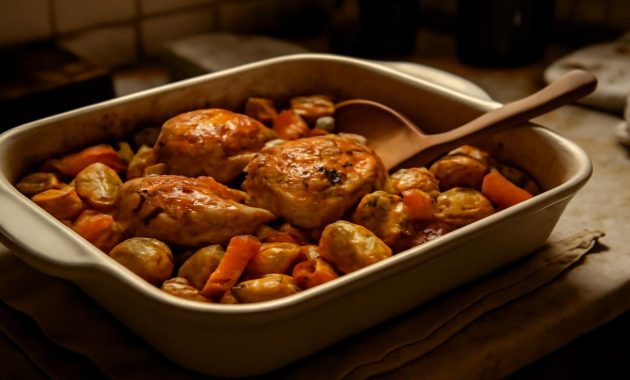
There are days when the kitchen feels like a stranger’s house. The pantry is full, the fridge hums softly, but nothing on the shelves seems to call my name. I stand there barefoot on the cool floor, arms folded, staring at jars and bags as if they might blink first. Inspiration, that loud, bossy friend who usually barges in with ideas—“Make a tart! Roast that squash! Try that new spice!”—is nowhere to be found. On those days, when my brain feels like a blank page and the world outside the window is just a smear of weather, I reach automatically for a single, simple recipe. It’s baked, it’s gentle, and it never asks too much of me. It’s the recipe I trust when I don’t feel inspired, the one that quietly offers, “I’ve got you. Let’s just begin.”
The Kind of Recipe That Listens to Your Day
The recipe began the way many trustworthy things do: by accident. Years ago, I came home from a long, rain-soaked day, the kind that leaves the bottom of your jeans heavy and cold. I remember peeling them off and tugging on old, soft sweatpants, the kind with frayed hems that feel like relief. The kitchen light was dim and yellow, and my mood matched it. I wanted something warm. I wanted something baked. But the idea of “real cooking” felt like being asked to swim across a lake when I could barely manage a bath.
I opened the pantry halfheartedly. Flour. Sugar. Oats. A jar of cinnamon with a worn label. A small sack of apples slumped in the fruit bowl, bruised in places, patient and forgiving. I didn’t want to follow a recipe, to flip pages or scroll through steps. I wanted something kinder. So I took the apples out, one by one, listening to their faint thud on the cutting board, and began to chop.
By the time the oven clicked on and exhaled its first warm breath, my shoulders had already dropped a little. The recipe took shape not from ambition but from need: a pan of soft fruit, scattered with a rough, nubbly blanket of oat crumble. No precise choreography, no elaborate layering. Just: fruit, sugar, spice, crumble, bake. It was so forgiving that I could be distracted, tired, or even a bit sad and it would still reward me with something golden and fragrant at the end.
Over time, what began as an improvised apple crisp grew into my trusted “whatever-is-here” baked recipe: a humble fruit crumble that bends and flexes with the season and with my mood. Peaches in July. Pears and cranberries in late fall. Frozen berries in February, when the world outside is the color of old newspapers. This recipe doesn’t demand excitement. It quietly builds it. You start out uninspired, and somewhere between the first slice of fruit and the last spoonful of warm, bubbling syrup, something inside you softens and turns curious again.
The Secret Comfort of a Low-Pressure Bake
So much of our cooking culture whispers (or shouts) about creativity—about bold flavors, surprising combinations, picture-perfect plating. But there is another kind of kitchen magic, quieter and more loyal: the recipe that holds your hand when you feel like you have nothing to offer. This baked crumble is exactly that for me.
Part of its power is that it doesn’t really care who you are that day. If you’re careful and precise, weighing every gram, it will turn out beautifully. If you are haphazard and distracted, tossing handfuls instead of measuring cups, it will still turn out just fine. If you are somewhere in between—eyes glued to the window, half-listening to the radio, stirring with one hand and scrolling with the other—this recipe allows for your scatteredness.
The ingredients feel like old friends: butter softening in a small dish; flour sifting in a lazy snowfall; handfuls of oats that sound like muted rain when they fall into the bowl; sugar that gleams like tiny bits of broken glass; cinnamon that releases a smell which belongs to every winter you’ve ever lived through and every kitchen you grew up in. These aren’t fancy things. They’re pantry basics. But when you stir them together with your fingertips, pressing the butter into the flour until it forms pea-sized clumps, something alchemical and soothing happens.
There is a point just before the crumble goes into the oven that I love more than any other moment: the pan, heavy in my hands, full of sliced fruit glistening with sugar, wearing its loose, shaggy quilt of oats and flour. The oven door opens with that familiar swoosh of warm air, and as you slide the dish in, you are gently reminded that you’ve done enough. The oven takes over now. You can step back, rinse the knife, lean against the counter. You can let the heat work on more than just the fruit.
The Recipe I Reach For, in Any Season
What I love most about this crumble is how it adapts not only to the weather, but to whatever emotional season I’m wandering through. In late summer, when the air outside feels full and restless and the markets overflow with stone fruit, I’ll tuck slices of sun-softened peaches under the oat blanket, maybe a handful of raspberries bleeding their crimson into the gold. In early autumn, I switch to apples and pears, the kitchen filling with a spicy perfume as if the house itself is gently exhaling.
In winter and early spring—those months that can feel like they are all one long, gray afternoon—I lean on frozen berries. They pour into the pan like little garnets, clinking softly, leaving cold kisses on the metal baking dish. I toss them with cornstarch and a bit of lemon juice, and when they bake, they collapse into a thick, velvety sauce that bubbles at the edges like a cauldron of color. Even when the world outside is muted, this pan bursts with jewel tones under its crust.
There is something profoundly steadying about having a single recipe that can bend this way. I never have to wrestle with it. If I’m short on butter, I compensate with a splash of neutral oil. If I’ve run out of white sugar, I use brown, or even honey, adjusting on instinct. If I want it cozier, I add extra cinnamon, maybe nutmeg. If I feel a little bright-eyed, I stir in lemon zest or scatter chopped nuts on top for an unexpected crunch.
It’s a baked thing that understands mood, and maybe that’s why I trust it so deeply. It has seen me in pajamas past noon, in messy hair and mismatched socks. It has listened while podcasts and old songs drifted through the room. It has teamed up with rainy Sunday afternoons, with family visits, with solitary evenings when the only sound was the oven ticking and the spoon clinking against a bowl. Each time, it has done its quiet work: turning simple, unremarkable ingredients into something that feels grounded and generous.
A Crumble That Invites You In
Another reason I turn to this recipe when I don’t feel inspired is that it’s incredibly forgiving to share. There’s no pressure of a perfect slice or a showy reveal. When you pull it from the oven, the top is a textured landscape of peaks and valleys, some places darker and caramelized, others a pale, toasty gold. Fruit juices bubble up at the edges like lava, staining the sides of the dish in slow, sticky rivers.
It doesn’t need meticulous cutting or plating. You simply dig in with a large spoon, crack through the crust, and scoop out a steaming, tangled mess of fruit and crumble into bowls. It is wonderfully unphotogenic in that way—unless you count the close-ups, when the crumble catches the light and the fruit glows like stained glass. But mostly, it is messy, and that is its charm. Dessert that doesn’t stand on ceremony is dessert that feels honest.
I’ve served this to friends who showed up without warning, their faces windburned from a long walk. I’ve brought it, still warm, to a neighbor as a thank you for watering my plants. I’ve eaten it standing at the counter, spoon in hand, with the oven door slightly ajar to let the last of the heat drift into the room. It is as comfortable in the center of a table as it is in front of the TV, balanced on a folded blanket on your lap.
Sometimes, I stir a small amount of vanilla into the fruit, or scatter shards of dark chocolate over the crumble before it goes into the oven, where they melt into discreet, moody pockets. On other days, I leave it plain, letting the fruit and oats speak for themselves. Either way, that first spoonful is always the same: a gentle surprise that something so easy, so low-pressure, could taste so much like a memory you didn’t realize you were missing.
The Gentle Ritual of Making It
The ritual around this recipe has become almost as comforting as the dessert itself. It starts with the sound of the oven preheating—tiny clicks, then a quiet, steady whoosh of flame or the low hum of electric coils waking up. The baking dish comes out from its spot, a little chipped at the edges, familiar as an old sweater. I grease it absentmindedly, tracing soft arcs with a folded scrap of butter wrapper.
Then comes the slow work of fruit. Slicing apples into crescents, their white flesh flashing against the knife. Halving plums and listening to the faint pop as the pit releases. Rinsing berries in a colander, staring at the way the water beads and rolls off their skins. These tasks are simple enough that they don’t ask for all of my attention, which is a gift on foggy days. My mind can wander—toward a conversation I had earlier, toward something I’m worried about, toward absolutely nothing at all—while my hands repeat movements they’ve learned by heart.
Making the crumble topping is even more grounding. Flour, oats, sugar, salt, cinnamon: they go into the bowl in an easy tumble. The butter, cut into small cubes, goes in last. I use my fingers, rubbing and pinching until the mixture shifts from powdery to clumpy, from separate ingredients to a sandy, pebbly mass. There’s a moment when the bowl smells like toasted grain and cold dairy, and I realize that I’ve been breathing a little deeper, my jaw unclenching without my noticing.
There is no point in this process that feels like a test. Nothing has to be exact. If I’m tired, I leave the fruit in rough chunks instead of thin slices. If I’m feeling a spark of curiosity, I might add cardamom, or ginger, or a handful of shredded coconut. The recipe responds to each change like calm water taking the shape of whatever you drop into it. It doesn’t punish you for trying, and it doesn’t sulk when you keep things basic.
The Quiet Alchemy of the Oven
Once the crumble is assembled and the pan is tucked into the heat, the oven does its quiet, tireless work. This part always feels a bit like magic I don’t have to understand. Time stretches differently when something is baking; ten minutes can pass in what feels like a breath. I’ll wipe down the counter, rinse the knife, or just lean on my elbows, listening to the faint ticks and sighs from inside the oven.
Soon, the first aromas slip out—a little shy at first, then bold. Butter melting into flour. Sugar loosening and caramelizing. Fruit softening, surrendering its juices. The air turns sweet and golden, and the whole kitchen seems to tilt toward the oven the way sunflowers tilt toward the light. If a window is open, the smell escapes onto the street or into the yard, where it might catch someone unaware and make them wonder who is baking and what their day feels like.
I always peek through the oven glass before the timer rings, not so much to check doneness as to witness progress. The crumble topping goes from pale beige to rich bronze, especially at the edges. The fruit below bubbles furiously, then settles into a slow, glossy simmer. It’s a small theater, staged behind a thin glass door, and yet it feels monumental every time: transformation happening in real time, ingredients turning into something more than the sum of their parts.
When I finally open the oven, heat rushes out with a soft roar, fogging my glasses if I’m wearing them. I set the pan down and listen to the gentle crackle as it cools just a little, the topping settling, the bubbling subsiding. For a moment, I don’t want to eat it at all. I just want to stand there with my hands on the counter, letting the smell wrap around me, recognizing that I made this small, good thing on a day when I thought I had nothing in me.
Simple Fruit Crumble Blueprint
Over the years, I found myself scribbling a loose “blueprint” for this recipe—not a strict set of rules, but a friendly guideline. It lives on a stained index card tucked into a drawer. Here is the heart of it, in a form you can tuck into your own kitchen.
| Component | What I Use | Flexible Options |
|---|---|---|
| Fruit Base | 4–6 cups sliced apples, pears, berries, peaches, or a mix | Fresh or frozen fruit; add a handful of cranberries or rhubarb for tartness |
| Fruit Sweetener | 2–5 tbsp sugar, depending on fruit sweetness | Honey, maple syrup, or brown sugar; adjust to taste |
| Thickener | 1–2 tbsp cornstarch or flour | Tapioca starch, arrowroot, or omit for a juicier crumble |
| Crumble Dry Mix | 1 cup flour + 1 cup rolled oats + 1/2 cup sugar | Swap some flour for nuts or seeds; use all brown sugar for deeper flavor |
| Fat | 1/2 cup (1 stick) cold butter | Use vegan butter or part oil; add a pinch of salt if using unsalted |
| Spice & Extras | 1–2 tsp cinnamon + pinch of salt | Nutmeg, cardamom, ginger, vanilla, citrus zest, chopped nuts, or coconut |
From there, it’s always the same simple dance: toss the fruit with its sugar, thickener, and maybe a squeeze of lemon; pour it into a greased dish; cover with crumble; bake at around 180–190°C (350–375°F) until the top is golden and the fruit is bubbling. Most days, that’s 35–45 minutes. Most days, that’s all it takes to turn a blank-feeling afternoon into something with a beginning, a middle, and a very sweet end.
Why I Trust It When Inspiration Disappears
There’s a strange kind of pressure to always be “creative” in the kitchen, to constantly try new things and push yourself, as if each meal or dessert has to be a performance. But life doesn’t move in a straight line of inspiration. Some weeks are full of ideas, and others feel like walking through fog. On those foggy days, this crumble offers a clear, gentle path.
I trust it because it’s dependable without ever being boring. Because it’s endlessly variable without ever being complicated. I trust it because it respects my bad days as much as my good ones. It doesn’t ask me to prove anything. It just asks me to show up, to preheat the oven, to slice a few pieces of fruit. It lets my hands remember what my heart has temporarily forgotten: that small, consistent acts of care can shift the whole tone of a day.
Most of all, I trust it because it has never once failed me. Not when I forgot to peel the apples. Not when I accidentally used too much cinnamon. Not when I swapped in whatever sugar I had within reach. Each time, the result has been something warm, fragrant, and deeply human: imperfect, a bit rustic, full of comfort.
So when the kitchen feels uninviting and inspiration has left the building, I don’t try to force brilliance. I pull out the old baking dish. I gather what fruit I have. I measure—or don’t measure—the oats and flour. I listen to the sound of the oven door closing and let that simple, everyday magic begin again. And somewhere between prep and the first spoonful, I almost always feel it: a small spark of curiosity, of gratitude, of quiet joy. Enough to carry me to the next recipe, the next day, the next moment of being inspired again.
FAQ
Can I make this crumble ahead of time?
Yes. You can assemble the fruit base and the crumble topping separately, store both in the refrigerator for up to a day, then sprinkle the topping over the fruit and bake just before serving. Baked crumble also reheats well in a low oven.
Is this recipe easy to adapt for dietary needs?
Very. Use gluten-free oats and a gluten-free flour blend for the topping, and a plant-based butter or neutral oil in place of regular butter. Adjust the sweetener to your needs, using less sugar or a different type if preferred.
What fruits work best?
Almost any fruit that softens in the oven works. Apples, pears, peaches, plums, berries, cherries, rhubarb, or a mix of fresh and frozen fruit are all excellent. Just balance very tart fruits with a bit more sweetener.
How do I know when the crumble is done?
The top should be golden and crisp, and you should see the fruit juices bubbling up around the edges. That bubbling is a sign the fruit has thickened and cooked through. If the top browns too fast, cover loosely with foil and continue baking.
How should I serve it?
It’s lovely warm, scooped into bowls. You can eat it plain, or add a cloud of whipped cream, a scoop of vanilla ice cream, a spoonful of yogurt, or even a splash of cold cream. Leftovers are excellent for breakfast, especially with yogurt.