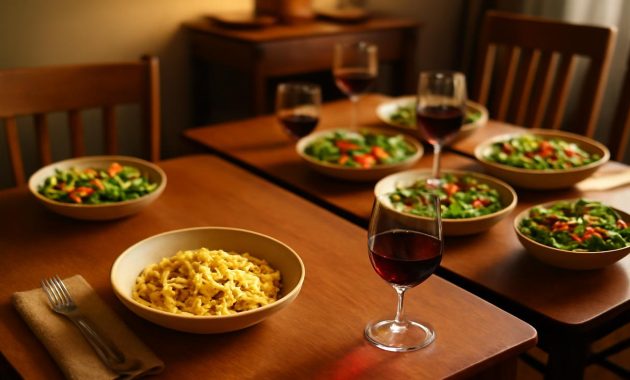
The first thing you hear is the gentle click of the oven door. It closes with a soft, decisive thud that seems to say: you’ve committed now. The house, which a moment ago felt hollow and echoing, has begun to shift. Heat sighs into the air. Olive oil blooms into a perfume. Somewhere beneath it all, a thin, bright note of garlic rises like a promise. You’re not at a restaurant. You’re not even sure if anyone else is coming. But tonight, there will be dinner—real dinner—and that alone already feels like a quiet kind of celebration.
The Kind of Dinner That Doesn’t Ask Questions
You know the sort of meal that comes with expectations. The holiday spreads where everyone’s watching the clock and the roast and each other. The elaborate date-night tasting menus where someone has ironed linen napkins into perfect diamonds and you suddenly feel guilty for not owning matching wine glasses. Those dinners are fine, sometimes even wonderful. They just have a way of turning food into a stage.
This one is different.
Tonight’s dinner is one that doesn’t care whether you are alone in your kitchen in yesterday’s sweater or hosting four friends who always forget to RSVP. It’s a pan of roasted vegetables—carrots, leeks, maybe some golden sweet potato wedges—tumbled together with garlicky chickpeas and a few slices of lemon. On another burner, a pot of small pasta or chewy farro simmers lazily, its steam clouding the window over the sink. On the counter, a bowl waits for everything to meet: a drizzle of good olive oil, a spoonful of thick yogurt or crumbled feta, a handful of herbs if you have them, a pinch of chile flakes if you like that kind of gentle heat.
This dinner doesn’t ask how many people it’s serving. It doesn’t insist on candles or playlists—though it will gladly accept both. It is as at ease in the quiet company of one as it is in a noisy kitchen full of stories. That’s its secret power: it expands or contracts to fit the night you’re having.
Shopping Like You Don’t Have to Impress Anyone
The trick starts at the grocery store or the farmers’ market, where you wander with a basket instead of a list rigid enough to frighten a wedding planner. Rather than chasing an exact set of ingredients, you’re out to gather a feeling: color, texture, the small pleasure of choosing.
You pause at the vegetable stalls. There are carrots with their feathery, dirt-dusted tops still on. Leeks, still smelling faintly of mud and rain. Plump red onions, purple like bruise and wine. You think about how they’ll look piled together in a pan, roasting under a light coat of olive oil, salt, and pepper until they shrink and sweeten, until their edges caramelize into the color of autumn leaves.
The actual choices matter less than the mix. You want some roots (carrots, parsnips, potatoes, beets, sweet potatoes) and something that softens into silk (onions, leeks, fennel). You grab a lemon because there is almost no world in which lemon is a bad idea. Maybe a bunch of flat-leaf parsley, maybe not. A can of chickpeas goes into the basket as easily as breathing.
The rest you probably already have: dried pasta or a grain (or rice, or couscous), olive oil, salt, pepper, something creamy or salty to finish—cheese, yogurt, or even just a few toasted nuts. This is a pantry meal disguised as a feast.
The Alchemy of a Single Pan
Back home, the ritual begins in the simplest way: you turn on the oven. It’s a small but deliberate act, one that transforms your kitchen from a place of transit to a place of belonging. While it heats, you chop, slice, and scatter your ingredients in an almost meditative rhythm.
You slice carrots on the diagonal, because making them a little pretty takes two extra seconds and makes you feel like you care—about them, about yourself, about this evening you’re building from nothing. You cut the leeks into coins, rinsing away the grit caught between their layers. Onion wedges fall apart in your hands. Sweet potatoes become sturdy crescent moons that will blister at the edges and turn into sweet, dense bites.
Everything goes onto a sheet pan in a loose, colorful chaos. You drizzle more olive oil than you think you should, then a bit more anyway. Salt falls like slow snow. Black pepper scatters in tiny constellations. You add the canned chickpeas, drained and patted dry, and they roll across the vegetables, finding their own spaces to nestle. Somewhere in the mix, you tuck in a few thin slices of lemon, rind and all, destined to soften and char and perfume everything around them.
You slide the pan into the oven, and then the real transformation starts. The oil begins to hiss. Carrots darken at their tips. Onions slouch into themselves. The chickpeas turn golden, then crisp, smelling like some impossible cross between roasted nuts and toasted bread. You stir once or twice, not for precision, but for pleasure—just to see the colors tumble, to hear the scrape of the spatula against hot metal, to watch steam escape in fragrant bursts.
On the stovetop, your starch of choice is quietly doing its work. Farro swirls in boiling water, releasing a nutty perfume. Or small pasta shells dance and bob, bumping into one another like friendly swimmers. You salt the water generously, because if the pasta is going to play a supporting role in this dinner, it might as well show up with its best self.
Setting the Table for One, or for Whoever Arrives
As the kitchen fills with warmth, you start to feel the question tugging at the edge of the evening: is this dinner just for you, or for more than you? You might have invited a friend who answered with a “Maybe”—the most flexible of promises. You might live with someone whose schedule is an unpredictable tide. You might simply be deciding whether you want company at all tonight.
This is where the beauty of this kind of dinner really shows. It doesn’t need certainty.
You can set one plate or four. You can lay out mismatched bowls, each with its own faint chip on the rim, stacking them in a small hopeful tower on the table. If you like, you pull out a cloth napkin, even if you’re alone. You light a candle, not as a gesture to romance, but to presence. The low flame steadies the room. It’s a small, privately radical thing to say, through your actions: this moment is worthy of care, no matter who witnesses it.
From the oven, the vegetables and chickpeas are now mottled with char, glistening with oil, shrink-wrapped into their sweetest selves. You pull out the pan and listen to the small sizzling chorus. The lemon slices have gone translucent at the edges; if you drag a fork through one, it collapses easily, offering up juice and softened rind. You drain the pasta or farro, keeping a spoonful of the starchy water back, just in case you want the finished bowl a little looser, a little silky.
Then you build the bowl—or many bowls—as if you’re quietly telling a story in layers: a base of grain or pasta, a generous scoop of vegetables and chickpeas, a drizzle of more olive oil, maybe that creamy thing (yogurt, cheese, tahini thinned with lemon), then a dusting of herbs or chile flakes. Each addition is a sentence added to the evening: Here is warmth. Here is texture. Here is brightness. Here is you, fed.
How the Same Dinner Changes When You Don’t Eat It Alone
When someone else joins you, this dinner becomes something else without needing to change its shape. The pan of roasted vegetables moves to the center of the table like a small, edible campfire. People lean in, breathing in the caramelized sweetness. They point: “What’s that one?” “Leek.” “Oh, I never cook leeks at home.” A conversation begins not with politics or work or small talk, but with curiosity about a wedge of fennel or the unexpected crispness of a chickpea.
Instead of portioning things out with the quiet precision you might use when eating alone, serving becomes an act of generosity. “Take more.” “No, you first.” Hands reach across the table; spoons clink against the lip of the bowl. Someone drizzles a little extra olive oil. Someone else sprinkles more salt without asking, which in this setting isn’t an insult but an intimacy—an assumption that the table is a shared space, not a performance.
The food itself invites lingering. It’s not too fussy or fragile. It doesn’t cool into inedible stiffness in five minutes. It keeps giving and giving, even as the conversation shifts to childhood stories, to the places everyone calls home, to the strange comfort of a meal that doesn’t pretend to be anything other than what it is: simple, generous, enough.
If you’ve ever sat at a table where you felt you needed the right clever story or polished outfit to earn your place, this kind of dinner feels like a relief. It asks nothing of you except that you arrive and, eventually, eat. Whether your guests are long-time friends or someone you’ve only just begun to know, the effect is the same: the meal makes room. It’s not flashy; it’s hospitable.
The Same Meal, Different Nights
The beauty of this dinner is how easily it shape-shifts. One night, it’s a quiet, candlelit bowl for you alone, eaten slowly with a book propped open nearby. Another night, it’s a family-style spread in the middle of a table surrounded by people talking over each other. In both versions, the core remains: roasted vegetables, a comforting starch, a creamy or bright finish.
Over time, you might find yourself adjusting the proportions based on your mood or your company. More chickpeas when you want extra heft. Extra lemon when you need brightness on a rainy day. Swapping yogurt for a soft, crumbling cheese when you want something saltier, more decadent. It’s a flexible script—a meal that can be played as a solo or as a full ensemble, without losing its melody.
The Quiet Luxury of Being Good Company for Yourself
There is a particular kind of loneliness that settles in the late afternoon, when daylight starts to recede and you haven’t quite decided what to do with your evening. Maybe the day has been noisy with other people’s needs—emails, messages, deadlines—and now there’s a sudden hush. Or maybe it’s been quiet all along, the only sound your own footsteps crossing the same familiar rooms.
This is the hour when the temptation of not cooking at all blooms loudest. You could scroll through delivery apps with half your attention. You could stand at the counter, eating crackers and peanut butter one spoonful at a time. You could call popcorn dinner and no one would know.
But when you choose to make this kind of dinner, you’re doing something slightly radical: you’re deciding that your own company is worth the time, the chopping, the small mountain of dishes. You’re acknowledging, if only to yourself, that you deserve a meal with color and texture and warmth even when there is no one else at the table to see it.
The vegetable scraps in the compost bowl, the hiss of pasta water boiling over, the clink of a spoon against a mixing bowl—all of it is proof of life. Cooking for yourself becomes a modest act of saying: I am here, and I am worth feeding well.
A Small Ritual of Care
As you stir the roasted vegetables into the pasta or farro, adding a splash of the reserved cooking water, watching it all loosen into something saucy and tangled, the aromas rise and wrap around you like a shawl. You taste, adjust, and taste again—not in the clinical way of a chef perfecting a dish for a critic, but as a person making sure they like what they’re about to eat.
Maybe you eat standing at the counter one night, bowl in one hand, fork in the other, the fridge humming companionably beside you. Another night you carry the bowl to the couch, pulling your knees up, letting the steam fog your glasses. One evening, you sit at the table, the one usually reserved for “proper” meals, and decide that this one counts too.
The more often you make this dinner for yourself, the less it feels like an exception and the more it feels like a practice. A way of coming back to yourself after days when you feel scattered in a thousand directions. The vegetables change with the season; the habit remains: turn on the oven. Warm the house. Feed the body. Let the mind follow.
Scaling Up, Scaling Down, Never Scaling Back
On paper, this dinner is the easiest thing in the world to multiply. One person? Half a pan of vegetables, a small pot of pasta. Four people? Double the vegetables, use the biggest tray you own, watch the chickpeas roll around like marbles. Eight? Roast on two pans, swap them halfway through. The math is simple; the effect is reliable.
But its real magic lies in how it scales emotionally.
Cooking alone, you learn your own preferences with a quiet intimacy that doesn’t always show up in shared meals. You notice that you like the almost-burnt edge pieces best, that you’ll always go for the lemons that have caramelized and collapsed. You realize you don’t actually love huge portions of grain, that what you want is more of the vegetables and just a handful of pasta to weave among them. You adjust in real time, no negotiation, no compromise.
Cooking for others, you learn something different: how to build a meal that holds everyone without fuss. You see who reaches for seconds of chickpeas, who carefully picks out every fennel slice, who quietly adds extra lemon. You start to anticipate these small desires. You add a second lemon to the pan next time. You set out a tiny extra dish of salt. You make the meal not just bigger, but more responsive to the people who gather around it.
| Element | When You Eat Alone | When You Share It |
|---|---|---|
| Portion | Flexible; cook once, eat now and tomorrow. | Scale up pans and grains, same method. |
| Mood | Quiet, reflective, unrushed. | Loud, communal, story-filled. |
| Ritual | Candle, book, music just for you. | Shared bowls, passing dishes, clinking glasses. |
| Leftovers | A ready-made lunch that feels like a favor from your past self. | Rare—people tend to go back for “just one more spoonful.” |
In both scenarios, the dinner holds its shape. It doesn’t become less itself when scaled down to a single bowl or up to a table full of plates. What changes is the story you’re telling with it: tonight I’m feeding myself; tonight I’m feeding us. The ingredients don’t care which sentence you choose. They roast, soften, crisp, and mingle just the same.
The Leftover Tomorrow
The day after a dinner like this, when containers of roasted vegetables and chickpeas are stacked in your fridge like colorful, edible bricks, tomorrow’s you receives a quiet gift. For the solo eater, it might mean a quickly reheated bowl between tasks, the vegetables lightly rewarmed in a pan until they’re just starting to sizzle again. For the host, it might mean a small private serving of yesterday’s feast, eaten over the sink or at the table in the hush after the party, when the house still smells like roasted lemon and garlic.
Leftovers are proof that the dinner’s generosity outlived the night. They say: this meal had more to give than we needed in a single sitting. They also say: you planned for yourself, not just the moment. You didn’t scale back your care just because it was “only you” or “only us.” You made enough.
In the End, It’s About Who You Become at the Table
Whether you’re alone or surrounded, what this kind of dinner offers is a chance to become a slightly softer version of yourself at the table. Not the person who worries that the sauce is too thick, that the conversation will stall, that the timing will be off. Not the person who fears that eating alone means that something is missing. Instead, you become someone who trusts that the ordinary can be beautiful and that a single pan of roasted vegetables and chickpeas over something comforting is enough to anchor an evening.
You watch the steam rise from your bowl. You notice the way the chickpeas shatter gently when you bite into them, how the lemon has melted into the background, brightening everything without insisting on being the main character. You take another forkful, another sip of water or wine or tea, and feel your shoulders drop a fraction of an inch. You’re here. You’re fed. That’s the whole story and also, somehow, it’s plenty.
This dinner doesn’t need applause. It doesn’t need witnesses. It works just as well eaten alone or together because, underneath all the decisions about herbs and grains and vegetables, it is built on a simple, generous idea: everyone at the table—including you, especially you—deserves to be well fed without having to earn it.
All you have to do is turn on the oven.
Frequently Asked Questions
What vegetables work best for this kind of dinner?
Sturdy vegetables that roast well are ideal: carrots, parsnips, potatoes, sweet potatoes, beets, onions, leeks, fennel, and even cauliflower or broccoli. Aim for a mix of root vegetables and something that softens and caramelizes, like onions or leeks.
Can I make this meal gluten-free?
Yes. Simply swap the pasta for gluten-free pasta, rice, quinoa, or another gluten-free grain. The roasted vegetables and chickpeas are naturally gluten-free, so the base is easy to adapt.
How do I adjust the recipe for one person?
Use a smaller handful of vegetables and half a can of chickpeas, plus a small portion of pasta or grains. Roast on a half-sheet pan or smaller tray. If you end up with extras, they reheat well and make an easy lunch.
What can I use instead of chickpeas?
You can substitute other canned beans (like cannellini or butter beans), cubed tofu, or even small lentils that have been cooked until just tender. Chickpeas hold their shape especially well when roasted, but the idea works with many proteins.
How can I make this dinner feel a bit more special for guests?
Add small touches: a simple green salad, a crusty loaf of bread, a drizzle of good olive oil at the table, a bowl of salty cheese or toasted nuts for sprinkling, and a candle or two. The core meal can stay exactly the same; it’s the little details around it that make the evening feel celebratory.