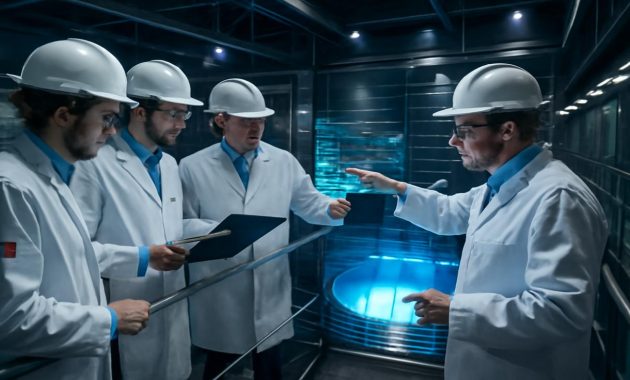
The night train slips out of Paris like a low, humming secret. Streetlights thin, warehouses flatten into silhouettes, and then the countryside opens—dark fields stitched with faint ribbons of road, the sky a deep, rolling velvet. Somewhere out there, past the sleeping villages and shuttered bakeries, sits a quiet complex of buildings and machinery that could, if its creators are right, change the way the whole world is powered.
France has been in the energy game for decades, of course. Nuclear power plants have long dotted its landscape like hulking, concrete cathedrals to the atom. But what’s happening now—what engineers, physicists, and policy makers are whispering about in half-technical, half-awed tones—is something different. It’s not just an upgrade. It feels more like an inflection point: a breakthrough that, once crossed, can never be uncrossed.
The quiet revolution inside a concrete ring
At dawn, the complex looks almost ordinary. Fog clings low to the ground, and the air smells of wet soil and distant woodsmoke. The fences are unremarkable, the car park full of regular hatchbacks and dusty vans. There are no gleaming sci-fi towers, no glowing blue orbs, no cinematic hum filling the air. Instead, there is a modest building and, tucked within it, one of the most ambitious human experiments in energy that Europe has ever seen.
France’s energy breakthrough isn’t a single machine with a grand name, but a convergence—advanced nuclear designs that promise far less waste and far greater safety, combined with an aggressive push into renewables and grid intelligence. At the beating heart of this shift is a simple, almost old-fashioned idea: if you can make clean, steady power cheap and reliable enough, everything else becomes negotiable.
Step inside the control room and the first things you notice are the screens. Maps of Europe in shifting color gradients. Real-time demand curves, dipping and rising like slow ocean swells. A narrow line shows France’s power output, mostly nuclear, with new streaks of wind and solar creeping in every month. But in one corner, a small, experimental bloc is highlighted in a sharper, brighter color. It represents the new reactors—smaller, more flexible, able to power cities or industrial zones without gulping down water or producing mountains of long-lived waste.
You can feel the tension in the room: part pride, part anxiety. The engineers here know they’re not just keeping the lights on. They’re rehearsing a different future.
The French wager: steady atoms, dancing electrons
The French state’s grand bet, made decades ago, was that nuclear power could free the country from the volatility of fossil fuel markets. It worked astonishingly well. Today, France boasts some of the lowest-carbon electricity of any major industrial nation. But the old reactors, those concrete giants along the rivers, are aging. The world has grown wary of nuclear’s risks. And climate deadlines are no longer vague warnings but hard, looming dates on government calendars.
This is where the new generation of French innovation steps in: advanced reactors designed to be smaller, safer, and much more flexible; and a grid built not as a rigid one-way pipeline but as a responsive, almost living network.
Picture it like a dance floor. The old system was a line dance: big, slow steps, everybody moving together, power flowing neatly from plant to plug. The new system is more like improv. Solar panels spike production under a noon sun, then drop as clouds roll through. Offshore wind farms ramp up at dusk, sigh down before dawn. Batteries pulse in and out. And in the middle of this swirling motion sit the new French reactors, not as immovable anchors, but as calm, responsive partners: steady, yes, but nimble enough to lean into the rhythm.
One of the engineers, a woman with oil-smudged hands and a coffee gone cold beside her keyboard, explains it in plainer terms. “We used to assume nuclear could not move,” she says. “Now we are teaching it to breathe with the grid.” Her gaze drifts back to the screen. “If this works here, it works anywhere.”
From monoliths to modular: a new nuclear anatomy
For most of us, “nuclear power plant” still conjures the same image: a pair of massive cooling towers, billowing steam like tame volcanoes. But the French breakthrough isn’t just about one big new facility; it’s about rethinking the scale and shape of nuclear itself.
Instead of a handful of colossal reactors, France is moving toward smaller, modular units that can be built faster, at lower cost, and closer to where the power is needed. These units are designed with passive safety systems—gravity, natural circulation, and smart materials doing what previously required complex active controls. If something goes wrong, the plant tends to shut itself down, not spiral out of control.
On a chilly afternoon, walking along the perimeter of one such pilot site, you don’t feel like you’re next to a dangerous beast. There is a hum, yes, a bass note under the wind, but the place feels strangely calm. Low buildings, clean lines, heat shimmering faintly above vents. You could mistake it for an oddly secure data center.
Inside, superheated fluids move through loops of advanced alloys, converting atomic fission into electricity with efficiencies that would have stunned the early pioneers of nuclear power. Where the old plants gulped water from rivers and seas, these designs sip and recycle, leaving the surrounding landscapes less disturbed. And where traditional reactors produced waste that remained hazardous for millennia, France’s new approach increasingly focuses on closing the fuel cycle—recovering usable materials, shrinking the volume and lifespan of what must be stored.
It is not magic. It is engineering, meticulous and unromantic. But stand outside long enough, watching the plumes vanish into the sky, and it starts to feel a little like alchemy: turning the invisible ticking of atoms into heat, into motion, into light burning in a child’s bedroom miles away.
Why the world is watching France again
France has been here before—eyes of the world turned toward its energy experiments. The difference now is context. Climate change is no longer a distant drumbeat; it is a siren in the present tense. Summers arrive hotter and stranger. Rivers run low. Forests catch fire in new places, at new times of year. Between these disruptions, societies argue: about who should pay, who should change, who should wait.
In this friction, the French model has a certain, almost rude clarity: build reliable low-carbon power at scale, and build it fast. Then use it ruthlessly—to electrify cars and trains, to heat homes and factories, to anchor the grid while wind and solar blossom around it.
Inside a planning office in Lyon, wall-sized maps tell the story. Colored overlays show the spread of solar farms across disused airfields, wind turbines marching offshore along the Atlantic coast, new interconnections weaving between France, Spain, Germany, and beyond. At the center of these maps are small icons of reactors—not the hulking symbols of old, but compact, repeated shapes, almost like Lego blocks.
One planner runs a finger along a cluster of them. “Each of these,” he says, “could replace an entire coal plant somewhere else in the world.” He looks up, eyes tired but bright. “If we prove the model, we export more than technology. We export time—time that others don’t have to spend experimenting from scratch.”
That is the global significance of this French breakthrough: it’s not just what happens within France’s borders, but the template it offers. A path for countries rich and poor, densely populated or sprawling, to build energy systems that are both low-carbon and reliable enough to support modern life.
The numbers beneath the poetry
In the midst of all this storytelling—the foggy mornings, the humming control rooms—it’s easy to lose track of the hard metrics. Yet, it’s the numbers that transform a hopeful narrative into a true breakthrough. Consider a compressed snapshot of what France is trying to lock in over the next couple of decades:
| Aspect | Today (Approx.) | 2035–2040 Vision |
|---|---|---|
| Share of low‑carbon electricity | ~90% | >95% with higher flexibility |
| Nuclear share of power mix | ~65–70% | ~50–60% plus more renewables |
| Average grid CO₂ intensity | Among the lowest in the G20 | Pushed even lower, closer to zero |
| New reactor designs | Pilot & planning stage | Deployed, export-ready |
| Grid architecture | Centralized, increasingly digital | Fully smart, highly interconnected |
These are not small adjustments; they are structural changes. They redefine what a “national grid” can be. For the world watching, the crucial question is not whether France can hit every percentage point exactly, but whether it can show that this general shape of system—steady nuclear core, wide renewable wings—actually works in real weather, with real politics, real budgets.
If it does, the implications ripple outward. Countries with fragile grids might build modular, French-style reactors to anchor their systems. Nations dependent on imported coal or gas might use this model to leapfrog directly into a cleaner, more resilient era. Even regions with ample sun or wind might look to France to understand how to keep the lights on when the sky doesn’t cooperate.
The human texture of a technical shift
It’s easy, from afar, to talk about energy in abstractions—gigawatts and tons of CO₂, capacity factors and storage curves. On the ground, though, the transition feels much more intimate.
In a small town near one of the new pilot sites, the café owner has mixed feelings. The plant means jobs, sure, and a steady lunch rush from engineers and technicians. But it also means sirens for occasional drills, security checks, outsiders coming and going, the low-grade anxiety of living near something powerful and invisible. “I am proud and cautious at the same time,” she says, wiping down a counter. “We all know the climate is changing. We also know accidents happen. You live between those truths.”
At a school nearby, children draw pictures of wind turbines and solar panels, but also of the plant itself, squarish and grey with cartoon steam puffs rising above. Their teacher uses it as a springboard: how does electricity get to your house? What makes it clean or dirty? What will this town look like when you are old?
One boy raises his hand. “If the power is clean,” he says carefully, “does it mean the air will smell like the mountains again?” There is a silence in the room, the question hanging between science and memory.
On the other side of the country, in Marseille, the conversation plays out differently. Here, the focus is on ports, ships, and factories. New French reactors could generate not just electricity, but also the high-temperature heat and clean hydrogen needed to decarbonize heavy industry. Shipbuilders talk about synthetic fuels. Chemical plants weigh the cost of redesigning entire processes. Dockworkers wonder if the jobs created by this green reconstruction will be theirs, or someone else’s.
Underneath all of it runs a quieter current: a sense that energy is no longer background noise. It is foreground, a story people are aware they’re living through.
The risks, the doubts, and the hard questions
No breakthrough is inevitable. And this French push toward a new kind of power system is riddled with hard questions. Can costs be contained, or will projects balloon over budget like so many past megaprojects? Can public trust in nuclear be rebuilt in a world that has seen disasters and near-misses? Can complex new reactors be regulated and managed safely across countries with very different capacities and cultures?
Then there are the deeper, almost philosophical doubts. Does focusing on high-tech solutions distract from simpler measures—using less energy, changing consumption patterns, redesigning cities? Will exporting nuclear technology to politically unstable regions create new security risks? Can an energy system that leans heavily on centralized infrastructure truly coexist with a grassroots, citizen-led vision of the green transition?
French officials don’t have neat answers to all of these questions. In private, some admit they argue about them late into the night. In public, the narrative is cleaner: we must decarbonize rapidly, and this is the most reliable way we know to do it at scale. Between those poles—the nuance and the necessity—the country moves forward, sometimes awkwardly, but relentlessly.
What is striking, perhaps, is not the absence of risk, but the willingness to confront it head on. To say, in effect: the risk of doing this imperfectly is still less than the risk of not doing it at all.
A different kind of power
Imagine, for a moment, a world twenty or thirty years from now, after this French experiment has had time to run its course.
In one possible version, the bet has paid off. Modular reactors quietly hum near industrial centers on every continent, feeding greened grids that flicker only rarely. Coal plants are museum pieces. Gas pipelines are fewer, shorter, less geopolitically charged. Cities, once choked with exhaust, breathe easier. The air over a winter morning in Delhi or Lagos or São Paulo smells, as that French schoolboy hoped, a little more like the mountains.
In another version, the story is messier. Technical setbacks, political swings, and economic shocks have slowed or warped the rollout. Some countries have embraced French-style nuclear; others have doubled down on renewables and storage alone. The world’s energy map is a patchwork, shimmering with different strategies and varying degrees of success. France remains a major player, but its experiment is one of several, not the singular path.
Reality, as always, will probably land somewhere between these extremes. But even in the more modest scenarios, what France is doing now matters. It expands the menu of serious options. It challenges the fatalism that says decarbonization must be slow, chaotic, or cripplingly expensive. It shows, in kilowatt-hours and concrete and steel, that a major industrial nation can radically cut its emissions while still running trains, lighting cities, powering factories, and heating homes.
As the night train glides back toward Paris, fields slipping by in a dark blur, you may notice something small but telling: the lights in the carriage never flicker. They burn on and on, a warm, unbroken thread. Somewhere, unseen, atoms split, wind spins, rivers push turbines, batteries discharge. Somewhere, also unseen but very real, carbon that would have risen into the sky stays locked in the ground.
This, in the end, is the heart of the French breakthrough. It is not just about generating more power. It is about redefining what power means—less as a lever of extraction, more as a shared, steady heartbeat humming beneath our lives.
FAQ
What exactly is the French energy breakthrough?
It’s a combination of advanced nuclear reactor designs, expanded renewables, and a much smarter, more flexible grid. Together, these elements aim to deliver very low-carbon electricity that is also reliable, affordable, and exportable as a model to other countries.
Is this mostly about nuclear power?
Nuclear is the backbone of the French strategy, especially with new, smaller, safer reactors. But the breakthrough only makes sense in combination with large-scale wind and solar, interconnections with neighboring countries, and digital grid management that can juggle all these sources in real time.
How is this different from older nuclear plants?
The new reactor designs are typically smaller and modular, easier to build and replicate, and use passive safety features that rely on physics rather than complex machinery to remain safe. They also aim to reduce waste and make better use of fuel, sometimes by recycling materials from older reactors.
Why does the rest of the world care what France is doing?
Because many countries face the same problem: they need a lot of clean, dependable power quickly to cut emissions without stalling development. If France proves that a nuclear-plus-renewables system can work at scale, it offers a concrete blueprint others can adapt and adopt.
Is this approach without risk?
No. There are technical, financial, political, and safety risks. Nuclear technology must be carefully regulated, and public trust has to be earned and maintained. But French leaders argue that these risks are manageable—and that, compared to the accelerating dangers of unchecked climate change, they are worth taking.
Will this mean cheaper electricity for ordinary people?
In the long run, the goal is to deliver stable or lower prices by reducing dependence on volatile fossil fuel markets and by standardizing reactor designs to cut costs. In the short term, investment and construction can be expensive, so the price path may be uneven.
Can countries without France’s resources follow this path?
Not every country can copy France exactly, but many can adapt parts of the model—importing reactor designs, participating in international financing, or focusing on renewables while tapping low-carbon imports from neighbors. The key contribution of the French experiment is to widen the range of proven options on the global table.