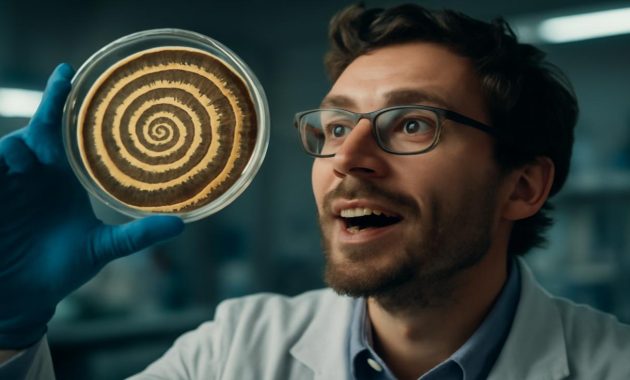
The email came on a Tuesday morning, the kind that feels too ordinary to hold anything world-shifting. Yet in a quiet lab office smelling faintly of coffee and ethanol wipes, a young biologist clicked open a preprint titled, almost shyly: “A New Law of Biological Organization.” Within hours, screenshots rippled across group chats, Slack channels, and Twitter feeds. By sunset, one thing was clear: something big had just cracked open in biology—an 80-year-old mystery that had sat, mostly unbothered, in the background of textbooks and lecture slides.
The Law Hiding in Plain Sight
If you were paying attention in high school biology, you may remember a gentle, tidy rule tucked into the chapter on body size: big animals live slower. Tiny shrews burn like matchsticks—heart racing, metabolism roaring—while elephants cruise through the decades at a measured, unhurried pace. This pattern, first formally noticed in the 1930s and 40s, grew into what became known as scaling laws: mathematical rules that describe how life changes as it gets bigger.
Back then, scientists like Max Kleiber began compiling data on animals’ metabolic rates. When they plotted body mass against energy use on a log scale, the dots lined up along a startlingly consistent slope: not 1:1, but close to three-quarters. A mouse doesn’t use a thousand times more energy than a tiny insect, and a whale doesn’t need a million times the metabolism of a mouse. Instead, the relationship bent, gently but predictably, across species and ecosystems. It was elegant. It was stubborn. It was inexplicable.
For nearly 80 years, biologists poked at this law—Kleiber’s Law, and others like it—like someone tapping their fingers on a locked door. Why three-quarters? Why not two-thirds? Why did such a simple equation appear in creatures as different as hummingbirds and tuna, pines and plankton, fungi and humans? Everyone agreed the law was real. No one could fully explain it.
And then, slowly, almost shyly, a new idea began to surface. Maybe the law wasn’t about species at all. Maybe it wasn’t about hearts or muscles or lungs. Maybe, scientists are now arguing, there is a deeper, more fundamental rule wired into the very way life builds itself—from the veins of leaves to the capillaries in your fingertips.
The Pattern Written in Branches and Blood
Walk into a forest and look up. Branches split into smaller branches, which split again into twigs, then needles or leaves. Inside those leaves, microscopic veins branch again, carving river-delta shapes into green tissue. Inside you, arteries divide into arterioles and capillaries, delivering oxygen to every corner of your body. Open a microscope slide of lung tissue, and the branching pattern repeats. Zoom out farther, into satellite imagery, and river systems fork in hauntingly familiar ways.
This is what a team of researchers—physicists turned biologists, ecologists turned network theorists—kept coming back to. Across wildly different forms of life, the infrastructure that moves energy and resources around looks strikingly similar. Trees do not use tiny conveyor belts. Tumors do not reinvent plumbing. Evolution prefers one structural solution again and again: branching networks that spread out like lightning bolts trying to touch every point.
For years, one idea had been quietly gaining ground: perhaps the mysterious three-quarter power law—that stubborn exponent in Kleiber’s graphs—emerged from the physics of these branching networks. The bigger an organism, the more intricate the branching needed to reach every cell. The trick was finding a way to turn that intuition into a hard, predictive law, one that worked not just for a few organisms, but across the messy, contradicting sprawl of life.
That is what this new work claims to have done. By weaving together decades of data with fresh mathematical models, the scientists argue they’ve uncovered a unifying rule: a new biological law that explains how energy flows, how size scales, and how life is constrained by the same geometric and physical limits, whether it swims, flies, grows, or blooms.
A New Rule for Living Systems
The heart of the new law is startlingly simple in its ambition: it says that every living thing, from single cells to vast forests, obeys a common set of scaling rules rooted in how efficiently it can move energy and materials through its internal networks. Rather than just describing how metabolism scales with size, the law connects several pieces that were once treated separately: growth rate, lifespan, reproduction, even how fast populations can expand or collapse.
Think of it as a kind of “governor” on life—a rule that doesn’t care whether you’re a jellyfish or a jaguar, only how your body (or community, or ecosystem) is wired to push energy around. The more efficiently your internal networks deliver fuel and remove waste, the more options evolution has to play with speed versus size versus longevity.
For decades, biologists debated why organisms cluster along a spectrum: fast and small, or slow and big; burn bright and die young, or take it slow and live long. The new law connects these life strategies to the physical architecture of living systems. Build dense, high-throughput networks—like the frenzied mesh of vessels in a mouse—and you can afford speed, but not stability. Spread resources slowly through a sprawling architecture—like the vascular system of a redwood—and you buy time, at the cost of youthful intensity.
In the quiet language of equations and exponents, the law formalizes this trade-off. But in the real world, it’s written in creaturely choices: a mayfly’s frantic day-long adulthood; a tortoise’s unhurried century; a forest’s slow-motion conversation between seedlings and giants.
The 80-Year Puzzle, Reframed
To see how radical this is, you have to understand what scientists have been stuck on. Kleiber’s Law and related scaling rules were annoyingly solid. Over and over, data on metabolism, heart rate, lifespan, and growth—when plotted against body mass—formed neat lines with slopes close to one-quarter or three-quarters. These exponents appeared across mammals, birds, fish, even across plants and microbes. Alternative explanations—like simple surface area versus volume arguments—never quite fit everything at once.
The new law reframes the whole puzzle. Instead of asking “Why three-quarters?” as if the universe had arbitrarily chosen a number, it asks: “What kind of network, filling three-dimensional space, optimized for energy delivery, would evolution favor again and again?” Under those conditions, the mathematics squeezes down to a narrow set of possible exponents—and one of them is that stubborn three-quarters. Suddenly, the old mystery feels less like a coincidence and more like a signature.
It’s as if biologists were studying the orbits of planets for generations, had all the numbers, and then someone finally wrote down gravity.
Listening to Life in Numbers
Of course, every new “law of nature” earns skepticism, and biology is famously messy. For every neat trend, you can find an exception: the bird with the wrong heart rate for its size, the tree that breaks the growth rules, the species that doesn’t seem to care about curves on a graph. But part of the strength of the new work lies in how it treats those exceptions—not as errors, but as stories.
When a bat or a bird falls off the usual line, it often has a good reason: powered flight, unusual thermal regulation, peculiar diets. When certain plants scale differently, it reflects their unique water transport systems or structural constraints. Rather than breaking the law, these organisms nudge its parameters, like jazz musicians bending notes without ever leaving the song.
To make that visible, researchers compiled sprawling datasets, pulling together species from as many branches of the tree of life as possible. They measured metabolic rate, body mass, growth curves, vascular structures, and more. Then they asked: if we assume that biological networks are optimized—to move energy with minimal cost, to fill space efficiently, to evolve under physical constraints—can we predict the patterns we see in nature?
The answer, surprisingly often, was yes. Under their framework, not only did the classic scaling exponents fall out naturally, but other patterns in growth and lifespan snapped into place as well. Different kingdoms, different lifestyles, but the same whispered math beneath it all.
| Biological Feature | How It Scales with Size | What the New Law Explains |
|---|---|---|
| Metabolic Rate | Increases slower than body mass (around 3/4 power) | Why large organisms use energy more efficiently than small ones |
| Heart / Pulse Rate | Slows down as size increases | Why tiny animals have racing hearts while giants beat slowly |
| Lifespan | Tends to increase with body mass | The link between energy delivery, wear and tear, and longevity |
| Growth Rate | Generally faster in small organisms | Why fast-growing species tend to be short-lived |
| Population Turnover | Quicker in small species, slower in large ones | How individual scaling shapes whole ecosystems |
In the end, what makes this feel like a law, not just another model, is scope. It doesn’t belong to mammals or trees or cells alone. It treats them all as different answers to the same underlying question: given physical limits, how can life move energy around, build bodies, and persist over time?
From Cells to Forests: One Rule, Many Worlds
The implications ripple out farther than you might expect. If there truly is a general law governing how biological systems scale, then it doesn’t stop at individual bodies. It reaches into how populations grow, how ecosystems respond to disturbance, even how climate change will reshape the living world.
Consider a forest on a warming planet. We know that temperature changes metabolism: as it gets hotter, chemical reactions speed up. If metabolic scaling is tied to a universal law, we can start to predict how increases in temperature will affect not just one leaf or one insect, but the entire flow of energy through the system. Will trees grow faster but die younger? Will small-bodied species outcompete larger ones as the pace of life accelerates? How will that change the way carbon is stored or released?
Zoom inward, and the same law matters for medicine. Tumors, after all, are communities of cells using energy, building networks, scaling up. Their growth follows curves that sometimes eerily mimic those of organisms or even ecosystems. The new frameworks emerging from this law could help us understand why some tumors grow explosively while others stall, or how blood vessel networks inside a cancer might limit—or enable—its expansion.
At the opposite extreme lies synthetic biology: our attempts to engineer life from the ground up. If we’re serious about designing organisms to perform tasks—digest plastic, fix carbon, clean water—we’ll need to play by the same rules evolution has been obeying for billions of years. A general law of biological scaling doesn’t just describe what life has done; it tells us what it can do, and what it can never do efficiently.
The Emotional Weight of a Law
It’s easy to get lost in the math and forget that this is, at its core, a story about our place in the living world. Laws are the universe’s way of saying: “No matter where you go, this is true.” For a long time, biology seemed, at least compared with physics, almost lawless—an explosion of exceptions, side paths, and singularities. Evolution, after all, thrives on accidents and detours.
Yet there is something quietly moving about realizing that the same deep rule which shapes the thickness of a whale’s arteries also dictates the branching of a maple leaf, the restlessness of a mouse, the slow heart of a Galápagos tortoise—and, yes, the fragile pacing of your own life. Your pulse, your breath, the speed at which your cells divide or falter: all are dancing, in their own messy way, to this background rhythm.
It doesn’t erase individuality, or the weirdness that makes life interesting. Instead, it gives us a shared grammar. When you walk through a city park, watching sparrows fuss in the grass beneath old oaks, you’re seeing different ways of solving the same equation: how to take sunlight, water, and nutrients, and turn them into motion, thought, wood, song.
Cracking the Mystery, Keeping the Wonder
So, is the mystery solved? Has biology found its version of E = mc²? Not quite. Scientists are cautious by training and necessity. They call this a law, but with the kind of humility that comes from watching nature break neat theories again and again.
There are still questions galore. How does this law change in extreme environments—deep oceans, arid deserts, polar ice? How do symbiotic relationships, like those between fungi and plants, bend or share their scaling rules? What about organisms that blur the boundaries between individual and collective—colonial corals, slime molds, or human cities themselves?
Some researchers are already asking whether the logic of the law might extend beyond biology. After all, any system that moves energy through a branching network and grows in space—river basins, urban infrastructure, even data networks—may feel similar constraints. It’s an uncanny thought: that a city’s traffic flows, your social media feeds, and a redwood’s veins might all be playing variations on the same structural theme.
Yet even as the math sharpens, something essential remains gloriously beyond capture. Knowing that a hummingbird’s frantic metabolism is the inevitable result of scaling laws doesn’t make its hovering any less miraculous. Understanding that a whale’s slow heartbeat is written into the geometry of its arteries doesn’t shrink the awe of watching it breach against a cold horizon.
If anything, the discovery of a new biological law does what the best science always does: it makes the world feel both more intelligible and more mysterious. We gain a glimpse of an underlying order—then realize how many stories remain to tell within it.
What This Means for Us
In the end, what makes this story matter is not just that scientists may have cracked an 80-year-old puzzle, but that it offers a new way to see ourselves. We are not separate from the rest of life, not exceptions standing outside the rules. Our bodies scale, our hearts slow with age, our cells follow the same constraints that guide an oak or an orca.
When our cities swell, when our technologies accelerate, when our economies race ahead, they do so built on a biological substrate that still obeys these timeless limits. We can push against them, but only so far. There is a pace at which tissues can heal, at which forests can regrow, at which ecosystems can absorb shock. Knowing the law that shapes those limits is not abstract; it is urgent.
As the climate warms and extinctions mount, this kind of deep, unifying understanding becomes a tool not just for curiosity, but for survival. Policies and models that ignore the fundamental rhythms of life risk missing the point. Those that attend to them may find more realistic paths through the turbulence ahead.
Meanwhile, somewhere in a lab, a graduate student is probably re-running a dataset, checking a slope, arguing about exponents with their advisor over a whiteboard. The work continues, as it always does: incremental, uncertain, sometimes tedious. But now, stitched into the backdrop of that work, is something rare in biology—a candidate for a true law, linking hummingbirds and humans, algae and elephants, in one long, branching equation of existence.
On another Tuesday, in a decade or two, a kid might read about it not as a breaking discovery, but as a fact of life, as ordinary and profound as gravity. They’ll flip past the diagram of vascular networks, glance at the neat little exponent, and go outside, into a world that’s humming with the same silent law, written into every leaf, every heartbeat, every breath.
FAQ
What exactly is this new biological law?
It is a proposed general law of biological scaling that explains how key traits like metabolic rate, growth, lifespan, and energy use change with size. It argues that these patterns arise from the physics and geometry of branching networks that deliver energy and materials within organisms and across living systems.
How is it different from Kleiber’s Law?
Kleiber’s Law specifically describes how metabolic rate scales with body mass (roughly to the 3/4 power). The new law doesn’t replace it; it extends and explains it. It provides a broader theoretical framework that not only reproduces Kleiber’s Law but also connects it to other traits and even to how ecosystems function.
Does this law apply only to animals?
No. One of its striking features is that it appears to hold across many forms of life: animals, plants, fungi, and microbes. Anywhere living systems move energy and resources through branching or network-like structures, the same basic constraints and patterns tend to emerge.
Are there exceptions to the law?
There are deviations and outliers, especially in organisms with unusual lifestyles, anatomies, or environments—such as flying species, extremophiles, or highly specialized plants. Most of these can be understood as variations within the broader framework, rather than outright violations of it.
Why does this discovery matter in practical terms?
Understanding how life scales helps us predict how organisms and ecosystems will respond to changes such as global warming, habitat loss, or disease. It can inform conservation strategies, medical research (for example, tumor growth and vascular diseases), agriculture, and even the design of bio-inspired technologies.
Does this mean biology is now as “lawful” as physics?
Biology will probably always be more variable and context-dependent than physics, because evolution explores many possible solutions. But discoveries like this show that beneath the diversity, there are deep, consistent rules that shape what life can and cannot do.
Has this law been fully accepted by the scientific community?
Not yet. It is influential and widely discussed, but still under active testing, refinement, and debate. As new data and models emerge, the law may be sharpened, adjusted, or partially revised. That ongoing process is a normal and healthy part of scientific progress.