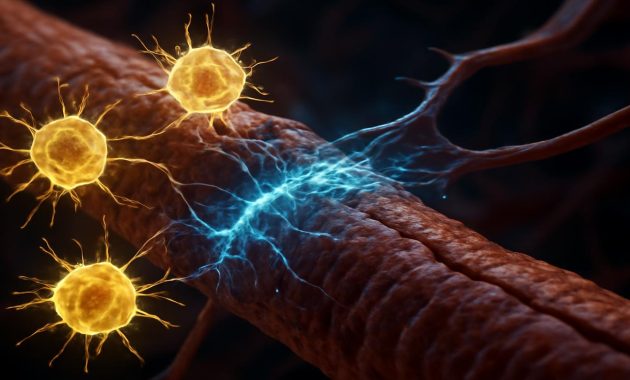
The first thing you notice is the hands. They tremble, almost imperceptibly, as the man reaches up toward the strap on the harness. It’s been years since his fingers could obey him like this—years since the car accident, the shattering pop at the base of his neck, the crushing verdict: “You may never walk again.” Yet here he is, in a quiet rehab gym that smells faintly of antiseptic and rubber mats, standing in a robotic support frame. Electrodes trace constellations across his skin. A physiotherapist watches his face, not his legs. Someone whispers, “Ready?” The man nods. And then, like a story turning a page, he takes a step.
When Hope Lives in a Drop of Fat
The story behind that first step does not begin in a glitzy tech lab or in some futuristic hospital of chrome and glass. It begins, oddly enough, with something most of us try to get rid of: fat.
For years, fat has been the villain in countless health narratives—pinched between fingers, circled on magazine covers, measured, scolded, shrunk. But inside that soft, unloved tissue lies something quietly astonishing: a dense population of stem cells, capable of turning into bone, cartilage, muscle, and—most tantalizingly for scientists working on paralysis—cells that can support and repair nerve tissue.
They are called adipose-derived stem cells, and under a microscope they look disarmingly ordinary. Yet in a breakthrough study that feels almost like science fiction rendered in slow, careful reality, these fat stem cells have been coaxed into healing broken spines in animals with injuries once considered permanent.
This isn’t a sudden miracle or an overnight cure. It’s the result of meticulous years of work—careful experiments, failures, do-overs, and the kind of patience that borders on faith. But when you stand in that rehab gym, watching a person whose legs had fallen silent take a halting step, you can feel the weight of those years pressed into a single electrifying moment.
The Silent Disaster Inside a Broken Spine
A spinal cord injury is not just a break—it’s a catastrophe written in microscopic detail. When the spine is crushed or severed, communication between brain and body shatters. Nerves can’t simply “grow back” the way skin might heal after a cut. The injury site becomes a kind of no-man’s-land: scar tissue forms, inflammation rages, and damaged nerve fibers wither in the hostile environment.
Even after the initial impact is over, a second wave of destruction rolls through. Cells die off from lack of blood flow. Toxic molecules leak into places they were never meant to be. The immune system, trying to help, can actually worsen the damage. Within days, the path for regeneration is cluttered with biochemical wreckage and scar tissue, a barricade against regrowth.
For decades, doctors did what they could: stabilize the spine, reduce swelling, prevent further damage. Rehabilitation focused on teaching the body to live with loss—compensating for paralysis rather than reversing it. The word “permanent” hung in the air like an iron weight.
So when a team of researchers began to ask whether the fat on a patient’s own body could contain the raw material to heal their spine, it sounded—at least at first—more like metaphor than medicine. Yet, quietly, experiment by experiment, that metaphor began to look a lot like reality.
The Fat That Became a Bridge
In the breakthrough study that has stirred the spinal cord community, scientists focused on turning ordinary body fat into a living bridge across the site of injury. The process, distilled to its essence, feels surprisingly simple—even if the execution is anything but.
First, they collect a small amount of fat tissue—far less than any cosmetic liposuction would remove. This tissue is then processed in a sterile lab, separating out the stem cells that live within the fatty matrix. Under carefully controlled conditions, the cells are encouraged to multiply, nudged with biochemical signals to take on traits particularly suited to healing nervous tissue.
What emerged from this work was more than a slurry of cells. It was a kind of living toolkit: cells that can support nerve survival, dampen runaway inflammation, and secrete molecules that coax the local environment into being friendlier to regrowth. In some versions of the study, these stem cells were embedded in soft, biodegradable scaffolds—like a tiny, biological trellis—designed to sit snugly in the gap where the spinal cord had been torn or crushed.
The results in animals with severe spinal cord injuries were startling. Over weeks and months, nerve fibers began to creep through the once-dead region. The scar tissue that had formed like cement around the injury softened into something more porous and permissive. Blood vessels snaked their way back in. The animals—once limp and motionless from the waist down—began to regain movement, then coordination, and ultimately, in many cases, the ability to walk.
It wasn’t perfect, and it wasn’t instant. Their gait could be clumsy, their balance fragile. But the leap from absolute paralysis to meaningful, voluntary movement is profound. In the quiet hum of the lab, cameras recorded tails that once dragged now swishing, paws that once collapsed now pushing off the ground.
Why Fat Stem Cells Are Different
Stem cells can come from many places—bone marrow, umbilical cord blood, even reprogrammed adult cells. But fat holds a special advantage that has scientists paying close attention.
| Source | Key Advantages | Typical Use |
|---|---|---|
| Adipose (Fat) Tissue | High stem cell yield, minimally invasive collection, rich in supportive factors | Regenerative therapies for joints, skin, and experimental spinal repair |
| Bone Marrow | Well studied, strong track record in blood-related treatments | Bone and blood disorders, some experimental nerve applications |
| Umbilical Cord / Placenta | Young cells, high regenerative potential | Banked for future therapies, immune and tissue repair research |
Fat stem cells are not just easy to collect; they also come with a surprisingly generous personality. They are remarkably good at calming inflammation—releasing molecules that tell the body’s overexcited immune cells to stand down. In the scrambled chaos after a spinal cord injury, this calming effect can mean the difference between a landscape where nerves can think about growing again, and one where they are suffocated by chemical hostility.
On top of that, fat stem cells secrete growth factors—tiny protein signals that whisper encouragement to damaged neurons: survive, extend, connect. They don’t need to turn into fully fledged nerve cells themselves to be useful; just being supportive neighbors might be enough to change the outcome dramatically.
From Laboratory Light to Hospital Hallways
It’s one thing for a rat or a primate in a controlled study to regain function. It’s another to bring that possibility into the fluorescent-lit hallways of real hospitals, where risk, cost, and human hope collide.
The path from animal success to human treatment is narrow and steep. Before a single patient is treated, teams must prove—again and again—that the cells are safe. That they won’t turn cancerous. That they won’t trigger catastrophic immune reactions. That they can be scaled up and standardized: the same quality, the same potency, each time, no matter who walks through the clinic door.
Still, the early translation has begun. Small, carefully monitored clinical trials have started to test whether using a patient’s own fat stem cells around the site of a spinal injury can improve recovery. Participants sign consent forms thick as novellas. Their expectations are guided, tempered, and tempered again: this is not a guaranteed cure, but a step into the unknown with guardrails.
The first signs are cautious but promising. In some trial participants, tiny signals of improvement bloom where there had been none: a flicker of muscle where there was once dead silence on the monitor; a small return of sensation; the ability to hold a posture a few seconds longer than before. These are not the dramatic, walk-out-of-the-wheelchair stories that headlines crave. But to the people living them, they can feel like tectonic shifts.
Behind every data point is a human being testing the edges of what their body can still do. A man concentrates on moving his toes and bursts into tears when they twitch. A woman who had resigned herself to never feeling her legs again describes, haltingly, the ghost of pressure when a therapist presses her shin. Clinicians, trained to be sober and exacting, allow themselves small smiles they quickly hide.
Engineering a Kinder Injury
What makes this breakthrough especially compelling is that it doesn’t rely on a single magic bullet. Fat stem cells are not acting alone; they are part of a broader reimagining of how we treat spinal injuries—not just patching the damage, but transforming the battlefield itself.
Researchers are learning to think like gardeners as much as surgeons. The injured spinal cord is soil that has gone bad: acidic, crowded with toxins, bordered by walls of scar. The fat stem cells help neutralize the acidity, soften the walls, and seed the ground with nutrients—but their power is multiplied when combined with other approaches.
Some experimental protocols pair them with biomaterial scaffolds that gently guide growing nerve fibers in the right direction, preventing wayward, painful miswiring. Others overlay electrical stimulation—tiny pulses that mimic neural traffic—to coax regrowing fibers into forming meaningful, functional circuits. Rehabilitation exercises, once seen purely as physical training, become active partners in shaping the new growth, teaching it where to connect and how to move.
In this view, the broken spine is no longer a dead end but a wild, damaged landscape that might, with careful tending, become habitable again.
Ethics in the Echo of a Miracle
Whenever a new therapy brushes close to the word “miracle,” ethics rush to meet it. The idea that fat from your own body might help you stand again is so emotionally powerful that it can overshadow nuance. Around the edges of legitimate science, shadows gather: unregulated clinics, oversized promises, and treatments priced like lottery tickets to a better life.
Scientists working with fat stem cells have become, reluctantly, gatekeepers. They speak in quiet caveats: early-stage trial, small sample size, no guarantees, long-term safety unknown. They ask for patience from people who have already waited long enough. They ask for measured hope from families who have learned to live inside aching, impossible hope.
It’s a strange tension: progress that is breathtakingly fast inside the slow world of biomedicine can still feel glacial to someone waking up every day in a body that will not respond. Yet caution is part of the compassion here. A rushed, poorly tested therapy that causes new harm would not only shatter individual lives; it would also erode trust in a field that is, for the first time, showing real cracks in the old concrete of “permanent paralysis.”
So while the headlines trumpet breakthroughs, inside conference rooms and regulatory offices, the mood is steady, almost stern. Protocols are scrutinized. Dosages are debated. Data are pulled apart and reassembled, looking for hidden dangers. The miracle, if it is coming, will not arrive as a sudden blaze of light. It will come as a corridor, lit bulb by bulb.
Rethinking What a Body Can Become
There is something quietly radical about the idea that our own excess—our stored calories, our soft places—might contain the keys to rebuilding us. Fat, so often associated with weakness or indulgence, becomes instead a reservoir of resilience.
In this new narrative, the body is not a fixed sculpture that, once broken, must forever bear scars in stone. It is closer to a forest after fire—charred, altered, but still holding, within its soil and surviving roots, the possibility of regrowth. Stem cells from fat are like seeds gathered from the least glamorous corner of that forest, scattered back into the burn.
For people living with spinal cord injuries, this shift is not just medical; it’s existential. The rigid line between “before” and “after,” between able-bodied and paralyzed, begins—slowly, carefully—to blur at the edges. Instead of a narrative that ends with loss and adaptation, a new chapter emerges: one of partial recovery, of ongoing change, of a body that might still surprise you years after it broke.
In that rehab gym, the man in the harness doesn’t care, in that moment, about regulatory pathways or cell signaling cascades. He cares about the sensation of his weight shifting onto a leg he thought had been lost to him. He cares about the queasy, exhilarating dread that comes before a second step. Around him, machines beep in their neutral language. The physiotherapist waits, hands hovering, ready to catch him if he falls.
He doesn’t fall.
He takes another step.
Frequently Asked Questions
Are fat stem cells already being used to treat spinal cord injuries in humans?
They are being tested in early-stage clinical trials, but they are not yet an approved standard treatment for spinal cord injury. Most use remains experimental and is conducted under strict research protocols.
Why use fat stem cells instead of other types of stem cells?
Fat tissue provides a high yield of stem cells from a relatively simple, minimally invasive procedure. These cells are good at calming inflammation and supporting tissue repair, which is crucial in the hostile environment of a spinal cord injury.
Can fat stem cell therapy fully restore walking after paralysis?
Current evidence does not support guaranteed full restoration of walking. In animal studies and early human trials, researchers have seen partial improvements—such as better movement, sensation, or muscle control—but responses vary greatly.
Is the treatment done with the patient’s own fat?
Most experimental approaches use a patient’s own (autologous) fat stem cells, which lowers the risk of immune rejection. However, the cells still need careful processing and quality control in a specialized lab.
How long might it take for this to become widely available?
If ongoing clinical trials continue to show safety and meaningful benefit, broader availability could still be years away. The timeline depends on regulatory approvals, long-term results, and the ability to standardize the treatment at scale.
Are there risks to using fat stem cells for spinal repair?
Potential risks include infection, abnormal tissue growth, unintended immune reactions, or no improvement at all. That is why these therapies are currently confined to carefully designed research settings.
How can patients avoid unproven or unsafe stem cell clinics?
Patients should look for treatments offered within recognized hospitals or research institutions, under registered clinical trials, and be wary of clinics that promise guaranteed results, demand large upfront payments, or operate without clear oversight and published data.