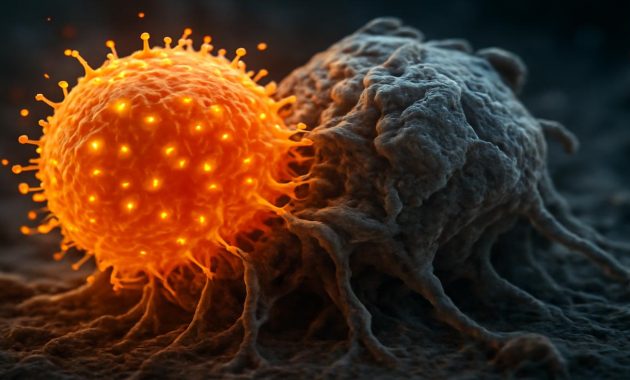
You don’t feel them when you wake up in the morning. You don’t hear them, or taste them, or sense them moving through you. But all day long, an invisible army drifts quietly through your veins, combing through the shadows of your body like rangers on patrol in a thick forest. They pause, they scan, they decide: friend, or foe. These are your T cells—tiny, disciplined hunters—and for the most part, they do their job so seamlessly that you never know how close you came to trouble.
When the Forest Grows Quiet
Imagine your body as a vast, living landscape. Rivers of blood carve through valleys of soft tissue; mountain ranges of bone hold everything up; forests of branching nerves carry messages like birdsong from one edge to the other. In that landscape, trouble rarely arrives all at once. It starts small—one restless cell forgetting the rules, deciding it won’t stop dividing when it should. Then another. And another.
Normally, T cells are there to catch this misbehavior. They’re trained, from the chaos of the bone marrow and the discipline of the thymus, to recognize the subtle signals that say: this cell is not right. They glide past healthy cells like hikers passing trees, but stop short when something looks off, like a strange fungus on a trunk—a mutated protein, a warped surface marker, a sign of danger.
But cancer doesn’t just grow. It learns to hide.
Over time, a tumor becomes less like a single intruder and more like a clearing in the forest that’s been taken over: the ground softens, the air thickens, the light goes dim. The tumor sends chemical whispers into the surrounding space, rewiring it into a safe zone where T cells wander in and simply… slow down. They grow tired. They stop attacking. They fall asleep on their feet.
To an oncologist, this isn’t just a metaphor; it’s a problem with a name: T cell exhaustion. To a patient, it can feel like the quiet dread of hearing that the tumor has stopped responding to treatment—that the medicines that once worked wonders have run out of magic.
But what if there were a way to wake those T cells back up?
The Quiet Switch Hidden on T Cells
In a laboratory that smells faintly of ethanol and coffee, where incubators hum softly like beehives and fluorescent lights turn petri dishes into pale moonscapes, a team of researchers recently watched a set of cells on a glowing screen and wondered if they were seeing a new way forward.
They knew, as many immunologists do, that T cells carry a host of molecular “switches” on their surfaces and inside their cytoplasm—tiny control panels that tell them when to activate, when to stand down, when to multiply, when to die. Some of these switches are famous now, like PD-1 and CTLA-4, the so-called “brakes” that cancer exploits to shut T cells down. Block those brakes with drugs—immune checkpoint inhibitors—and you can sometimes unleash the immune system with astonishing force.
But not all patients respond. Not all cancers surrender. The forest learns new tricks.
So this team went hunting for lesser-known controls: deeper dials, more subtle toggles hidden in the wiring of T cells themselves. Through painstaking experiments—altering genes, tracking signals, exposing cells to simulated tumor environments—they began to home in on a curious pattern. A particular intracellular pathway, once dismissed as background noise, seemed to be acting like a master sleep button.
In exhausted T cells, this pathway wasn’t just active—it was humming at full volume. Flip it one way, and the cells calmed, their energy sputtering out. Flip it another, and something remarkable happened: T cells that had been sluggish, unresponsive, almost ghost-like in their behavior suddenly stirred. Their inner engines roared back to life.
This wasn’t about simply stepping on the gas. It was about finding the right ignition key.
Flipping the Wake-Up Switch
At first, the researchers tested their idea in dishes—controlled, sterile worlds where T cells and cancer cells mingled in transparent arenas. They watched under the microscope as T cells, once listless and hesitant, began to stretch out probing arms again, to latch onto their targets with renewed purpose.
What they had discovered—simplified for all of us who don’t live inside pipette tips—was a new way to “wake up” cancer-killing T cells by modulating a previously underappreciated signaling route. Instead of just taking the brakes off, as existing therapies do, this approach nudged the cells’ internal metabolism and alertness states back into high gear. It was like splashing cold water on the face of a soldier who’d been lulled into a daze at the edge of a battlefield.
When the team moved into animal models, the landscape changed from flat glass to living tissue. Mice implanted with tumors received T cells that had been tuned using this new method. Inside those small, warm bodies, the forest stirred.
The awakened T cells didn’t just attack blindly. They seemed more focused, more durable, better able to survive in the harsh, low-oxygen, nutrient-poor environment of the tumor. Instead of falling into exhaustion, they adapted. They remembered their mission.
Tumors that had previously shrugged off immune attacks began to shrink. Not in every mouse, not in every trial—but enough to turn cautious curiosity in the lab into a quiet, trembling hope.
Learning to Listen to T Cells
One of the most intriguing parts of this new discovery isn’t just that we can wake T cells up—it’s that we’re starting to understand their language better.
For years, scientists have looked at immune cells through the lens of on and off, attack and stand down. But exhausted T cells are not simply broken; they’re changed. They carry scars of their long battles with cancer—altered genes, shifted metabolic pathways, different patterns of surface receptors. They are, in a way, veterans of a long war, tired but not useless.
The new research suggests that exhaustion might be more reversible than we thought—at least in part. Rather than discarding these cells and hoping new recruits will do better, we may be able to rehabilitate them, restore them, reawaken them with more precision.
And precision matters, because the immune system is not a tame beast. If you push too hard—if you wake everything at once—you risk it turning on the body it’s meant to guard, causing autoimmune storms that leave rashes, inflamed organs, or worse in their wake. Immunotherapy’s greatest victories have always walked hand-in-hand with its greatest risks.
This new approach doesn’t just slam the accelerator; it subtly tunes the engine, trying to give T cells more stamina without spinning them out of control.
The Tumor as a Dark, Clever Ecosystem
To really understand why this discovery matters, it helps to picture the tumor not as a lump, but as an ecosystem.
Step inside, if only in your mind. Picture a dense, crowded thicket of cells, packed so tightly that oxygen struggles to drift between them. Nutrients are hoarded. Waste products accumulate. The chemistry here is different than in the open, bright spaces of healthy tissue. It’s sour, stressed, tense.
Now, add to that tangle the non-cancer cells that tumors draft into their service: fibroblasts that build scaffolding around them like fortifications; blood vessels rerouted and twisted to feed them; immune cells that have been bribed or bullied into silence, secreting soothing, suppressive signals instead of alarms.
For a T cell, this is not neutral ground. It’s enemy territory.
Every step deeper into this zone drains its strength. Signals that once said “danger here” are blurred by decoy messages that whisper “stand down, nothing to see.” Nutrients it needs for fuel are scarce. Even the acidic, low-oxygen air works against its inner machinery, nudging it further toward sleep.
The new wake-up strategy doesn’t magically erase this environment. But it gives the T cell better boots, better lungs, a clearer head. By adjusting key internal pathways, the cell can keep its energy flowing even when glucose is low, maintain its alert state despite the chemical lullabies being sung all around it, and resist the slide into permanent exhaustion.
In a sense, the researchers have found a way to teach T cells how to move and fight in the dark.
How This Differs from Existing Immunotherapies
Immunotherapy isn’t new anymore. In cancer centers around the world, oncologists already prescribe checkpoint inhibitors, CAR-T cell treatments, and monoclonal antibodies designed to help the immune system recognize and destroy tumors.
But each of these approaches has limits.
- Checkpoint inhibitors work best when there’s already a robust T cell presence near the tumor—when the army is at the gate but stuck behind red tape.
- CAR-T cells, engineered outside the body and reinfused, have had dazzling success in some blood cancers but far more limited impact in solid tumors, where that harsh tumor ecosystem wears them down.
- Vaccines that teach the immune system to see cancer as foreign can spark a response, but not always a sustained one.
The new wake-up strategy slots into this landscape not as a replacement, but as a potential amplifier. Instead of being the hero that does it all, it could become the quiet assistant that makes other therapies work better:
- Paired with checkpoint inhibitors, awakened T cells might sustain their attack longer.
- Combined with CAR-T therapies, it could help those engineered cells survive inside tough solid tumors.
- Used alongside cancer vaccines, it might keep newly trained T cells from fading into exhaustion too soon.
It’s less about inventing a whole new army and more about reminding the one you already have of what it’s capable of.
From Lab Bench to Bedside: The Long Road
Of course, the path from a glowing petri dish in a lab to a human sitting in a clinic chair is long, and not all discoveries make it intact to the other side.
First come more animal studies, more repetitions, more attempts to poke holes in the early optimism. Can this wake-up method be delivered safely? Does it require tinkering with genes, or can it be done with drugs that nudge T cells from the outside? How long do the effects last? Does waking up exhausted T cells in one part of the body have consequences in another?
Then, if it passes those tests, early human trials begin—small groups of volunteers, often patients who have run out of standard options, stepping forward into the unknown. In the sterile peace of a trial room, with an IV line taped gently to their arm, someone might one day receive the first human dose of a therapy built on this discovery.
Doctors will watch closely—not just the tumor scans, but the blood work, the immune markers, the quiet, subjective experience of the person in the chair. Do they feel different? Do the fevers that sometimes accompany immune reawakening flare? Does their body accept this new tuning of its defenses?
Science is patient. Cancer rarely is. Between the two, patients live in a tense middle space where hope and realism have to coexist, sharing the same narrow bench.
A Glimpse at What Might Be Possible
For now, much of this work still lives in the realm of preclinical promise. But even at this stage, it invites a kind of reimagining.
For decades, cancer treatment leaned heavily on the strategy of destruction: cut, burn, poison. Surgery, radiation, chemotherapy. These approaches have saved and extended countless lives—but they also came with collateral damage, like controlled burns in a forest that sometimes scar the land as deeply as the fire they’re meant to stop.
Immunotherapy shifted the story. It suggested that instead of endlessly inventing new external weapons, we could sharpen the ones built into us. This new way to wake up T cells is another step down that path. It’s gentler in concept, not because cancer is gentle, but because the body itself is complex and worth working with instead of simply working upon.
If it succeeds, it may help turn some cancers from fatal ambushes into chronic skirmishes the body is better able to handle—more like an ongoing, manageable tension in the forest than a wildfire racing out of control.
Seeing Ourselves as Living Defenses
It’s easy, in the thick of medical jargon and molecular diagrams, to forget what’s really at stake: the quietly astonishing fact that your body is not just a victim of disease, but a participant in its own defense.
The discovery of a new way to wake up cancer-killing T cells is, on one level, a technical advance in immunology. On another, it’s a reminder of how much of our survival depends on conversations happening just below the threshold of our awareness: cells talking to cells, proteins greeting proteins, signals flaring and fading in complex symphonies we rarely get to hear.
Every time a researcher uncovers a new switch or pathway, they’re not just finding a therapeutic target. They’re learning a few more words of a language our bodies have been speaking for millions of years.
And maybe that’s the real heart of this story: not that scientists have found a way to bully T cells into action, but that they’ve learned, however imperfectly, how to nudge them awake with more finesse. Less shouting, more listening.
In the end, healing often looks like that—a slow alignment between what we can do from the outside and what the body can do from within. A quieter kind of power.
A Simple Snapshot of What’s Changing
To bring it all into focus, it helps to line up where we’ve been and where this might lead:
| Aspect | Traditional View | With T Cell Wake-Up Approach |
|---|---|---|
| Role of T Cells | Either active fighters or permanently exhausted | Exhaustion seen as partly reversible, with a chance for revival |
| Tumor Environment | Overwhelmingly suppressive, often shutting down immune attacks | Harsh, but more navigable for re-energized T cells |
| Immunotherapy Goal | Remove immune brakes or add new engineered cells | Fine-tune internal T cell pathways to restore stamina and focus |
| Potential Use | Standalone treatments, often with variable response | Combination partner to boost and prolong other therapies |
| Long-Term Vision | Fight each new cancer with new external tools | Empower the body’s own defenses to adapt and endure |
Questions We’re Still Learning to Answer
As with all promising research, the most honest stance is both hopeful and careful. This new way to wake up cancer-killing T cells is not a miracle cure—not yet, and maybe never in the way headlines sometimes suggest. But it is another crack of light in a wall that, for centuries, felt impenetrable.
Somewhere, right now, in a quiet lab or a bustling research hospital, someone is running yet another experiment on these pathways—adjusting dosages, testing combinations, peering at graphs that represent not just data points, but future patients.
The forest is still dense. The enemy is still clever. But the rangers are stirring.
Frequently Asked Questions
What exactly are T cells?
T cells are a type of white blood cell that play a central role in your immune system. Some T cells act like scouts, identifying potential threats, while others act like assassins, directly killing infected or cancerous cells. They constantly patrol your body, checking other cells for signs of danger.
What does it mean to “wake up” cancer-killing T cells?
“Waking up” T cells means reversing or easing their exhausted state so they can recognize and attack cancer cells more effectively. Instead of being sluggish and unresponsive inside a tumor, awakened T cells regain energy, focus, and killing power.
How is this different from current immunotherapy drugs?
Many current immunotherapies remove external “brakes” on T cells (like PD-1 or CTLA-4). The new approach focuses more on the internal machinery of T cells—tuning their signaling and metabolism—so they can stay active and resilient in the harsh tumor environment.
Is this treatment available to patients now?
At this stage, the approach is largely in preclinical or early research phases. That means it’s not yet widely available as a standard treatment. If it continues to show promise, it would move into human clinical trials, a process that typically takes years.
Could waking up T cells cause side effects?
Any therapy that boosts immune activity has the potential to cause side effects, including inflammation or autoimmune reactions, where the immune system mistakenly attacks healthy tissue. One goal of this research is to find ways to re-energize T cells with as much precision and safety as possible.
Will this replace chemotherapy or radiation?
It’s unlikely to completely replace existing treatments in the near future. More realistically, it could join them as part of combination therapies, helping immunotherapies work better or extending their effects, while other treatments tackle the tumor from different angles.
What types of cancer might benefit most?
Cancers that create especially suppressive tumor environments—such as certain lung, liver, pancreatic, and solid tumors in general—might benefit, because these are settings where T cell exhaustion is a major obstacle. However, specific benefits will only become clear through detailed studies and clinical trials.
What can patients do now while this research develops?
Patients can talk with their medical team about current immunotherapy options and ongoing clinical trials that might be appropriate. Staying informed, seeking second opinions when needed, and connecting with support networks can all make a meaningful difference while emerging therapies like this one continue to move from idea to reality.