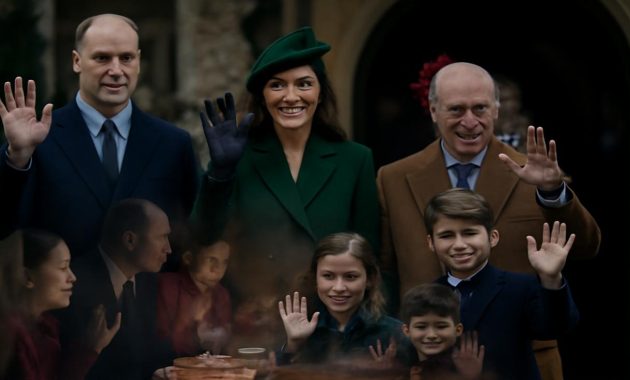
The air at Sandringham tastes like frost and woodsmoke, the kind of winter cold that nips at your fingertips no matter how tightly you curl them in your gloves. On Christmas morning, the long drive that cuts through the Norfolk estate fills slowly with people—families juggling flasks of coffee, camera phones, and excited children who have been coaxed from their own living rooms and roast potatoes to stand and stare at another family’s Christmas ritual.
They’re not just any family, of course. They are the family—Britain’s Royal Family, stepping into their annual performance with the steady rhythm of carols, church bells, and shutter clicks. Year after year, they walk the same route to St Mary Magdalene Church as if the gravel remembers their soles. And year after year, the question hangs heavier in the cold: what does it mean for this carefully choreographed Christmas tableau to continue, unchanged, in a world that’s changing faster than ever?
The Frost, the Cameras, and the Choreography
The first thing you notice isn’t the royals themselves. It’s the murmur that rolls along the waiting crowd, a low tide of conversation and speculation. A whistle of breath when the first dark sedan glides into view. The creak of someone shifting their weight, the click of a thermos lid, and then—suddenly—the sharp, mechanical buzz of cameras waking up like startled insects.
They emerge from the cars in a kind of slow-motion ballet: coats perfectly tailored, hats angled just so, scarves lying flat with an almost mathematical precision. The King, with that mixture of familiar stoop and determined stride; the Queen, radiating the kind of unflappable composure that looks almost unreal against the chapped faces in the crowd. Behind them, younger generations filter out: polished boots, long coats, a curated splash of seasonal color here and there. Burgundy, forest green, that unmistakable royal blue that seems to glow even under a pewter sky.
Their breath puffs out in pale clouds, visible in the cold morning, but their expressions are strictly controlled—warm but not too informal, gracious but not too familiar. A few waves, a handful of brief greetings, heads slightly inclined as if to let the awe of the moment roll right over them without leaving so much as a fingerprint.
There’s a strange silence inside the noise. You can feel it as they walk past, this thin membrane between the spectacle and the sentiment it’s supposed to represent. A Christmas Day church service, the story goes, is about faith, reflection, humility. Yet here, on this carefully managed strip of gravel, it’s just as much about optics and expectation. A Christmas liturgy rewritten as a photo call.
The Façade That Never Cracks (At Least Not in Public)
From the outside, the Sandringham Christmas is a masterpiece of continuity. In a world where nearly everything feels up for debate, this is one of the rituals that never seems to flinch. The Royal Family arrives, attends church, greets the vicar, exchanges a few seasonal phrases, then disappears back into the estate’s red-brick seclusion to carve turkeys, open presents, and conduct whatever carefully private conversations royalty allows itself.
It is, by design, a façade that doesn’t crack.
Every aspect of the day fits the story: togetherness, Christian tradition, a monarch in touch with both heritage and people. But as the cameras pan from the King to his heirs, from the Queen’s brooch to the cut of a princess’s coat, the contradiction grows louder. The family framed as a national symbol of unity is also the family at the center of some of the sharpest public divisions in recent British history.
The holiday smiles do an impressive job of glossing over it. No one expects a doorstep confessional. No one imagines a royal stepping up to the crowd and saying, “Today we’ll talk honestly about power, privilege, and pain.” Sandringham is where tension gets smoothed into ritual. Where the sharp edges of scandal and family conflict are tucked neatly beneath velvet lapels and feathered hats.
Christmas, in most households, is when resentments bubble up around the dinner table. At Sandringham, they’re barely even allowed to exist in public imagination. Instead, the ritual continues, as if nothing ever changes—even as so much does.
Royal Christmas, Real World
Not far from the estate gates, the rest of the country has its own Christmas morning. Boilers cough in chilly kitchens. Someone burns the parsnips. Someone else prays the electricity meter holds out. A student stares at their phone, trying not to think about the loan payment reminder that will arrive before New Year. Across the country, food banks stretch themselves thin so that some version of festive dinner can happen for the families who need it most.
Then there’s Sandringham: gates, grounds, wealth layered over the landscape so thickly that even the frost seems more ornamental than threatening. The distance between those worlds is not just geographic; it’s emotional, ethical, existential.
And yet, the images beam out anyway—onto television screens, news feeds, phones that may have cracked screens but still find room for royal coverage. For some, the ritual is comforting: proof that some thread of national identity is still holding fast. For others, it’s a reminder of a hierarchy that feels increasingly out of step with any honest idea of fairness.
The optics sharpen the contradiction. A family that speaks publicly of service, duty, and responsibility parades its privilege in the language of normality. “Just like any other family,” the captions sometimes suggest, as if everyone’s grandparents own a sprawling estate and a private chapel, as if everyone’s Christmas Day walk is monitored by global media.
Hypocrisy, or Something More Complicated?
The word that keeps circling around these scenes—whispered in opinion columns, shouted on social feeds, muttered in living rooms—is “hypocrite.” How can you stand in front of a church that preaches humility and love for the poor while inhabiting a system built on inherited wealth, colonial history, and deference? How do you talk of togetherness with your own family fractures so glaringly exposed to the world?
But hypocrisy here is more than individual. It’s structural. It lives not just in the smiles of the royals but in the lenses trained on them, the editors choosing the front-page image, the viewers who condemn and click in the same gesture. The Royal Family’s Christmas is a mirror, and what it reflects isn’t only them; it’s us—the appetite for tradition, the craving for spectacle, the muddled desire to both dismantle and preserve the things we’ve been taught to revere.
There’s a kind of double-think at work. Many people roll their eyes at the monarchy, but still tune in to see what the princess wore. They critique the institution but share the photographs. They question the legitimacy but defend the sentimental value. And the palace, knowingly, walks that line, offering just enough access to keep the world watching while maintaining a moat of opaqueness around what really matters: power, money, accountability, truth.
In that sense, calling the Royal Family alone hypocritical can be too easy. The entire spectacle rests on a network of complicity. Governments rely on royal symbolism when it suits them. Media builds traffic and profits around the seasonal rituals. And the public keeps showing up—physically at Sandringham, digitally on every device—with a curiosity that keeps the façade alive.
Silence Between the Carols
Inside St Mary Magdalene, the service unfolds with comforting predictability. Carols feel like muscle memory, even if you only sing them once a year. The vicar’s words float up into the rafters, mingling with incense and the faint sweetness of pine from the greenery. Light glows through stained glass in a muted winter palette, all soft reds and blues and golds. Kneelers, hymn books, the familiar choreography of stand, sit, sing, pray.
Somewhere in those words are themes of justice, humility, forgiveness, compassion for the marginalized. Lines about the mighty being brought low, the hungry being fed, the last being first. The kind of wild, disruptive theology that, if taken seriously, would blow a crater straight through the polished floor of institutional monarchy.
But the message softens once it filters through centuries of ritual and power. It becomes tradition, culture, continuity. The Christmas sermon is absorbed into a pageant where everyone knows their role—church, crown, camera operator, spectator.
The silence in the gaps between carols hums with everything that isn’t said. No mention of palace briefings or family estrangements, the invisible rifts between those who walk in step and those who have chosen, or been pushed, to the outside. No open acknowledgment of the questions that swirl around the institution’s past and present. On Christmas morning at Sandringham, the story is curated, boxed, and tied with a ribbon of respectability.
Once the service ends, they emerge again into that waiting sea of faces. The smiles haven’t slipped. The pace hasn’t changed. A small wave. A nod. A carefully judged phrase: “Merry Christmas, thank you for coming.” They walk back through the cold, the stones crunching underfoot, and the cameras soak up every second like thirsty soil.
Public Devotion, Private Fractures
There’s an old saying that every family has its secrets; the only difference with this family is that their secrets become headlines. Over the past years, the glossy façade has shown its cracks—allegations, accusations, interviews that feel less like confession and more like detonation. The carefully managed narrative has had to coexist with competing stories told from the margins.
And yet here they all are (or at least those still within the fold), walking shoulder to shoulder down a Norfolk path as though everything is in hand. It’s this dissonance that many people can’t swallow. The public posture of unity contrasted with private histories of pain, silence, and unresolved hurt.
Is it hypocrisy to perform harmony when fracture exists? Or is it simply the only language monarchy knows—control the image, and you might still control the institution? Either way, the Sandringham Christmas becomes less a family moment and more a kind of theatre. The roles are familiar: the steady patriarch, the supportive consort, the dignified elders, the photogenic heirs. Missing characters are written out silently, their absence explained with phrases like “not attending” or “spending Christmas elsewhere.”
It’s here, in this studied normality, that the hypocrisy feels sharpest. Not in the idea that a wealthy family goes to church—that’s hardly shocking—but in the insistence that this is somehow emblematic of the nation, of the people, of values shared across class, race, and circumstance. The collective pretense that this particular Christmas walk is about unity, when so much of its power relies on separation.
What We See, What We Don’t
Between the official photographs and the broadcast clips, the day can look seamless—a snow globe of tradition you can shake and watch as the glitter settles softly over royalty in tasteful winter coats. But underneath the imagery, there’s always a more complicated ledger of what’s being shown and what’s being hidden.
| What We See | What We Don’t See |
|---|---|
| Elegant coats, hats, and coordinated outfits | The staff, planning, and resources behind every “effortless” appearance |
| Smiles, waves, quick greetings | Private tensions, disagreements, and emotional fallout |
| A family attending Christmas church “like everyone else” | Security details, controlled access, and layers of privilege |
| Public language of duty, service, and tradition | Unanswered questions about power, money, and accountability |
| A comforting image of stability | The cost—financial, emotional, and cultural—of preserving that image |
The table might as well be printed on the back of every photo from the day. For each frame, there’s a negative we’re not meant to develop. The elegance is not accidental; it’s crafted. The normality is not organic; it’s curated. And still, there’s something magnetic in the scene. Even critics can find themselves pausing, scrolling back, looking a little longer than they planned.
Maybe that’s part of the unease: realizing that you’re drawn to something you also question. That the very spectacle you analyze is the spectacle you keep consuming. Somewhere between fascination and frustration, the Sandringham Christmas persists, too entrenched to vanish, too scrutinized to remain unchallenged.
A Country Between Traditions
Britain itself feels caught between stories. On one side, the comforting myth of continuity: that some things, like monarchs and Christmas carols, never really change. On the other, a rising insistence that we look honestly at history, privilege, and structures that benefit the few over the many.
The Royal Family walking to church is a distilled image of that tension. It reassures those who want to believe that the old symbols still mean what they once did—or what we were told they did. It infuriates those for whom those symbols now feel hollow or actively harmful. For many, it simply washes over them like noise: another seasonal broadcast, another carousel of photographs that will be replaced in a day or two by something else.
Yet the question lingers: can an institution built on hierarchy convincingly play the role of national conscience and comfort at a time when inequality is a defining feature of life? Can a family that guards its own privacy so jealously claim moral authority over a public grappling with transparency, consent, and accountability?
On Christmas morning at Sandringham, these questions don’t get asked out loud. But you can feel them in the gaze of someone in the crowd who isn’t smiling, who is watching not with adoration but with wary curiosity. You can feel it in the commentary that surfaces online minutes after the first images do. And you can sense, faintly, that the institution itself knows the performance is under more scrutiny than ever.
The Walk Back, the World Ahead
As the service ends and the family makes the journey back along the gravel path, the light has shifted slightly. The frost is loosening its grip; patches of grass show through, damp and dark. The crowd begins to thin. A child is hoisted onto a parent’s shoulders for one last look. Someone checks their watch, already thinking about lunch. A journalist hurries to file their copy before the images go stale.
The royals disappear back into Sandringham House, where Christmas resumes behind thick walls and heavy curtains. The cameras are left outside. The narrative thins out. No one films the moment when shoes are kicked off, ties loosened, voices drop an octave. We imagine it—because imagining is all we’re allowed.
Maybe there are laughs. Maybe there are tense pauses. Maybe certain topics are studiously avoided over lunch. Maybe a joke lands wrong and hangs in the air longer than expected. It would almost be a relief to know that, beyond the façade, they are deeply, recognizably human. Flawed. Vulnerable. Inconsistent. Capable of growth as well as denial.
Instead, the public is left with the polished version: the Christmas walk, the church steps, the carols, the coats, the curated warmth. A ritual that both comforts and provokes, that reassures and repels, that invites affection while bristling at real accountability.
Is it hypocritical? In many ways, yes. A system that preaches service while built on service to it. A family that embodies privilege yet speaks the language of common feeling. A Christmas performance that leans heavily on religious imagery but rarely entertains the radical implications of the faith it displays.
But the hypocrisy isn’t contained neatly within those red-brick walls. It spills out into the crowd at the gate, into the editors choosing the most flattering angles, into a culture that both resents and romanticizes the crown. If Sandringham at Christmas is a façade, it’s one that stands because so many hands—seen and unseen—keep shoring it up.
The day winds down. The light fades. Somewhere, the final dishes are stacked in a royal kitchen while washing-up liquid fizzes in a plastic basin in an ordinary flat. A child in a tower block stages their own solemn parade with toy figures across a patterned carpet. A pensioner watches the evening news, where the same few seconds of royal footage play on a loop.
Beyond the spectacle, the country carries on with its messy, unequal, resilient life. And next year, unless something truly seismic happens, the same walk at Sandringham will happen again, the same cameras will be waiting, the same conflicting feelings will rise.
Maybe, in time, the façade will crack in ways that can’t be smoothed over. Or maybe it will adapt, as it always has, cloaking itself in new language while preserving familiar power. Until then, the Christmas ritual remains: a picture-perfect scene that asks us not only what we think of the Royal Family, but what we’re willing to accept, excuse, or ignore in the name of tradition.
Frequently Asked Questions
Why does the Royal Family attend Christmas Day service at Sandringham?
The Royal Family’s Christmas Day service at St Mary Magdalene Church on the Sandringham Estate is a long-standing tradition. It combines personal religious observance with a public display of continuity and stability. The event also functions as a symbolic gesture of connection with the nation, even though it’s tightly choreographed and carefully managed.
Is the Christmas service at Sandringham open to the public?
The church service itself is not open to the general public, but people are allowed to gather along the route outside the church and near the estate’s entrance. They can watch the family arrive and leave, sometimes briefly interacting with them, though access is controlled and heavily policed for security reasons.
Why do some people call the Royal Family hypocritical for this ritual?
Critics use the word “hypocritical” because the imagery of humility, faith, and togetherness at Christmas clashes with the realities of inherited privilege, wealth, and unresolved controversies around the monarchy. The contrast between public messaging about service and the private protections of power, money, and reputation fuels that perception.
Do the royals have a “normal” Christmas behind closed doors?
Reports from insiders suggest that, once the public elements are over, the family follows a fairly private and structured celebration—gift exchanges, meals, board games, and traditions passed down over generations. However, “normal” is relative; everything happens within the context of great wealth, protocol, and public scrutiny, even when the cameras are gone.
Will the Sandringham Christmas tradition change in the future?
It may evolve, but traditions like this tend to change slowly. Public pressure, shifting attitudes toward the monarchy, and internal family dynamics could all shape how visible or formal the ritual remains. For now, it continues because it still serves a purpose: projecting an image of continuity at a time when much else feels uncertain.