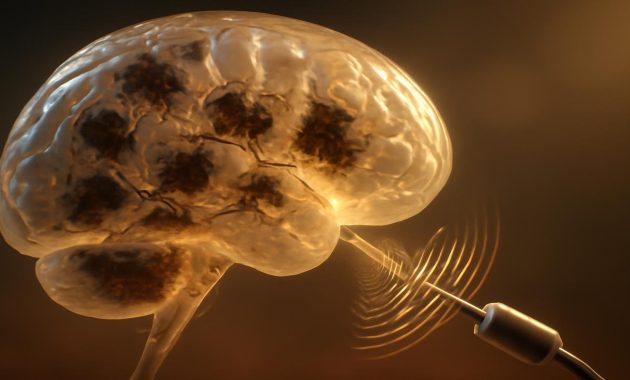
The room is almost completely dark, except for the soft glow of a monitor and the gentle pulse of a blue light. A mouse sits quietly in a clear enclosure, its tiny chest rising and falling. Then, almost imperceptibly at first, a tone begins to hum in the air—40 gentle pulses every second. The sound is not loud, not harsh. It hangs there like a distant, steady cricket chorus. Scientists lean in toward the glass, watching. Somewhere deep inside the mouse’s brain, something extraordinary may be starting to happen: a cleaning crew of cells awakening to sweep away the toxic debris of Alzheimer’s disease.
When the Brain Listens: A New Kind of Treatment
We usually think of medicine as something we swallow, inject, or surgically implant. Pills, infusions, scalpels. But what if one of the most promising tools against one of our most feared diseases turns out to be something as simple—and as ancient—as sound?
In a series of breakthrough studies over the past few years, researchers have discovered that carefully tuned sensory stimulation—especially sound at specific rhythms—may help the brain clear out amyloid plaques and other hallmarks of Alzheimer’s disease. Not through chemicals or cutting-edge gene therapy, but through rhythm. Through vibration. Through the way neurons love to fire together in time.
At the center of this emerging story is a particular rhythm: 40 hertz. That’s 40 pulses every second, a low, thrum-like flicker that sits at the edge of human hearing and within the brain’s natural gamma frequency band. Gamma waves have long been associated with focused attention, memory, and the synchronized conversation between different brain regions. In Alzheimer’s, those gamma rhythms fade, as if the orchestra of the mind has lost its conductor.
Scientists wondered: if we could restore those gamma rhythms from the outside—by using flickering lights, or pulsing sounds, or both—could we coax the brain into cleaning itself up?
The Mouse Room That Changed Everything
It started, as so many scientific turning points do, with a curious observation in the lab. Researchers working with Alzheimer’s mouse models had been studying how brain waves change as the disease progresses. These mice carry genes that make them develop amyloid plaques and memory problems similar to human Alzheimer’s. When scientists recorded their brain activity, they saw that gamma oscillations were weakened and disrupted.
What if, they wondered, we could drive gamma from the outside?
They began with vision. They exposed the mice to a light that flickered at 40 hertz—on, off, on, off—like a robotic firefly trapped in a strobe. After an hour a day of this light for several days, the researchers looked at the mice’s brains. The amyloid plaques in the visual cortex, the brain’s center for processing sight, had shrunk. Microglia—the brain’s resident immune cells—had awoken, extended their spindly arms, and begun devouring the toxic proteins.
It was astonishing, but also strangely specific. The effect appeared mainly in brain regions tied to visual processing. That sparked the next question: could sound “reach” deeper?
The Surprising Power of 40-Hz Sound
So the lights went off, and the speakers came on. This time the mice were bathed in a 40-hertz clicking or buzzing sound—like a quiet, perfectly even metronome tick. For an hour a day, for a week, the mice listened.
When the researchers examined the animals’ brains afterward, they found that something remarkable had happened again. This time, the changes were strongest in the auditory cortex and the hippocampus—the brain’s memory hub, a region ravaged early and relentlessly by Alzheimer’s disease. Amyloid plaques there had diminished. Blood vessels showed less clogging. Microglia had shifted from a drowsy, inactive state into a more alert, housekeeping mode.
Even more intriguing, the effect seemed to ripple out. It wasn’t just the primary sound-processing area that was affected; nearby regions involved in learning and memory also showed benefits, as if the sound had synchronized a network rather than just a single spot.
The mice also behaved differently. In maze tests and memory tasks, they navigated more confidently and remembered locations with more accuracy. Their brain rhythms, once chaotic and dulled, now showed stronger gamma patterns—like the soft return of a melody they’d almost forgotten.
To map this more clearly, you can think of it this way:
| Stimulation Type | Frequency Used | Main Brain Areas Affected | Observed Effects in Mice |
|---|---|---|---|
| Flickering Light | 40 Hz (gamma range) | Visual cortex | Reduced amyloid plaques; activated microglia |
| Sound Stimulation | 40 Hz (audible clicking/buzzing) | Auditory cortex, hippocampus | Reduced plaques and tangles; improved memory tasks |
| Combined Light + Sound | 40 Hz in both senses | Multiple connected networks | Broader brain engagement; stronger gamma rhythms |
To the scientists in that dark little room, it felt like a door had opened onto a new hallway: perhaps the brain could be nudged, gently but powerfully, simply by giving it a rhythm to follow.
How Rhythm Turns on the Brain’s Cleaning Crew
It sounds almost mystical: play a specific sound, and the brain begins to heal itself. But underneath the poetry is biology—messy, electric, molecular biology.
Inside your brain, billions of neurons are constantly firing small electrical impulses. They do this not randomly, but in coordinated waves. Some waves are slow and dreamy, like the deep, rolling delta waves of sleep. Others are fast and tight, like the chattering gamma waves that sweep through the cortex when you’re paying attention or trying to remember something.
In Alzheimer’s disease, many of those gamma waves weaken or vanish. The communication between cells becomes noisy, out of sync. Think of a crowded room where everyone used to speak in coordinated turns, and suddenly everyone is mumbling at different volumes and tempos. The message gets lost.
Microglia: The Forest Keepers of the Brain
Living among those neurons, like quiet guardians, are microglia. They’re small, branched immune cells that patrol the brain, pruning excess connections, responding to injury, and—in theory—helping to clear away harmful proteins such as amyloid-beta and tau. But in Alzheimer’s, microglia often shift into an unhealthy state: either too aggressive, causing inflammation, or too passive, allowing debris to accumulate.
Gamma stimulation—whether through light or sound—appears to nudge microglia back toward their healthier, more vigilant role. In the mouse studies, 40-hertz sound increased the number of microglia that wrapped themselves around amyloid plaques, nibbling them down. It also seemed to improve blood flow and reduce leakage from tiny brain vessels, helping to stabilize the delicate environment in which neurons live.
It’s as if the entire ecosystem of the brain’s “forest” responds to a certain kind of song. When that song is missing, chaos creeps in—the underbrush tangles, unhealthy growths spread. When the song returns in the form of gamma rhythm, the forest keepers stir, straighten the pathways, and start to restore some order.
From Mouse Cages to Human Rooms
Of course, mice are not people. They live fast, short lives. Their brains are far simpler, their sense of time and memory radically different from ours. So the great, looming question has become: can any of this translate into actual help for human beings living with Alzheimer’s?
In recent pilot studies, volunteers with early-stage Alzheimer’s have sat in softly lit rooms while 40-hertz light flickered and 40-hertz sound pulsed around them. Not the uncomfortable strobe of a nightclub, but subtle, carefully controlled visual and auditory patterns. Participants typically receive these stimulations for an hour a day, over weeks or months, while researchers monitor brain activity, cognitive performance, and brain structure with imaging.
These first human studies are small and preliminary, but some early signs are intriguing. Participants have shown changes in brain connectivity, strengthening of certain networks, and slower brain atrophy in specific regions compared with control groups. Some have demonstrated stabilization or mild improvements in memory measures over short periods.
It is not a cure. It is not a miracle. But it might be a gentle hand on the wheel, nudging a drifting brain back toward a steadier lane—at least for a time.
The Human Side of the Experiment
Imagine sitting in such a room yourself. The chair is comfortable, the air slightly cool. You’re asked to relax, maybe keep your eyes gently open as the walls glow with a soft, rhythmic flicker. You hear a faint, almost mechanical beat—tick tick tick tick—so fast that it turns into a low hum. Perhaps it becomes background quickly, like rain on a distant roof. You feel nothing dramatic. No buzz, no jolt. Just time passing.
But inside your skull, neurons are synchronizing. The 40-hertz pattern of light and sound is like a metronome set at exactly the tempo your gamma waves prefer. Cells that had fallen out of step begin to fire together again. Microglia shift, as if hearing a call to attention. Blood vessels subtly constrict and widen in new rhythms, shuttling nutrients and waste with improved coordination.
After a session, you stand up, maybe a little stiff from sitting, maybe a little skeptical. You don’t suddenly remember every name you’ve lost. You still misplace your keys. The weight of the diagnosis still sits in your chest. Yet somewhere in the data—on the scans, in the waveforms, in the quiet comparisons to last month’s numbers—scientists may see tiny movements: plaques a bit smaller, atrophy a bit slower, networks a bit stronger.
Hope, Hype, and Honest Uncertainty
Any time a new approach to Alzheimer’s makes headlines, hope and skepticism collide. Families living with the disease are hungry—desperate—for progress. The idea that something as simple as sound or light could help can feel almost too good to be true. And the internet, as always, is ready to sell: sound machines, miracle-frequency playlists, DIY therapies.
This is where caution is essential. The research on 40-hertz stimulation is still in its early days. Most strong evidence of plaque clearing and cognitive benefits so far comes from animal studies. Human trials are ongoing, small, and tightly controlled. Scientists are still figuring out the best dose, duration, and combination of sensory inputs. They are also watching carefully for unintended consequences—overstimulation, headaches, sleep disruption, or subtle shifts in brain rhythms that might not be helpful.
What We Know—and Don’t Know—So Far
To keep the picture honest, it helps to lay out the landscape clearly:
- Promising Signals: In mice, 40-hertz visual and auditory stimulation reduces amyloid plaques and tau tangles, improves blood vessel health, and boosts memory performance. In early human studies, brain scans suggest improved network connectivity and slowed atrophy in some regions.
- Not a Standalone Cure: No study has shown that sound or light alone can stop Alzheimer’s, reverse years of damage, or restore full memory. At best, it may slow progression or support other therapies.
- Precision Matters: The exact frequency (40 Hz), pattern, timing, and intensity appear to be crucial. Random sounds or music, no matter how relaxing, are not the same as controlled gamma stimulation.
- Individual Differences: Not everyone’s brain responds the same way. Age, disease stage, genetics, and overall health all shape how well gamma entrainment might work.
- Still Experimental: Outside of clinical trials and regulated research devices, home setups are speculative and may not deliver the specific stimulation patterns used in studies.
The story, in other words, is still being written in real time. We are somewhere between the thrilling early chapters and the sober, clarifying middle of the book.
A New Way of Thinking About the Aging Brain
Even if sound-based stimulation turns out to be only modestly beneficial, this line of research is changing how scientists think about the brain and aging. For decades, treatments have focused almost exclusively on chemistry—creating drugs that attack proteins, block receptors, or adjust neurotransmitter levels. But the brain is not just a bag of molecules. It is also rhythm, timing, and pattern.
The discovery that you can nudge immune cells, blood vessels, and even gene expression by tapping into the brain’s favored frequencies suggests something profound: the brain’s own electrical language can be part of the therapy.
There is also something quietly beautiful about the idea that noninvasive, sensory experiences—light, sound, perhaps even touch—might become part of how we care for minds at risk. Not just as comfort or distraction, but as active, targeted treatments. Instead of rows of pills, imagine rooms designed like gentle observatories of the brain: soft chairs, warm lamps, soundscapes precisely tuned to awaken sleepy circuits.
In such a future, treatment might feel less like being “hooked up” and more like being invited into a carefully crafted environment that works with your senses instead of bypassing them.
Listening Forward
For now, the mouse in the dim lab room is still one of our main guides. The researchers still watch the tiny chest rise and fall as the soft, precise clicking hums around it. They still collect brain slices, run scans, pore over data. In the quiet between experiments, you can almost imagine the brain itself listening—testing this strange musical language we’re offering it.
Will we one day sit with our grandparents, parents, or partners in sound-and-light therapy rooms and know, with high confidence, that this is helping to clear away the dark clusters of Alzheimer’s from their brains? The answer is not here yet. Science moves in cautious steps, not leaps.
But the idea that a brain in trouble might be coaxed back toward health not only by molecules, but by rhythm and sensation, feels like a new kind of hope. It’s not flashy. It’s not magic. It is, in many ways, deeply natural—an echo of what brains have always done: listen, synchronize, respond.
Somewhere between the ticking of a 40-hertz tone and the soft rustle of microglia awakening, a different conversation with dementia is beginning. It sounds, for the first time in a long time, like possibility.
Frequently Asked Questions
Does sound stimulation really clear Alzheimer’s plaques in humans?
So far, strong plaque-clearing evidence comes from animal studies, especially mice. Early human research shows changes in brain activity and structure that suggest possible benefits, but clear, large-scale proof of plaque reduction in people is still being gathered in ongoing clinical trials.
What is special about 40-hertz sound?
Forty hertz sits in the brain’s gamma frequency band, which is linked to attention and memory. In Alzheimer’s models, 40-hertz visual and auditory stimulation can restore gamma rhythms and activate microglia, the brain’s cleanup cells, leading to reduced amyloid and tau in animal studies.
Can I use music or sound apps at home to get the same effect?
Not reliably. The research uses precisely controlled 40-hertz stimulation patterns, often with specialized devices. Regular music, white noise, or generic “brainwave” apps are unlikely to reproduce the exact conditions used in laboratory and clinical studies.
Is sound-based therapy safe?
In controlled studies, 40-hertz sound and light are generally well tolerated, though some people may experience mild discomfort such as headaches or eye strain with visual flicker. Long-term safety is still being evaluated. Anyone interested should only participate through regulated clinical trials or under professional guidance.
When might this become a standard treatment for Alzheimer’s?
It’s too early to say. Larger, longer human trials are needed to confirm benefits, determine who responds best, and define safe protocols. If results remain promising, sound and light stimulation may eventually be used alongside medications and lifestyle interventions as part of a broader treatment toolkit.