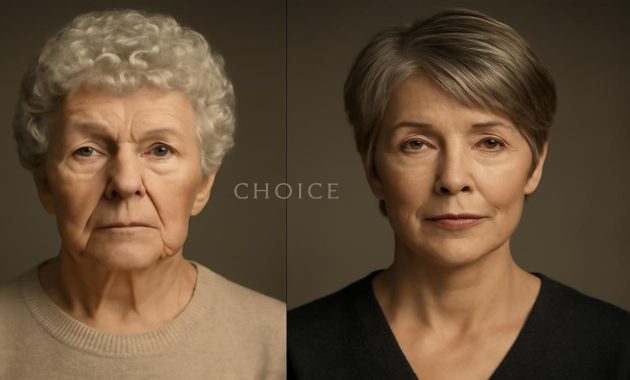
The morning she turned sixty-three, Marta stood in front of her bathroom mirror and realized that nothing in the reflection felt like her—except the eyes. The same deep, searching hazel she’d had at twenty. The same curiosity. But everything around them had softened, dulled, and… settled. Her hair—once a wild, wavy ink-black—hung in a tired, faded helmet. “The safe cut,” her old stylist had always called it. The “easy to manage” cut. The “you’re not twenty anymore” cut. That morning, the words landed differently. They sounded less like care and more like a quiet surrender. That was the day she booked the appointment that would shatter everything she thought she knew about “age-appropriate” hair—and what it really means to grow older on your own terms.
The Myth of the “Old Lady” Haircut
Walk into almost any salon on a weekday mid-morning and you’ll see a familiar scene: women in their late fifties, sixties, seventies, sliding into black capes, ready for the ritual trim. There’s a script that plays out, as reliable as rain in April.
“Just a little off the ends.”
“Same as last time.”
“Nothing too drastic, I’m too old for that now.”
The stylist nods. Out come the scissors. A few careful snips. A quick blow-dry that swirls into the same rounded, tidy shape—a puffed, curled-under bob, a helmet of short layers that never quite move, bangs that hide the forehead and half the expression. It’s functional. Polite. Invisible.
Ask most stylists privately, though, and they’ll tell you a secret: this “old lady” look is not some inevitable checkpoint on the road of aging. It’s a stylistic choice—often an accidental one—that can age you faster than the gray hairs ever could.
“There is no such thing as ‘age-appropriate hair,’” says one veteran stylist in her sixties who has chopped off more “helmet cuts” than she can count. “There is only ‘energy-appropriate hair.’ Does your hair reflect the life you’re living now—or the fear of leaving the life you used to have?”
The problem isn’t short hair. Short hair can be electric, elegant, even wild in the best way. The problem is when style freezes in time. When hair stops evolving, it quietly sends a message before you say a single word: I’ve stopped experimenting. I’ve stopped expecting surprise. I’ve decided I’m finished changing.
The Blunt Truth: Your Hair Is Telling on You
Hair carries stories. It remembers summer saltwater and office fluorescents, new babies and funeral days. But it also broadcasts something else—your relationship with risk and possibility. Stylists read it the way botanists read leaves.
They see the woman who clings to the same rounded bob she got at forty-five, even though her jawline has softened and her neck has thinned. They watch how she grips the armrest when they suggest a new shape or texture. They listen to the phrases: “What if it makes me look older?” “I don’t want people to think I’m trying too hard.” “My daughter says I should just keep it simple.”
But staying locked into a “safe” style doesn’t freeze time. It does the opposite—it speeds up the sense of aging. You can see it: the heavy volume all at the bottom, dragging the face down; the too-dark, single-tone color that looks flatter with each passing year; the eternally curled-under ends that form a stiff frame around the cheeks like a soft cage.
“When women hit sixty,” another stylist explains, “they often start designing their hair for everyone but themselves—for their kids, for their partner, for their imagined critics. The irony is, that’s when your hair could be the most powerful tool for showing exactly who you still are.”
The blunt truth? Keeping an “old lady” look is often less about what your hair can or can’t do—and more about how much of your own aliveness you’re willing to show. Aging is inevitable. But looking like you’ve stepped permanently into the background? That’s negotiable.
The One Cut That Exposes Everything
Stylists call it different things: a modern blunt bob, a sharp lob, a precision cut. But they talk about it with the same slight reverence, like a well-made knife or a favorite pair of boots. It’s clean, it’s honest, and it leaves nowhere to hide.
Imagine hair that grazes just at or slightly below the jawline, cut straight—blunt—at the ends. No rounded, bubble shape. No bulky layers trying to “soften” or “hide” anything. The weight sits at the bottom, but the line is crisp, almost architectural. It doesn’t flip under in a nervous curl. It falls—confident, intentional.
On gray or silver hair, this cut can be astonishing. The blunt ends catch the light; the natural variations of gray shimmer instead of looking dull. On fine hair, it suddenly looks thicker because there are no wispy, thinned-out tails. On curly or wavy hair, kept just a touch longer, the blunt shape skims across the shoulders, creating a modern, airy frame for the face.
Why does this one cut matter so much? Because a blunt, modern shape does something that scares many people: it shows your face, exactly as it is now.
No curling under to shelter the jawline. No helmet volume blooming over the ears. No feathery layers softening every angle into a blur. Just you—and the life that has etched itself into your features.
“Give a woman in her sixties a precise, blunt cut that truly suits her bone structure,” says one stylist, “and you will see in ten seconds whether she’s been styling for comfort—or for courage. The hair exposes it. You can’t hide in this cut. You can only inhabit it.”
That’s why this style has become a quiet revolution in salons that specialize in women over fifty: it doesn’t just refresh the hair. It reveals your attitude about aging—and sometimes rewrites it.
The Subtle Science of Looking “Alive,” Not “Younger”
Look closely at women whose hair feels ageless—those you’d describe as “striking” rather than “young for their age.” Their secret isn’t chasing youth; it’s amplifying vitality. Stylists talk less about looking younger and more about looking awake, present, lit from within.
Here’s where the conversation gets interesting: stylists argue that there are visual signals of aliveness we instinctively read in hair, no matter how old someone is. The magic isn’t in erasing years; it’s in amplifying these cues:
- Movement: Hair that sways, flips, or shifts when you turn your head signals energy. A stiff, sprayed-in-place style signals caution and retreat.
- Contrast: Slight depth at the roots, lighter around the face, or embracing natural silver with subtle lowlights creates dimension. Flat, uniform color can read as lifeless—even when the tone is “youthful.”
- Intentional edges: A clean edge at the ends, even if gently softened, reads like clarity. Ragged, over-layered or over-thinned hair suggests indecision and fatigue.
- Face framing: Pieces that skim the cheekbones or jawline draw the eye to expression, not age markers. Hair pulled too far back or puffed around the ears can leave the face isolated, overexposed, or oddly minimized.
The blunt bob—or its slightly longer sister, the lob—checks every one of these boxes when done well. Even the shortest version can move, swing, and fall back into shape with a simple shake of the head. It creates a strong line that says, “I am still making choices.” It doesn’t pretend you’re forty; it announces that sixty-plus can have just as much sharpness and wit.
Stylists will quietly confess that when a woman lets go of the default “old lady” cut and steps into a modern blunt shape, something curious happens. She often starts dressing differently. Her posture shifts. She experiments with lipstick again. It’s not that the haircut has magical powers; it’s that it serves as a daily, visible reminder that change is still an option.
Choosing Your Cut: A Stylist’s Honest Playbook
If you’re over sixty and feeling that tug—that sense that your hair might be telling an outdated story—you don’t have to march into the salon and demand a drastic chop. But you do need to come in differently: as a collaborator, not as a cautious passenger.
Stylists say the most transformative haircuts for women over sixty tend to fall into a few broad categories. None of them are about “acting younger.” All of them are about amplifying the life you’re actually living:
| Cut Style | Best For | Why It Works After 60 |
|---|---|---|
| Blunt Bob (jaw to collarbone) | Straight or lightly wavy hair; strong cheekbones or jawline | Creates instant structure, thickens fine hair, frames the face with a clean, modern line. |
| Soft Lob (shoulder-skimming) | Most textures; those uneasy about going shorter | Keeps movement and versatility while losing the drag of long, thinned-out ends. |
| Textured Crop | Thicker, wavier hair; bold personalities | Short, airy layers that move, avoiding the “helmet” look while showing off bone structure. |
| Curly Shaped Cut | Natural curls or coils | Respects curl pattern, prevents the triangle shape, lets curls form a lively halo around the face. |
| Silver Statement Cut | Those embracing natural gray | Uses precise lines and subtle toning to make silver look intentional, not accidental. |
A skilled stylist will look not just at your hair, but at your shoulders, your neck, your eyes, the way you sit. Are you animated when you talk with your hands? Do you wear big earrings or prefer delicate studs? Do you love soft knits, or do you live in sharp jackets?
Bring photos of cuts you like—yes, even on much younger women. A good stylist doesn’t copy; they translate. That sharp chin-length bob on a thirty-year-old might become a softer, collarbone-skimming version for you. That shaggy crop on the model might become a more tailored, tousled look that suits your natural wave.
The non-negotiable, many stylists say, is this: do not sit down and say, “Just the usual.” Say, “Here’s who I am now. What would make that visible?” Then listen—and be ready for quietly radical suggestions.
Letting Go of “I’m Too Old For That”
There’s a moment many stylists describe with almost cinematic clarity. A woman in her sixties or seventies, draped in the black cape, stares at herself in the mirror as the last long pieces fall away, landing soft and final on the floor. There’s a heartbeat of shock—then a slow exhale, as if she’s put down something heavy she didn’t know she was carrying.
Age, in that chair, becomes less about numbers and more about decisions. Keeping the hair you’ve had for twenty years can feel like loyalty—loyalty to the woman who once wore it. But that loyalty can start to look like a cage when it keeps you from discovering how good this version of you can look and feel.
“Old lady hair,” stylists insist, isn’t a length or a color. It’s a posture. It’s the choice to hide behind predictability. The one cut that exposes it—the modern, blunt, intentional shape—is just a tool for revealing what’s been true all along: that you have not run out of versions of yourself.
Marta, on that morning in the salon at sixty-three, watched the curtain of her old life fall in increments. The stylist cut her hair to just below her jaw, blunt and simple, with a few nearly invisible softening snips near her cheekbones. They toned her fading dye into a cool, luminous silver that matched the new growth at her roots. When the blow-dryer finally went silent, the woman in the mirror wasn’t a stranger. She was… clearer. Less camouflaged.
Later, walking home, she caught her reflection in shop windows and saw something unexpected: not youth recaptured, but mischief. Possibility. An almost dangerous kind of ease. Strangers didn’t see “a woman with a new haircut.” They saw someone fully here, fully now.
Hair grows. Time moves. There will be more cuts, more experiments. But the choice she made that day—to stop defaulting to the “old lady” look out of quiet fear—shifted something no mirror can fully capture.
And that is the real blunt truth stylists are trying to tell: after sixty, the question isn’t “What’s appropriate?” It’s “What story do you still want your hair to tell about you?”
FAQ: Hairstyles After 60 – The Blunt Truth
Is short hair always better after 60?
No. Short hair isn’t automatically more flattering; it’s just often more practical. What matters more is shape, movement, and how your cut relates to your features. A well-cut shoulder-length lob can be far more youthful and vibrant than a too-short, round, “helmet” style.
Does a blunt bob work for every face shape?
Almost every face shape can wear some version of a blunt bob, but the exact length and detail matter. Round faces often benefit from a slightly longer length (below the chin), while longer faces may look best with a jaw-grazing or cheekbone-skimming version. A good stylist customizes the line to your bone structure.
What if my hair is very thin or fine?
A blunt cut is often ideal for fine hair because it keeps the ends full instead of wispy. Avoid excessive layering and thinning, which can make fine hair look stringy. Keeping the hair between jaw and collarbone with a strong edge usually creates the illusion of more density.
Can I keep my long hair after 60?
Yes—if it looks intentional and well-maintained. Long hair that’s dry, heavily layered, or frayed at the ends can pull your features down. Long hair that’s trimmed regularly, with some face-framing pieces and healthy texture, can look elegant at any age. The key is avoiding the “I just never cut it” look.
Should I stop coloring my hair and go gray?
Going gray is a personal choice, not a rule. Many women look stunning with natural silver, especially when paired with a modern, precise cut. Others feel more themselves with soft color. What matters is that whatever you choose looks deliberate—no harsh root lines, no flat, inky darkness that fights your skin tone.
How often should I get my hair cut after 60?
For shorter or blunt styles, every 5–8 weeks keeps the shape sharp and prevents the cut from collapsing into something unintended. For longer lobs or shoulder-length styles, 8–10 weeks is usually enough. Regular trims are less about “maintenance” and more about preserving that sense of intention.
What should I tell my stylist if I want to avoid the “old lady” look?
Try saying something like: “I don’t want a rounded, overly layered or curled-under style. I’d like a modern, clean shape with movement that frames my face. I’m open to change—what cut would make me look most alive, not just neat?” That language signals you’re ready for more than “the usual.”
Can I still wear bangs after 60?
Yes—but choose them carefully. Heavy, short bangs can feel dated, while soft, wispy, or side-swept bangs can beautifully highlight your eyes and soften lines. The key is that they blend with your cut and don’t sit like a separate, rigid strip across your forehead.
How do I know if my current haircut is aging me?
Ask yourself: Has my hair looked basically the same for more than ten years? Do I wear it this way because it’s truly “me,” or because it feels safe? When you see photos, does your hair look stiff, overly round, or disconnected from how you feel inside? If the answer to any of these is yes, it might be time to reconsider.
What’s the first small step if I’m nervous about a big change?
Start with refining what you already have: sharpen the ends into a cleaner line, reduce bulk where it balloons out, add subtle face-framing pieces. Then, next appointment, consider going a bit shorter or bolder. Change doesn’t have to be all at once—but it does have to begin.