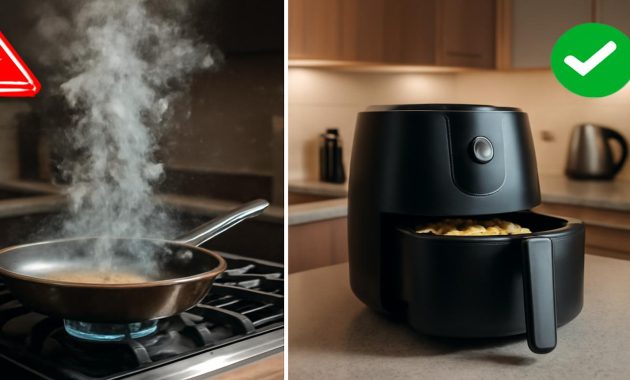
The first thing you notice is the smell. Not the heavy, cling-to-your-hair fog of a deep-fried dinner, but something lighter, almost shy. The air fryer hums on the counter with the calm of a small fan, a muted whirr instead of a furious sizzle. Potato wedges inside are crisping up, edges turning golden. No oil popping onto your forearms. No greasy film creeping across the stovetop. For a moment, you simply stand there and breathe, and, without quite meaning to, you wonder: what exactly is in the air right now—and how different is it from the clouds of invisible stuff that rise off a pan of hot oil?
The Invisible Smoke We Never See Coming
We’re used to judging cooking by how it looks, smells, and tastes. A perfect sear. That roasted-onion sweetness. The way a kitchen fills with warmth on a winter night. What we’re not very good at sensing are the particles—so tiny they slip deep into our lungs without leaving a trace of sensation.
When we fry food in a pan or a deep fryer, oil is heated to temperatures that push it past comfort and into stress. At those high temperatures, droplets and fumes are released, forming what scientists call ultrafine particles—so small that tens of thousands can fit across the width of a human hair. Alongside them come volatile organic compounds (VOCs), aldehydes, and other chemical by-products that ride the steam and smoke up into your face, into your home, and, eventually, into your bloodstream.
Most of us think of pollution as something that happens “out there”—on highways, in factories, drifting from wildfire smoke. But there is growing evidence that indoor air, especially in kitchens, can sometimes be more polluted than a busy city street. Frying is one of the main culprits. You can’t always see the haze, but your lungs feel it, your blood vessels respond to it, and over years, your body remembers.
So when a new study arrives saying that air fryers produce far fewer toxic particles than traditional frying, it feels, surprisingly, like a story not just about gadgets and recipes, but about what kind of air we want to breathe at home.
Inside the New Study: A Tale of Two Kitchens
Imagine two test kitchens set up side by side, each as controlled and clinical as a laboratory but filled with the smells we all know: potatoes, chicken, a hint of spice. In one room, a pan of oil simmers on a stovetop, then moves into a hard, crackling fry. In the other, an air fryer is loaded, its basket tucked in, its temperature and timer carefully set.
Researchers, curious and methodical, watch not the food but the air. They place sensors near the appliances, in the breathing zone of a person who’d be standing there cooking. These instruments count particles: those between 10 and 100 nanometers that can slip deep into the lung’s tiniest branches, bypassing many of the body’s usual defenses. They track VOCs and certain reactive chemicals known to be toxic or irritating, especially when inhaled over long periods.
What the study finds is both simple and large in implication: compared to pan or deep frying, modern air fryers release dramatically fewer ultrafine particles and far lower levels of harmful gases under typical home-cooking conditions. Not zero—cooking always creates some emissions—but consistently, significantly less.
In some test runs, traditional frying produced bursts of particles that spiked up to several times the background levels of indoor air, hanging around in the room even after the burner turned off. The air fryer, by contrast, produced a gentler curve: smaller peaks, faster decline, fewer chemicals associated with oil breakdown and oxidation. The difference was particularly noticeable at higher temperatures and with oil-rich foods, where conventional frying really let loose a storm of invisible material.
How an Air Fryer Changes the Chemistry of Dinner
The magic is not in some mysterious technology, but in a set of ordinary design choices. Instead of a pool of oil, the air fryer mostly uses hot air rushing around the food at speed, like a miniature, super-focused convection oven. A light coating of oil may be brushed or sprayed on the surface of the food, but that’s very different from immersing it in a deep bath of fat.
With less oil exposed directly to intense heat, there’s simply less material available to vaporize or break apart into tiny particles. The closed chamber of the air fryer also helps contain and redirect steam and droplets, many of which condense on interior surfaces rather than drifting straight into your face.
Air fryers also tend to operate at carefully controlled temperatures—often lower than what some enthusiastic home cooks accidentally reach when they crank up a stove burner until the oil nearly smokes. That extra few degrees might mean a slightly faster cook, but chemically, it can tip oil into the zone where harmful degradation products form more quickly.
In short: less oil, more control, and a semi-enclosed environment translate into less pollution in the air you breathe while cooking.
The Air in Your Kitchen vs. The Air Outside
It’s strangely comforting to think of air as all the same. But the reality is that the air hovering over your stovetop has a different story to tell than the air passing under your front door. When you sauté, roast, grill, or fry, particles mix into that story with every crackle and hiss. The more oil and higher heat, the more dramatic the additions.
Scientists talk about PM2.5 (particles smaller than 2.5 micrometers), which can slip deep into the respiratory system. Ultrafine particles are even smaller. They don’t just lodge in the lungs; some can pass through into the bloodstream, touching the heart, brain, and other organs. Over time, repeated exposure has been linked to higher risks of cardiovascular disease, lung irritation, and possibly cognitive decline.
Traditional frying is a perfect storm for particle generation. Hot oil releases droplets and fumes, especially when foods with water content are dropped in, causing explosive bubbling. Bits of batter or crumbs that fall off scorch at the bottom of the pan or fryer, creating additional smoke and breakdown products. If the oil is reused or overheated, it degrades even faster, producing more aldehydes and polycyclic aromatic compounds—some of which are known or suspected carcinogens.
Air fryers change this landscape. The new study’s key message is that shifting from deep or pan frying to air frying can substantially reduce those harmful emissions, all while delivering a crispy texture many of us associate with indulgent comfort food. It doesn’t erase all pollution—no cooking method does—but it reduces one of the biggest indoor sources in many homes.
Think of it like switching from a smoky firepit to a carefully designed woodstove: you still get warmth and flame, but a lot less smoke in your eyes.
Numbers You Can Almost Breathe
While different studies use different setups, a consensus is emerging. In several tests, air fryers have been shown to produce between 50% and 90% fewer ultrafine particles than traditional frying under similar conditions, depending on the food, oil, temperature, and ventilation.
To make this easier to picture, imagine something like this simplified comparison from typical experimental scenarios:
| Cooking Method | Approximate Particle Emissions* | Relative Toxic Particle Load |
|---|---|---|
| Deep/ Pan Frying (High Heat) | Very high spikes of ultrafine particles; dense bursts | Baseline: 100% |
| Deep/ Pan Frying (Moderate Heat) | Moderate to high continuous emissions | Around 70–80% |
| Air Fryer (Typical Use) | Lower, steadier levels; smaller peaks | About 20–40% |
| Air Fryer (Lower Temp, Light Oil) | Minimal increases above background | As low as 10–20% |
*Values are illustrative, summarizing ranges reported across multiple controlled experiments. Actual results vary with food type, oil, temperature, and ventilation.
For a home cook, the precise number is less important than the pattern. When you heat less oil and keep it contained, you breathe fewer toxic particles. That’s the simple equation the new research is underlining, one study at a time.
The Sensory Shift: What Cleaner Air Feels Like
The science is compelling, but the experience is more intimate. Think about the last time you fried something particularly aromatic—fish, for example, or a big batch of wings. Hours later, you could still smell it in your living room, on your sofa, in your hair. That lingering scent is a clue: particles and chemicals settling into fabrics, floating through spaces you didn’t cook in.
With an air fryer, the aromas are there, but they’re often more contained, more focused on the food than the room. There’s less of that heavy, greasy “hang” in the air. You might finish cooking and find you don’t immediately reach for the window latch. You don’t feel that slight roughness in your throat or stuffiness in your nose that sometimes follows an oil-splattered dinner.
On a quiet night, you might even notice the difference in sound. No loud, frantic crackling. Just the soft, steady churn of air and the occasional little pop as moisture escapes from a piece of food. It feels less like a controlled flare-up and more like a low, ongoing weather system inside a metal shell.
Air fryers will not transform your kitchen into a pristine mountaintop, but they lean toward a calmer environment: less smoke alarm drama, fewer eye-watering moments when oil hits its limit, and a subtle sense that the air around you is not being sacrificed for the sake of crispiness.
Ventilation Still Matters
Even with cleaner cooking methods, the new research nudges us toward one unglamorous truth: ventilation is still your best friend. Air fryers may emit far fewer toxic particles than frying, but they are not a magic force field.
Whenever possible, running a range hood that vents outdoors, cracking a window, or using an air purifier with a HEPA filter can help sweep away the leftover fumes from any cooking method. The difference is that with an air fryer, there’s simply less to sweep.
For people living in small apartments, or in homes with limited ventilation and shared air, that reduction can matter a lot. Parents with young children, people with asthma, and anyone already navigating respiratory or cardiovascular issues may feel the benefits more acutely, even if they don’t always connect those subtle improvements to the change in cooking habit.
Balancing Indulgence, Health, and the Planet
There’s another quiet dimension to this story. The same properties that make air fryers gentler on indoor air—the use of far less oil, the controlled heat, and the efficient, focused cooking—also ripple out in other directions.
Less oil means less agricultural input and less waste. If you’ve ever poured out a liter of used frying oil and wondered where, exactly, it’s supposed to go, you’ve brushed up against the awkward afterlife of our food choices. Many people still pour it down the drain, where it can clog pipes and complicate wastewater treatment. Others bottle and bin it, sending it on to landfills or, in the best cases, recycling streams. With air frying, you often use just a spoonful of oil, easily absorbed into the food itself.
Health-wise, reducing the amount of oil in your meals doesn’t automatically guarantee a perfect diet, but it does gently steer you away from some of the heaviest fat loads we associate with deep-fried foods. When the crispiness you crave no longer requires a full oil bath, “fried night” begins to look less like a guilty indulgence and more like a manageable part of everyday eating.
And yet, this isn’t a story about puritanical restraint. It’s about making room for pleasure in a way that’s kinder—to your lungs, to your heart, to the shared air inside your home. The new research is simply voicing what your body might have already suspected: there’s a way to chase that satisfying crunch without stirring up such a toxic cloud.
Choosing and Using an Air Fryer Wisely
If you’re thinking about shifting more of your cooking toward an air fryer, a few practical patterns echo through the research and expert advice:
- Don’t overpack the basket. Give air room to move so food cooks evenly without extra time or heat.
- Keep temperatures moderate when you can. You don’t always need the maximum setting; slightly longer cook times at lower temperatures can mean fewer emissions and gentler browning.
- Clean the interior regularly. Built-up residue can char and smoke, nudging emissions upward even in an air fryer.
- Use just enough oil. A mist or light brush on the food is often plenty; extra oil doesn’t always equal better texture.
- Combine with good ventilation. Even a small window cracked open during and after cooking helps clear what remains.
None of these steps are difficult. They are small adjustments to what you already do: preheat, season, wait for that moment when the timer beeps and the kitchen smells like dinner.
Future Kitchens, Softer Skies Indoors
The new wave of research around air fryers and indoor air quality is still unfolding, but the direction is clear. As scientists continue to measure what happens when we plug in these countertop devices, the numbers point to the same conclusion our noses and lungs quietly hint at: air fryers, when used properly, generate far fewer toxic particles than traditional frying.
It’s a modest change with surprisingly wide echoes. In thousands of homes, where cooking is both necessity and ritual, shifting more meals to a cleaner method can gently bend the curve of exposure over years. Each dinner might feel like nothing more than a busy Tuesday night. But stacked together, they become a quieter story of protection: for children doing homework at the kitchen table, for grandparents who come over on weekends, for you, leaning on the counter between tasks, breathing in the ordinary air of your own life.
One day, perhaps, we’ll look back on the era of unventilated, oil-heavy frying the way we now look at smoking indoors—normal once, but hard to justify in hindsight. For now, though, change happens more softly. It begins with the hum of a small appliance on your countertop, the almost-gentle aroma of crisping food, and the simple, radical act of choosing air that’s just a little bit cleaner to breathe.
Frequently Asked Questions
Do air fryers completely eliminate toxic particles?
No. Any high-heat cooking method produces some particles and gases. Air fryers significantly reduce emissions compared with traditional frying, but they don’t bring them down to zero. Good ventilation is still important.
Are air fryers safer for people with asthma or lung issues?
They can be. Because air fryers typically emit fewer ultrafine particles and less smoke than pan or deep frying, they may be gentler on sensitive lungs. However, every individual is different, and people with respiratory conditions should still prioritize ventilation and consult their healthcare provider if they notice symptoms.
Is oven baking as clean as air frying?
Oven baking usually produces fewer emissions than deep frying, but it can still release particles and fumes, especially at high temperatures or when fats drip onto hot surfaces. Air fryers often cook faster and more efficiently, using less oil and a smaller heated space, which can further limit emissions.
Does the type of oil matter for air quality when frying?
Yes. Oils have different smoke points and chemical profiles. When overheated, all oils can break down and release harmful compounds, but some degrade more quickly than others. Regardless of oil type, using less of it—as in air frying—helps reduce toxic particle formation.
Can I still use my range hood with an air fryer?
Absolutely. In fact, it’s a good idea. Using a range hood or opening a window while the air fryer runs helps clear any remaining particles and vapors, keeping indoor air cleaner overall.
Are there any downsides to air fryers from a health perspective?
The main concerns are not about emissions, but about how often and what you cook. It’s still possible to overdo calorie-dense, highly processed foods in an air fryer. From an air-quality standpoint, though, research so far points to clear advantages over traditional frying.
Do larger air fryers produce more emissions than smaller ones?
Larger units may move more air and handle bigger batches, but emissions depend more on temperature, cleaning habits, and how much oil and food you use than on size alone. Across sizes, air fryers tend to outperform deep or pan frying for particle emissions when used correctly.