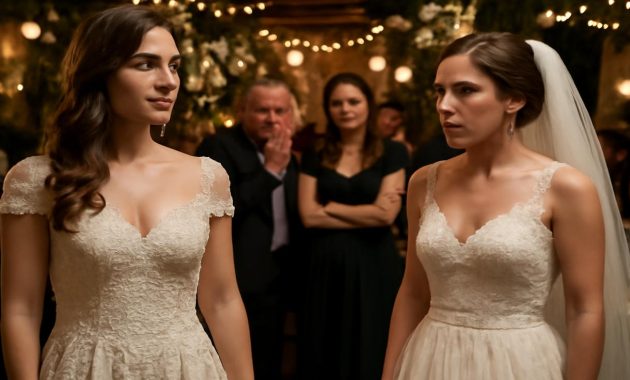
The dress was the color of storm-lit seawater—somewhere between blue and green and trouble. Years later, when people remember that day, they don’t talk about the vows or the cake or the way the evening light fell over the vineyard like a blessing. They talk about that dress. They talk about the woman who wore it. And they talk about the way a single choice cracked open an old family fault line that everyone had politely pretended wasn’t there.
The Rule No One Said Out Loud
By late afternoon, the vineyard hummed with a soft, rehearsed happiness. Glassware chimed like tiny bells, and white folding chairs were lined up in neat rows that made the grass look greener, as if even the ground itself had been edited for the photos. The air carried a braid of scents—fermented grapes, mown grass, roses from the arbor, and, beneath it all, the unmistakable salt-and-skin scent of too many anxious people in their best clothes.
Everyone knew the rule. No one had said it out loud, because they didn’t have to. This was a wedding, a traditional one, and the bride was wearing white. So no one else would. Not ivory, not cream, not anything that looked like it might have once dreamed of being a bridal gown. Even loud colors were discouraged; “nothing too showy,” the bride had said with a laugh in the group chat.
In that same chat, her older sister, Leah, had replied with a single emoji: the smirking face. People had scrolled past it, not thinking much of it, the way you don’t pay attention to a dog’s low growl if you’ve always known it to be gentle.
The sisters had always been studied opposites. Nora, the bride, unfolded herself quietly into every room—soft, accommodating, the kind of person who apologized when other people bumped into her. Leah arrived like weather: sudden, loud, undeniable. Where Nora dialed herself down, Leah dialed herself up, as if existing at full volume was the only way she knew how to breathe.
Growing up, their mother used to say, “Leah shines so bright, Nora’s my calm harbor.” It was meant kindly, but the division stuck. One was light, the other was shelter. It sounded poetic when you stitched it onto family stories. Less poetic when it turned into seating charts and shared birthdays and the unspoken understanding that when Leah was in the room, she would, inevitably, be the main event.
That’s what made the rule so important, even if no one named it: on this one day, finally, the spotlight was supposed to belong entirely to Nora.
The Moment the Barn Door Opened
The ceremony was set for golden hour. Guests began arriving in swirls of floral prints and navy suits, an orchestrated palette of “muted and tasteful.” The bridesmaids floated around in sage green chiffon, rustling like leaves in a gentle wind. There were photos on the lawn, the photographer coaxing out smiles and rearranging errant curls.
Inside the refurbished barn-turned-venue, fairy lights draped from beam to beam like strands of captive stars. Mason jars held candles on the tables, and centerpieces of eucalyptus and pale roses sprawled with curated wildness. The air was warm, almost thick, and the DJ was doing his best to be invisible, checking cables and pretending he didn’t hear the tension rising and falling in the pockets of conversation.
When Leah’s car pulled up, no one immediately noticed. There were too many moving pieces—kids escaping shoes, a tipsy uncle already on his second rosé, the bride’s father pacing with a speech folded and re-folded in his hand. The gravel of the drive crackled under tires; a door thumped shut. Somewhere, a screen door squeaked.
The first gasp came from the cluster of cousins near the barn entrance. A sound like a hiccup and a squeal reshaped itself into a silence that spread outward, catching and pulling the attention of anyone within range. Heads turned like wildflowers following the sun.
Leah stood in the open doorway of the barn as if the whole scene had been designed for her entrance. The dress clung to her like a second, much more glamorous skin. It wasn’t white—technically. It was that storm-lit seawater, iridescent and liquid, beading light along every seam. The neckline plunged deep, the back even deeper. The dress had a train, not long like a bride’s, but just long enough to whisper I should be announced every time she moved.
Against the soft greens and creams and dusty pinks of everyone else, she looked like she had stepped out of another world and accidentally into this one—shimmering, cinematic, and spectacularly wrong.
You could almost hear the guests working it out in their heads: It’s not white, so maybe it’s fine. It’s… a lot, though. Isn’t that too much? It’s her sister’s wedding. Why would she…? The questions clustered in their throats, unsaid but heavy.
Leah smiled, the slow, unapologetic smile of someone who knew every eye was on her and liked the feeling. “Am I late?” she asked, as though she’d arrived in jeans and a ponytail.
Whispers, Warnings, and the Tightening Air
It was Nora’s maid of honor, Clare, who first stepped forward, her bouquet trembling just a little. “Wow, Leah,” she said, voice too high to be casual. “That’s… some dress.” Her eyes skated over the sequins as if they might cut her.
Leah twirled, the dress catching the light and flinging it back around the room. “You like it? It’s vintage. Found it in this little shop in the city. I had it tailored—took ages. But it was worth it, right?”
A passing cousin whispered to another, “You can’t wear that to your sister’s wedding.”
“Why not?” Leah replied without missing a beat, startling them both. Her hearing, like her presence, had always been sharp. “It’s not white.”
Technically, she was correct, and everyone knew it. But weddings don’t run on technicalities. They run on feelings, traditions, and invisible lines everyone pretends not to see until someone trips over one.
From across the lawn, Nora’s mother spotted the commotion. She froze. For a heartbeat, the world narrowed to that one reflection of her eldest daughter standing there in a gown that didn’t just bend the rule; it rewrote it with glittering ink.
She walked over, each step measured. Her face wore the neutral expression of someone holding a fragile object inside their chest—hope, maybe, or dignity. “Leah,” she said quietly, “you look very… dressed up.”
“It’s a wedding,” Leah replied. “I thought we were going all out.”
There was a beat where the mother could have said it. Where she could have spoken the rule, made the invisible line visible and hard and clear. Instead, she inhaled and let the breath out as a sigh. “The ceremony is starting soon. Just find your seat, okay?”
She turned away before Leah could see the way her mouth trembled. Or maybe Leah did see and filed it away somewhere under Things We Don’t Talk About, alongside old arguments and childhood slights and the time Nora got the bigger bedroom.
By the time the bride appeared at the top of the path in her own dress—simple, graceful, luminous—some of the shock had settled, but not the tension. It hung over the chairs like a second canopy, invisible but audible in the way people spoke too softly and smiled too tightly. The photographer’s camera clicked. Birds in the vineyard hedges chirped oblivious counterpoint. Somewhere in the second row, a pair of guests were still silently mouthing: Can you believe her?
| Group | Immediate Reaction | Years Later Stance |
|---|---|---|
| Bride’s Close Friends | Shock, anger, protective of Nora | Still see Leah as selfish, avoid her |
| Older Relatives | Disapproval, whispered judgments | Use the story as a cautionary tale |
| Younger Cousins | Awe, entertained by the drama | Split: some admire her boldness, some don’t |
| Family Friends | Uneasy curiosity, “not my circus” | Use it as an anecdote at other weddings |
The Photos No One Can Agree On
After the ceremony, as the last words of the vows evaporated into the evening air, the real performance began. Guests spilled back toward the barn and the grape rows, glasses were filled, and the photographer arranged people into polished clusters.
“Let’s do one with the bride and her immediate family!” he called, cheerful, oblivious.
They lined up: parents on either side, Nora in the center, and Leah just off to the right. On the camera’s tiny screen, it later looked almost orchestrated, like a deliberate composition. Nora in white, soft and still, her dress catching the last of the daylight. Leah in that seawater sheen, brighter, louder, a visual exclamation mark in a sentence that was supposed to end with the bride.
In real time, it played differently. As they arranged themselves, Nora could feel the static of fabric against fabric. Her own gown, matte and understated, brushed against Leah’s gleaming one, which whispered like something alive. She didn’t look at her sister—couldn’t, really. Her eyes kept drifting toward the photographer, toward the lens she’d always imagined would capture this day as the moment she finally became the main character of her own life.
“Closer together, please,” the photographer urged.
There was a shuffle. A fraction of space closed. Leah’s perfume—jasmine and something sharper—drifted over, cutting through the roses and the grass and the faint tang of champagne. Nora felt it like a hand on the back of her neck.
Later, long after, the photos became a battleground. Some guests would say, “You can’t even look at those pictures without seeing Leah first.” Others would counter, “She looks great, but Nora is still the bride. You can tell who it’s about.” The images themselves never changed, but what people saw in them did, colored by their loyalties, their memories, and the arguments they’d had over dessert and long car rides home.
For Nora, the photos were less about beauty and more about a sharp, bright truth: even on her wedding day, she was sharing the spotlight with her sister. Not because she wanted to, but because that was the story everyone had agreed to, whether they realized it or not.
The Toast That Broke the Table
It wasn’t the dress alone that sparked the family war. The dress was the match. The speech was the strike.
By the time the plates were cleared and the cake was waiting patiently beneath its sugar flowers, there was a low-grade buzz in the room, the kind that comes from equal parts alcohol and unresolved tension. Fairy lights blinked; the DJ cued up instrumental covers of pop songs; candles sank into themselves, little by little.
The maid of honor went first, voice shaky but earnest. She talked about Nora’s loyalty, her kindness, the way she always answered the phone on the first ring. People dabbed their eyes. The groom’s brother followed with light-hearted jokes about college and late-night pizza. Laughter loosened the knots in people’s shoulders.
Then Leah stood up, uninvited but not entirely unexpected. She tapped her spoon against her glass once, twice, three times, until the room quieted the way a forest does when a predator steps into the clearing.
“I wasn’t going to say anything,” she began, which everyone knew was a lie. “But I can’t let my little sister get married without a few words from the person who knows her best.”
There was a forced cheer from somewhere in the back. Someone muttered, “Here we go.”
Leah’s speech started innocently enough—childhood stories, gentle teasing, the obligatory “I can’t believe you’re all grown up.” But soon, the edges sharpened. She talked about how Nora “always played it safe,” how she “never took the big risks,” how “someone in this family had to be brave enough to break the rules.”
Her hand swept down the line of her dress on that last sentence, almost unconsciously, as if to illustrate exactly what she meant.
The room tightened. People glanced at Nora, who sat very still, her smile fixed like something pinned to a board. Her new husband’s jaw clenched. Under the table, he reached for her hand; she didn’t squeeze back.
“But seriously,” Leah concluded, “I’m proud of you, Nora. For once, you’re the one everyone’s here to see.” She raised her glass, the words hanging there like a dare. “To my little sister, the star of the show.”
The toast clinked around the room, uneven and brittle. Some people didn’t raise their glasses at all, their hands heavy at their sides. Others overcompensated, cheering too loudly, as if enthusiasm could spackle over the cracks.
It was in the stunned quiet afterward that someone at the next table whispered, “She’s making this about herself.” And someone else replied, “She always does.” And another, braver or drunker, added, “Well, someone should say something.”
A cousin did. Then an uncle. Then a family friend. By the time dessert arrived, the barn was a patchwork of tense conversations, hushed but heated. One table defended Leah—she’s just being herself, that’s how she is, she didn’t mean it that way. Another took up arms on Nora’s behalf—this was her day, that dress was a slap in the face, the speech was unforgivable.
There was no single explosion, no overturned table or shouted insult to point to as the moment the war began. It was more like watching a crack spread through ice. One second the surface looked solid; the next, there were lines of fracture everywhere.
Years Later, at Other People’s Weddings
The vineyard still exists. Strangers marry there every summer, standing in the same patch of grass, under the same arbor, as if joy and disaster don’t leave residue on a place. The lights are still strung from the barn beams. The grapevines still run in disciplined rows, drinking in sun and rain and secrets.
Among the people who were there that day, the story of “Leah’s Dress” has become its own kind of legend. At other weddings, in other venues, it surfaces like a cautious fish.
Someone will lean in over a plate of chicken or sea bass and say, “Okay, but I was at this wedding once where the sister showed up in a gown that looked like it belonged on the red carpet…” And someone else will say, “No way.” And then the sides form all over again.
Some guests remember admiring Leah’s defiance, how she refused to disappear just because the script said she should. Others remember watching the bride’s face shutter slowly over the course of the night, each comment and glance layering over her like dust. How do you measure harm in that context—in inches of fabric, in lumens of shine, in the weight of an unspoken rule broken in public?
Over time, people’s stances have calcified into identities. There are those who say, “It was just a dress. People need to calm down.” They frame Leah as a victim of an overreacting, tradition-obsessed family. Then there are those who say, “It was a declaration.” They talk about intent, about patterns of behavior, about all the smaller moments that led up to this one—the birthdays overshadowed, the holidays hijacked, the countless times Leah’s need to shine rewrote the room.
At a baby shower a few years later, one of the former bridesmaids heard Leah’s name and rolled her eyes. “I’m not going there if she’s invited,” she said. “I’m not doing another event where the main character changes mid-scene.”
In another corner of the same room, a cousin defended her. “She just has big energy. That’s not a crime.” Then, softer, almost to herself: “Anyway, she looked incredible.”
The war isn’t fought with slammed doors and cut-off phone calls so much as it is waged in these quiet alignments, these whispered verdicts. People still see each other at holidays, at christenings, at funerals, but there’s a new map underneath the seating chart now—who sat where at the wedding, what they said afterward, which story they chose to believe.
What the Sisters Remember
If you asked Leah about it, years later—on a Tuesday night, maybe, after a glass of wine and a long day—she might laugh. “It was a dress,” she’d say. “I didn’t kill anyone. Everyone was just waiting for an excuse to be mad at me.”
She’d tell you she spent hours finding something that felt like her, that she was tired of shrinking herself to fit into family expectations. She’d talk about how, growing up, every compliment she got seemed to cost Nora something—how their mother’s praise was always weighed and measured, handed out like rations. How she learned early that if she was going to be blamed for taking up too much space anyway, she might as well enjoy it.
If you asked Nora, she wouldn’t start with the dress. She’d start with the morning. With waking up to the sound of wind in the vines and thinking, This is it. This is finally mine. With the way she’d rehearsed, in her head, what it would feel like to walk down that aisle and know, beyond question, that every eye was on her in celebration, not by accident.
Then she’d tell you about seeing the photos for the first time. Not the candids on everyone’s phones, but the official ones, curated and edited and delivered in a neat online gallery. She’d tell you how she clicked through them with a kind of reverence, only to feel, slowly, that sinking sensation of familiarity. Of being on the edge of her own story again.
She might not say she hates her sister. That word is too big, too heavy, and anyway, there are good memories tangled up with the bad. But she’d admit that something shifted that day—a quiet, private decision not to keep handing over the central role in her life just because Leah refused to audition for any other part.
They still speak, sometimes. Birthdays, holidays, the necessary check-ins when a parent is sick. Their conversations are careful, walking the perimeter of that day like a fence. What neither of them admits, out loud, is that the dress didn’t create the divide between them. It illuminated it, the way lightning momentarily reveals the shape of the land.
Why the Rule Still Matters
On the surface, it’s a simple etiquette story: Don’t upstage the bride. Don’t wear anything that makes people forget whose day it is. It’s easy to reduce it to fashion advice, to pin it on color charts and style blogs and lists of “What Not to Wear to a Wedding.”
But beneath that, there’s something more primal at work: the human need, just once in a great while, to be unquestionably chosen. To be the one everyone has gathered for, without rival or interruption.
Your sister’s wedding isn’t just about dresses and speeches; it’s a ritual of witness. It’s your chance to stand behind her and say, with your presence, “I see you. This is your moment. I will not compete with you for it.” When someone ignores that—whether out of carelessness or defiance—it feels less like a fashion faux pas and more like a tiny betrayal woven in satin.
The unspoken rule is, at its core, an act of generosity: today, I dim so you can glow. Tomorrow, maybe it’s my turn. When one person refuses to dim, every time, it stops being self-expression and starts being a pattern that people have to contort their lives around.
That’s why Leah’s dress still comes up years later. Not because of the fabric or the cut or the color, but because it crystallized a question every guest has had to answer in their own heart: Whose side are you on when someone’s shine keeps eclipsing someone else’s day?
There’s no tidy moral here, no neat resolution where everyone sits down over coffee and laughs about it. The story lingers precisely because it doesn’t resolve. The war isn’t over; it’s just quieter now, folded into the way people remember that afternoon light, the way the barn smelled like sawdust and sugar, and the way, for better or worse, a single dress turned a wedding into a mirror.
Frequently Asked Questions
Why was Leah’s dress considered such a big problem if it wasn’t white?
Because weddings aren’t only about color rules. Her dress was dramatically attention-grabbing—shimmery, form-fitting, and styled like a red-carpet gown. In a setting where the bride is meant to be the visual focus, Leah’s choice felt like a deliberate attempt to share or steal that focus. Technically, it wasn’t white, but emotionally, it crossed a line.
Was the family overreacting, or was Leah really in the wrong?
Both perspectives exist. Some guests felt the family overreacted and should have brushed it off as “just a dress.” Others felt it was the culmination of a long pattern where Leah centered herself at key family moments. Whether it was wrong depends on how much you believe intent and history matter, not just the single choice of an outfit.
Could this situation have been prevented?
Possibly, if expectations had been clearly communicated and enforced. A direct conversation before the wedding—about dress code, about past tensions, about what the day meant to Nora—might have helped. But families often avoid these talks, relying on “unspoken rules” that only become visible when someone breaks them.
Why do people still talk about this years later?
Because the dress became a symbol. It represents larger issues: sibling rivalry, family roles, boundaries, and the need to be seen. People use the story to explain which side they’re on in quiet family debates, and it resurfaces whenever another wedding or major event raises similar questions about attention and respect.
What’s the main lesson for guests at future weddings?
Ask yourself one simple question: “Will what I’m wearing or doing pull focus from the couple?” If the honest answer is yes, even a little, it’s worth choosing something else. The most elegant thing you can bring to a wedding isn’t a stunning outfit—it’s the willingness to let the couple be the uncontested center of the story, just for that one day.