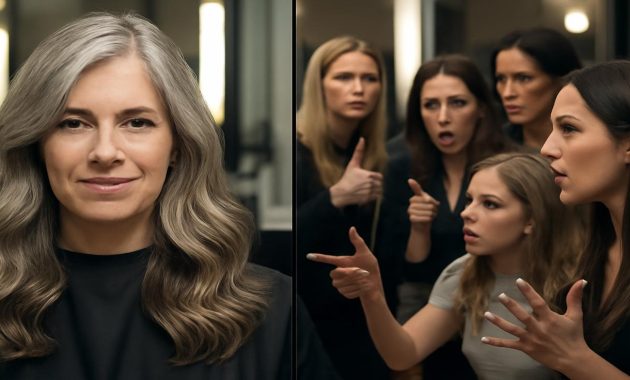
The woman in the salon chair hadn’t said a word yet, but her hands gave her away. One rested protectively over the strip of silver at her temple, the other twisted the end of the cape as if she wanted to escape. Outside, late-afternoon light was folding itself between parked cars and storefronts; inside, the air smelled of coffee, peroxide, and something like anticipation. Her stylist, a man with copper hair and half-moon glasses, tapped a comb against the counter and asked softly, “So… are we saying goodbye to the dye today?”
The Quiet Rebellion Happening in Salon Chairs
If you listen closely in salons, locker rooms, and group chats for women over 50, you can hear it: a low, restless hum. It’s the sound of a generation that was told to “never let the gray show” wondering if maybe—just maybe—they’ve had enough. Not of beauty, not of taking care of themselves, but of the cycle: roots, appointments, fumes, foils, and the vague anxiety that someone will catch the silvery thread along the part before your next touch-up.
But here’s the twist: today’s most controversial new “trend” to look younger doesn’t always mean going darker, richer, or more covered. It means something stranger, more nuanced, and more personal. It’s a movement that lives somewhere between full gray and full dye. Call it “hybrid hair”: low-commitment color, gray-blending, strategic highlights, airy toners, and dimension that tricks the eye into seeing vibrance rather than age.
In other words, “goodbye hair dye” doesn’t mean farewell to color. It means farewell to the old contract. Women over 50 are rewriting the terms, and the beauty world isn’t quite sure how to feel about it.
The New Gray: Not Quite Silver, Not Quite Blonde
Listen to enough stylists talk about this shift and you’ll hear a new language: smoke lights, salt-and-pepper balayage, shadow roots, reverse ombré, glaze, toner-only appointments. None of this existed when box dye on a Sunday evening at the bathroom sink was the gold standard.
Walk through any city and you might spot it: a woman in her fifties with a shimmering halo of gray woven through soft beige blonde; another with dark roots deepened, not erased, so that her scattered gray looks intentional, like a constellation rather than static. These aren’t mistakes. They’re carefully crafted illusions—ways of letting the gray exist while nudging how it’s perceived.
The goal, surprisingly, isn’t always to hide age. It’s to sidestep the tired cycle of chasing roots and, at the same time, avoid the stark line of demarcation that comes with going cold turkey gray. It’s a softer landing, a glide instead of a crash.
Why “Goodbye Dye” Doesn’t Mean Going Natural Overnight
There’s a romantic fantasy about going gray: you picture waking up one morning and deciding, with cinematic resolve, “That’s it. No more dye.” You walk into the salon, you give a moving speech, your stylist nods, and six months later you’re a luminous silver goddess.
Real life, of course, is messier. Grown-out roots don’t always come in evenly. Decades of dark dye can leave brassiness that has to be coaxed away with careful lightening and toning. And then there’s the emotional hangover: the way you catch yourself in the mirror and, for a split second, don’t recognize the person who’s looking back.
That’s where gray-blending comes in. Instead of painting over every snowy strand, stylists now mix in hand-placed highlights and lowlights in shades that echo the natural gray pattern. The result isn’t “not gray” and it’s not “fully gray.” It’s more… atmospheric. Hair looks like it has depth and movement, and the actual gray becomes just one note in a larger, more interesting chord.
This is where the trend turns controversial: some call it liberation; others say it’s just repackaged pressure to stay “youthful”—only now it comes with a higher salon bill and a fancier name.
The Great Divide: Stylists, Influencers, and the Gray Question
Behind every new hair trend lives a battle of philosophies, and this one cuts deep.
Many stylists are thrilled. Gray-blending demands artistry: an eye for pattern, tone, and movement. It lets them become collaborators in a long-term transition rather than technicians on a fixed-color treadmill. Some even describe a sense of relief when a client over 50 says, “I don’t need to be my ‘old brown’ anymore. I want something softer.”
But others feel conflicted. Covering gray has long been a cornerstone of salon revenue. A client who returns every four weeks for root retouches is, frankly, a financial anchor. When women begin spacing appointments to every three months—or shift to glosses and toners that are faster and less expensive—business models change. Some salon owners quietly resent influencers for pushing what they see as a trend that could undercut their livelihood.
Influencers, meanwhile, are split into two visible camps:
- The “Silver Sirens”: women who’ve documented their full gray transitions and preach total dye abstinence. They talk about saving time, money, and mental energy, and about the deep relief of not living at war with their roots.
- The “Soft-Filter Colorists”: creators who showcase glossy, blended tones that bend the rules of aging without breaking them. They frame hybrid color as an upgrade, not a compromise.
Some accuse the first group of moralizing—implying that if you’re still coloring, you haven’t accepted yourself. Others argue that the second group is selling women another impossible standard: you can go gray, but it had better be artfully highlighted, toned every six weeks, and effortlessly chic.
And the women in the middle? They’re tired of being told what “empowered” is supposed to look like.
Women Over 50 Speak: Liberation or Just Another Rule?
On a quiet Tuesday morning in a small-town café, three women—friends since their kids were in preschool—compared their hair like they once compared diaper brands and car seats.
One wore her natural steel-gray curls, cropped close, a streak of white at the front like an exclamation point. She stopped dyeing after her sister’s diagnosis: “I thought, if my body’s doing something this honestly, who am I to argue?”
Another had a perfectly blended mix of sandy blonde and pewter, the kind of color that takes time, money, and a stylist who knows the difference between warm and ashy by instinct. “I don’t want to be my thirty-year-old self again,” she said. “But I don’t want to be written off, either. This feels like a handshake between how I feel and how the world sees me.”
The third, still devoted to her chestnut-brown dye, shook her head: “I like my rituals. My color appointment is a boundary I keep with myself. I sit. Someone takes care of me. I walk out feeling sharper. That matters.”
None of them believed they’d cracked the code for everyone else. All of them were wary of the word “trend” being attached to something as intimate as aging.
How Gray-Blending Works (And Why It Can Look So Youthful)
When people say gray-blending makes them look younger, they rarely mean “younger as in 30 again.” They mean something subtler: brighter skin, softer lines, more light around the face. Color, after all, is energy. The right shades can reflect light upward, soften shadows, and create the illusion of lift.
Here’s what’s quietly happening in those salon chairs when someone decides to say goodbye to harsh, all-over dye and hello to a more nuanced approach:
| Technique | What It Does | Best For |
|---|---|---|
| Gray-Blending Highlights | Adds lighter strands that echo natural gray, softening regrowth lines. | Dark hair with scattered gray. |
| Lowlighting | Adds slightly deeper tones to prevent an all-over washed-out effect. | Mostly gray or very light hair that needs dimension. |
| Shadow Root | Keeps roots a touch darker to make gray look intentional and modern. | Anyone with a strong demarcation line from past dye. |
| Toner / Gloss Only | Neutralizes yellow or dull tones and adds shine without full color. | Natural gray that looks flat or brassy. |
| Partial Coverage | Covers gray only around the face or part line. | Those not ready to commit to full gray or full coverage. |
When done well, these methods don’t erase time; they redistribute it. A shadow root can make a receding hairline look thicker. Highlights around the face can bounce light into the eyes. A clear or subtly tinted gloss can make coarse gray strands feel silky rather than wiry.
Critics argue that calling this “going natural” is misleading. And they’re right—it isn’t. But maybe that’s the point: perhaps the future of beauty after 50 isn’t a rigid choice between “totally natural” and “totally fake,” but a spectrum. A place where you can pick and choose what makes you feel awake in your own skin.
The Emotional Labor of Every Strand
Hair isn’t just hair. For many women, it’s a timeline. The short crop after a breakup. The bangs you cut yourself in your thirties. The deep red phase that matched the year you said “yes” to too many things. The quiet, steady brown that carried you through carpools and late nights and PTA meetings.
When gray creeps in, it doesn’t just signal age—it marks a before and after. The woman who was everyone’s caretaker sometimes looks at her reflection and wonders when she became someone her younger self might not recognize in a crowd. There’s grief tangled in those silver threads, but there can also be power.
“I felt like I was betraying my younger self by letting the gray show,” one woman admitted after her first gray-blending appointment. “But then I realized I’m not her job anymore. My job is to be fully myself right now.”
For some, that means keeping the bottle close and the gray at bay. For others, it means walking straight into the storm of silver and seeing who emerges on the other side. And increasingly, for many, it means walking the line: softening, not erasing; enhancing, not disguising.
Not All Hair, or Lives, Transition the Same Way
The controversy often overlooks something simple: hair doesn’t age equally. A woman with naturally light ash-blonde hair might float into silver with barely a ripple. Someone with thick, dark curls may find that every gray strand reflects light in a way that makes frizz more visible and shape harder to manage.
Texture changes too. Some women lose density; others gain unexpected waves. Hormones, health, medication, and stress leave fingerprints in every fiber. To talk about gray as a single “trend” is to flatten thousands of very personal stories into something as flimsy as a hashtag.
That’s why the best stylists don’t start with “What color do you want?” but with “How do you want to feel when you look in the mirror?” Grounded? Fierce? Soft? Playful? Invisible? (You’d be surprised how many quietly choose that last one for a season of life.)
From there, the new conversation begins: Does it bother you when your roots show? Do you like seeing some gray or none at all? How often do you want to be in this chair? How much are you willing—or able—to spend? These questions matter just as much as undertones and developer strength.
Is “Youthful” Still the Right Word?
Somewhere in the back-and-forth about gray, a bigger question keeps surfacing: why is “looking younger” still the default compliment? Why is the new gray-blending trend being sold, so often, with a whisper of, “Don’t worry, you’ll still look younger”?
Maybe the more honest promise is this: you can look more like yourself, more awake, more intentional. You can choose color techniques that work with your life instead of against it. You can say goodbye to dye as obligation and, if you want, hello to it as art.
You can also reject the whole framework and keep your boxed brown or your salon black or your copper highlights until the very end. Or shave your head. Or wear wigs in wild shades. Not because you’re chasing youth, but because you understand that at this stage of life, time is too precious to spend it on anyone else’s definition of “appropriate.”
In that salon chair, as late afternoon slips toward evening, the woman with her hand over her gray temple finally answers her stylist. She doesn’t want to go fully natural yet. But she also doesn’t want to be a slave to her roots. They decide on something in between: a shadowed base, pale ribbons of light, a cooler gloss to make the silver look deliberate.
When she steps back out into the street, her hair doesn’t look younger. It looks like this exact moment—complex, shifting, luminous when the light hits it right. Which, in its own quiet way, might be the most radical trend of all.
FAQ
Is giving up traditional hair dye really a trend or just a social media phase?
It’s a genuine shift. While social media amplifies it, the push toward gray-blending, lower-maintenance color, and embracing some natural gray comes from real fatigue with constant upkeep and a changing conversation around aging. Likely, the exact techniques will evolve, but the desire for more flexible, less rigid beauty rules is here to stay.
Does gray-blending actually make you look younger?
It can make you look fresher rather than “younger” in a literal sense. By adding dimension, light, and softness around the face, gray-blending often brightens the complexion and reduces the harsh contrast of regrowth lines, which many people interpret as more youthful.
Is it more expensive to transition to gray or to keep fully covering it?
The initial transition to a blended or more natural look can be more expensive and time-consuming because it often involves multiple techniques. Over time, though, maintenance appointments are usually less frequent and can cost less than monthly full root coverage, depending on your hair and salon.
Will stopping dye damage my hair?
Stopping dye itself doesn’t damage hair; in fact, it usually allows new growth to be healthier. However, the process of transitioning—especially if it involves lightening old dark dye—can be stressful on the hair. A careful plan with a professional and good home care can minimize damage.
What if I try going gray or gray-blending and hate it?
You can always change your mind. Color can be deepened, tones can be warmed or cooled, and you can return to fuller coverage if you prefer. The trend isn’t a one-way door; it’s a permission slip to experiment until your reflection feels like home again.