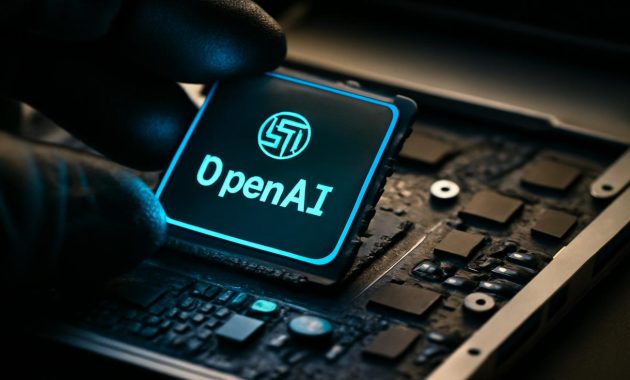
The first time I held one of the new AI‑accelerated laptop prototypes in my hands, it felt like cheating. The fans stayed quiet, the metal stayed cool, and yet on the screen a video editor, a code assistant, a voice translator, and a photo generator were all running at once, as if the machine had forgotten the laws of physics. The engineer standing beside me simply smiled and said, “That’s the OpenAI silicon talking.”
The Night Shift in the Lab
It was after midnight in a cramped lab tucked behind a glass wall, the kind of place that smells faintly of dust, solder, and burnt coffee. Cables draped from shelves like mechanical vines. Test boards blinked with green and amber LEDs, each heartbeat a sign that another experiment was still alive.
Across the long bench, Arun—one of those quiet, brilliant hardware people who always seem slightly under-caffeinated and ten steps ahead—slid a matte-black laptop toward me. No logo on the lid, no clue on the casing. Just a machine that looked like any other you’d see in a coffee shop.
“This,” he said, tapping the trackpad, “is running one of the first production samples built around OpenAI’s chips. Not just for the data center. For this.” His fingers curved around the edge of the chassis, like he was holding a fragile bird.
OpenAI, to most people, is software—ChatGPT, models, APIs, lines of code that live somewhere in the cloud. But in this room, you could feel the gravity shift. Here, OpenAI was copper traces, silicon layers, and power rails. It was something you could drop on the floor and regret instantly.
He opened the lid. The screen bloomed to life with a desktop cluttered by test apps: model dashboards, power monitors, small debug windows showing cryptic numbers. At the center: a simple prompt window, waiting.
“Ask it anything,” he said. “But don’t think of it as talking to the cloud. Think of it as talking to the laptop itself.”
The New Heart Inside the Machine
People usually imagine a laptop’s innards as a neat checklist: CPU, GPU, RAM, SSD, battery. For years, that’s been the story, with only minor plot twists. More cores. More watts. Smaller nanometers. Brighter screens. Nothing that fundamentally changed what your laptop is.
The OpenAI chips Arun was testing don’t just slot into that old story. They rewrite the script.
“Everyone assumes AI happens somewhere else,” he said. “In a server farm, in a region, behind an API key. But this,” he pointed toward the keyboard, “this is the next jump. Models that run here, locally, at a scale that actually matters.”
These chips aren’t magic, but they’re shockingly focused. The architecture is tuned for one thing above all else: making large AI models feel small enough—and fast enough—to live inside a portable computer. Think of them as the nervous system upgrade your laptop never had. CPUs handle logic and scheduling. GPUs chew through parallel math. OpenAI’s silicon is built for the thing in between: running gigantic neural networks efficiently, without cooking your knees.
“Most laptops today can run some AI,” Arun said. “Small models. Lightweight tasks. But the full-strength stuff—GPT‑class models, high-res generative media, live multimodal analysis—that’s still mostly cloud territory. The chips we’re building with OpenAI’s designs are meant to drag that power down into your backpack.”
Why These Chips Feel Different
Under the microscope, the secret is deceptively simple: specialization. Traditional processors are Swiss Army knives, good at almost anything but not brilliant at one thing. AI accelerators like these chips are scalpels, slicing cleanly through a very specific kind of computation—matrix math, tensor operations, the dense digital fabric of neural networks.
But the difference isn’t just raw horsepower. It’s orchestration. The chips are designed to offload the heaviest parts of AI workloads from CPUs and GPUs, while cooperating with them in real time. Models can be split intelligently: some parts local, some parts in the cloud, depending on your battery, connectivity, and privacy needs.
“We’re getting to the point,” Arun said, “where your laptop can host a serious model by itself. Not a toy. Not a demo. A real assistant, a real creation engine—running under your fingertips, even on a long flight with no Wi‑Fi.”
When Your Laptop Knows You, Not Just Your Logins
A few minutes later, we were no longer just testing benchmarks. We were talking to the machine.
On the screen, a local model—optimized to run directly on the OpenAI chip—began building a picture of me from the handful of files and settings we’d fed it. Draft articles. A calendar snapshot. A folder of photos. No data shipped to the cloud, no progress bar begging for a connection. It was all happening in the quiet hum of the lab.
“Watch this,” Arun said.
I asked the assistant to draft an email I’d been putting off for weeks, a messy, sensitive message about project delays, new directions, and bruised egos. I gave it a rambling verbal description. Within seconds, the screen filled with a note that sounded uncomfortably like my own voice, but clearer, kinder, more composed.
“That’s not just large language modeling,” Arun said. “That’s personalization. The model has access to your writing samples, your context, your schedule, all locally. It can adapt to you without asking a server for permission.”
And that’s where the OpenAI chips start to feel less like new hardware and more like a new relationship with our computers. For years, personalization has meant “we tracked you.” Now it can mean “your laptop knows you because it’s learned with you, on-device, without turning your life into analytics.”
Privacy, Power, and the Silent Revolution
There’s a quiet but radical shift when you stop sending every intelligent operation into the cloud. Your files stay on your machine. Your habits don’t become a line item in a dashboard. When your laptop translates your voice, summarizes your journal, or cleans up your photos, that work can happen in the sanctuary of your own hardware.
“We had to reach a certain level of efficiency to make that possible,” Arun explained. “OpenAI’s models are huge. You don’t just toss them in a laptop and call it a day. You need hardware that speaks their language natively—fast memory paths, low-latency compute blocks, and a power envelope that doesn’t roast your thighs.”
In practice, that means your next-generation AI laptop will feel strangely calm. No fans screaming when you generate images. No waiting while your notes upload to some server just to get a summary. The intelligence happens near your fingertips, in the same physical space where you’re thinking, typing, editing.
That quietness is deceptive. Underneath, the shift is as big as moving from dial-up to broadband—or from typewriters to word processors. The OpenAI chips aren’t just making things faster. They’re changing where thinking happens.
Why Laptop Makers Are Quietly Racing Toward OpenAI Silicon
Walk through any major PC manufacturer’s R&D floor this year and you’ll see a repeating pattern: test rigs powered by new AI-centric chips, people huddled over heat maps and battery charts, product managers arguing over just how much “AI laptop” to put on the box.
Behind those closed doors, one question keeps coming up: which AI hardware stack will define the next decade of portable computing? For many of them, OpenAI’s chips are rapidly becoming the answer.
What’s So Compelling for Manufacturers?
Arun pulled up a simple comparison table on his screen, something he’d made to convince an internal team that these chips weren’t just hype. With his permission, here’s a simplified version:
| Feature | Traditional Laptop | Laptop with OpenAI‑Class Chips |
|---|---|---|
| AI Workloads | Mostly cloud, limited local inference | Full local models + smart cloud offload |
| Battery Impact | High drain under AI tasks | Optimized for low‑power neural compute |
| Latency | Dependent on network | Near‑instant, on‑device responses |
| Privacy | Data often leaves device | Sensitive tasks stay local |
| User Experience | Apps with “AI features” | OS‑wide, always‑on AI companion |
“Manufacturers don’t just want faster benchmarks,” Arun said. “They want a story. A reason to tell people: this laptop feels fundamentally different.”
With OpenAI accelerating its own silicon stack, that story suddenly has sharp edges. Tighter integration between models and hardware. A roadmap that ties chip revisions to AI capability leaps. A world where the same organization that trains the brain also designs the bones it lives in.
Imagine a product cycle where your next laptop isn’t pitched as “30% more performance,” but as “can run the next-generation assistant entirely offline” or “can train a personal model on your documents in an hour instead of a day.” That’s the kind of language that moves markets, not just specs.
What It Feels Like to Use One of These Laptops
Later that night, Arun let me take the prototype for a spin as if it were my own. No benchmarks. No lab scripts. Just a pretend workday compressed into a few hours.
I opened a blank document, dropped in a mess of bullet points, half-formed ideas, and quotes from interviews. Instead of juggling windows and tabs, I just asked the laptop, out loud, to help. The on-device model rearranged paragraphs, suggested structure, and pulled in references from a folder of PDFs it had already indexed locally.
There was no spinning cursor. No “connecting to server.” Just the faint vibration of keys and the soft glow of the screen as sentences clicked into place.
When I jumped into a video call simulation, the assistant quietly generated live summaries, marked decisions, and tagged action items—without sending the recording anywhere. When I opened a design app, it suggested color tweaks and layout ideas after scanning my past projects, all under the same roof of silicon and copper.
At some point, I forgot I was “using AI.” The laptop just felt cooperative, attentive, almost conversationally present. And that, Arun said, was exactly the point.
From Feature to Fabric
“We’ve treated AI as a feature for too long,” he said, leaning back in his chair. “A button you press. A filter you apply. With these chips, AI stops being a feature and starts being the fabric of how you use a computer.”
That fabric might look like:
- A file system that understands meaning, not just filenames.
- A photo library that can find “the rainy afternoon when we decided to move cities,” even if you never tagged it.
- A code editor that doesn’t just autocomplete, but refactors with an understanding of your entire project history—stored locally.
- A writing environment that remembers how you argued a point last year and suggests continuity for your new draft.
All of it powered by models that run at the edge: close enough to feel instant, close enough to feel private. The OpenAI chips inside make that possible not as a party trick, but as the default behavior of the machine.
The Next Generation of Laptops: Quietly, Radically Different
So why say these chips will power the next generation of laptops, and not just “influence” or “enhance” them? Because once you’ve worked on a machine like this, going back feels like stepping into a past decade.
Future laptops, the ones already sketching themselves in whiteboard lines and CAD models, will likely share a few defining traits:
- Deep AI at the OS level: Not just apps adding “AI features,” but operating systems woven through with assistants, summarizers, searchers, and creators that run on-device, accelerated by dedicated silicon.
- Hybrid compute by default: Your laptop will decide—moment to moment—whether to use local OpenAI‑class chips or lean on the cloud, optimizing for speed, cost, and privacy without you having to think about it.
- Personal models per user: A private, evolving model that reflects your style, preferences, and workflows, trained continuously on your device’s hardware.
- Richer offline life: Airplanes, cabins, long train rides—these places will no longer feel like “dumb zones.” Your full AI assistant will be there, even in airplane mode.
In that world, the question isn’t whether OpenAI’s chips are nice to have. It’s whether anyone can compete seriously in the “AI laptop” space without their level of integration between models and hardware.
Standing in that lab, watching the prototype quietly transform a chaotic folder into a coherent report, I realized something unsettling: we’re about to spend a lot less time “using software” and a lot more time simply talking to our machines about what we want done.
And under that conversation, humming invisibly, will be a new kind of silicon—born from the same minds that gave us the models we’re speaking to.
Why This Matters More Than Another Spec Bump
It’s easy to dismiss all this as another cycle of tech marketing: new chips, new buzzwords, same old tasks. But the shift that OpenAI’s chips are enabling cuts deeper than a performance graph.
It’s about trust: keeping your data close while still getting the benefits of large-scale intelligence. It’s about presence: having an assistant that doesn’t vanish when the Wi‑Fi drops. It’s about expression: letting ideas move out of your head and into your tools with less friction, fewer steps, less staring at little loading animations.
Arun shut down the prototype, and the lab fell into a sudden, almost eerie quiet. The LEDs on the boards dimmed. The fans spun down to silence.
“In a few years,” he said, “people will forget there was a time when their laptops couldn’t do this. They’ll expect this level of intelligence the way we expect a screen to light up instantly when we open the lid.”
The next generation of laptops won’t announce themselves with neon stickers or shouting specs. They’ll slip into backpacks and onto desks, outwardly ordinary. But inside, they’ll carry a new heart—one that beats in tensor units and token streams, tuned by OpenAI and etched into silicon.
And once you’ve worked with a machine that truly understands you, quickly, quietly, right there on your lap—you won’t want to go back.
FAQ
Will OpenAI-powered laptops still need an internet connection?
They can do a lot without one. Many core AI tasks—writing help, summarizing documents, organizing files, basic image work—will run directly on the OpenAI‑class chips. The internet becomes optional for heavier, cloud-scale tasks or syncing across devices.
How is this different from current AI features in laptops?
Most current “AI features” rely heavily on the cloud or small, limited models. OpenAI’s chips are designed to run far larger, more capable models locally, making the AI feel faster, more private, and more deeply integrated into the operating system.
Does local AI mean my data is safer?
Local AI reduces the need to send sensitive data to remote servers, which can improve privacy. While nothing is perfectly secure, keeping more computation on-device gives you more control over where your information lives.
Will these chips only benefit power users like developers or creators?
No. Everyday tasks like email, note-taking, search, photo organization, and video calls all become smoother and smarter. The goal is that even non-technical users feel the difference without needing to understand the hardware.
When can we expect laptops like this to become common?
Early models and prototypes are already in testing behind the scenes. Over the next few product cycles, expect more mainstream laptops to ship with dedicated AI accelerators inspired by, or directly based on, OpenAI’s chip designs, gradually making this experience the new normal.