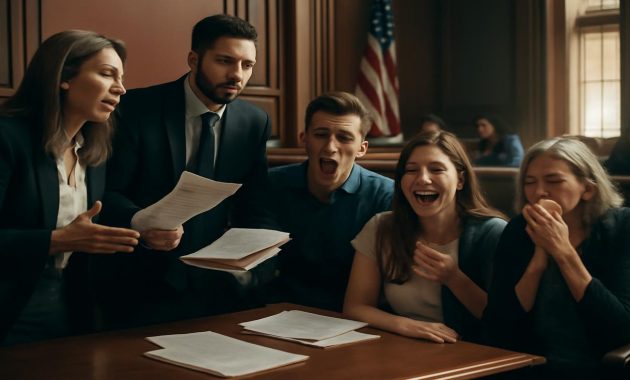
The first time they saw the document, it was already creased at the edges, thumbed by too many hands and translated too many times. A thin sheaf of papers—stapled crookedly, smelling faintly of toner and courthouse dust—suddenly weighed more than any stone. On one side of the family table, a daughter dabbed her eyes with a napkin. On the other, a son stared at the wall as if it might crack open and reveal a different future. In the center, between plates of half-eaten food and coffee gone cold, lay the will of a man who had, for most of his life, been invisible on paper.
He’d crossed a border thirty years earlier with a backpack, a borrowed jacket, and no documents. He was a ghost in databases, a rumor in official records. Yet here he was, resurrected in legal ink: an undocumented father whose final wishes had just been upheld in a court ruling that no one in the room fully understood—and that half the country now seemed eager to argue about.
The Father Who Never Existed on Paper
His name was Miguel in one language and Michael in another, depending on who was asking. To his children, he was simply “Dad,” the man who fell asleep in his work boots, who smelled like engine oil and oranges, who spoke in long, looping stories about a place they’d never seen.
Miguel arrived without a passport, overstayed a visa, and then disappeared into the invisible workforce that keeps the edges of a nation running quietly. He installed drywall, picked tomatoes, cleaned offices at hours when nobody noticed lights flicking on. He paid in cash and was paid in cash. He watched other people’s lives accumulate on paper: mortgages, licenses, marriages, college degrees. In his pocket, the closest thing to identification was an expired library card and a folded photograph of his mother back home.
Still, invisibility did not protect him from love. He fell for Elena at a church picnic, under a canvas tent strung with Christmas lights in the middle of July. They shared plates of rice and overcooked hamburgers, the music loud enough to blur the self-consciousness off their accents. By the time the first leaf turned red that year, they were living together in the back half of a house that a cousin rented from a man who’d never bothered to ask about papers.
Children came like seasons. First Camila, then Diego, then—years later, when they thought their lives had settled into a permanent state of careful, quiet survival—little Rosa with her wild hair and hurricane-loud laughter. Each birth certificate etched their presence more deeply into the country that refused to write his name in any official ledger of belonging.
There are thousands of stories like Miguel’s, stacked like unshelved books in the shadow library of the undocumented. But what set his story on a collision course with lawyers and legislators was not the path he walked into the country, but the path he tried to leave behind when he realized he might not be walking much further.
The Will Written in Two Languages and Three Worlds
The cancer arrived in the way bad news always seems to in working-class lives: suddenly, and then, all at once. A fatigue that didn’t go away. A pain he called “just age” until it became impossible to bend, lift, climb. By the time the doctors named it, the word came like a cornerstone dropped from a great height: late-stage, unlikely, aggressive.
An immigration attorney once told him, years before, that making any official document with his full name and address was “risky.” So he avoided paper the way other people avoid high ledges. But facing his own absence, he sat down with a legal clinic volunteer and began to speak his wishes out loud.
He wanted everything for his family. That part was easy to say. But which family?
In the town where he’d been born—where his father’s grave overlooked a wind-torn hillside and his sister still kept a framed photo of him as a boy—there were nieces and nephews who’d grown up on the money he wired home. There was the house he’d helped put a roof on, the debts he’d quietly paid off. Somewhere across that border, with its razor wire and field of waiting, there was love and obligation pressed into the soil.
In the country where he’d worked, there were three U.S.-born children, a common-law wife, and a modest tangle of assets: the small construction business he’d fronted through a citizen friend, a pickup truck, two bank accounts under an assumed name that matched his face but not his birth certificate. He had, by any ordinary measure, very little. And yet every dollar had a story attached to it.
The clinic volunteer, a law student with ink smudged on his fingertips, explained the problem in careful, translated phrases. Without status, everything Miguel had built here could be contested, challenged, even seized. Without careful drafting, his wishes could evaporate into a fog of “technicalities,” that strange weather beloved by bureaucracies.
And then there was the question nobody wanted to ask outright: Were children born in another country, to a woman Miguel had once promised to return to, still part of this story?
He wrote a will anyway. In Spanish first, spoken in the rhythm of his memories. Then in English, dry and efficient, the sentences scrubbed of poetry. Between the two languages, he tried to draw a single, continuous line that began in the dust of his village and ended in the linoleum kitchen where Rosa colored on the floor.
The Courtroom Where Everyone Was a Little Bit Wrong
Wills are supposed to be about clarity. Strip away the sentimental stories, and you’re left with a blunt question: who gets what? Yet when Miguel died, the reading of his will did not answer that question so much as fling it into the air like handfuls of loose papers. Some landed in one camp, some in another. Some drifted into a new legal landscape that had only just begun to take shape.
His U.S.-born children, sitting in uncomfortable wooden chairs in a county courthouse, were expecting at least one thing: that their father’s wishes would anchor their grief. They’d heard him talk about “taking care of everyone,” about the land back home and the new life here. They’d watched him work through holidays and storms, chasing overtime like a lifeline. They thought, perhaps naively, that death might finally make him official—if not in immigration databases, then at least in the eyes of a judge holding his will.
On the other side—connected by blood but divided by miles and politics—were the relatives back home. Some had logged into the hearing from a spotty video connection in a cinderblock living room. Others had sent written objections through lawyers who specialized in these border-spanning, status-tangled inheritances, where a person’s legal existence shifts shape depending on which side of a line you stand.
The question was stark: Could a man who never “legally” existed in the country where he lived for decades nonetheless make a valid will there? Could he pass business interests and bank accounts opened in borrowed names to children who held citizenship papers he never had? And could relatives abroad, some born to a first partner he’d never officially separated from, claim a share based on the law of the country where his story had begun?
The judge’s ruling, when it finally came, did not fit neatly into anyone’s expectations. It upheld the will. It recognized his intent. It validated transfers of property that, on another day, in another courtroom, might have been dismissed as fraudulent or void.
But it did something else, something raw and unnerving: it extended inheritance rights in a way that folded in relatives on both sides of the border, across citizenship status, across distances. The court, in essence, treated Miguel as a man whose obligations and affections did not stop at the checkpoint.
For some, this was a triumph of humanity over red tape. For others, it was chaos.
The Split: Love, Law, and the Price of Recognition
The legal community reacted like a flock of startled birds, scattering into commentary, op-eds, and late-night debates in law school classrooms. Some attorneys saw in the decision a long-overdue acknowledgment: that undocumented does not mean un-rooted, that a person’s lack of formal status should not erase their ability to shape what happens to their life’s work.
Others warned that it set a dangerous precedent, a precedent built on contradictions. If a person is “not here” in the eyes of immigration law, can a court simultaneously confirm that they were here enough to own, control, and bequeath property? If the answer is yes, what does that say about the laws that render millions of people as shadows, visible only when convenient for taxation, consumption, or labor?
For the families involved, the abstraction of legal theory hit with the impact of a physical blow. In one house, cousins who had grown up on remittances felt vindicated. “He didn’t forget us,” they said, clutching photocopies of the ruling like it was proof their sacrifices—and his absence—had meant something more than a long silence.
In another house, across a continent, a daughter felt something closer to betrayal. “We were the ones here,” she muttered over the phone to a friend. “We were the ones who went with him to chemo, who translated at the hospital, who worked in his shop.” When she saw the percentage of the estate allocated overseas, her grief acquired edges. Loss became ledger.
Even among the lawyers who advocated for migrant families, the ruling sparked quiet discomfort. Some worried about unintended consequences: Would this embolden predatory relatives to crawl out of the woodwork, claiming ties to sick, undocumented workers in hopes of future inheritances? Could courts be flooded with cross-border disputes that small, underfunded legal systems were unprepared to untangle?
Yet beneath the arguments about precedent and policy lay a softer, knottier truth: love, especially when stretched between countries and constrained by borders, does not divide neatly into legal shares.
When Exile Becomes an Heirloom
What Miguel left his children was not just money or property. It was a legacy of exile itself—a condition passed down like eye color, showing up in different ways in each generation.
For his children here, exile was a story told at the dinner table: the river crossed at night, the truck hidden behind a gas station, the house back home with the fig tree and the sound of roosters at dawn. They inherited a country that was fully theirs on paper but felt, at times, borrowed in reality, shadowed by the constant fear that their father’s lack of status might one day rip their family apart.
For the children and nieces and nephews abroad, exile was something more ghostly. They grew up with an uncle or father who existed primarily as a voice on a bad phone line, a regular wire transfer, a rare visit every few years when paperwork and risk briefly aligned. Their inheritance, before any ruling, was already stamped with loss—the knowledge that economic survival required love to stretch like taffy across distance and time.
When the court recognized Miguel’s will, it inadvertently recognized exile as a factor in inheritance. It admitted, in its legalistic, footnoted way, that obligation does not stop at the border patrol checkpoint, that a family line can extend in both directions even when people can’t.
Consider, for a moment, how this looks when laid out not as heated testimony but as simple, bare facts:
| Aspect | Country of Origin | Country of Residence |
|---|---|---|
| Legal Status of Father | Citizen | Undocumented / no lawful status |
| Children’s Citizenship | Foreign nationals | U.S.-born citizens |
| Property Location | Family land, small house | Business assets, vehicle, savings |
| Primary Caregiving | Emotional, during short visits | Daily care, medical support |
| Court’s Recognition | Acknowledged kinship, allowed share | Upheld majority control, honored will |
On a phone screen, these columns narrow into stacked rows, but the imbalance remains visible. Love and labor, risk and reward, sacrifice and proximity—they do not line up tidily. The court tried, perhaps clumsily, to map this asymmetry into a distribution that felt, if not perfectly fair, at least defensible.
But law is not a therapist. It cannot sit with a grieving daughter and explain why her half-brother, whom she has met only twice, now owns a stake in the shop on the edge of town. It cannot tell the cousin in the village why the man who once promised to build her a house died in another country and left most of his assets there. It can only stamp and file, gavel and close.
The Quiet Revolution in the Clerk’s Office
In the days after the ruling, the courthouse returned to its regular rhythms: parking tickets, custody hearings, the soft rattle of the copy machine. But something had shifted in the thick binders of precedent and procedure that lined the clerk’s office shelves.
For years, undocumented people had been encouraged—quietly, cautiously—to make wills and powers of attorney, to leave something more than shock and confusion behind when illness or an accident came. Legal aid organizations had run evening clinics in church basements, explaining that “even if the government says you don’t belong, your story still matters to your family.”
Yet the advice was hedged with warnings. Wills could be challenged. Assets might be frozen. Names that didn’t match IDs could trigger investigations. A life lived under the radar did not suddenly become simple just because you put your wishes in writing.
The new ruling didn’t erase these risks. But it carved out space—a modest, contested space—for courts to treat undocumented lives as legible, coherent, and binding in death even when they had been structurally blurred in life. It said, in effect: You may have been invisible to one system, but you are legible to another.
Some judges in other jurisdictions might reject this line of thinking. Others, quietly, might adopt it. That is how small legal revolutions begin: not with fireworks, but with footnotes.
Outside the legal system, the ripples spread differently. Community organizers began adding a new note to their presentations: not just “know your rights” but “shape your legacy.” Adult children of undocumented parents started asking wary questions at tax clinics and town halls: How can we protect what little we have? Who gets to decide what happens when my parents are gone?
Not every family will want a cross-border inheritance. Some estrangements are deep and justified. Some lives fracture beyond reconciliation. But for those who are trying to stitch a narrative between “before we left” and “after we arrived,” the ruling offered a strange, bittersweet validation: your migration story is not a glitch in the system; it is part of the ledger.
What We Really Pass Down
In the end, most inheritances are less about property than about stories. The truck will rust; the shop might fail; the house on the hillside may one day be sold to pay for a grandchild’s schooling. What lasts longer is the tale of how those things came to be gathered, how they were fought over, how they were given.
Miguel’s story will be told differently in each branch of his family.
In the country of his birth, his relatives may speak of him as the one who left and never fully came back, who tried to send a piece of his new world home through remittances and, later, through a court’s acknowledgment. They will talk about the time his face froze on a video call, mid-laugh, when the power went out again. They will remember the weight of the envelope that arrived with documents written in a language some of them cannot read.
In the country where he died, his children will remember the nights he came home too tired to talk, the mornings he braided Rosa’s hair with clumsy hands, the arguments about whether it was safe to drive at night without a license. They will remember sitting in that courtroom, listening to strangers pronounce their father “the decedent” as if he were a legal puzzle more than a man who hummed while he washed dishes.
They will also remember how it felt when the judge agreed that their father’s wishes mattered—that his voice, recorded in both Spanish and English, survived his body.
Some will celebrate the ruling as a victory for migrant dignity. Some will resent it as yet another way in which distant relatives and faceless systems can reach into the most intimate corners of a family’s grief. Many will feel both, often in the same breath.
What lingers, long after the lawyers have filed their briefs and moved on, is a quieter question that threads through so many lives shaped by migration: What do we owe the places we come from, and what do we owe the places that take us in, however imperfectly? Where does responsibility end and self-preservation begin? How do you split love between coordinates?
A will, in theory, answers: “This goes here. That goes there.” The unexpected court ruling on an undocumented father’s will did something more unsettling and more honest. It held up the messy map of his life—love in one country, labor in another, children on both sides—and refused to pretend that any single line, drawn in black ink, could divide it cleanly.
Frequently Asked Questions
Can an undocumented person legally create a valid will?
In many jurisdictions, yes. Legal capacity to make a will is usually based on age and mental competence, not immigration status. However, practical complications arise when assets, names, or identities don’t neatly match official records. Local laws vary, so professional legal advice is crucial.
Does immigration status affect inheritance rights for children?
Children’s rights to inherit are often tied to family relationships and the laws of the place where the estate is handled, not solely to their immigration status. But cross-border cases can become complex when heirs live in different countries or hold different citizenships.
Can relatives in another country claim part of an estate?
Yes, in some circumstances. If the deceased had legal or recognized family ties abroad, and especially if local law or the will itself acknowledges them, those relatives may have claims. How strong those claims are depends on local inheritance laws and the clarity of the will.
What challenges arise when an undocumented person owns property under another name?
Assets held through assumed names, informal agreements, or “straw owners” can be hard to trace and legally validate. Courts may scrutinize such arrangements closely, and disputes can emerge between intended heirs and nominal owners. Documentation and credible testimony become critical.
How can mixed-status families prepare for inheritance issues?
They can start by gathering documents, consulting with trustworthy legal aid or estate-planning attorneys, and clearly expressing wishes in writing. Naming executors, keeping records of ownership, and discussing decisions with family can reduce future conflict, even when immigration status complicates other parts of life.