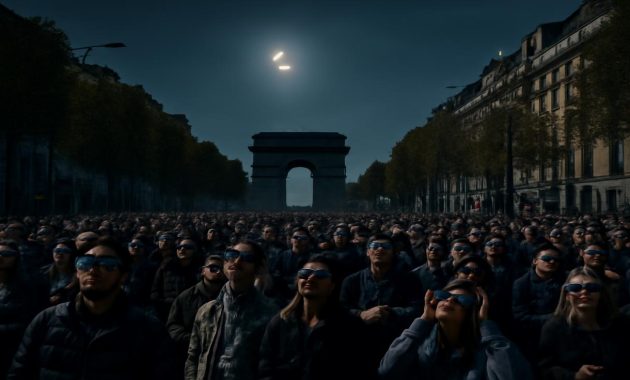
The warning came in the kind of clipped, measured language scientists prefer: “For several minutes, daylight will diminish significantly across a wide region.” But the words have been quickly translated, reshaped, and whispered into something far more visceral: light will disappear. Millions of people will stand under a sky that forgets, briefly, how to be day. An extraordinary solar eclipse is officially approaching, and the world is starting to feel that strange tug of anticipation that comes whenever the universe announces it has plans of its own.
The Day the Sky Forgets It’s Daytime
Imagine an ordinary morning. The coffee on your kitchen counter is still hot. Traffic is finding its rhythm. A dog is barking at a mail carrier. Then, almost imperceptibly at first, the light begins to thin.
It doesn’t vanish like a switch being flipped. It drains. Colors flatten. Shadows sharpen, too crisp for the hour. The blue of the sky takes on an odd, steely cast, and somewhere in your chest, an old animal part of your brain stirs and mutters: something isn’t right.
Experts call it a total or near-total solar eclipse, the alignment of Sun, Moon, and Earth so precise that the Moon slides exactly into the Sun’s path. On a diagram, it’s geometry. On the ground, it’s a mood. It feels like weather, but stranger: a front moving in not from the west, but from deep time and orbital mechanics.
Birds notice first. Their calls falter, then hush, as if someone has drawn a curtain over the soundscape. Bees tumble confused back toward their hives. Flowers that track daylight begin to fold. Humans do what we do best—we look up, we reach for cameras, we squint, even though every expert has told us not to, reminding us that you don’t negotiate with the Sun with bare eyes.
In that tension between warning and wonder, the stage is set. The coming eclipse will turn highways into pilgrimage routes and fields into impromptu observatories. It will pull strangers onto sidewalks and rooftops, heads tilted to the same mute, indifferent sky.
The Science Behind Those Vanishing Minutes
For all the mythic language it inspires, an eclipse is a stubbornly precise thing. The Moon’s orbit is tilted, its distance from Earth constantly shifting in a slow cosmic dance. Most months, the Moon sails a bit above or below the Sun in our sky, missing the mark. But sometimes, perfectly, it hits the bullseye.
When that happens, the Moon’s shadow streaks across Earth at thousands of kilometers per hour, carving a narrow path—often only around 100 to 200 kilometers wide—across continents and oceans. Inside that path lies the heart of the event: totality. For everyone else, a partial eclipse: still remarkable, but not the full, uncanny plunge into almost-night.
Scientists can predict these moments centuries in advance, down to the second. The calculations involve orbital dynamics, gravitational interactions, and the precise size and shape of our celestial bodies. It’s a triumph of human understanding, but the emotional impact resists tidy equations.
When experts warn that “light will disappear for minutes,” they’re describing the onset of totality, that brief stretch when the Moon completely covers the Sun’s blazing disk. Only the Sun’s outer atmosphere, the delicate solar corona, remains visible—an otherworldly halo of pale fire rippling out into the darkened sky.
In those minutes, the world undergoes a compressed twilight. Temperatures can drop several degrees. Winds may shift, following the fast-moving front of cool air beneath the Moon’s umbra—the darkest heart of its shadow. Weather stations and environmental sensors record the event as a dramatic, measurable anomaly: a planetary shiver.
A Moment Measured in Heartbeats
The statistics of the eclipse are as spare and beautiful as a poem written in numbers. The total phase might last two, three, perhaps four and a half minutes at best, depending on where you stand along the path. To astronomers, that window is a precious slot for instruments and observations; to everyone else, it is a once-in-a-lifetime heartbeat.
Here is a simple comparison of what those minutes might feel like across different experiences of the eclipse:
| Experience | What You See | What You Feel |
|---|---|---|
| Partial Eclipse (Outside Path of Totality) | A Sun shaped like a bite has been taken from it, but daylight remains. | Strange light, sharper shadows, mild drop in temperature, curiosity more than awe. |
| Near-Total Coverage | Sun becomes a thin crescent; landscape looks like a surreal late-evening scene. | Noticeable chill, uncanny silence in nature, a rising sense of anticipation. |
| Totality (Inside Path of Totality) | Sun vanishes; corona appears; stars and planets become visible. | Goosebumps, a visceral sense of awe; time feels both stretched and collapsed. |
Despite the warnings and the maps and the countdowns, many people will still be caught off guard by how quickly it all happens. One moment, everyone is chattering. The next, words feel too small for what the sky is doing. Cameras click at random. Some people cry. Some laugh. Some simply stand with their mouths open, temporarily emptied of language.
Warnings, Eyes, and the Gravity of Caution
The same experts who speak breathlessly about the science of eclipses also spend a great deal of time doing something that feels, frankly, unromantic: repeating warnings about eye safety over and over again.
Here’s the unembellished truth. The Sun does not become harmless during an eclipse. Even when it’s mostly covered, the exposed sliver is still orders of magnitude brighter than anything your retina is built to handle directly. Looking at it without proper protection can cause permanent damage—painless in the moment, devastating afterward.
That’s why astronomers and health agencies sound almost parental in their insistence: use certified eclipse glasses that meet strict safety standards; inspect them for scratches or damage; never stack regular sunglasses and assume you’re safe. Cameras, telescopes, and binoculars demand special solar filters, or they can concentrate the Sun’s energy into a beam that can destroy sensors and eyes in an instant.
There is, however, one precious exception—the moment of totality itself. When the Sun is completely hidden, when not a single direct ray is leaking around the edges of the Moon, the world turns safely dim. In those few minutes, you can remove your glasses and look directly at the eerie corona, at the stars and planets appearing in the wrong part of the day.
But experts emphasize this like a refrain: the instant even a hairline of Sun reappears, the show becomes dangerous again for bare eyes. It’s a choreography of caution—on glasses, off glasses, on again—timed to something happening 150 million kilometers away.
The Other Kind of Safety: Roads, Crowds, and Shadows
There is another layer to the warnings that has nothing to do with sunlight and everything to do with human behavior. Whenever a major eclipse crosses heavily populated regions, it doesn’t just rearrange the sky; it rearranges the map.
Highways leading into the path of totality pack with cars hours or even days beforehand. Small towns suddenly find themselves at the center of a celestial festival they didn’t audition for. Cell service can stutter. Gas stations run low. People pull off onto shoulders or worse, stop in travel lanes when the light begins to change.
Emergency managers and local governments quietly brace. They ask people to plan ahead, to arrive early, to treat the day as they would a serious winter storm or major holiday: full tanks, snacks, water, backup routes. It’s not about dampening excitement; it’s about making sure awe doesn’t turn into chaos.
In the days leading up to the event, you’ll hear the phrase “respect the shadow” passed around by skywatchers. It means honoring both the wonder and the logistics—listening to officials, following basic rules of the road, and remembering that the eclipse is a gift, not an entitlement.
How Nature Reacts When the Light Leaves
One of the most surprising things about a total solar eclipse is that it feels less like an astronomical event and more like an ecological one. You don’t just see it; you hear and feel it gather.
As the light dwindles, the landscape becomes a kind of experiment you didn’t realize you were part of. Birds that had been calling from trees go quiet or begin their dusk routines. Barnyard animals head toward shelters or cluster together, uncertain. Nocturnal species, fooled by the sudden “evening,” may stir and emerge, only to retreat again when daylight returns abruptly a few minutes later.
Temperature sensors show a sharp dip—sometimes 5 to 10 degrees Fahrenheit—spreading across the region like a cold breath. The air feels different against your skin, not just cooler but heavier, as if pressure itself is watching. Winds can flip direction, chasing the thermal gradient created by the shadow’s passage. Weather balloons released during eclipses trace these subtle shifts, sketching invisible waves in the atmosphere as it responds to the sudden loss of solar heating.
Plants, tuned delicately to the cadence of daylight, may pause or reverse their clocks. Flowers that usually close at night begin folding in confusion. Insects hum more softly or fall silent. The entire system that depends on the Sun’s steady beat takes a stutter step.
For a few minutes, you can feel, in your bones, just how much of life has written its code around the assumption that the Sun does not simply vanish. The eclipse is a reminder that even our most reliable constants are, in the right alignment, negotiable.
Humans Under a Briefly Alien Sky
If animals respond instinctively to the eclipse, humans respond narratively. We reach for stories to hold onto something so out of character for the familiar world.
Ancient cultures saw dragons or wolves devouring the Sun, angry gods sending warnings, cosmic battles playing out overhead. In some traditions, people banged on pots, set off fires, shouted at the sky to scare away the darkness. The Sun, obligingly, always came back.
Today, we know precisely why the light disappears and exactly when it will return. Yet the emotional effect is not diminished—it is sharpened by context. To stand in the shadow of the Moon and understand, at that very moment, what geometry and gravity have conspired to create, is to feel both small and strangely included in the universe’s private jokes.
Modern eclipse chasers speak of traveling across continents just for those few minutes. They talk about the way totality reorders priorities: how long-ignored neighbors gather in common spaces; how screens are forgotten, their faint artificial glow useless against the drama overhead; how children, who have known only digital wonders, suddenly gape at something that cannot be paused or replayed.
When light disappears, it reveals something else: our rare ability as a species to stand together, silently, and watch.
Preparing for the Shadow’s Arrival
As the extraordinary eclipse approaches, preparation becomes its own kind of ritual—part scientific readiness, part pilgrimage planning, part quiet personal reflection.
The first decision is simple, but profound: where will you be when the light leaves? For those living inside the path of totality, the answer may be as easy as stepping outside. For others, it might mean a long drive, a train ride, or a flight, chasing a moving line of darkness on a map.
People mark calendars, request days off from work, coordinate with friends and family. They research local parks, hilltops, and wide-open fields. They check typical cloud cover for the season, knowing that the one guest that can truly spoil the show is a thick, stubborn blanket of gray.
Then there are the practical details: eclipse glasses acquired early, not in a last-minute scramble; a simple pinhole projector made with a piece of cardboard for indirect viewing; camera lenses fitted with filters, or simply set aside in favor of being present without a viewfinder.
Some people pack notebooks to record their impressions; others sketch or paint, trying to capture the peculiar gradient of light at the edges of totality—the way the horizon can glow in a ring of colors while the sky overhead melts to an uncanny, inky violet.
In that preparation, there is a quiet acknowledgment that this is not just another date on a calendar. It is a scheduled moment with the cosmos, and like all important meetings, it asks you to show up fully.
What to Notice When the Day Turns Strange
When the eclipse day finally arrives, you’ll likely feel both readiness and disbelief. How can something you’ve anticipated for months or years be over in the length of a song? That’s the paradox of totality: it is both fleeting and, in memory, expansive.
If you’re lucky enough to stand under the Moon’s darkest shadow, there are a few things worth paying attention to beyond the obvious drama overhead:
- The shapes of shadows on the ground as the Sun turns to a crescent—leaves can act like natural pinhole cameras, casting hundreds of tiny crescent Suns onto sidewalks and walls.
- The color of the light in the final minutes before totality, a dim, metallic wash unlike any normal dusk.
- The reaction of the people around you: the sudden hush, the exclamations, the involuntary gasps as the last fragment of Sun slips away.
- The appearance of bright stars and planets in the wrong part of the day, like secrets briefly made visible.
- The moment the “diamond ring” appears—the Sun’s first flash returning at one edge of the Moon, a burst so beautiful and sudden it often draws a chorus of shouts.
Experts warn of many things: protect your eyes, plan your travel, respect nature. But there’s another warning that doesn’t come printed on safety brochures: be ready for how much this may move you. Many people come away changed or at least re-tuned, their sense of scale rearranged by those vanished minutes of light.
When the Light Returns
The strangest part of a total solar eclipse might not be the darkness itself, but the rapid return of the ordinary. After the gasps and cheers of the moment when the Sun emerges again, the world resumes with almost rude efficiency.
Birds pick up their interrupted songs. Traffic noise swells. Screens are pulled out again, signals sought. People pack chairs back into cars, fold blankets, check messages, argue about the best route home. The extraordinary collapses into the everyday as quickly as a tent being taken down.
Yet something lingers. In the days that follow, communal spaces buzz with the shared language of the eclipse. “Did you see it?” becomes as common a greeting as “How are you?” Photos are compared—not just the dramatic shots of the corona, but the human-scale details: a child’s face illuminated by the eerie half-light, the way streetlights flicked on at midday, the crooked line of cars pulled over at a farm road just to stare.
Scientists, meanwhile, disappear back into their data: measurements of the corona’s structure, the Sun’s magnetic behavior, the effect on Earth’s ionosphere and weather systems. For them, the event is both sublime and utilitarian, a rare window into phenomena that are otherwise impossible to isolate.
But even the most analytical among them are not immune. Ask an astronomer how they felt under totality, and their language often slides gently away from charts and equations toward something closer to poetry. Awe, they’ll tell you, is a legitimate scientific experience: the feeling of standing near the edge of what we can measure and peering briefly into what we can merely feel.
A Reminder Written in Shadow
The warning that “light will disappear for minutes” sounds almost apocalyptic when stripped of context. In truth, it is the opposite. It is a reminder of the exquisite predictability and fragile serendipity of our place in space.
We live at a moment in cosmic history when our Moon is at just the right distance to perfectly cover our Sun from our vantage point. It wasn’t always this way, and it won’t always be. The Moon is drifting slowly away from Earth, centimeter by centimeter each year. Far in the future, total eclipses like the one approaching will no longer be possible—only annular ones, where a ring of Sun always remains visible.
To stand in the path of totality now is to participate in a limited-time feature of the universe, one that future beings on this planet may know only through records and simulations. The shadow sweeping across continents is more than a spectacle; it is a note scribbled in darkness about impermanence and timing.
In the end, the experts are right to warn us. Not just about our eyes, or traffic, or the shock to animals and ecosystems. They are warning us about the emotional gravity of what’s coming—a gravity as real as that which pulls the Moon into its orbit.
For a few minutes, light will disappear. When it returns, the world will be the same, and yet, if you’ve been paying attention, it won’t be quite the same for you.
FAQ
How long will the total solar eclipse last?
The total phase—when the Sun is completely covered—usually lasts between about 2 and 4.5 minutes, depending on your exact location along the path of totality. The entire event, from first bite of the Moon to last, can stretch over 2 to 3 hours.
Is it ever safe to look at the eclipse without eye protection?
It is only safe to look without protection during the brief period of totality, when the Sun is completely hidden. The moment even a sliver of Sun is visible, you must use proper eclipse glasses or indirect viewing methods.
Can a partial eclipse damage my eyes?
Yes. Even when most of the Sun is covered, the exposed part is still intense enough to cause permanent eye damage if viewed directly without adequate protection.
Do animals really react to solar eclipses?
They do. Many animals respond as if evening has arrived—birds may roost, insects quiet down, and some nocturnal species may become active briefly. Their behavior offers a clear reminder of how deeply life is tuned to light.
What’s the difference between a total and an annular eclipse?
In a total eclipse, the Moon fully covers the Sun, revealing the faint solar corona. In an annular eclipse, the Moon is slightly farther from Earth and appears smaller, so a bright ring of Sun remains visible, and total darkness never occurs.
Why do experts emphasize planning and travel safety?
Solar eclipses draw large crowds into a relatively narrow path. This can strain local resources, crowd roads, and create dangerous situations if people stop unsafely or ignore guidance. Planning ahead helps keep the experience safe and enjoyable.
Will there be more eclipses in the future?
Yes. Eclipses happen regularly, but total solar eclipses crossing easily accessible land areas are rarer. Astronomers publish long-term schedules, so you can plan future trips to stand again in the Moon’s shadow—if the experience captures you enough to chase it.
Originally posted 2026-03-05 00:00:00.