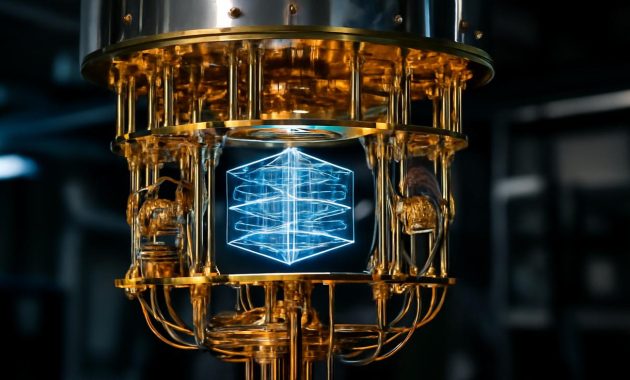
The lab is so quiet you can hear the air itself, a thin metallic whisper moving through ducts high above the ceiling. Somewhere behind the tangle of cables and steel, beneath the rounded bulk of a gleaming silver cylinder, a qubit is hanging on to its quantum state for a thousand fragile, impossibly long microseconds. One millisecond. In that sliver of time, a team of researchers in the United States has just broken a world record—and nudged the future of computing a little closer to our fingertips.
The moment a millisecond became a milestone
For most of us, a millisecond is nothing—less than the blink of an eye, less than a hummingbird’s wingbeat. But for a qubit, the basic unit of quantum information, a millisecond can feel like an eternity. Quantum states are notoriously skittish. They slip, wobble, and vanish when nudged by the faintest interference: a stray magnetic field, a wandering photon, the warmth of the room.
That’s why, in a chilled chamber near absolute zero, American researchers have been patiently wrestling with nature’s most delicate behaviors. And now they’ve coaxed a qubit into remaining coherent—staying “quantumy” instead of collapsing into ordinary, classical reality—for one steady, measurable millisecond. In the abstract world of physics, this is a technical benchmark. In more human terms, it’s like convincing a soap bubble to float intact through a windstorm… and then doing it again, and again, on command.
Quantum coherence is what lets a qubit exist in a blend of 0 and 1 at the same time, sampling multiple possibilities like a chorus instead of a solo. Lose the coherence, and the magic dissolves. Keep it long enough, and you can weave strands of quantum states into complex calculations, error correction codes, and ultimately—if all goes well—a working quantum computer that solves problems beyond today’s reach.
What a qubit really is when you’re standing next to it
On paper, a qubit is an abstract two-level system. In the lab, it looks a little less romantic. Picture a maze of coaxial cables, gold-plated components, and superconducting circuits patterned on a chip no bigger than your fingernail. This chip is bolted into the cold heart of a dilution refrigerator—a towering structure that looks like the chandelier of a spaceship—layer after layer of copper, shielding, and vacuum.
Inside that cold, the qubit itself might be a tiny loop of superconducting wire interrupted by one or more Josephson junctions—microscopic sandwiches of insulating material between superconductors that behave in ways your gut instinct will absolutely not predict. By driving currents and microwaves through these circuits, researchers create and manipulate quantum states: little packets of possibility, dancing between “this” and “that.”
To stand in the room while the experiment runs is to feel the tension between the ordinary and the extraordinary. On the monitors, faint traces appear: oscillations, decay curves, numbers that don’t look like much until you realize what they imply. Somewhere out of sight, sheltered in a cocoon of cold and quiet, that tiny circuit is holding its breath in quantum superposition a little longer than any qubit has done before.
Why one millisecond matters so much
Quantum computers aren’t just about having fast qubits—they’re about having qubits that can stay themselves long enough to be useful. The measure of this is called coherence time, and it comes in flavors with technical names like T1 and T2, each tied to different pathways that a quantum state can use to fall apart.
In the early days of the field, coherence times were measured in nanoseconds: billionths of a second. That was long enough to show intriguing physics, but far too short to stabilize a computation. Progress nudged the numbers into microseconds. Each order of magnitude brought with it new dreams: maybe chemistry simulations, optimization problems, cryptography, machine learning.
When a team crosses the one-millisecond mark, it’s not just another notch on an experimental belt; it redraws the map for what kinds of algorithms might be feasible on near-future machines. Millisecond coherence opens the door to more elaborate error correction codes—the elaborate, layered safety nets that will one day keep large quantum processors from drowning in their own noise.
Keeping quantum states alive is an art of subtraction
To make a qubit that can last a millisecond, you can’t simply build a stronger, flashier device. You have to remove things: heat, vibration, defects in materials, electromagnetic interference. It is a technology of subtraction, a conversation with the universe where the main request is, “Please, just leave this one microscopic system alone.”
The U.S. team’s breakthrough grew from painstaking attention to those quieting details. Ultra-pure materials. Refined fabrication techniques that leave fewer unwanted atomic “rattles” in the crystal lattice. Surfaces treated and layered to tame rogue electric fields. Microwave control pulses sculpted with the subtlety of a violinist training their bow hand.
Then comes the cold. The qubit is chilled to millikelvin temperatures—fractions of a degree above absolute zero—so the random jostling of thermal energy settles down. Filters on cables keep out high-frequency noise. Magnetic shields block Earth’s own fields and the hum of nearby devices. It’s like building a monastery for a single quantum prayer.
Even then, the qubit wants to forget. It wants to relax back into a plain, classical state the way a plucked string wants to fall silent. The millisecond record is a delicate standoff between that natural decay and all the engineering the scientists can muster to hold it at bay.
The new frontier: when hardware and software meet in the quantum middle
Longer coherence times don’t just give bragging rights; they shift how researchers design every other part of the quantum stack. With a qubit that can last a millisecond, a control engineer can string together longer sequences of operations. An error-correction theorist can test codes that were previously confined to whiteboards and dreams.
Imagine trying to paint a mural while your canvas keeps disintegrating every few seconds. That’s what quantum algorithm designers have dealt with for years. Now, with coherence stretching into the millisecond range, the canvas is holding together just long enough to attempt more ambitious strokes.
In quiet offices and shared whiteboard spaces, the software side of quantum computing is already beginning to tilt toward this new reality. Which algorithms can profit most from these slightly more durable qubits? How should gates be scheduled to make the best use of every precious microsecond? What error models are most accurate when the hardware finally begins to behave a little less chaotically and a little more like the tidy systems the textbooks describe?
A record measured not just in time, but in trust
Standing in front of a screen filled with decaying curves and fitted lines, someone in the lab had to be the first to say it out loud: “That’s… a millisecond.” The number wasn’t just a blip; it showed up again with new measurements, new calibrations. It walked the tightrope between skepticism and excitement, then tiptoed across.
In science, a world record isn’t just about the magnitude of a number. It’s about the confidence behind it—the careful elimination of other explanations, the weary patience of rerunning the experiment with slight tweaks, the controlled disbelief that keeps a team honest. A millisecond must be earned, not simply announced.
And there’s another kind of trust at stake. Every improvement like this, every breakthrough in coherence and control, quietly strengthens the case that quantum computing is not a mirage. Investors, policymakers, and a new generation of students are all watching the slow upward crawl of these numbers, deciding whether to stake time, money, or entire careers on them.
Where this milestone sits in the race for quantum practicality
Quantum research is sprawling and international. Laboratories in Europe, Asia, and North America are all pushing different designs: superconducting circuits, trapped ions, neutral atoms, photonic qubits, and more exotic hybrids. The United States setting this particular world record doesn’t end the race; it sharpens it.
Millisecond coherence for one kind of qubit in one architecture is a strong signal, but not a final verdict. The bigger question hovers over everything: which platform, or combination of platforms, will scale up to thousands or millions of error-corrected qubits without becoming unmanageable?
Still, milestones matter. They compress abstract progress into a single, human-sized story. “Our qubit lived for a millisecond” is easier to grasp than “we marginally improved the Q factor of our resonator across multiple modes.” In that sense, this record is a narrative hinge: a chapter in a longer book where quantum devices slowly leave the territory of pure science and enter the messy world of engineering and industry.
How a single millisecond could ripple into everyday life
It’s fair to wonder: what does any of this mean if you’re not the one huddled over a cryostat at 2 a.m. or debugging microwave pulses over cold coffee? For now, quantum computing remains a distant storm on most people’s horizons—felt indirectly through headlines and funding announcements rather than through apps on their phones.
Yet if you trace forward from coherence time to error correction to large-scale quantum processors, the practical implications begin to sharpen. Drug discovery that once relied on coarse, classical approximations might one day be refined by quantum simulations of molecules that mirror reality more faithfully. Logistics networks—shipping, aviation, power grids—could be optimized in ways that shave off waste and emissions at a global scale. Certain cryptographic schemes, the mathematical locks that guard our digital lives, may need quantum-resistant replacements.
None of that appears the day after a millisecond record is set. But the record is a necessary rung in the ladder. High-fidelity qubits with long coherence are the canvas, the brush, and the paint all at once. Without them, the dramatic artwork that quantum evangelists like to describe remains stuck as a sketch.
A quick look at how this record stacks up
To see this progress in context, it helps to shrink the idea into numbers:
| Era / Approximate Year | Typical Superconducting Qubit Coherence | What It Allowed |
|---|---|---|
| Early 2000s | Nanoseconds | Proof-of-principle demonstrations; basic quantum behavior detected. |
| 2010s | Tens of microseconds | Simple algorithms, small entangled states, experimental quantum supremacy claims. |
| Early 2020s | Hundreds of microseconds | More stable operations, early error-correction demonstrations, noisy intermediate-scale quantum (NISQ) devices. |
| Now | One millisecond (1,000 microseconds) | Deeper circuits, more robust experiments, a significant step toward practical error-corrected systems. |
Seen this way, the millisecond record isn’t a sudden leap out of nowhere; it’s the latest bead on a string that has been lengthening for decades. Every tenfold jump in coherence echoes long years of quiet, methodical work.
The human side of a cold, quiet achievement
It’s easy to picture quantum breakthroughs as the output of humming machines and sterile algorithms. But this record, like any other, is braided out of human lives—out of late nights when nothing seems to work, out of small arguments over data fitting, out of the emotional whiplash between “we’ve hit something big” and “check it again; it might be a bug.”
Someone had to babysit the cryostat through its cooldown cycle, waiting as the device crawled from room temperature down into the strange, slow world of millikelvin physics. Someone had to write the control software, armed with the knowledge that a few stray lines of code might waste weeks of precious lab time. Someone had to stand in front of a skeptical crowd at a conference and let the data speak, knowing that every question would probe the weak points, the places where doubt could slip in.
This is how science moves: not in grand, cinematic scenes, but in the steady, almost stubborn determination of people who choose to spend their days cajoling fragile effects out of uncooperative matter. A world record coherence time is as much about those people as it is about the silicon, superconductors, and cryogenics under their care.
Holding on to wonder as quantum tech grows up
Quantum computing, for all its hype, is still young enough to feel strange and almost mystical. A part of its charm comes from the language: superposition, entanglement, tunneling. These words carry the echo of a universe that doesn’t behave the way our senses think it should. As the field matures, as devices stabilize and products start to emerge, there’s a risk that this wonder might be buried under product roadmaps and quarterly reports.
Milestones like a one-millisecond qubit coherence pull that wonder back into focus. They remind us that behind the pitch decks and headlines lies a very old quest: to understand and harness the rules that run beneath reality’s surface. To build a machine that thinks not in bits, but in possibilities. To turn particles into partners.
In a lab chilled to nearly absolute zero, a tiny circuit has just held onto its quantum identity for a thousand microseconds. The number will grow again, and then again, until one day it ceases to surprise us. But for now, the record stands as a quiet, shimmering marker on the road to a new kind of computer—and a new kind of relationship with the hidden depths of the natural world.
FAQ
What exactly is qubit coherence?
Qubit coherence is the amount of time a qubit can maintain its quantum state—its delicate combination of 0 and 1—before interactions with its environment cause that state to collapse into a definite value. Longer coherence times mean qubits can participate in more operations and more complex algorithms before losing their quantum behavior.
Why is one millisecond such a big deal?
For quantum processors built from superconducting circuits, coherence times used to be measured in nanoseconds and then microseconds. Reaching one millisecond is a substantial, order-of-magnitude improvement. It provides enough “breathing room” for more demanding algorithms and better error correction schemes, moving the field closer to practical, large-scale quantum computing.
Does this mean we now have a fully useful quantum computer?
No. A long-lived qubit is a crucial ingredient, but it’s only one piece of the puzzle. Building a practical quantum computer also requires many qubits that can be entangled, controlled with high precision, scaled up to large numbers, and stabilized with robust error correction. The millisecond record is a foundational step, not the final device.
Will this breakthrough affect everyday technology soon?
Not immediately. The impact will first be felt within research labs and companies developing quantum hardware and algorithms. Over time, as advances like this accumulate, they will help enable applications in areas such as drug discovery, materials design, optimization, and secure communication. Those shifts may eventually ripple into everyday technologies, but the timeline is still measured in years to decades.
Are other countries also working on quantum coherence improvements?
Yes. Quantum research is highly international. Teams in Europe, Asia, and elsewhere are pursuing their own approaches to long-lived qubits, using platforms such as trapped ions, neutral atoms, and photonic systems. The U.S. record in qubit coherence is part of a broader global effort to push the boundaries of what quantum devices can do.