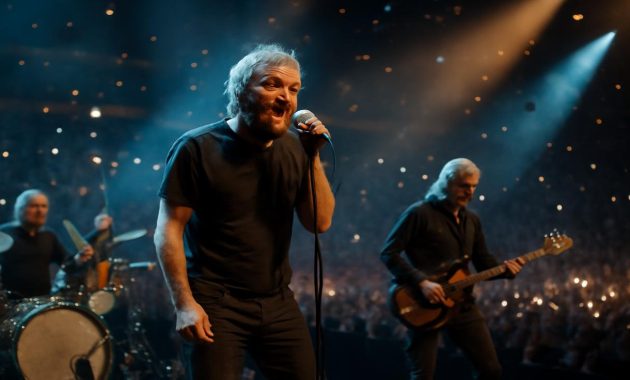
The night they finally played it for the last time, you could feel fifty years of sound hanging in the air like static before a storm. No one needed to say the song’s name. The crowd knew. The band knew. The roadies who had grown old hauling those same black cases knew. It was that song—the one they’d sworn they were tired of, the one that built their houses and paid for their kids’ school, the one people had tattooed on their skin and carved into high school desks. The hit everyone knows.
The last chord in a lifetime of noise
The arena lights dimmed to the familiar dusk-blue, the color that always came before the opening riff. Thousands of phones lifted like a field of tiny moons. From the floor, the faces were soft and damp with anticipation, lit from below. Up on stage, four figures—older, slower, shoulders a little more rounded—took their places as they had taken them countless times over half a century.
Fifty years. Half a century of sticky dressing rooms and sunrise highways; of songs tested in cramped clubs before anyone sang them back; of boring soundchecks and miraculous nights when the music seemed to set the air itself on fire. That arc led here, to this final show, to this final song. A journey ending where it had so often begun.
The guitarist—white hair pulled into a low knot, same battered sunburst guitar—stepped up, looked out, and smiled the kind of smile that knows its own ending. “All right,” he said, voice cracking and magnified across the rafters. “One more time.”
And then he hit the riff.
The song that wouldn’t let go
Every legendary career has a gravitational center, and for this band, that center was a four-minute-and-thirty-two second slice of lightning recorded in a studio that no longer exists. They wrote it, they like to say, to fill out Side A. Just another track, tracked in just another long night in 1974, when the outside world was all oil crises and cold war, and inside the walls of Studio K, it was just smoke, coffee, and a thin young singer determined to get the verses right.
They called the track “Midnight Intersection,” not that its title mattered for long. It became something else out in the wild—“that song,” “the hit,” “the one from the movie,” “the thing my parents danced to,” and eventually, simply, “The Intersection.”
You probably know the way it starts, even if you never bought the album: that clean, chiming guitar, three notes descending like a sigh; the gentle brush of hi-hat; then the bass sliding in, not flashy but inevitable. The singer’s voice, back then, was a bright blade cutting through the mix—young, defiant, almost cocky. No one in the room knew that four minutes later, they would have carved their names into the shared memory of strangers they would never meet.
When “Midnight Intersection” hit radio, it didn’t just chart—it spread. College dorms. Truck cabs. Paris cafés. Neon-stained New York sidewalks. Beach parties where sand got into the cassette deck. Sixteen-year-olds kissed to that song. People broke up to it. Bars closed and lights came on while that solo bent and cried on the speakers. For fifty years, somewhere on Earth, at almost any hour, that song has been playing.
The band wrote better songs, more complex songs, braver songs. But this was the one that never quite let them go.
The blessing and the curse of “the hit everyone knows”
The relationship between a band and its biggest hit is a lot like a long marriage: full of gratitude, cluttered with small resentments, and impossible to fully untangle. In interviews, they would roll their eyes and call it “the monster” or “the old warhorse.” They joked about performing it backward, or as a polka, just to entertain themselves.
Yet every tour, every city, the same pattern repeated. Some nights they’d stick it in the middle of the set, try to get it “out of the way.” Other nights, they’d threaten to drop it altogether, wanting people to hear the newer songs—the ones that still felt dangerous, still had wet paint on them. But then the first show without “Midnight Intersection” brought a wave of confused, then angry, then heartbroken fans. To so many people, that song was the band.
“If we don’t play it,” the drummer once said, “it’s like showing up at a wedding and refusing to dance. People invited us into their lives with that track. The least we can do is show up on the dance floor.”
So they kept playing it. Their fingers aged around those chords. The tempo slowed slightly over the decades, the way a heart learns not to sprint. The singer’s voice sank lower, softened, but the chorus still soared where it needed to. By the 2000s, the band didn’t so much perform the song as shepherd it. They seemed to guide the crowd through it, letting ten thousand voices carry the parts they could no longer reach.
Looking back, they once tried to describe their relationship with their most famous creation in simple terms:
| Era | How the Band Felt About the Song | How the Crowd Responded |
|---|---|---|
| 1970s | Proud, stunned, riding the wave | Discovery, obsession, radios blaring open windows |
| 1980s | Slightly trapped, trying to prove they were more than one hit | Nostalgic already, lighters in the air at arenas |
| 1990s | Reconciled, rearranging it, playing with the form | Multigenerational, parents bringing kids to “hear it live once” |
| 2000s | Affectionate fatigue, aware of its legacy | Sing-alongs, stadium choirs, viral live clips online |
| 2010s–2020s | Grateful, almost tender toward it | Anthemic, a ritual passed down like a family story |
The song outgrew them. Then, gently, it turned back and held out a hand.
Fifty years of weather and sound
Retirement for a rock band is never only about age. It’s about weather—emotional, physical, cultural. The weather that erodes knees and backs, that roughens vocal cords, that makes the idea of another twelve-city sprint through airports feel less like adventure and more like punishment.
But it’s also about the weather of the world. The music industry that birthed this band doesn’t exist anymore. They came up in an era of vinyl sleeves and terrestrial radio, of late-night TV performances that could reroute their whole career. They watched their songs move from LPs to cassettes to CDs to tiny invisible files living in billions of pockets. They watched everyone become their own DJ, their own archivist, their own critic.
Through all of it, “Midnight Intersection” remained unnervingly stable. It crossed formats like someone stepping between stones across a river. The band evolved, mellowed, exploded, reunited, broke up again, reconciled. The song stayed. When the streaming era arrived and algorithms began to decide what “everyone knows,” that same guitar riff still popped up in playlists with names like “Road Trip Classics” and “Your Dad’s Favorite Songs.”
Meanwhile, the band kept touring. They were never the type to disappear into mansions and nostalgia packages. They kept making new records long past the point where the industry considered such things necessary. Some of those late albums had songs as tender and complex as anything they had written in their twenties. The audiences for them were smaller but fiercer. Yet at every show, however deep they dug into recent material, however obscure they got, there came that moment halfway through the night when someone would shout from the back:
“PLAY THE HIT!”
Sometimes it was a joke. Sometimes it was a demand. Sometimes it was a plea. But underneath it was something simple and human: a desire to connect the present moment to a memory that felt safe, charged, golden. People weren’t just asking for a song. They were asking to be briefly nineteen again, or ten in the back seat, or kissing someone under bad bar lighting while that chorus swelled.
The decision to step offstage
So why stop now? Why put away the guitars and walk away from crowds that would very likely keep showing up until the last amp died? The band’s answer was as fragile and ordinary as it was profound.
“Because,” the singer explained in one of their final interviews, “we want to leave while the music still feels like music and not like a job we’re too scared to quit.”
There is an art to endings, to knowing when to let the camera pan out and the credits begin to rise. Bands aren’t always good at this. Many play on past the point of our shared illusion, when the notes feel more like obligation than incantation. This band, somehow, wanted something different. They wanted to write their own final chord.
The idea of retiring gathered slowly, like a storm building offshore. A knee surgery here, a postponed tour there. The bassist finding that long flights left him walking stiff for days. The drummer, always the engine, waking up sore in places he didn’t know he had. More poignantly, there were empty spaces on stage. Original members gone, their absence a silence you could almost hear between songs.
They’d started as kids playing for beer and attention. Now they were grandparents. Whole decades had piled up behind them. They had done what they came to do, and far beyond. There were other kinds of life calling—gardens that needed tending, grandchildren with soccer games, books unwritten, mornings without soundcheck.
So they chose a date. Announced a final tour. The phrase “farewell” sat in press releases like a strange, glittering object. Fans reacted the way people do when hearing of a distant storm headed inward: denial, bargaining, tickets purchased in panicked batches.
From the first night of that last run, every show felt like a long, slow goodbye. They dug deep into the catalog. They told stories they’d never told onstage before. They messed up and laughed. They brought out old friends. And every night, right before “Midnight Intersection,” there was a hush—an awareness that we were all marching toward one specific, historic last time.
The last time everyone sings along
On that final night, you could smell a kind of electricity—beer and popcorn and the faint medicinal tang of the fog machine, but also something nearly metallic, like the air right before rain. The band moved through the set list with the strange, tense calm of people climbing a familiar mountain for the final ascent.
When the time came, they didn’t drag it out. No twenty-minute speech, no monologue about what it all meant. Just a look between them—an entire shared lifetime of vans and bad coffee and miraculous nights in one glance—and then the riff.
The crowd’s response felt less like sound and more like weather. It rose, hit, and rolled back, carrying with it five decades of accumulated meaning. In the upper decks, you could see lips moving in sync, people who had mouthed these words alone on dark buses now shouting them into the open air. On the floor, couples held each other in that stiff, awkward way that says: If I let go, I might float away.
The singer didn’t bother chasing the high notes. He pointed the microphone outward, and the audience obliged, a single, imperfect choir. His job now was to hold space, to be the conductor of this huge, shared memory. The drummer pulled the groove a hair slower, savoring it. The guitarist leaned into the solo, not playing it note-for-note as on the record, but shading it with little bends and pauses, as if marking out all the roads he’d traveled with it.
For four minutes and thirty-two seconds, time folded. Somewhere, a teenager heard it for the first time via a shaky livestream. Somewhere else, a woman in her sixties stood in her kitchen, volume up on a small radio, feeling something unclench in her chest. In that arena, wrinkles and wrinkles-in-the-making all glowed the same blue-white in the phone light.
The last chord rang out, wavered, and finally fell into silence. For a breath, nobody moved. Then came the roar.
After the last encore
Every show has to end. The lights come up. Security starts herding people gently toward the exits. Roadies in black shirts move in, efficient and invisible, coiling cables, easing guitars into cases cloaked in scars and stickers. On this night, the usual post-show bustle was layered with something more ceremonial—like dismantling a beloved stage set knowing it will never be rebuilt.
Backstage, there were hugs that lasted longer than usual. Crew members who had been with the band for decades—who had measured their own lives in tours and album cycles—stood a little apart, watching the four musicians move through the small constellation of family and friends waiting with glassy eyes and champagne flutes. There were jokes, because how else do you greet an ending? Jabs about retirement hobbies, about which classic rock station would overplay them first now that they were officially “heritage.”
But after the noise dimmed, each of them, in their own way, had to walk out into the night as individuals rather than as pieces of a legendary machine. The singer into a quiet car, where his voice—soaked in sweat and adrenaline—finally went still. The guitarist, fingers still buzzing, flexing his hands like someone untying a long, invisible knot. The bassist and drummer, tired in their bones, already half-dreaming of mornings with no alarm except sunlight through curtains.
Out in the parking lot, fans lingered as they always do, reluctant to let the night snap shut. They traded stories: the first time they’d heard “Midnight Intersection,” the time a verse got botched in ’89 and the whole arena laughed, the way their mum used to sing the chorus off-key while making Sunday breakfast. For some, these were just anecdotes. For others, they were foundational memories, the small bricks that build a life.
The band had retired. The music, inconveniently, had not. It would keep playing from car stereos, from streaming playlists, from worn-out vinyl, from the mouths of cover bands in bars with sticky floors. New ears would find it. Old ears would return to it like a photograph pulled from a box.
At its core, this is what a legendary song does. It outlives its creators’ touring schedules, their bodies, their interviews, their arguments. It slips the leash of time and attaches itself to events it was never written for—weddings, funerals, late-night drives, quiet mornings. It becomes part of the shared emotional weather of the planet.
Somewhere down the line, a kid will hear “Midnight Intersection” with no context, no sense of fifty-year arcs or farewell tours. It will just be a melody that makes something in their chest ring in sympathy. Maybe they’ll learn the riff. Maybe they’ll start a band. Maybe, in a small and private way, the song will be the hit that they know.
Meanwhile, the four people who birthed it into the world will be doing deeply ordinary things—watering houseplants, standing in line at the post office, listening to bird song instead of amplifiers. They will carry in their bones the rhythm of applause, but they will also learn the quieter music of unspectacular days.
The band has retired after fifty years. The hit everyone knows is still out there, humming beneath our days like a distant train. And maybe that’s the most rock-and-roll ending of all: not a blaze of self-destruction, but a graceful step offstage, leaving the song to wander on its own, finding new ears, long after the last chord has faded from the arena air.
Frequently Asked Questions
Why did the band decide to retire after 50 years?
They chose to stop while performing still felt meaningful rather than mechanical. Age, health, the loss of original members, and a desire for a quieter life all played a part. After half a century, they felt they had told their story onstage and wanted to write a deliberate, graceful ending.
Did they ever get tired of playing their biggest hit?
Yes and no. At times they felt trapped by it and wished audiences would focus more on newer material. But over time, they grew to see the song as a shared ritual with fans—a responsibility and a gift. By the final tour, they approached it with deep gratitude.
Was the final performance of “the hit everyone knows” different from usual?
It wasn’t drastically rearranged or over-the-top. What made it different was the awareness in the room that this was the last time. The band leaned into the crowd’s energy, letting the audience sing much of it, turning the performance into a communal farewell.
Will their music still reach new listeners now that they’ve retired?
Absolutely. Their catalog lives on in recordings, streaming platforms, radio, and covers by other artists. For many future listeners, discovering the band will begin—just as it did for millions before—with that one song everyone seems to know.
What does their retirement mean for fans who never saw them live?
It closes the chapter on experiencing the band in person, but it doesn’t close their story. Live recordings, videos, and shared fan memories keep a version of that experience accessible. The emotional impact of their songs remains very much alive, whether heard in a crowded arena or alone in headphones.