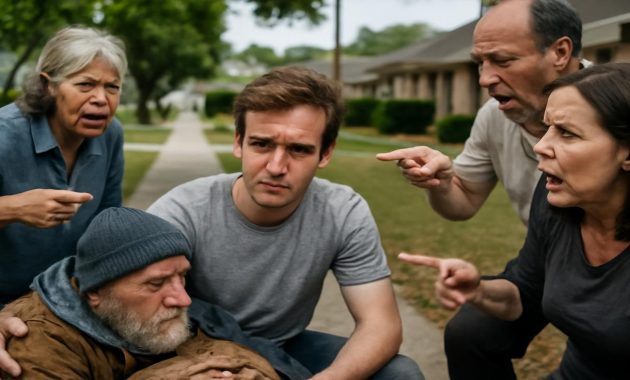
By the time the tulips opened along Maple Street, the story had already grown legs, a spine, and teeth. It started, as these things often do, with something small and soft and earnest—a single act of kindness in a neighborhood where people waved from driveways but mostly kept their troubles behind glass. No one knew that a grocery bag, a doorbell, and a murmured “thank you” would split the block into quiet factions, each convinced they were the ones who really deserved better from the world.
The Grocery Bag at the Blue House
The blue house at the corner of Maple and Tenth had always seemed tired. Its paint flaked like old sunburn, and the front steps leaned as if holding in a sigh. People walked past it on their evening loops with their dogs, glancing just long enough to think, Someone should really fix that place up, before letting the thought dissolve in the glow of porch lights and dinner invitations.
It was on one of those early spring evenings—when the air felt like it had been rinsed in cold water and hung up to dry—that Lena noticed the woman from the blue house for the first time.
The woman was standing at the curb, staring at a slip of paper in her hand like it might suddenly rearrange itself into better news. Her gray hair was twisted into something that had once been a bun. Her shoes were thin, the kind that had surrendered to too many winters. A bus roared past, spitting exhaust, and the slip of paper fluttered from her fingers to the gutter.
Lena watched from her car, engine idling. She’d seen the woman before, but only as a shadow behind the blue house’s curtains, a shape moving from room to room. Now the woman looked very small against the ragged façade of the house, as if the building itself were leaning over her, heavy with secrets.
Lena hesitated, fingers resting on her steering wheel. She could have kept driving. She was tired—everyone was tired lately. Work emails stalked her into the night; her son’s asthma was flaring; the news vibrated with catastrophe. It didn’t feel like there was much room left to worry about someone else’s story.
Still, she found herself rolling down the window.
“Excuse me,” she called out. “Do you need a hand?”
The woman turned, startled, like a deer pulled from its own thoughts. For a moment, Lena thought she might just shake her head, pick up the paper, and disappear back into the blue house.
Instead, the woman blinked, as if adjusting to being seen.
“I… I’m fine,” she said. Her voice was dry, like paper rubbed thin. “Just a mix-up with my benefits check. They, uh… it’s late.” She laughed, but it didn’t sound like laughing. “Can’t call the electric company and tell them the government’s feeling shy.”
Lena felt something tighten in her chest. “Do you… need anything? Groceries? I’m headed to the store anyway.”
The woman’s eyes did something complicated then—gratitude, reluctance, pride all bumping into one another. “You don’t have to—”
“I know,” Lena said. “But I want to.”
By the time the sky rolled into a deep indigo, Lena was back at the blue house with two bags of groceries: rice, beans, pasta, fresh fruit, a small bouquet of daisies she grabbed at the last second because the woman’s kitchen window looked like it needed color even more than it needed calories.
The woman met her at the door. The hallway behind her smelled faintly of dust and tea. The television murmured in another room.
“I’m Nora,” she said, as Lena passed the bags into her arms. “I’ll pay you back when my check comes. I keep a notebook of what I owe people.”
“You don’t owe me anything,” Lena replied. “Just… take care of yourself.”
As she turned to leave, Nora’s voice followed her down the steps.
“Thank you,” she said, and this time the words were full, like someone had put both hands around them. “You’re very kind.”
It should have ended there, as a quiet thing shared between two people. But the street—that peculiar organism of fences and front porches and sideways glances—was already paying attention.
The Whisper in the Dog-Walking Hour
The next morning, the sun rose into a washed-out sky and the neighborhood did what neighborhoods do: it hummed. Garage doors grumbled open. Coffee scented the air. The mail truck made its first cautious pass.
By late afternoon, the dog-walking hour began. This, everyone agreed, was when the real news traveled.
It was during that hour that Sarah from number 14, tugging her golden retriever away from a suspicious patch of lawn, spotted Nora stepping carefully around three full grocery bags on her small front porch. The daisies peeked out from the top of one, a small yellow rebellion against the chipped blue door.
“Well, that’s new,” Sarah murmured to her dog.
She kept walking, but not before she pulled out her phone and thumbed a message into the neighborhood group chat.
Anyone know who dropped groceries at the blue house? Looks like a delivery mix-up?
By the time she turned the corner, her screen blinked with answers.
Heard she’s on disability. Maybe a charity drop?
Could be her family helping her out.
Family? I thought she was alone. My kids say the house is haunted.
Haunted by overdue bills probably.
Then, from a number without a saved name, a simple confession:
It was me. Not a mix-up. Just helping out. —L
There was a brief pause in the digital chatter, the kind that, in an actual room, would have felt like everyone inhaling at once.
That’s really sweet of you, L.
We should all chip in! Maybe set up a schedule?
Honestly, we’re all struggling. Wish someone would surprise ME with groceries.
That last comment came from Tom at number 22. Tom, whose basement had flooded twice that winter, who drove for two ride-sharing apps on top of his day job and still checked his bank account every time he pumped gas.
Lena stared at her phone when that one came through. Her heart, which had been floating pleasantly on a shallow tide of Doing Something Good, bumped up against an invisible sandbar.
She typed, then deleted.
We’re all struggling. The words sat there on her screen, not as a reply, but as a quiet echo.
The Table of Need
That weekend, at the monthly neighborhood potluck in the cul-de-sac—an event held in all seasons, because if you skipped the cold or the heat you’d never see each other—someone dragged out a folding table and placed it near the dessert section. A handwritten sign leaned against a bowl of potato salad.
“Neighbors Helping Neighbors”
Below it, a simple grid was drawn on a large sheet of paper, secured with strips of tape that curled at the edges in the humidity. A jar of pens stood ready.
“What’s this?” Lena asked, balancing a tray of roasted carrots as she approached.
“Our very own kindness system,” said Maya, the unofficial organizer of all things Maple Street. Her hair was pulled up in a red bandana; her forearms were dusted with flour from the pies she’d brought. “If someone needs something—groceries, a ride, help with bills—they can write it down. And if someone can help, they can put their name next to it. That way, it’s not random. It’s fair.”
“Fair,” Lena repeated, slowly.
The table began to fill, first with cautious scribbles, then with more confident strokes as the evening went on.
| Neighbor | What They Need | Offered Help |
|---|---|---|
| “N” | Groceries until benefits arrive | Lena (shopping), Maya (cooking extra) |
| Tom (22) | Help with basement repair | Jared (tools), Diego (weekend labor) |
| Single dad (Bldg C) | Occasional childcare, school drop-offs | Sarah (mornings), Mrs. Patel (after school) |
| Any elder | Rides to doctor’s appointments | Rotating volunteers—sign up below |
People nodded approvingly as they passed the table. “This is how it should be,” someone said. “Organized. Transparent.”
Lena watched Nora’s line—just the initial “N,” shaky but determined—as it anchored the top row. Her earlier impulse, that private moment on the curb between just the two of them, was now pinned under fluorescent light, open for community arbitration.
She found herself thinking of a different, invisible table—one stretching far beyond Maple Street, perhaps across the entire country, maybe the whole world. A table where every person had placed down their own little card of need:
Help. I’m exhausted.
Help. The rent is due.
Help. My body hurts, but I can’t afford to stop working.
Help. I did everything I was supposed to, and it still isn’t enough.
On Maple Street, at least, they had pens and paper and a folding table and the illusion that if they just organized well enough, everyone would get what they deserved.
Who Deserves the Lifeboat?
The first crack appeared a week later, thin as a hairline fracture in a favorite mug.
It was a Tuesday morning when the garbage truck let out its mechanical sigh and rumbled away, leaving a smell of diesel and banana peels in its wake. Lena, wrestling a bag of recycling into the blue bin, caught sight of Nora at her mailbox.
“Hi, Nora!” she called.
Nora startled again, then smiled. She lifted a small bundle of envelopes in explanation.
“Bills,” she said. “They always find you.”
Her eyes flickered to something beyond Lena’s shoulder, and her smile thinned, folded, and disappeared.
Lena turned. Across the street, Tom watched them from his driveway, his arms crossed over his chest. An orange Home Depot bucket sat beside him, half-filled with tools and the metallic smell of newly cut pipe.
He didn’t wave.
That evening, the group chat lit up once more. Lena read the messages alone in her kitchen, the glow of her phone turning her reflection into a ghost in the darkened window.
I’m not saying she doesn’t need help, one message read, but I saw her son visit in a nice car the other day. Leather seats. Meanwhile I’m patching my basement with duct tape.
Wait, she has a son?
Yeah. I thought she was alone.
My mom’s on a fixed income too and doesn’t get hand-delivered groceries.
Feels like the loudest stories get the most sympathy.
No one mentioned names, but the shape of the conversation cast only one shadow.
Later that week, at the coffee shop near the bus stop, Lena overheard two neighbors talking behind her as they waited for cappuccinos.
“I mean, it’s great to help,” one said, stirring sugar into her cup with crisp little clinks. “But some people always seem to be in crisis. It’s like they collect it.”
“Everyone’s in crisis,” the other replied. “Have you seen the price of eggs?”
Lena pretended to read the notice board. Yoga classes. Lost cat. A flyer for a missing pair of glasses someone had loved enough to print in color.
Underneath, she saw a copy of the “Neighbors Helping Neighbors” chart, printed and posted, the gridlines sharp and official. Next to Nora’s request for groceries, someone had added a small question mark in pencil. It was faint but unmistakable.
Who decides, she wondered, when need is real enough? When is it a crisis, and when is it just life? If everyone feels like they’re drowning, who gets the lifeboat?
The Shame of Needing, the Anger of Not Getting
One afternoon, Lena stopped by the blue house with another bag of food—less this time, because her own grocery bill made her wince now too. The daisies had collapsed in their jar, petals browned and curling like paper on fire.
Nora opened the door slower than usual.
“I didn’t write my name on the table this time,” she said, before Lena could speak. “Maya asked if I wanted to, but… I’m tired of seeing my own handwriting in that little box.”
She stepped aside, letting Lena in. The house was dim, but tidy in the way of someone who has more time than energy. A faint radio played old standards somewhere in the back.
“People are kind,” Nora continued, lowering herself into a chair at the small kitchen table. “But they stare at you differently once they know. Even when they’re smiling. It’s like they’re measuring you against some invisible chart.”
“I’m sorry,” Lena said, sitting across from her. “That wasn’t what I wanted.”
“I know.” Nora folded her hands together. Her knuckles were the color of skimmed milk. “I was young once too, you know. I worked. I paid my bills. Raised a son. My husband died in that factory job you’re all so proud is back in town.” She paused, her mouth tightening. “Now I’m here, and everyone thinks this is who I’ve always been. A Problem.”
Lena looked at the bags on the counter. Rice, beans, pasta. Necessities that, in the wrong light, could look like charity instead of fuel.
“People are struggling,” Nora said softly. “I see it. The way they look at prices. The way they talk about their bosses. Everyone feels like the world has shortchanged them. So when I get a bag of groceries…” She exhaled, slow and shaky. “They see it as losing ground. Like there’s only so much help to go around, and I’m taking more than my share.”
Lena thought of Tom in his driveway. Of the pencil question mark. Of her own quickening heartbeat every time an unexpected bill slid through her mail slot.
“Have you ever been angry,” Nora asked suddenly, “watching someone else get what you wish you had?”
Lena swallowed. Images flickered through her mind: colleagues whose careers seemed to glide while hers potholes; friends whose parents could help with down payments; strangers online vlogging about working four hours a day in Bali. “Yes,” she admitted.
“Me too,” said Nora. “Before all this. Maybe even during. That’s the thing, isn’t it? There’s never just one kind of hurt on a street like this. It just wears different jackets.”
The Meeting on the Grass
When the scandal finally grew obvious enough that pretending not to notice felt dishonest, Maya called for a “discussion.” The word felt careful and swollen with good intentions.
They met on the patch of communal grass near the playground, where the ground was scattered with the evidence of children’s joy: a lost sneaker, a plastic dinosaur, chalk drawings half-erased by last night’s rain.
“This is getting weird,” Maya began, standing in front of the small cluster of neighbors. “Whispers about who deserves what. About who’s taking advantage. That’s not who we are.”
A murmur rippled through the group. People shifted in their camp chairs. The air smelled faintly of sunscreen and damp earth.
“Well,” Tom said, clearing his throat, “who are we? Because sometimes it feels like we’re a neighborhood where some struggles count more than others.”
Lena felt the word some like a fingertip pressing a bruise.
“I’m not saying we shouldn’t help,” Tom went on. “I am saying I work three jobs. I still can’t afford to fix my basement properly. No one shows up with a bag of… of… sump pumps.” Laughter flickered nervously around the circle. “And then I see people getting food, rides, money—over and over. It’s hard not to feel like I’m invisible because I don’t look tragic enough.”
“You wrote your name on the table,” someone pointed out.
“Yeah,” he said. “And a couple guys helped. I’m grateful. I really am. But there’s still this feeling that unless you’re the worst-off, you should shut up and be grateful it’s not worse.”
“Isn’t that… just how life is?” another neighbor asked. “We can’t all be the priority.”
“Why does there have to be a priority at all?” a voice called from the back.
It was Nora.
She walked slowly across the grass, leaning on a cane. The group shifted, parted slightly to let her through. For once, everyone looked at her directly instead of from the corners of their eyes.
“I know my name has been in your conversations,” she said. “Even when it wasn’t spoken. And I know you’ve helped me. For that, I am honest-to-God grateful.”
She took a breath that sounded like it traveled a long way through her ribs.
“But I also know something else: every one of you is carrying something heavy you don’t talk about at these potlucks. Mortgages. Medical debt. Fear. Grief. The sense that you did everything they told you to do and still ended up… here.” She gestured around them. Not at the grass specifically, but at the fragile, overextended ordinariness of all of it.
“When you see me get help, maybe it reminds you of all the times you didn’t. Maybe you think, ‘Why her and not me?’ I’ve thought that too, about other people. We’re all ready to audition for the role of Biggest Victim, because we’re certain we were shorted in the casting call.”
The group was very quiet now. Even the children at the edge of the playground seemed to hush, as if the sound of the swings had dimmed.
“But here’s the thing,” she went on. “Deserving doesn’t work the way we think it does. It’s not a ladder where the higher your pain climbs, the more rungs of help you earn. It’s not a game where there’s only one winner. If we turn every act of kindness into a debate about worthiness, we’ll all lose. Not just the ones at the bottom.”
“So what then?” Tom asked. “We just… help everyone? We can’t. We’re not rich. We’re barely holding it together.”
“No,” Nora said. “You help where you can. You say yes when it’s honest, and no when it has to be no. But you stop telling yourself that because you’re hurting, someone else’s hurt is a threat. You stop treating kindness like a resource that runs out faster if you spend it on the wrong person.”
Lena watched the wind ruffle the grass around their ankles. She thought of how quickly her good deed had become a yardstick. How easily the story had shifted from “Look how we can care for one another” to “Look how unfair the caring is.”
She raised her hand, feeling slightly ridiculous, like they were in school.
“I didn’t ask you first,” she said to Nora. “Before I told everyone I helped. I made your need public without your permission. I’m sorry.”
Nora’s gaze softened. “You were trying to build a bigger net,” she replied. “You didn’t know the net would start to feel like a spotlight.”
“Maybe,” Maya said slowly, “the problem isn’t that we’re helping the wrong people. Maybe it’s that we’re trying to do charity while living in a system that makes most of us feel one bad day away from asking for it.”
Someone snorted. “So we’re going to fix the entire system here on this lawn?”
“No,” Maya said. “But we can decide what kind of neighbors we want to be inside of it.”
The Smallest Possible Shift
The scandal didn’t end with a grand resolution. No petition was signed proclaiming once and for all who deserved what. The grid on the “Neighbors Helping Neighbors” sheet stayed, but it changed.
Requests grew less specific, more honest:
Need: Someone to talk to. Tired all the time and don’t know why.
Need: Help navigating medical bills. I’m lost.
Need: A night off from cooking. Three kids. Will trade for yard work.
People started writing not just what they needed, but also what they could offer, however small:
Can Offer: Listening. Good at forms and phone calls.
Can Offer: Extra garden veggies. And bad jokes.
Can Offer: Rides on Tuesdays. One spare seat in the car.
The acts of kindness became less cinematic, more mundane. Less about swooping in with a cape, more about showing up with a casserole, a socket wrench, a spare hour. People still compared, of course. Old habits cling like burrs. But the comparisons dulled, becoming more self-aware, less sharp-edged.
One evening, as the sun laid a thin gold coin of light over the roofs, Lena left another bag at Nora’s house. This time, it was half-full: some fresh fruit, a loaf of bread, and a small jar of jam Nora liked.
Back at her own door, she found a bag waiting for her. Inside, there was a note in familiar, slightly shaky handwriting.
Lena,
I can’t pay you back in money. But I can cook. There’s a pot of stew on my stove with more than I can eat. Come by when you’re free and bring a container.
—Nora
She held the note to her chest for a moment, surprising herself with the sting in her eyes. It was a small thing. Just stew. Just an old woman refusing to be only a recipient. Just two people feeding each other in a world where everyone was, in some way, hungry.
On Maple Street, the blue house still looked tired. The paint still peeled. The steps still leaned. But sometimes, when you walked past at the right hour, you could catch the smell of something warm drifting from its kitchen, mixing with the sounds of children on bikes and the low hum of someone’s television.
In that ordinary music of the neighborhood, the scandal shrank down to its true size: not a question of who really deserves help, but a reminder that everyone believes their hurt is the one the world has overlooked. The trick, maybe, was not to argue whose pain was real, but to remember that there is no contest, no trophy, no ultimate victim who wins.
There are only people knocking on each other’s doors, hands full of something they hope will be enough, knowing it never really is—but offering it anyway.
FAQs
Why did a simple act of kindness cause tension in the neighborhood?
Because many neighbors were already under stress—financially, emotionally, and socially. Seeing help given to one person highlighted their own unmet needs and created a sense of competition over limited resources, even though that competition was more emotional than literal.
Is it wrong to feel jealous when others receive help?
No. Jealousy in this context is a human response to feeling overlooked or overwhelmed. The key is what we do with that feeling—whether we turn it into resentment and judgment, or into awareness of our own needs and empathy for others.
How can communities offer help without creating shame or scandal?
By centering consent and dignity: asking people how they want to be helped, avoiding public labeling of “the needy,” and encouraging everyone to name both what they need and what they can offer. Shared responsibility feels different from top-down charity.
What if I want to help someone but I’m struggling myself?
Help doesn’t have to be financial or grand. It can be time, skills, rides, listening, sharing food, or helping with forms and phone calls. It’s also valid to set boundaries and say no when you can’t help without harming yourself.
How do we decide who “deserves” help in a world where everyone feels like a victim?
We may never find a perfect formula for deserving. Instead of ranking pain, we can focus on proximity, capacity, and consent: help where you are, with what you have, for those who ask or clearly need support—while remembering that someone else’s help doesn’t mean there’s less humanity left for you.