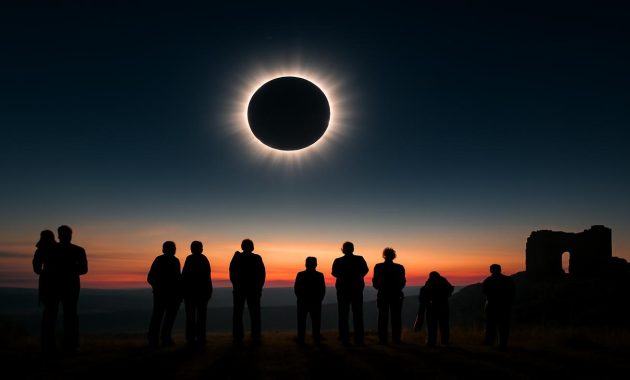
The first thing you’ll notice isn’t the darkness. It’s the hush. A bird cuts off its song mid-note. The air cools by a degree you can actually feel on your bare arms. Shadows sharpen, then turn strangely blurred at the edges. People around you, who were talking a little too loudly a minute ago, fall silent. Somewhere far out on the horizon, the light turns metallic, like someone dimming the world with a slow, deliberate hand. And then, just as your brain begins to protest that afternoon doesn’t work this way, the Sun itself grows a thin, impossible bite.
When Noon Forgets It’s Daytime
On the day the longest total solar eclipse of the century crosses the sky, noon will briefly forget that it is daytime. Over the course of a few hours, the Moon will trace a dark path across Earth, lining up so precisely with the Sun that it will turn brilliant daylight into deep, twilight-colored shadow.
This isn’t the kind of eclipse you catch from the corner of your eye through office windows. This is a rare, slow-moving event that astronomers have been circling on their calendars for years. From remote rural fields to high mountain plateaus, from dense cities to fishing villages, millions of people will step outside, cardboard glasses in hand, to watch the sky perform something that feels suspiciously like magic—only this time, the trick is written in gravity and geometry.
At its longest, totality—those heart-stopping minutes when the Sun is completely hidden—will stretch longer than any other eclipse this century. The Moon’s shadow, known as the umbra, will carve a carefully plotted trail across our planet, lingering just a little longer than usual as orbital mechanics line up in our favor. It is as if the cosmos decided, just this once, to hold the curtain closed a few extra moments.
To experience it fully is to stand in the middle of a grand, slow-motion transformation. Color drains from the world in an almost painterly way. Greens of grass turn to muted silver; reds become darker, browner. The sky deepens into a shade that isn’t quite night, nor day—an indigo dome holding a Sun that is suddenly only a ring of fire.
The Slow Dimming: How an Eclipse Unfolds
Most people remember the dramatic climax of a total solar eclipse—the sudden darkness, the gasps, the moment of totality. But the story begins about an hour before the Sun disappears completely, in a phase that’s more subtle and strangely intimate.
At first, the Sun looks only slightly imperfect, as if a cosmic mouse took a tiny nibble from its edge. Through proper eclipse glasses or filtered telescopes, that first encroaching curve of darkness is a perfect arc, the Moon’s silhouette sliding silently across the Sun’s face. Minute by minute, the bite grows deeper. The light around you begins to feel “off.” Colors look washed. The world seems a little too bright and a little too dim at the same time.
Shadows tell you the truth before your eyes fully trust it. Look at your hands. Look at the leaves on the ground. The gaps between them no longer form ordinary ovals or soft-edged smudges. Instead, they become hundreds, maybe thousands, of tiny crescent Suns scattered across the sidewalk, a secret pattern only visible during those few fleeting moments of partial eclipse.
The temperature drops more rapidly now. A faint breeze stirs, as air responds to cooling land. Animals begin to react. Bees hurry back to their hives. Cows in distant fields may drift toward their nighttime resting spots. Crickets tentatively clear their throats, confused by the signal that day is, perhaps, ending earlier than scheduled.
The Moment the World Holds Its Breath
As the last sliver of Sun narrows into a shining thread, the light takes on a sharp, otherworldly quality. This is the edge of totality, the brink. The landscape looks oddly flat, the way it does in old photographs. Your sense of time stretches. People fidget with their eclipse glasses, checking, waiting, trying to time the moment just right.
Then, on the edge of the shrinking crescent, bright beads of light appear—tiny flashes called Baily’s beads, sunlight streaming through mountain valleys on the Moon’s rim. For a second or two, a single brilliant point of light remains, like a sparkling diamond set in a black ring. This “diamond ring” effect is the sky’s final, dazzling announcement: totality is here.
Everyone around you pulls off their eclipse glasses in near-unison, and there it is: the Sun, gone—yet still impossibly present, transformed into a perfect black disk surrounded by a ghostly, flowing corona.
Inside the Moon’s Shadow
Totality lands like a soft shock. In the span of a heartbeat, day plunges into a strange, shimmering darkness. Streetlights, confused by the deepening gloom, may flicker on. Venus or Jupiter could suddenly appear, bright and crystalline in the darkened sky, along with a sprinkling of stars that have no business being visible in the middle of the day.
The corona, usually drowned in the Sun’s ferocious brightness, now spills outward in pearly streams and delicate rays. It looks alive, as if it were made of silk fire or breath. No photograph, no matter how exquisite, quite matches the way it moves in real time, subtle structures shimmering and stretching in delicate loops and plumes.
Some people gasp. Others laugh or cry, without entirely knowing why. There is something ancient and primal about standing inside the Moon’s shadow, watching the Sun become a black hole in the sky ringed with light. The human nervous system, tuned by millions of years of predictable sunrises and sunsets, doesn’t have an easy category for “midday night.”
On the ground, colors shift again. The horizon glows in a full circle—an eerie 360-degree sunset, orange-pink light at every compass point while overhead the sky remains deep and dark. It’s as if you are standing in the center of an enormous bowl, its rim lit with twilight.
For scientists, these are the most precious minutes of all. Telescopes pivot and lock onto the hidden Sun, recording data about the corona’s shape, temperature, and violent outflows of charged particles that stream across the solar system. Instruments measure how Earth’s atmosphere reacts—the rapid cooling, the shifts in wind, the subtle changes in ionization high above.
What Makes This Eclipse So Long—and So Rare?
Not all total solar eclipses are created equal. Some last mere seconds in any given location; others, like this century’s longest, linger for precious minutes. The difference comes down to a finely tuned cosmic choreography.
Totality lasts longest when three things line up in our favor. First, when the Moon is near its closest point to Earth in its orbit, it appears slightly larger in the sky and can fully cover the Sun with some extra margin. Second, when Earth is near its farthest point from the Sun, the Sun appears a bit smaller, again making the Moon’s job easier. Third, the path of the Moon’s shadow stretches across Earth in such a way that the geometry allows for a more extended overlap.
You can think of it as celestial stamina. On this particular day, the Moon’s shadow will have more staying power, sliding across Earth in slow, deliberate motion. In some parts of the path, totality will last long enough for observers to fully absorb the transformation—time to look up, look around, and look back up again, to see how the corona subtly changes, how the sky’s colors shift, how their own emotions rise and fall.
Unlike more fleeting eclipses, this one will invite people to settle into the darkness for a few lingering breaths of time, to notice things they might otherwise miss: the way a distant hilltop glows like embers on the edge of the shadow, or how the corona’s shape hints at the invisible magnetic fields sculpting it, or the way the calls of birds stack together into an improvised nocturne.
A Planet Pauses to Look Up
Long before the first bite appears on the Sun, the world beneath will already be stirring. In cities that lie along the eclipse’s path, hotels will fill months, even years in advance. Small towns will brace for an influx of visitors that could temporarily double or triple their population. Highways will turn into streams of quiet anticipation as cars drift toward the line of totality in the predawn hours.
In schoolyards, students will decorate cardboard with hand-painted Suns and Moons. Amateur astronomers will haul out carefully aligned telescopes and solar filters. Families will pack picnic baskets, sunscreen, and the oddly humble piece of equipment that makes safely watching the eclipse possible: those crinkly, dark-lensed glasses that transform the blazing Sun into a comfortable orange disk.
The eclipse will not belong to any one group. On a single hillside, you might find a researcher muttering delightedly over a spectrograph reading, a couple huddled under a blanket sharing a thermos of coffee, a teenager trying to record everything on their phone, and a grandparent whose first eclipse memory dates back decades. Language barriers soften when everyone is staring at the same sky.
Even far from the path of totality, people will step outside to watch a partial eclipse—where the Moon takes a visible chunk from the Sun but never covers it entirely. Offices may empty onto sidewalks. Construction workers might pause, hard hats tipped back slightly, eclipse glasses perched over their usual eye protection. The scale of participation transforms this rare celestial alignment into a kind of global ritual.
Seeing It Safely: A Quick Guide
For all the wonder an eclipse inspires, the Sun remains as dangerous to unprotected eyes as ever. The only time it is safe to look directly at the Sun without protection is during the brief window of totality—when the Sun is completely covered and only the corona is visible. Before and after that, you need proper eye protection.
Here are a few simple ways people will be watching this historic event:
| Viewing Method | What It Is | Key Safety Note |
|---|---|---|
| Eclipse Glasses | Special glasses with filters that block almost all sunlight. | Use only certified eclipse glasses; regular sunglasses are not safe. |
| Solar Filters on Telescopes/Binoculars | Filters placed over the front of optical equipment. | Never look through unfiltered optics at the Sun, even briefly. |
| Pinhole Projectors | A simple device that projects an image of the Sun onto a surface. | You watch the projection, not the Sun itself. |
| Natural Leaf Shadows | Tiny gaps between leaves project crescent Suns on the ground. | Great for ambiance, but still avoid looking directly at the Sun. |
| Live Broadcasts | Video coverage from multiple locations along the eclipse path. | Perfect option if you’re outside the path or clouded out. |
For those fortunate enough to stand under the path of totality, there will be one surreal, unforgettable moment when it is safe to remove the glasses. The Sun will be completely hidden; only the corona will blaze in the dark sky. People will have just a few minutes—no more—to drink it in with unfiltered eyes before the first piercing bead of sunlight returns, demanding that the glasses go back on.
A Living Laboratory in the Sky
To many, the eclipse will feel like art: a moving, celestial installation of light and shadow. To scientists, it is also an exquisitely timed experiment—one they cannot repeat at will.
Along the path, teams of researchers will be scattered like beads along a necklace, each station recording its own segment of totality. Some will study the Sun directly, tracking the structure and behavior of the corona as solar activity waxes and wanes. Others will focus on Earth’s atmosphere, measuring how quickly temperatures drop, how winds shift, and how upper atmospheric layers respond to the sudden, temporary dimming.
Biologists, too, will be watching. Previous eclipses have revealed unexpected behavior: spiders dismantling their webs as if night has fallen, flowers closing their petals, fish swimming to deeper waters. With the luxury of a long totality, scientists will have time to observe more nuances in this swirl of responses.
Even your phone may become part of the data trail. Some projects invite citizens to record temperature readings or soundscapes (like changing bird calls) before, during, and after the eclipse. Each observation adds a pixel to the larger picture, helping to build a more detailed understanding of how an entire planet reacts when its primary light source flickers off and back on again.
What the Eclipse Reveals About Us
In the flurry of telescopes and data logs, it’s easy to forget another, quieter experiment that happens with every total solar eclipse: we get to see ourselves differently. There is a particular humility in watching the Moon’s shadow sweep across continents, indifferent to borders, politics, or time zones.
Under that shadow, strangers stand shoulder to shoulder, faces tilted upward, all looking at the same, singular thing. Conversations drift between languages but share the same shapes of awe: the quick intake of breath, the soft, disbelieving exhale, the barely whispered, “Look at that.”
For a few minutes, whatever usually tethers our attention—screens, schedules, notifications—loosens its grip. The sky, so routine and predictable most days that we barely glance at it, demands our full attention. Day becomes night and then day again in under three hours, as if to remind us that even the most familiar rhythms can contain rare and staggering surprises.
After the Shadow Passes
Just as it arrived, the darkness leaves in stages. The first returning point of sunlight, that fierce new “diamond” on the Sun’s edge, feels almost startling. Instinctively, people reach again for their eclipse glasses. The corona fades from view, swallowed once more by the Sun’s overpowering brilliance.
The world brightens unevenly, light pouring back into the sky but leaving behind, for a moment, a strange emotional afterimage. Birds resume their songs, though a little hesitantly at first. The temperature creeps back up. Colors flow into the landscape again, as if someone has gently turned the saturation dial.
Conversations rise like returning tide. People compare notes—what they saw, what they felt, what surprised them. Someone might admit they didn’t expect to be emotional but were. Another might say the corona was thinner, or wilder, or more delicate than they’d imagined. A child might ask when the next one will be, already plotting a future journey into the path of another moving shadow.
By late afternoon, the day might look perfectly ordinary again. Traffic moves. Shops reopen. The sky settles into its usual, familiar blue. Yet for those who watched, something has shifted. The memory of standing in the Moon’s shadow, watching day turn to night and back again, will hover at the edge of everyday life like a quiet, shining secret.
Years from now, people will remember where they stood during this eclipse: on a beach where waves darkened under a ring of fire; on a farm where cows turned slowly toward an unexpected dusk; on a city rooftop, where the sudden night made neon lights flicker like confused stars. They’ll remember cold air on their arms, the way the horizon glowed all around, the collective breath that the world seemed to hold.
And somewhere, someone will step outside on an ordinary day, look up at the Sun, and feel that familiar quickening of curiosity: that great blazing disk, so constant and unyielding, once vanished in plain sight. If it can disappear—for a moment—what else might we be taking for granted?
When the longest total solar eclipse of the century has come and gone, its shadow will still linger in stories told and retold. The Sun will be as steady as ever, the Moon still circling, but for a few minutes of one extraordinary day, millions of people will have shared the same, wordless astonishment as day slowly, beautifully, and impossibly turned into night.
Frequently Asked Questions
How long will totality last during this eclipse?
At its longest point, totality will last several minutes—longer than any other total solar eclipse this century. The exact duration depends on where you are along the path, but some locations will experience more than six minutes of total darkness.
Is it safe to look at the eclipse with the naked eye?
It is only safe to look with the naked eye during the brief period of totality, when the Sun is completely covered and only the corona is visible. At all other times before and after totality, you must use proper eclipse glasses or indirect viewing methods to protect your eyes.
What if I’m not in the path of totality?
If you’re outside the path of totality, you may still see a partial eclipse, where the Moon covers part of the Sun. While it won’t get fully dark, you can still experience dimming light and crescent-shaped Sun images through safe viewing methods. Live broadcasts can also bring the full effect of totality to you.
Why do animals act strangely during an eclipse?
Many animals rely on light cues to guide their daily rhythms. When the sky suddenly darkens and temperatures drop, they may interpret it as evening arriving. Birds may roost, crickets may start chirping, and other creatures may shift into nighttime behavior, all within a span of minutes.
How often do total solar eclipses happen?
Total solar eclipses occur somewhere on Earth roughly every 18 months, but any given location may experience totality only once every few hundred years. That’s why people often travel great distances to stand in the path of the Moon’s shadow when it does sweep across the planet.
Do I need special equipment to enjoy the eclipse?
You don’t need complex equipment, but you do need proper eye protection, such as certified eclipse glasses or a safe projection method. Simple tools—like a pinhole projector or even the dappled light under a tree—can reveal beautiful effects. A pair of your own eyes, protected and fully present, is the most important “instrument” of all.
What makes this eclipse so special compared to others?
This eclipse stands out because of the exceptional length of its totality, making it the longest of the century. That extended duration gives scientists more time to study the Sun and Earth’s atmosphere and gives observers more time to absorb the awe of day turning to night and back again. It is a rare alignment not just of celestial bodies, but of science, story, and shared human experience.