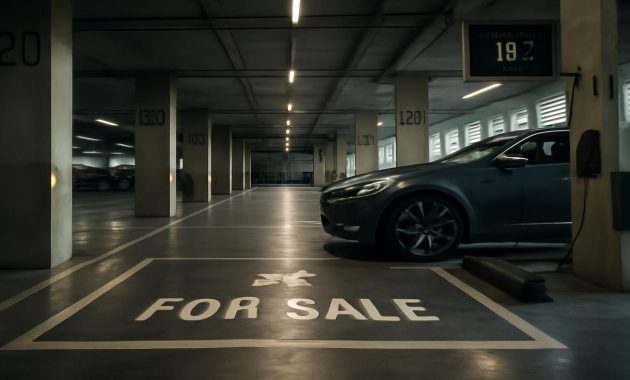
The first time you stand in a silent, concrete parking garage at midnight, it doesn’t feel like “real estate.” It feels like a leftover space, a kind of afterthought carved out beneath the bright lives of apartments and offices above. Fluorescent lights buzz. A late train rumbles under the city. Somewhere, a car alarm chirps and falls quiet. This doesn’t look like the sort of place you’d “invest” in—yet in 2026, people are running numbers on these empty rectangles of paint on the ground and wondering: is this 8% yield waiting to happen, or just a future resale headache covered in brake dust?
The Strange Allure Of A Single Parking Space
It usually starts with a tiny listing. An email alert. A conversation at a dinner table.
“They’re selling spaces in that new building near the station,” a friend says, between forkfuls of pasta. “Eight percent yield, they reckon. No tenants, no broken boilers. Just park-and-pay.”
Your brain does a little calculation on the fly. A studio flat means a mortgage, furnishing, void periods, calls about leaky taps. A parking space is… a rectangle of asphalt. No kitchen to replace, no carpets to clean. In cities where car ownership is still high and on-street parking is a blood sport, the idea of owning a guaranteed spot feels almost romantic. A tiny island of certainty in a sea of circling cars.
The pitch is seductive in its simplicity. You buy a space in a private garage or a purpose-built car park. Commuters or residents pay you monthly. The managing agent handles the access fobs and the snarl of daily admin. You collect the rent and watch your yield float around that eye-catching 7–8% line. That’s how the brochure tells it, anyway.
But property trends in 2026 are like weather in early spring: shifting, temperamental, and never quite what you expect when you leave the house. To see whether that shiny projected yield is real, you have to step out of the brochure and into the real spaces—the jammed streets, the half-empty EV chargers, the shifting zoning maps pinned on city hall walls.
Reading The City’s Parking Pulse
Start with a walk. Not with spreadsheets or abstract numbers, but with actual footsteps.
On a weekday evening, you wander around the neighborhood where you’re thinking of buying. Look at the curbs. Are they lined with double-parked cars, hazard lights blinking while drivers wait for a spot to free up? Do you see “Residents Only” signs bristling from lamp posts, like warning flags? Or do you notice an easy rhythm: delivery vans, a few cars, but plenty of spaces a short stroll from the main drag?
Standing at a street corner, you begin to get a feel for something that the sharpest yield spreadsheet can’t show you: pressure. Real, gritty parking pressure. In certain districts—the office cluster by the station, the historic quartier with narrow streets—pressure is high enough that paying a steady fee for off-street parking feels like a bargain. In others, especially newer suburbs with wide roads or areas under active “car-lite” planning, demand quietly drains away.
By 2026, more cities are pushing hard on cycling lanes, bus corridors, congestion charges, and low-emission zones. In those same council meetings, planners are occasionally whispering a heresy: “What if we don’t need so much parking?”
For an investor, that’s the tectonic plate underneath your potential 8% yield. You’re not just buying 12 square meters of painted concrete. You’re betting on how people will move through that neighborhood over the next ten or fifteen years.
Counting The Cost Beneath The Surface
Eventually, of course, the numbers do call you back. Even in the most evocative multi-storey, with its diesel tang and echoing footsteps, this is still a spreadsheet game.
Imagine a single space in a modern city-center development. The developer sets the price at a level that makes homeowners pause: perhaps enough to buy a small apartment outright in a cheaper town. The hook, again, is the promised rental return.
| Item | Example Amount (Annual) |
|---|---|
| Purchase price | $40,000 (one-off) |
| Gross rental income | $3,200 ($267/month) |
| Service/maintenance fees | $400 |
| Insurance & admin | $150 |
| Net income (before tax) | $2,650 |
| Net yield | ≈ 6.6% |
On paper, that looks respectable. Not the fabled 8%, but still solid compared to many residential rentals weighed down by regulations and refurbishments. But it’s the parts that don’t fit neatly into a table that can turn an investment either into a quietly humming asset—or into the space you stop mentioning at parties.
What if the building’s management company raises the service charge because the lift in the underground car park needs replacing? What if they suddenly require all owners to contribute to adding EV chargers? What if the city introduces a workplace parking levy that makes your commuter tenants rethink driving at all?
These questions float in the fluorescent light like dust motes. A space might be low-maintenance, but it’s not no-maintenance. The concrete might not complain like a tenant, but the rules around it can change faster than you expect.
Yield Today, Uncertainty Tomorrow
To understand 2026’s parking investments, you have to look in two directions at once: down at your immediate yield, and forward at the shape of streets five, ten, fifteen years from now.
In the short term, parking demand is still stubborn in many cities. Tradespeople need vans. Families ferry kids and groceries. Suburban commuters balk at unreliable trains. Even with rideshares and scooters buzzing around, the car still owns a large chunk of physical and psychological space.
So that 6–8% yield often appears, in the early years, almost on schedule—especially if you’ve bought in a well-chosen location: near a major transit hub but in an area where residents can’t easily get permits, for instance, or in a dense district where older buildings never had garages to begin with.
Longer term, the road narrative is shakier. Many governments are nudging, coaxing, or shoving drivers toward electrification and shared mobility. Some are re-zoning lots where car parks sit, especially open-air ones, for housing or green space. New developments are sometimes deliberately under-provisioned with parking to force a behavioral shift.
Will your future buyer want what you own? If parking minimums are abolished and people move around differently, the market for a private bay might shrink. Or—if cities add more restrictions on street parking—it might tighten and drive values up. You’re not just an investor. You’re, in a small way, a forecaster of how asphalt will be used.
The Hidden Character Of A “Good” Parking Space
Ask an experienced parking investor and they’ll talk about spaces the way some people talk about vintage wines. There are subtle qualities, they’ll insist, that most first-time buyers overlook in the haze of high-yield promises.
Is the space in a secure, gated garage with good lighting, or in a gloomy corner where people feel uneasy walking alone at night? Security matters: not only for theft, but also for the type of tenant you attract—premium, long-term parkers or bargain-hunting daily commuters who churn frequently.
Is access straightforward? A generous ramp, clear signage, a reliable barrier system? Or do drivers have to navigate a tight spiral that scrapes bumpers and patience alike? The easier it is to glide in and out, the more consistent your occupancy will tend to be.
Then there’s the question of the “extra.” In 2026, that usually means EV-readiness. An on-site charger—or at least the infrastructure that allows one to be installed—can future-proof a space. A bay wired for a charger speaks directly to the growing wave of electric-car owners who discover that street charging is both inconvenient and unpredictable.
Private Bay Or Part Of A Bigger Machine?
Some investors fall in love with the idea of owning individual titles: a single space here, two there, each bought outright in a residential or mixed-use scheme. Others are drawn toward managed parking lots, where their capital is part of a larger operation run like a business—dynamic pricing, app-based booking, weekend event rates.
The first model feels tangible and personal. You can stand in “your” spot, run a hand over the cold concrete pillar next to it, and feel like you truly own a piece of the city. The second feels more like owning a slice of infrastructure, a parking machine that churns away while you sleep.
Both approaches have their quirks. Single-title spaces rely heavily on the building’s management and rules. A change to the lease conditions, a major structural repair to the garage, or a dispute with the freeholder can ripple through your returns. Pooled or managed parking, on the other hand, ties you to the operator’s competence. Prices, marketing, maintenance—all in their hands, not yours.
For a quiet, semi-passive income, many people lean toward residential-style spaces rented to long-term tenants. For a more entrepreneurial, hands-on approach, public-facing lots and partnership with parking platforms can offer upside—but with more moving parts and risks.
When A Parking Space Turns Into A Puzzle
On a gray afternoon, years after buying, imagine you find yourself in a lawyer’s office. The fluorescent light hums here too, but the air smells faintly of paper and old coffee instead of rubber and dust. You’re selling your space. Or trying to.
The buyer’s solicitor has questions. Lots of them. Who owns the freehold? How long is left on the lease, if it’s leasehold? Are there rights of access that could be revoked? Have there been any disputes with the managing agent? Is the space truly transferrable to someone who doesn’t own an apartment in the building?
This is where the “resale headache” part of the equation often appears. Liquidity for parking spaces can be thinner than for residential property. Fewer buyers search “parking bay” than “two-bed flat.” Some banks are reluctant to lend against a pure parking asset. In some developments, rules restrict sales to existing residents only, shrinking your buyer pool.
If, over the ownership period, yields dipped—because of rising fees, local transport changes, or vacancies—you might find yourself holding something that neither throws off great income nor sells quickly. It is still a tangible thing; it just isn’t a liquid one.
The Subtle Art Of An Exit Strategy
Going into a parking investment in 2026 without an exit plan is like driving into a city without knowing how to get back to the highway. You might enjoy the journey, but you also might find yourself stuck in a confusing one-way system.
Before buying, it’s worth quietly asking agents: who typically buys these spaces locally? Owner-occupiers who live in the building? Nearby businesses for staff? Speculative investors? Is there a record of previous transactions, and how long were they on the market?
If your only realistic exit is to sell to another investor chasing yield, last year’s rent numbers become your main bargaining chip. Any negative trends—higher fees, lower occupancy— can drag price expectations down. A space in a prime, tightly parked neighborhood has a better chance of dodging this. One in a marginal area, where demand was always fragile, may not.
The best time to think about resale is painfully early, when you’re still being charmed by brochures promising “hassle-free income.” Asking: “Who will want this after me?” is a far more powerful question than “What does the yield look like this year?”
So: 8% Yield Or Resale Headache?
In the half-light of a real car park, the answer is less binary than the headline makes it sound. A parking space in 2026 is neither a guaranteed golden ticket nor a guaranteed dead end. It’s a sharp little investment blade that can cut either way, depending on how and where you wield it.
In the right place—where traffic is heavy, public policy is still car-tolerant, and there’s a chronic shortage of secure off-street parking—a well-bought space can indeed hum along at an impressive yield. It can be that rare thing in real estate: a simple, almost elegant income stream, with minimal day-to-day drama.
In the wrong place—where transport is improving, car ownership is slowly falling, or regulations are shifting—the same painted rectangle can become an awkward relic of an older way of moving around. It might still be useful to someone, but not necessarily at a price or speed that makes you smile.
If you decide to wade into this world, do it with both your senses and your spreadsheets awake. Walk the streets. Count the cars. Talk to locals about how hard it is to park on a rainy Tuesday night. Read the fine print on leases and service charges. Think of EVs, zoning plans, and how your city wants its streets to feel in ten years.
And as you stand there, in that quiet garage, breathing in the cool air and listening to the occasional drip of water from a pipe overhead, remember that investing is often about paying close attention to things most people overlook. Sometimes, that’s a forgotten corner of forest or a disused rail line. Sometimes, in 2026, it’s a space drawn in white lines on a patch of concrete beneath a city that’s still deciding what to do with its cars.
Frequently Asked Questions
Is investing in a parking space still profitable in 2026?
It can be, but profitability is highly location-dependent. In dense areas with limited on-street parking and strong car dependence, yields around 6–8% are still achievable. In areas moving aggressively toward car-lite policies or with plentiful free parking, returns can be weaker and more volatile.
What should I look for when buying a parking space?
Focus on demand drivers: nearby offices or apartments without parking, transport hubs, restrictions on street parking, security, lighting, and ease of access. Check service charges, lease length, ownership structure, and any rules that limit who you can rent or sell to. EV readiness is increasingly important.
Are parking spaces easy to resell?
They’re generally less liquid than residential flats. Buyer pools are smaller, some lenders won’t finance them, and certain developments restrict sales. A prime, well-located space can still sell reasonably quickly; a marginal one may sit on the market for months.
How risky is it compared to buying a small apartment?
Different risks, not necessarily lower. You’ll have fewer maintenance headaches but more exposure to changes in transport policy, parking regulations, and local car ownership trends. Rental laws are often simpler, but resale and financing can be more challenging.
Who is a parking space investment best suited for?
It tends to suit investors who want relatively low-hassle, asset-backed exposure to property, are comfortable researching micro-locations in detail, and can afford to hold long term if the resale market slows. It’s rarely a good fit for those needing quick, guaranteed liquidity.