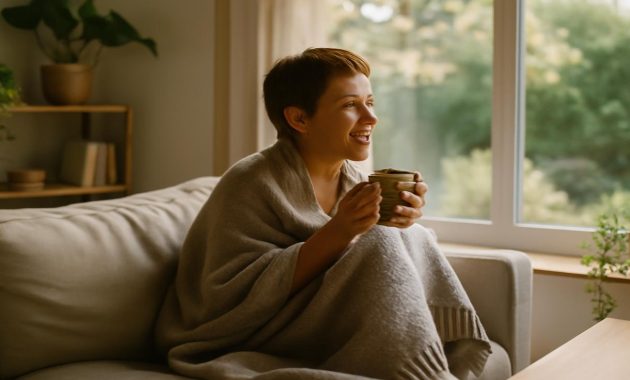
On certain evenings, when the sky bruises purple and the noise of the day finally loosens its grip, you might feel it—that slow, spreading relief that comes the moment the last social obligation ends. The door clicks shut behind you. The kettle begins to murmur on the stove. Your shoulders fall from around your ears. It’s as if your nervous system has been waiting, politely, for everyone to leave so it can finally exhale. You’re not angry at anyone. You’re not avoiding life. Yet there is a simple, quiet truth: you feel calmer alone than you do with other people.
The Hidden Symphony of Your Nervous System
Imagine that inside you is a small orchestra—strings, brass, flutes, drums—constantly tuning to the room you’re in. When you’re with others, that orchestra is listening, adjusting, checking the tempo of the conversation, the tone of someone’s voice, the micro-shifts in mood and facial expression. Without realizing it, your body is scanning: Are we safe? Are we accepted? Are we OK?
Neuroscientists call this continuous scanning “neuroception”—your nervous system’s automatic way of detecting safety or threat, long before your thinking mind has caught up. In social situations, especially unfamiliar or emotionally charged ones, your neuroception can go into overdrive. Your heart beats a little faster, your muscles hold a bit more tension, and your brain shifts into a state of subtle vigilance. You’re not panicking, but you’re not fully at rest either.
Now, picture yourself alone—no one’s gaze to track, no sentence to carefully craft, no emotional undercurrent to decode. Your internal orchestra gets to play its own music, on its own schedule. The strings soften, the brass quiets, and the percussion settles into a calmer, slower rhythm. What you feel as “calm” is actually a shift in your nervous system: away from monitoring others and back toward simple, internal regulation.
Internal regulation is the capacity to soothe, ground, and steady yourself from the inside out. Some people rely heavily on external regulation—needing other people’s presence, reassurance, or feedback to feel safe. Others are wired so that they find their deepest ease when they return to themselves. If you’re in that second group, solitude doesn’t just feel comfortable; it feels like your most natural baseline.
Why Your Brain Works Harder Around Other People
There’s a reason your energy drains faster at a crowded gathering than on a long solo walk, and it’s not just about being “introverted.” The human brain is a social prediction machine. When you’re with others, your mind is constantly running tiny simulations: What will they say next? How should I respond? Did that joke land? Are they bored, annoyed, confused? This happens even when you’re not consciously anxious.
Psychologists sometimes describe this as “social load,” the invisible mental weight of reading and responding to people. It’s like having extra browser tabs open all the time: monitoring tone, tracking group dynamics, remembering details, planning your next move. For some, especially those who are sensitive, empathetic, introverted, or neurodivergent, that load can be heavy.
When you’re alone, the social prediction engine idles. Your attention shifts away from other people’s facial expressions and toward your own internal landscape—the taste of your tea, the steady rhythm of your breath, the feel of socks on your feet, the texture of silence. Your brain moves out of performance mode and back into presence.
You might notice how your thoughts arrange themselves differently in solitude. Ideas unspool more slowly. Memories drift to the surface without being hijacked by someone else’s story. You’re no longer unconsciously mirroring another person’s posture, mood, or pace. Instead, your body picks its own tempo, often slower, often softer. This is your nervous system taking a long drink of water after crossing a crowded, noisy desert.
When Calm Alone Is Not Isolation
There is a quiet stigma that lurks beneath a preference for being alone. Culture often glorifies constant connectivity: group chats that never sleep, open-plan offices, social calendars packed like overstuffed suitcases. Wanting time by yourself can be mislabeled as antisocial, avoidant, or even selfish. But psychology draws a sharp line between healthy solitude and painful loneliness.
Solitude is chosen. Loneliness is imposed. In solitude, you feel anchored in yourself, even if there’s no one else in the room. In loneliness, you feel cut off, even in the middle of a crowd. That calm you feel alone—the sense of being more yourself, more attuned, more at peace—is a sign that your solitude is serving you, not harming you.
Many people who feel calmer alone are actually deeply caring, deeply attuned to others. They might be the ones who notice subtle shifts in mood, who sense when someone is uncomfortable, who feel the emotional “weather” of a room as if it’s their own skin. This sensitivity, while beautiful, can be draining. It’s not that you don’t like people; it’s that being around them asks a lot of your nervous system.
Psychologically, occasional withdrawal is a form of self-preservation. It’s the psyche saying: I need to hear my own voice for a while. I need to come back to neutral. When you heed that message, you’re practicing a form of emotional hygiene. Just as sleep resets your body, solitude resets your emotional circuitry.
The Difference Between Coping and Disappearing
Of course, any strength can slide into a shield. Solitude that starts as nourishment can quietly morph into a bunker. The key distinction lies in how you feel after your alone time. Do you emerge clearer, softer, more open? Or do you emerge even more anxious about engaging with others, more convinced that the world is too much and people are too dangerous?
Healthy internal regulation has a rhythm: you step out to recharge, then step back in when you’re ready. Unhealthy withdrawal gets stuck on the “step out” part. If your alone time is filled with dread about the next time you’ll have to interact—or if you feel like you’re disappearing from your own life—then what’s at play may be more than temperament. Anxiety, past relational wounds, or depression can all masquerade as “I just like being alone.”
But at its best, solitude is not an escape from humanity; it’s a way to return to it without losing yourself. It’s a pause button, not a permanent shutdown. The calm you feel alone is your system reminding you that you have an inner home, one you can always come back to—even in a room full of people.
Internal vs External Regulation: A Small Map of Calm
One way to understand your preference for being alone is through the lens of regulation styles—how you stabilize your emotional state. Some people rely primarily on external regulation: a reassuring text from a friend, a hug, a conversation, shared laughter. Others lean toward internal regulation: breathing, self-reflection, creative expression, movement, quiet.
| Aspect | Internal Regulation | External Regulation |
|---|---|---|
| Main Source of Calm | Within yourself (breath, thoughts, body) | With others (support, reassurance, presence) |
| Typical Preference | Alone time, quiet spaces, reflection | Company, conversation, shared activities |
| Feels Draining When | There is constant social contact, little privacy | There is too much isolation, not enough contact |
| Growth Edge | Letting others support you without feeling overwhelmed | Building inner tools to self-soothe without always reaching out |
Most people use a blend of both, but your nervous system usually has a favorite. If you feel calmer alone, your system may simply be better practiced at internal regulation. You might reach for journaling before calling a friend, or choose a long bath over a busy café. When something upsets you, your first instinct might be to retreat, think, and feel on your own.
There’s a quiet strength in this. Internal regulators tend to know themselves deeply: what overstimulates them, what grounds them, what they value. They often have a rich inner world and a fine-tuned sense of their emotional landscape. This doesn’t make them superior to external regulators—just differently wired.
Psychology suggests that the healthiest pattern is flexibility: being able to anchor in yourself, but also reach out when you need others. If you can say, I’m going to take tonight for myself and also, I’ll call someone tomorrow if this still feels heavy, you’re walking the middle path. Solitude is your anchor, not your prison.
How Your Senses Help You Self-Soothe
Internal regulation is not just about thoughts; it’s profoundly sensory. When you decompress alone, notice how you instinctively reach for certain experiences. The smell of coffee or incense. The weight of a blanket. The sound of rain recordings or soft music. The way your hands move as you cook, paint, play an instrument, or run them under warm water.
These sensory rituals are not trivial preferences—they’re how your nervous system downshifts. Research on self-soothing shows that repetitive, gentle sensory input can signal safety to the brain: slow breathing, rocking, humming, tactile textures, rhythmic sounds. You might not be thinking, I am now regulating my vagus nerve, but in your own private way, you are.
When you’re alone, you can curate your sensory world without compromise. No competing playlists, no clashing energy, no sudden interruptions. The lighting is how you like it. The volume is set to “just enough.” The space is saturated with familiar cues that whisper: You’re safe here. Over time, your body learns this. It starts relaxing faster each time you return to these rituals, like a well-worn path savored under bare feet.
Social Burnout and the Myth of “Too Sensitive”
Some people are more susceptible to what’s often called “social burnout”—that bone-deep fatigue that hits after too many interactions, even pleasant ones. If you’re highly sensitive, introverted, or neurodivergent, your threshold for stimulation may simply be lower than the cultural norm. Noise, lights, overlapping conversations, and emotional tension can all stack up, quietly overwhelming your system.
Instead of seeing this as a flaw, imagine it as having a finely tuned instrument for a nervous system. It picks up more detail, more nuance, more frequency. But with that sensitivity comes over-responsiveness; you get saturated sooner. Alone, the input shrinks. Your environment becomes more predictable, your choices more tailored. What’s left is not emptiness, but clarity.
Reframing “I Can’t Handle People”
If you often tell yourself, I just can’t handle people, look a little closer at what, specifically, you can’t handle. Is it small talk? Crowds? Conflict? Loud environments? The feeling of being watched or evaluated? The pressure to respond quickly? Naming the actual strain points helps separate your true nature from your coping strategies.
Often, the truth is gentler: It’s not that you can’t handle people; it’s that your body struggles with constant stimulation and unspoken expectations. It’s not that connection is impossible; it’s that your version of connection needs more space, slowness, and sincerity. Realizing this can soften the self-judgment. Preferring solitude becomes less of a verdict on your worth and more of an honest acknowledgment of your wiring.
From there, you can make kinder choices: smaller gatherings instead of giant parties, one-on-one conversations instead of group debates, quieter spaces instead of chaotic ones. You’re not opting out of humanity; you’re choosing conditions where your nervous system doesn’t have to white-knuckle its way through.
Building a Life That Honors Your Inner Quiet
If being alone is where your system resets, the question becomes: how do you build a life that respects that need without cutting you off from meaningful connection? The answer lies less in dramatic reinvention and more in small, consistent acts of alignment.
You might start by noticing your natural cycles. When in the day do you feel most fragile, and when most steady? When does socializing feel more possible—morning, afternoon, or night? Knowing your own internal tides helps you schedule life in a way that doesn’t constantly push you into depletion.
Tiny Agreements With Yourself
Consider making quiet agreements with yourself, like:
- I will give myself at least one truly unscheduled evening a week.
- After any long social event, I will plan a buffer of solitude before the next thing.
- I will choose fewer, deeper relationships over many shallow ones.
- I will pause and check in with my body before saying yes to invitations.
These aren’t rules; they’re forms of self-respect. Over time, such agreements become an internal promise: I won’t abandon myself to keep up with a pace that doesn’t fit me.
At the same time, internal regulation doesn’t mean doing everything alone. It can mean knowing when to lean out and when to lean in. You might practice letting a trusted person into your inner quiet—someone who can sit with you in silence, share a slow walk, or talk softly over tea without demanding performance. Relationships like this expand your sense of safety: you learn that you can be with others without betraying your own nervous system.
In this way, your solitude becomes a bridge, not a wall—a solid base from which you can choose connection, rather than defaulting to it from fear of being alone.
Letting Your Calm Be Real
Underneath all the theories and terms, there is a simple, lived experience: sometimes you only feel fully exhaled when no one else is around. Your body unhooks from the day’s social choreography. Your mind loosens its grip on what others think. You return, quietly, to yourself.
Psychology helps name this as internal regulation, sensory self-soothing, nervous system downshifting. It gives you language for why relief floods your chest when plans get canceled, or why you crave an empty house the way others crave a crowded bar. But you don’t actually need a diagnosis or a label to legitimize this. Your calm is evidence enough.
You are not cold for wanting space. You are not broken for feeling better in your own company. You are a person whose inner world is vivid and whose nervous system needs regular shelter from the storm of stimulation. When you honor that, something in you aligns. You stop fighting your nature and start working with it.
And paradoxically, the more you root in that inner calm, the more spacious your presence can become when you do choose to be with others. You arrive less frayed, less defended, more whole. You’re not asking them to regulate you, nor letting them erode you. You’re simply bringing your own weather—steady, grounded, quietly clear—into the shared sky.
So when the evening comes and you feel that familiar pull toward an empty room, a dim lamp, a soft chair, and your own thoughts, notice what’s really happening. Your nervous system is turning toward its oldest, surest refuge: the slow, deliberate rhythm of your own inner life. That calm is not a retreat from who you are. It is who you are, finally given enough quiet to be heard.
Frequently Asked Questions
Is preferring to be alone the same as being introverted?
Not always. Many introverts do feel calmer alone, but some socially anxious or burned-out extroverts also crave solitude. Introversion is about where you get energy (from within rather than from groups), while a need for alone time can also come from sensitivity, stress levels, or life circumstances. The key is how you feel after solitude—restored or more isolated.
How do I know if my alone time is healthy or a sign of anxiety or depression?
Healthy solitude usually leaves you feeling clearer, steadier, and more able to re-engage with life. If your alone time is filled with numbness, hopelessness, dread of contact, or a sense that you’re disappearing, it may be linked to depression or anxiety. Persistent low mood, loss of interest in things you love, or fear of social interaction are signals worth discussing with a mental health professional.
Why do I feel drained even after spending time with people I like?
Liking someone and being energized by their presence are not always the same. Your brain and nervous system may still be doing a lot of work—tracking emotions, navigating conversation, adjusting your behavior. If you’re sensitive or easily overstimulated, even positive interactions can tax your system. This doesn’t mean your relationships are wrong; it simply means you need recovery time built in.
Can I become better at regulating myself around others?
Yes. You can practice micro-regulation even in social settings: slowing your breath, feeling your feet on the ground, taking short breaks, or briefly stepping outside. Choosing quieter environments, smaller groups, and relationships that feel emotionally safe also helps. Over time, your nervous system can learn that connection and calm can coexist, especially when you honor your limits.
How can I explain my need for alone time to friends or family?
It helps to frame it as care, not rejection. You might say, “I recharge by having some quiet time. It helps me show up more fully when we’re together,” or “When I take space, it’s not because I don’t value you; it’s how I reset my brain and body.” Being specific—like asking for a night off plans after a busy week—can make your needs clearer and less personal for others.