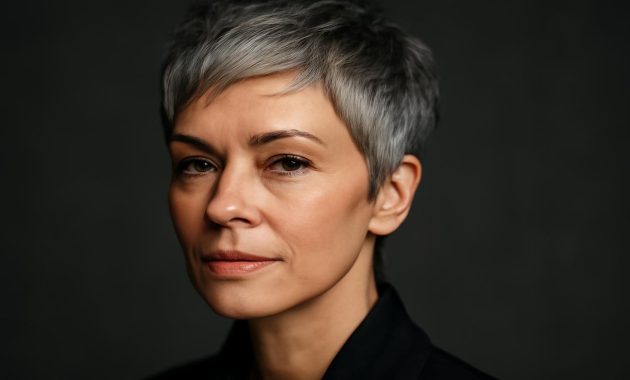
The first time you see yourself in the mirror with a pixie cut after 50, it can feel like stepping into a brighter room. Suddenly your jawline is sharper, your eyes look bigger, and there’s this lightness—like you’ve put down a heavy bag you didn’t realize you were carrying. You touch the back of your neck, surprised at the softness of the air against newly bare skin. It’s a little shocking, a little thrilling, and somewhere in the middle of that surprise is a quiet realization: you look younger. Not in a trying-too-hard way, but in that “Oh, there you are” kind of way, like you’ve reintroduced yourself to the version of you that laughs easily and doesn’t apologize for taking up space.
The Secret Message of a Short Cut
There’s something quietly rebellious about choosing a pixie cut after 50. For decades, the unspoken rulebook suggested that “age-appropriate” hair meant safe lengths and gentle layers, neat bobs and sensible styling. Long hair was for youth; short hair was for practicality. But a modern pixie doesn’t whisper practicality—it announces intention.
When you walk into a salon and say, “Let’s go short,” you’re not simply changing your hairstyle. You’re changing your story. You’re saying, “I get to decide who I am now.” And that decision can erase years from your face, not because short equals young, but because confidence does.
That’s the real magic: a pixie cut frames your face so closely that whatever you’re feeling is amplified. If you feel tentative, the cut will show it. If you feel curious, playful, ready for your next chapter—that radiates through every inch of that short, feathered frame. The goal isn’t to look 25 again. It’s to reveal the kind of vitality that makes people think, “She looks incredible. What changed?”
Of course, there are tricks—small, specific, practical ones—that can make that pixie work like a natural facelift: lifting your features, brightening your eyes, and softening the places time has etched its stories. Think of these four tips as subtle camera filters for real life, except you don’t swipe them on a screen—you build them into the cut, the texture, the color, and the way you style it.
Tip 1: Choose the Right Pixie Shape for Your Face
Pixie cuts after 50 aren’t one-size-fits-all; they’re more like custom tailoring. The right shape can visually lift your cheekbones, soften a strong jaw, or balance a fuller face. The wrong one can sit like a helmet and age you faster than any wrinkle ever could.
Start with your face shape, but don’t treat it like a strict rulebook—think of it as a helpful map:
- Round face: Go slightly longer on top with volume at the crown and a bit of height. Soft, side-swept bangs and slightly tapered sides can elongate your face and make your features look more sculpted.
- Square or strong jaw: Ask for a layered pixie with textured edges and movement around the temples. Wispy, asymmetrical bangs can blur those sharp angles in the most flattering way.
- Oval face: Lucky you—most pixie styles work. You can play with micro fringes, messy layers, or a sleek, close-cropped cut and still look balanced.
- Heart-shaped face: Choose a pixie with a bit of length around the ears and at the nape, plus softness near the chin line. This balances a wider forehead and draws attention to the eyes.
When you sit in the salon chair, don’t just say, “I want a pixie.” Say, “I want a soft, layered pixie with movement,” or “a choppy, modern pixie that lifts my cheekbones.” Use words like soft, textured, piecey, feathered, or undone. Those are your 10-years-younger words. Avoid “blunt” or “severe” unless you’re deliberately going for high-drama editorial (and you know exactly what that looks like on you).
Ask your stylist to keep a smidge more length around the hairline at the nape and in front of the ears. That delicate framing does wonders: it softens your profile, makes your neck look longer, and gives you that effortless, slightly tousled look instead of the strict, too-short, schoolboy cut that can harden features.
Tip 2: Let Texture Do the Heavy Lifting
Texture is where the pixie cut becomes a time machine. The right texture doesn’t just make your hair look fuller—it makes your whole face look more awake. As we age, hair tends to lose some density and bounce, especially around the crown and hairline. A flat, smooth pixie can cling to your head and highlight that loss. But bring in some texture—soft, lifted, a little bit messy—and suddenly it looks intentional, modern, alive.
Imagine running your fingers through your hair and feeling it move instead of sitting stiff and fixed. That movement catches the light, draws the eye upward, and adds dimension. It’s like adding contrast to a photo—everything sharpens a little.
Ask your stylist for point cutting or razor texturizing instead of blunt layers. This creates feathered edges that blend into your hair rather than sitting on top of it. Tell them you want “easy, finger-styling” hair, not a cut that demands a round brush and 20 minutes of your life every morning.
At home, the products you use are crucial—not to create that crunchy, 1990s hair, but to add airy definition. A tiny amount of lightweight styling cream, paste, or mousse can lift the roots and create that undone, youthful movement. You’re aiming for “I woke up like this” energy, not “I just left a blow-dry bar.”
| Hair Need | Best Product Type | How It Makes You Look Younger |
|---|---|---|
| Fine or thinning hair | Light volumizing mousse or foam | Adds lift at the crown, makes hair look fuller and more lively. |
| Flat top, no movement | Texturizing spray or dry texture mist | Creates airy texture that gives a fresh, modern, effortless vibe. |
| Frizz and coarse strands | Soft styling cream or smoothing balm | Tames fuzz without flattening, keeps the hair looking polished, not puffy. |
| Lack of definition | Light paste or pomade (matte finish) | Defines pieces and fringe, framing the face and eyes. |
Go easy: use less product than you think, then add more if you need it. Overloading fine or aging hair can make it look greasy instead of glowing. The guiding question every morning should be, “Does this look like my hair, but more awake?” If the answer is yes, you’re in the right zone.
Tip 3: Play With Color and Shine Like It’s Your Best Accessory
A pixie cut after 50 puts everything on display: your cheekbones, your eyes, your neck—and your hair color. Without longer lengths to diffuse things, flat or overly dark color can suddenly feel harsh. The trick to looking a decade younger with your pixie is to think in terms of light rather than just color.
Human eyes instinctively associate light, reflection, and glow with youth and health. So, when your hair gleams—even in a soft, subtle way—it sets off a chain reaction: your skin looks smoother, your eyes brighter, your whole expression more relaxed.
If you’ve gone naturally silver or white, a pixie can turn that into your most striking feature. Ask your stylist about gentle toners to keep your silver from yellowing and maybe adding a hint of icy or soft beige tone to prevent it from looking dull. Silver hair, when cut close and styled with intention, can look more rock-star than retiree.
If you color your hair, consider softening your shade slightly. Instead of a flat, inky brown or uniform black, choose a mix of tones—subtle highlights or lowlights that are just one or two shades away from your base. This doesn’t scream “I color my hair”; it whispers “My hair catches the light beautifully.” Around the face, ask for very delicate, face-framing brightness. That’s where the “10 years younger” magic often lives: a whisper of light around the eyes and cheekbones.
Even if you don’t change your color, add shine. Aging hair can become more porous and matte. Weekly masks or glossing treatments can restore some of that natural reflection. When light bounces off your short hair, it creates an almost halo effect around your head, lifting your features instead of casting shadows.
Don’t forget eyebrows, either. A bold pixie paired with sparse brows can look unfinished, like a beautiful painting in an empty frame. Gently defining your brows—keeping the shape soft, not overly arched—balances your new, open hairstyle and pulls everything together in a way that feels polished but not heavy.
Tip 4: Style With Softness, Not Perfection
The difference between a pixie that ages you and a pixie that makes you look brighter, freer, and younger often comes down to this: perfection is the enemy. Hair that is too set, too stiff, too “done” can add years. Hair that moves, bends, and has a bit of personality erases them.
Close your eyes and picture a younger version of yourself: did your hair sit in one exact position all day? Probably not. It moved, it fell into your eyes, you pushed it back with your fingers. That’s the feeling you want to recreate—even if your life now includes reading glasses and a more patient sense of time.
When you style your pixie, think “soft edges”:
- Let a few pieces fall forward onto your forehead instead of flattening everything back.
- Push the top slightly to one side, then muss it with your fingers so it doesn’t look too precise.
- Keep the sides a touch closer to the head if you prefer a sleek look, but don’t shellac them into place.
- If you wear glasses, let your pixie skim lightly around the frames rather than fighting them; they can be part of your overall style story.
Short hair is wonderfully fast to style, but that doesn’t mean it has to be boring. There are days when you might want it sleeker and more classic, and others when a bit of extra texture and height feels right. The key is making sure you can shift between those moods in under five minutes. If your pixie needs a complicated blow-dry each time, it isn’t serving you.
Run your hands through it throughout the day. Tuck a little behind your ear. Ruffle the crown. This kind of movement keeps the cut alive and frames your face in ever-so-slightly different ways as you move through your day. People won’t see a “haircut”; they’ll see a woman who looks comfortable in her own skin.
Let Your Personality Lead the Cut
Underneath all the advice about angles and texture and shine lives a deeper question: What story do you want your hair to tell about you now? Because that’s what really makes a pixie cut after 50 look younger, fresher, more compelling—it’s the alignment between who you feel you are and what the world sees.
If you’re naturally bold, a sharper, more dramatic pixie with pronounced bangs or an undercut at the nape might feel like home. If you’re soft-spoken and reflective, a gently layered, feathered pixie that brushes your ears and forehead may match your inner tempo. If you’re mischievous and playful, a choppy, piecey top with a bit of height might echo that sparkle in your eye.
The women who look astonishingly youthful with short hair aren’t just blessed with good bone structure—they’re aligned. Their hair isn’t fighting them; it’s amplifying them. And that’s available at any age, for any face, for any hair type.
So when you sit in the chair and the cape goes around your shoulders, take a breath. Feel that tiny thread of nervousness, that flutter of anticipation. Imagine how you want to walk out: lighter, more visible, less hidden. Tell your stylist not only how you want your pixie to look, but how you want it to feel on your head and in your life: “I want it to feel easy,” “I want it to feel fun,” “I want to feel like myself, but brighter.” Those words will guide their scissors as much as any photo reference.
And when that first lock of hair falls to the floor, remember: you’re not just cutting off length. You’re cutting away the old stories about what a woman “should” look like after 50. In their place, you’re writing your own—short, strong, luminous, and absolutely present.
FAQs: Pixie Cut After 50
Will a pixie cut make me look older instead of younger?
It can, if it’s too harsh, too flat, or not tailored to your face. A youthful pixie has softness, texture, and movement. As long as you avoid overly severe lines, heavy styling, and flat, one-dimensional color, a pixie is more likely to lift and open your features than age them.
What if my hair is thinning—can I still wear a pixie?
Yes, and in many cases a pixie is the best option. Short, layered hair can make thinning areas far less noticeable than longer hair, which tends to separate and expose the scalp. Ask for subtle layers and light texturizing, then use gentle volumizing products at the crown.
How often will I need to get my pixie trimmed?
Most pixie cuts look their best with trims every 4–6 weeks. Because the shape is so defined and close to the head, even a small amount of growth can change the silhouette. Regular trims keep it looking intentional rather than overgrown.
Can I keep my gray hair with a pixie and still look youthful?
Absolutely. In fact, a pixie can make gray or silver hair look chic and modern. The key is keeping the tone fresh—ask for a toner or gloss to reduce brassiness and add shine. Soft, healthy-looking silver paired with a flattering pixie reads as confident and stylish, not “giving up.”
What should I tell my stylist to get the best result?
Bring a couple of photos of styles you like and say how you want the cut to feel: soft, textured, modern, low-maintenance. Mention your face shape, whether you wear glasses, and how much styling time you’re willing to invest each day. Ask specifically for a layered, textured pixie with a bit of softness around the face, and be honest about what you’ll realistically do at home.