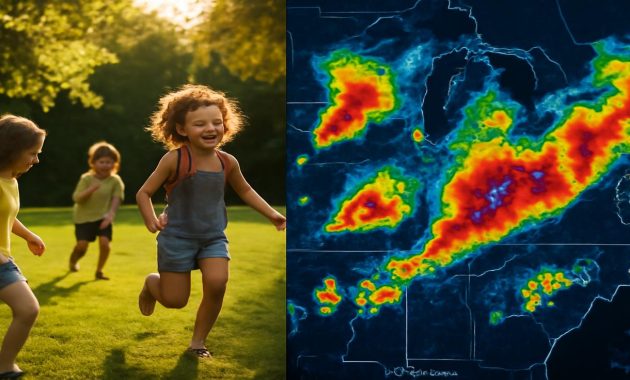
The last weekend of summer vacation arrives the way a song fades out on the radio—slowly, then all at once. One afternoon you’re barefoot on a warm sidewalk, the next your phone is buzzing with school supply lists and weather alerts in the same breath. You stand at the kitchen counter, the smell of sunscreen still lingering on beach towels piled by the door, and your screen flashes: Severe Thunderstorm Watch. Or maybe it’s a heat advisory, or a hint that a tropical system is swirling somewhere offshore. Either way, the final, fragile days before back-to-school suddenly feel like they’re under negotiation with the sky itself.
The Forecast That Interrupts the Summer Spell
It starts in the smallest, quietest ways. The light changes first. The sun sets a little earlier, throwing longer shadows across playgrounds and backyard fences. Evening carries that first, almost imaginary edge of coolness, like the season is clearing its throat. Then the alerts roll in.
Your weather app, usually glanced at to see whether to pack sunglasses or a hat for the day, now looks like a dashboard in a cockpit. Color-coded warnings spill across maps of your region: yellow for thunderstorms, orange for heat, dark red for something more serious off the coast. The last weekend before school is supposed to be simple: one more cookout, one more beach day, one more late night catching fireflies or watching movies in a living room tangled with blankets and snack crumbs. Now, it’s layered with uncertainty.
Parents start texting: “Are we still doing the park on Saturday?” A coach wonders if that final preseason scrimmage will be rained out. A teenager weighing whether to go to the lake or the mall has to factor in radar loops and humidity indexes. Somewhere between planning a barbecue menu and checking backpack zippers, adults find themselves decoding cloud patterns like amateur meteorologists, sniffing the air before deciding if it’s worth filling the cooler.
This is the moment when the abstract idea of “changing weather patterns” drops into the small, immediate theater of late August life. Not as a headline on a news site, but as a question about whether you can squeeze one more swim in before the storm sirens sound.
The Sky’s Mixed Messages
Step outside on this kind of weekend and the world may not look particularly alarming. The air might hang heavy, warm and floral, crickets rehearsing their evening chorus from hedges and fields. Kids chalk hopscotch grids on the pavement, their voices bouncing off the quiet houses. A dog sprawls under a maple tree, squinting against the brightness. Nothing screams “weather alert” just yet.
But if you pay close attention, the sky is telling a more complicated story. High overhead, thin cirrus clouds might smear the blue like distant brushstrokes, the first sign of moisture being pulled in from somewhere far beyond the horizon. Or the cumulus towers begin to build, innocently puffy at midday, ominously muscled by late afternoon. You notice the wind tug once, then again, at the leaves. A maple’s underside flashes silver in the breeze, and your grandmother’s voice echoes in your memory: “Leaves turning over—storm’s coming.”
It’s a strange in-between. The weekend is still summer by any calendar or thermometer, but the mood feels transitional, restless. In many regions, that uneasy feeling is backed by data: late August and early September often bring unstable air masses, clashing temperatures, and the peak of tropical storm season. So while you’re packing notebooks into a backpack, the atmosphere is busy running its own chaotic equations overhead.
That’s the thing about weather alerts now—they’re not just about immediate danger; they’re shaped by bigger trends. Warmer oceans can turbocharge storms, hotter cities can trap heat longer, and dry surfaces can flip into flash floods after a sudden burst of rain. Instead of a neat, predictable “one last sunny weekend,” many people face a forecast that looks like a mood ring: uncertain, reactive, and capable of changing fast.
What’s Really Coming: More Than Just “Bad Weather”
On your phone, the warnings are compact: a few lines, a time range, maybe a map. But inside those red boxes and shaded polygons is an entire lived experience waiting to unfold. When forecasters say “scattered severe thunderstorms,” they’re compressing a whole sensory world into statistics.
In one neighborhood, that might mean an afternoon that starts with distant rumbles, that low percussion you feel in your chest before you hear it with your ears. The sky dims from the edges inward, like someone slowly lowering a dimmer switch on the day. The air shifts from heavy and stagnant to sharply alive, wind threading through tree branches, snapping flags taut against poles. A smell rises from asphalt and soil—a dark, metallic scent of ozone and dust, like the earth holding its breath.
And then: the first fat raindrops, cold against sun-warmed skin. Maybe you’re midway through grilling burgers or spreading out towels on the lawn when they spot the concrete, large and separate at first, like coins tossed from some invisible hand. Children squeal, adults glance at each other, half amusement, half calculation: ride it out, or scramble inside?
In other regions, “weather alert” reads very differently. It’s a heat advisory that warns of temperatures soaring into triple digits even as the school bus routes are being finalized. On that last weekend, instead of wind and thunder, the danger is invisible and slow. Pavement radiates like a griddle, playground equipment too hot to touch. Metal seatbelt buckles brand fingertips. A simple back-to-school shopping trip requires timing it early or late, water bottles slotted into every cup holder.
And on the coasts, the phrase that appears in late August can change the tone of an entire weekend with just two words: tropical system. It may be days away, its path uncertain, its name not yet chosen or already flashing across news tickers. You stand in a grocery aisle in front of shelves of bottled water and canned beans and feel the thin line between “normal” and “preparation mode” blur. One more beach day, or one more run to the hardware store for batteries and plywood? The weather alert forces you to choose how you’ll tell the story of this weekend years from now.
Kids, Storms, and the Art of the Last Long Day
For kids, the last weekend before school is already charged with feeling. It’s a threshold: part excitement, part dread, part curiosity about new teachers and classmates. Layer a weather alert on top of that, and the air thickens with a new kind of suspense.
A child standing at the window watching a wall of rain march down the street isn’t thinking about climate models or historical averages. They’re thinking: Will I still get to swim later? Will the fireworks be canceled? Will our family picnic be ruined? To a ten-year-old, the sky can feel personal in a way grown-ups sometimes forget. When a storm cancels that final sleepover or makes a power outage interrupt a movie marathon, it’s not an abstract “event”—it’s the summer itself being cut short.
Yet there’s also an odd magic in those weather-twisted afternoons. The way a whole neighborhood can fall quiet under heavy rain, all the usual weekend sounds muffled. The way candlelight turns an ordinary living room into a small, glowing ship in a dark ocean when the power blinks out. Board games appear, flashlights become props in invented stories, and the outside world recedes to the steady drum of water on rooftops.
It becomes a kind of rehearsal, too. Fire drills and safety talks aren’t just school rituals; they’re echoes of nights you’ve already spent counting seconds between lightning and thunder, or filling bathtubs before a storm “just in case.” Families develop mini-scripts for these weekends: who brings the flashlight, who checks the batteries, who texts the neighbors if the streets flood. Children absorb it all, learning—sometimes without realizing it—how to live with a sky that doesn’t always cooperate.
When a Weather Alert Becomes the Main Character
Scroll through social media on a weekend like this and the weather is no longer background scenery. It’s the main character, center stage. Photos of radar screens, videos of whipping trees, time-lapses of fog rolling over hills, snapshots of thermometers glowing an almost surreal red. The weather alert that pinged everyone’s phone becomes a shared reference point, a collective plot twist.
There’s a strange camaraderie in it. Someone posts from a suburban cul-de-sac: lawn chairs soaked, grill covered hastily with a tarp, captioned “So much for burgers.” Someone farther out in the countryside films hail clattering onto a tin roof, the sound like marbles poured from a jar. In the city, a clip shows rain pooling at curb edges, taxis throwing up sheets of water as they pass. All of it, stitched together, becomes the unofficial documentary of “that last weekend before school when the storm hit.”
In some places, the story is gentler: a weather alert that never quite lives up to its threat. The storms split and slide north and south, leaving your town in a pocket of humid, anticlimactic calm. The grilling goes on, the pool stays crowded, and the biggest drama ends up being a popped balloon or a spilled drink. You shake your head at the unneeded alerts—until you remember the times they weren’t unnecessary at all.
Because in other years, other regions, the same kind of alert preceded something nobody in town will ever forget. A school whose first day back was postponed because the building lost its roof. A main street turned temporary river. A playground littered with branches where kids had swung just hours before. The line between ordinary inconvenience and lasting memory is thin, and often decided by a front that stalled or shifted just a few miles.
Packing, Planning, and the Tilt Toward Autumn
Inside the house, while the sky deliberates, the rituals of the season continue. New shoes lined up by the door. Tags still dangling from backpacks. Folders and pens spread across the dining table like a classroom exploded in your home. In the background, a muted weather channel loops satellite images, or the radio murmurs about “unstable air” and “watching the coastline.”
Parents juggle more than logistics now. There’s the desire to squeeze joy out of every remaining hour and the quiet urgency to be prepared if the forecast escalates. You can feel the push and pull in your own body as you study the radar: the tug toward one more carefree afternoon outdoors and the prickling awareness of risk.
It can help to zoom out—not in the digital map sense, but in perspective. Late-summer weekends now have patterns as familiar as school supply aisles. Certain regions almost expect wildfire smoke to tint the sky, or humidity to smother the mornings, or tropical rains to arrive with unnerving punctuality. A weather alert on this particular weekend is not a surprise guest; it’s more like that relative who always shows up uninvited yet expected.
Still, knowing that doesn’t make the choice between canceling and continuing any easier. So you improvise. You move the picnic under a pavilion. You shift the time of the hike to early morning, when the heat index hasn’t yet climbed into the danger zone. You angle box fans in windows, freeze water bottles, clear the storm drain in front of your driveway. It isn’t surrender; it’s a kind of choreography with the forecast, a negotiated dance with what the sky intends.
Regional Weekends: A Patchwork of Weather Stories
Across different regions, this same weekend under alert can feel radically different. Imagine a patchwork quilt of scenes, each square shaped by local climate and tradition. Here’s a compact snapshot of how the last weekend before school can play out under weather alerts in different areas:
| Region | Typical Alert | How the Weekend Feels |
|---|---|---|
| Coastal areas | Tropical storm/hurricane watch | Beach days weighed against supply runs; boards on windows and sand still in the car. |
| Inland suburbs | Severe thunderstorm warning | Cookouts on standby, lightning apps checked between refilling lemonade and lighting citronella. |
| Urban centers | Heat advisory / air quality alert | Sidewalks shimmery with heat, parks thinned out at midday, late-night breeze walks instead of afternoon outings. |
| Mountain towns | Flash flood watch | Hikers eye the sky, trails crowded early, creek crossings weighed more carefully than usual. |
| Drought-prone regions | Red flag (fire weather) warning | Campfires canceled, smoky horizons, sprinklers off even as lawns fade to straw. |
Put together, they sketch a portrait of a planet in transition, not only between summer and fall, but between the climate rhythms our parents knew and the ones our kids will inherit. The last weekend before school is simply where those global patterns intersect with grocery lists, bus schedules, and bike rides around the block.
Finding the Story You’ll Remember
When people look back on “that year” of school, they often anchor it to weather without even realizing it. “Oh, that was the year the first week was delayed because of the storm.” “That was the year the heat wave wouldn’t break, even in September.” “That was the year we watched the river rise on live TV.” The atmosphere becomes part of the curriculum in a way no syllabus can capture.
This is what’s really coming, beneath the icons on your app and the text of your local alerts: more weather woven directly into the personal stories we tell. More nights where the family stands on the porch watching lightning spider across the sky. More afternoons rearranged because the air is too thick with heat or smoke. More conversations with kids about why the winters feel shorter, the summers hotter, the storms stranger.
Yet nested in that is also the possibility of a new kind of attentiveness. Children growing up now are perhaps more weather-literate than any generation before them. They know the language of advisories and warnings, of radar and “real-feel” temperatures, of evacuation routes and emergency kits. Neither frightened nor indifferent, many learn to read the sky as a living system they’re a part of, not simply a backdrop for their plans.
So as you stand in your driveway or at your apartment window on that final Sunday night, the air thick with the scent of wet concrete or lingering heat, you’re not just closing a chapter on another summer. You’re rehearsing, again, how to live inside a world where the first bell of the school year might ring under clear blue skies—or in the echo of thunder.
You gather up the towels from the line before the next band of showers, unplug the last string of fairy lights in the backyard, zip up the backpack that will be slung over a sleepy shoulder tomorrow morning. Somewhere in the distance, a siren wails, or a train horn cuts through the dusk, or the cicadas swell their song. Overhead, clouds move on, rearranging themselves for the next act.
The last weekend before back-to-school doesn’t always give you the weather you thought you wanted. But it does, almost always, give you a story. One made of interrupted plans and improvised joys, of sudden storms and unexpected clearings, of children standing in doorways between the summer they’re leaving and the year waiting for them just beyond the first roll of thunder—or the last long, hot, breathless day.
Frequently Asked Questions
Why are there so many weather alerts around the end of summer?
Late summer and early fall are naturally volatile times in many regions. Warm surface temperatures, lingering humidity, and changing air masses create conditions ideal for thunderstorms, heat waves, and, in coastal areas, tropical systems. Modern forecasting tools also detect more localized threats, which means more alerts tailored to specific areas.
Are weather alerts sometimes “overblown” or unnecessary?
It can feel that way when a predicted storm fizzles or shifts course. But alerts are issued based on probability and potential impact, not guarantees. Forecasters aim to give enough lead time for people to act safely, even if that sometimes means sounding the alarm for events that end up being less intense than expected.
How can families balance enjoying the weekend and staying safe?
Check reliable forecasts a few times a day, especially in the morning and early afternoon. Plan outdoor activities during safer windows, have a backup indoor plan ready, and agree on simple rules: where to go if there’s lightning, when to head home if the heat index spikes, what to pack in case weather turns quickly.
What’s the difference between a “watch” and a “warning” during this season?
A “watch” means conditions are favorable for dangerous weather—thunderstorms, tornadoes, flash floods, or extreme heat—but it may not be happening yet. A “warning” means the event is occurring or imminent in your area. A good rule for families: a watch means “pay attention,” a warning means “take action now.”
How can I help kids feel less anxious about scary weather alerts?
Talk openly and calmly about what alerts mean, and focus on what you can control: where you’ll go, what you’ll bring, how you’ll stay in touch. Practice your plan when the weather is calm so it feels familiar, not frightening. Emphasize that alerts are tools meant to keep people safe, not predictions that something terrible will definitely happen.