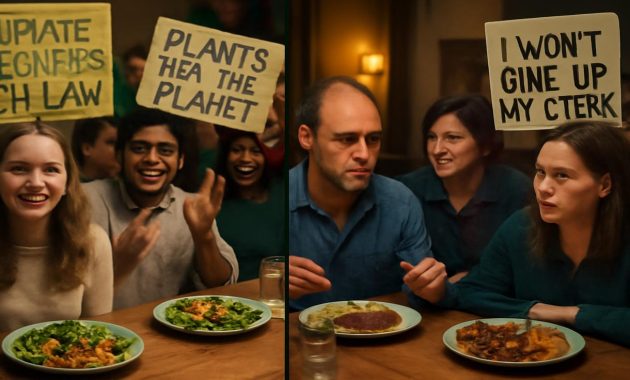
The smoke curled up from the grill in lazy question marks, as if even the backyard itself wasn’t quite sure whose side it was on. On one end of the patio, a platter of thick marbled steaks waited for their turn over the flames. On the other, a rainbow of vegetables—zucchini coins, bell pepper strips, fat mushroom caps—rested beside a bowl of chickpea salad and a pack of plant-based burgers with a bright green label. It was Sunday, family dinner day, the weekly ritual that usually smoothed over busy lives. But tonight, the air felt charged, and not just because of the heat. This was the first weekend after the new climate law had kicked in—an aggressive pricing scheme that had effectively made meat a luxury item overnight. And this quiet suburban cookout had become a front line in a culture war over what belonged on our plates.
“You Can’t Tax My Dinner”: The Night the Law Hit Home
When the law passed, it came with a tidy name: a “Climate Food Impact Levy.” Most people just called it the meat law. In policy briefings and press conferences, the logic sounded almost sterile in its precision: livestock emissions, deforestation, water use, public health. A simple equation, the experts said. Price meat according to its climate cost, watch consumption drop, and cut national emissions in one bold move.
But laws don’t land in spreadsheets—they land on kitchen tables.
At first, the changes were numbers on a screen. Grocery apps updated overnight. The price of ground beef jumped so sharply that people had to double check if it was a typo. Bacon climbed into the realm of treats once reserved for fancy chocolates. Steaks—especially the prized cuts—suddenly sat on shelves with price tags that used to be reserved for good wine or a special-occasion dessert.
Some shoppers stared at the meat aisle as if it were a museum exhibit from a more reckless time. Others, jaw tight, loaded their carts anyway, muttering that no government was going to tell them what to eat. By the end of the week, a new phrase was trending across feeds, stitched over grill videos, grocery haul clips, and furious car rants: “I won’t give up my steak.”
The slogan wasn’t just defiance; it was a kind of identity badge. For some, meat had become the last line of defense in a world where everything—energy, cars, flights, plastic bags—was being scrutinized. Now dinner, too?
The Meat Tax that Split a Generation
The divide didn’t map neatly along party lines, though politicians tried their best to claim it. It ran through dorm rooms and dinner parties, through WhatsApp family chats and office Slack channels. The law had done something no social media infographic ever could: it made climate change show up on the receipt.
For older generations, especially those who had grown up with meat as the centerpiece of every meal, this felt like sacrilege wrapped in a moral lecture. A grandfather in Ohio summed it up at a family reunion: “When we finally had enough money, we started having steak twice a month. You want to tell me that was wrong?”
Across the table, his granddaughter, a 23-year-old climate science major, didn’t flinch. “It’s not that it was wrong then,” she said, “it’s that we know better now.”
He shook his head, knuckles whitening around his fork. “You’re calling my entire life a mistake because of some new chart.”
Scenes like that played out in a thousand variations: a dad who refused to attend his son’s “meatless wedding menu”; roommates who argued over whether it was okay to split the grocery bill when one still bought “climate gouged” meat; couples recalculating their budgets and quietly resenting the other’s non-negotiable cravings.
For many younger people, though, the law felt less like an intrusion and more like long-overdue backup. They’d grown up with climate anxiety as background noise—wildfire summers, freak storms, orange skies, terrifying graphs. They had carried long-running arguments on their phones, trying to convince their parents to fly less, drive smaller, waste less. Now, finally, the system itself had nudged in their favor.
It wasn’t just policy; it was an affirmation. Their sacrifices—turning down trips, cutting back on fast fashion, switching to public transport when possible—no longer felt like lonely, personal choices floating in a world that refused to budge. The meat levy said: yes, the big things have to change too.
What Meat Really Costs: The Numbers Behind the Anger
Stripped of emotions, the law is built on numbers—stark, unromantic, and difficult to swallow. Cattle, for instance, are walking methane factories, each animal emitting potent greenhouse gases through digestion. Massive tracts of forest are cleared for grazing or to grow feed crops. Water tables strain under the weight of industrial livestock. By the time a steak lands sizzling on a plate, it carries a hidden ledger of emissions, land, and water used.
Lawmakers decided that ledger should be visible in the price.
The new levy adjusts costs according to estimated climate impact per kilogram. Beef and lamb bear the heaviest charges; pork and poultry less so; plant-based proteins the least. To many economists, this is textbook: make the true cost of something visible and let the market nudge behavior.
But humans aren’t textbooks. To someone whose weekly griller’s pack suddenly costs as much as a small utility bill, the policy doesn’t feel like a rational rebalancing. It feels like a punishment for enjoying something they’ve always been told was normal, even aspirational.
Here’s a simplified snapshot of how it shook out in the first month in one mid-sized city:
| Item | Average Price Before Law | Average Price After Law | Change |
|---|---|---|---|
| Beef steak (per lb) | $11.00 | $19.50 | +77% |
| Ground beef (per lb) | $6.50 | $11.20 | +72% |
| Chicken breast (per lb) | $4.80 | $6.20 | +29% |
| Pork chops (per lb) | $5.50 | $7.80 | +42% |
| Plant-based burgers (per pack) | $6.00 | $5.50 | −8% |
| Dried lentils (per lb) | $1.80 | $1.70 | −6% |
On paper, it’s a clever mirror: high-emission foods get pricier, low-emission foods get a modest break, funded by the new levy. In practice, it means some families stare at beef behind glass and do mental arithmetic, feeling a mix of guilt, anger, and nostalgia.
The Taste of Tradition vs. The Weight of Tomorrow
Food is never just fuel. It’s memory, ritual, and sometimes the only thread tying generations together. A Christmas roast, a summer barbecue, a passed-down stew recipe you can’t imagine without meat—that’s where the law hits deepest.
A cattle rancher in the High Plains, who watched orders shrink in the first weeks, puts it bluntly: “We’re not selling just protein, we’re selling people’s sense of home.” He’s torn. He has three grandkids, one of whom leads a high school climate club and won’t touch beef. “So when I hear ‘climate crusaders,’” he says, “I’m thinking, that’s my own family, too.”
He walks his land at dawn, watching the steam rise off the backs of his herd. There are mornings now when he doesn’t just count cattle—he counts years left in this way of life. The levy hasn’t killed his business, but it’s sharpened the wind that was already blowing: bank loans tied to sustainability metrics, supermarkets demanding transparent emissions data, restaurants shrinking portion sizes or offering more plant-based options.
For climate advocates, these are necessary corrections in a world running out of stable seasons. One organizer tells me, “We’re not trying to erase anyone’s memories. We’re trying to make sure our kids have a climate stable enough to make their own.”
Yet the emotional math doesn’t line up so neatly. Telling someone their favorite childhood meal carries a heavy carbon footprint can sound, to them, like you’re accusing their mother or grandfather of harming the planet. The conversation becomes less about cows and more about shame, respect, and who gets to define what’s right.
“Climate Crusaders” and the New Moral Map of Eating
In the first days after the law, social feeds split into parallel universes. In one, TikToks of sizzling steaks, overlaid with text like “Climate tax this” and “You’ll pry my ribeye from my cold hands.” In the other, viral clips of young activists filling carts with legumes and vegetables, crowing over their low-carbon haul, or posting recipes under hashtags celebrating “climate-smart eating.”
Each side framed the other as extreme. Meat loyalists painted climate advocates as joyless scolds, “food police” out to drain all pleasure from life. Climate-conscious eaters saw meat defenders as stubborn holdouts clinging to habit at the expense of a livable future.
But if you look closely, there’s a lot of overlap hiding in the noise. In surveys taken after the law, many people who were furious about the price hikes also agreed that industrial meat was a problem. Plenty of climate advocates admitted they still craved certain dishes and struggled with the emotional pull of tradition.
The law, in a way, forced everyone to redraw their personal moral map of food. Previously, people could float in a vague mist of “I should probably cut back” without real friction. Now, each steak carried a new question: Is this worth it?
For some, the answer was simple: absolutely, and often. For others, it became “yes, but only on special occasions.” For still others, it transformed into a firmer “no,” reinforced each time they saw the price difference and imagined a hotter, harsher future.
Family Dinners as Battlefields—and Bridge-Building Labs
Nowhere is this moral sorting more vivid than around family tables. One week, a university student comes home, eyes widening at the roast in the oven. “You know that meal is like driving a car for a week, right?” they blurt, the way you might warn someone about a gas leak.
The room goes quiet. An aunt bristles. A cousin rolls their eyes. The host—usually a mother or father who has spent hours cooking—feels, for a flicker of a moment, accused. The climate conversation doesn’t stay on the TV; it lands, hot and heavy, among the silverware.
But for every dinner that ends in icy silence, there’s another that ends in a kind of wobbly truce. A family that decides, after a tense talk, to keep meat on Sundays but go plant-based during the week. A grandmother who asks, privately, for a lentil recipe that “doesn’t taste like punishment.” A father who starts buying smaller cuts of meat and more vegetables, claiming it’s “for health,” but quietly thinking of his daughter’s climate anxiety.
In those small shifts, culture begins to move. It’s not clean or linear. It doesn’t look like a protest or a policy announcement. It looks like someone pushing away from the table and saying, “Next time, let’s try…something else.”
What We Lose, What We Gain, and What Comes Next
In the early evening, after the backyard grill finally quiets, the leftovers tell a story. Half the steaks are gone, juicy traces left on paper plates. The plant-based burgers are, to some guests’ surprise, mostly eaten too. Someone joked that they “weren’t awful,” which, for a first try, is faint praise but a crack in the door.
This is what change looks like in the real world—not an overnight conversion, not a universal surrendering of steak, but a messy negotiation between habit, cost, conscience, and culture.
Will this new law, alone, save the climate? No. Even its architects admit that. But it does something more subtle and perhaps more powerful: it forces an unskippable moment of reflection into one of our most intimate rituals. Every time a shopper pauses in front of the meat case and weighs price against desire, every time a host explains to guests why the menu looks a little different this year, the old idea that meat is the unquestioned center of the plate erodes just a bit.
For some, this feels like a loss of freedom. For others, it feels like at last being taken seriously in a world they are inheriting with fewer certainties and more storms. Between those poles lie the real climate stories of our time—not just ice cores and emission curves, but the way a single law reaches all the way into a backyard at sunset, into a simmering pot on a weekday, into the worn recipe cards passed from one hand to another.
Culture wars, for all their shouting, are really about who we think we are and who we are willing to become. Around the question of meat and climate, that war has found its way to dinner. The plates we fill in the coming years—what’s on them, what’s missing, and what new traditions appear—will tell future historians more about us than any press conference ever could.
Some will always say, “I won’t give up my steak.” Others will quietly stop saying it, not because they were defeated, but because their sense of what matters has shifted. Between those stances lies a narrow table where, if we’re careful, there might still be room for everyone to sit down, argue, laugh, experiment, mourn a little, and then reach together for something new.
Frequently Asked Questions
Why did the government decide to price meat higher?
The law is based on the idea that foods with a high environmental impact should reflect their true cost. Livestock, especially cattle, produce significant greenhouse gas emissions and require large amounts of land and water. By making meat more expensive and lowering prices on lower-impact foods, policymakers hope to reduce emissions and shift consumption toward more sustainable options.
Is this the same as banning meat?
No. The law doesn’t ban meat; it makes high-emission products more expensive through a levy. People can still buy and eat meat if they choose, but they’ll pay more for items that carry a larger climate footprint. In theory, this preserves choice while nudging behavior.
How are low-income families affected?
That’s one of the most contentious issues. Critics argue the levy hits low-income households hardest, turning meat into a luxury. Supporters point to subsidies on plant-based foods and programs designed to offset costs, but whether those measures are enough is still hotly debated. The fairness of the policy will likely shape its long-term public acceptance.
Does reducing meat consumption really help the climate?
Yes, to a meaningful extent. Studies consistently show that shifting diets away from high-emission animal products and toward plant-based foods can significantly cut individual and national emissions. It’s not the only solution—energy, transport, and industry changes are also crucial—but food system reform is a major piece of the climate puzzle.
What about people whose livelihoods depend on meat production?
Ranchers, farmers, and workers in the meat industry are directly affected by declining demand and changing markets. Some support is being offered in the form of transition funds, training for alternative agricultural practices, and incentives to adopt more sustainable methods. Still, for many, this is an uncertain and painful transition that raises complex questions about fairness and responsibility.
Do plant-based alternatives really taste like meat?
Opinions are mixed. Some people find newer plant-based burgers and sausages surprisingly close to meat in flavor and texture, while others feel they still fall short. Taste is also influenced by how the food is seasoned and cooked. Over time, many people report their preferences shifting as they experiment with new recipes and ingredients.
Is this just the beginning of more climate-related food laws?
Most likely, yes. As climate impacts intensify, governments are under pressure to address emissions from all sectors, including food. Future measures might include stricter labeling, limits on advertising high-emission foods, support for regenerative agriculture, or additional levies. The current meat pricing law is widely seen as an early, high-visibility test of how far society is willing to go to align what’s on our plates with the planet’s limits.