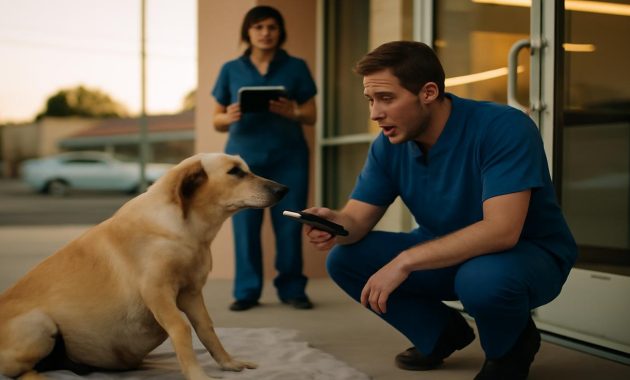
The first thing anyone noticed about her was the belly. Round as a ripening moon, swaying gently with every step, it told the quiet story of lives not yet here but very close. The second thing they noticed was how carefully she had been placed—right up against the cool brick wall by the back door of the veterinary clinic, where the security light hummed and the cameras never slept. No leash. No collar. Just a faded floral blanket beneath her and a cardboard box tipped on its side like a makeshift shelter. It was 5:12 a.m. when the first staff member pulled into the parking lot, coffee still too hot to drink, headlights sweeping across a scene that would unravel into something far stranger than an ordinary abandonment.
The Dog at the Door
She didn’t bolt. That was the first surprise. When the vet tech opened their car door, juggling a bag, keys, and a travel mug, the dog turned her head slowly, as if she’d been expecting them. Her eyes were the deep, glassy brown of late autumn puddles—tired, watchful, and too calm for a dog who’d clearly been left behind.
The morning air carried a damp chill, wrapping around her like a thin, unwanted coat. Her fur, a patchwork of caramel and white, was dusted with street grime, but the lines where her harness should have rubbed her chest and shoulders were still visible. She had not been stray for long.
“Oh, sweetheart,” the vet tech whispered, setting the coffee on the car roof and slowly lowering themselves into a crouch. The dog flicked her tail once, then twice, wary but hopeful. Her belly shifted as puppies rolled inside, a soft wave of motion beneath taut skin.
There was no note. No collar. Just the blanket and box—and, as they were about to discover, a small, buried piece of data under her skin that would pull on a thread reaching far beyond this quiet parking lot.
Scanning the Secret Under Her Skin
Inside the clinic, the lights smelled like disinfectant and the faint, metallic tang of instruments fresh from the autoclave. It was too early for barking or meows from the boarding kennels; the building felt half-asleep, the way cities do right before dawn properly arrives.
They brought her in gently, letting her walk on her own. Her nails clicked on the tile floor with the hesitance of someone entering a stranger’s house but hoping to be invited to stay. A soft towel was spread across the exam table, and a second vet tech joined, eyebrows rising as they took in the sight.
“She’s close,” the second tech murmured, resting a hand on the dog’s side. “Listen to them.”
They fell briefly silent, the hum of the overhead lights and the distant rumble of a passing garbage truck filling in the space. Beneath their hand, tiny feet pushed back, small, insistent thumps like raindrops against a tent. Life, alive and impatient.
The clinic’s scanner came out—a white, handheld device, smooth and utilitarian, the kind of tool built for answers more than comfort. The first tech ran it slowly along the back of the dog’s neck, then between her shoulders, moving with practiced patience.
A soft, electronic beep cut the air. The display lit up with a number, a neat row of digits that had once represented a promise: if lost, I will be found. If found, I can be sent home.
“We’ve got a chip,” the tech said. The dog’s ears twitched at the sound of their voice. “Let’s see who you belong to, mama.”
When the Data Doesn’t Fit the Story
Microchips, for all their invisible magic, are simple things: a tiny capsule, no bigger than a grain of rice, tucked under the skin, waiting. Embedded in that small piece of hardware is nothing more than an identification number, but that number leads to a database, and the database—ideally—leads to a human who once said, “She’s mine.”
At the front desk, the computer keys clacked softly as the number was entered into the microchip registry. A few seconds of spinning cursor, and then a name, phone number, and address blinked into existence. But there was something else, too—something unexpected.
The dog’s registered name was not “Mama” or “Daisy” or “Sweetheart,” as the techs had been calling her under their breath. It was an alphanumeric string that sounded more like a serial number than a pet: FGR-Luna-07F. And the owner was not a family or a single name.
It was a company.
Not an adoption group, not a rescue. A corporate entity several towns over that most of the staff had never heard of: Fairgate Research LLC.
“Research?” the receptionist said, wrinkling their nose. “Like… research research?”
Behind them, the coffee sat cooling on the counter, untouched. The pregnant dog, now resting in a quiet exam room, sighed and shifted her weight, one paw dangling over the edge of her towel like she’d done this kind of waiting before.
The vet on duty that morning checked the state licensing database. Fairgate Research was indeed registered—under a broader umbrella of “biomedical services.” They had permits. They had facilities. They had a bland website filled with stock images of labs and smiling professionals.
But none of that explained why one of their dogs—heavily pregnant, abandoned with nothing but a blanket—had turned up like a forgotten package on the back step of a small veterinary clinic.
What the Records Revealed
The clinic did what clinics do. They stabilized the dog, ran quick tests, checked for parasites and infections, took a blood sample. Her vitals were strong. She was underweight but not starving, and her teeth were surprisingly clean. Physically, she was doing better than many abandoned animals who arrived at their door.
But on the inside, her paperwork told a different story.
When the vet called the number listed with the microchip provider, a recorded voice announced that Fairgate Research’s phone lines had been “temporarily restructured” and directed them to fill out an online inquiry form. That was the first red flag.
The second came when they contacted the microchip company directly, requesting ownership history. It took a few hours and some insistent emails, but by late morning, a PDF arrived in the clinic’s inbox.
The document showed that Luna, as they now learned to call her, had been microchipped three years earlier, at eight weeks old. She had originally been registered to a small-scale breeder, then transferred to Fairgate Research less than six months after that.
The breeder’s name, when searched, appeared on enthusiast forums with glowing reviews and photos of healthy, bouncing puppies. But on a more obscure discussion thread—one that required a few deeper clicks and search filters—there were whispers: “Sells to labs,” “Won’t say where some of her ‘extras’ go,” “Avoid if you care where their puppies end up.”
The coffee had been forgotten now. The clinic staff moved with a focused, unsettled energy, their workday rearranging itself around the dog in Exam Room Three and the unanswered questions she had carried in with her.
| Detail | What Was Discovered |
|---|---|
| Dog’s Condition | Heavily pregnant, underweight but stable, clean teeth, recent handling |
| Microchip Owner | Registered to Fairgate Research LLC, a biomedical services company |
| Previous Owner | Small-scale breeder with mixed online reputation |
| Contact Attempts | Phone lines redirected, responses only via automated online forms |
| Legal Status | Company licensed, but no clear record of humane oversight for breeding animals |
The Quiet Scandal Behind a Single Dog
There are loud scandals—the kind that make their way to headlines and talk shows—and then there are the quiet ones, the ones that begin with a single creature lying on a blanket outside a back door. What unfolded around Luna was the second kind: small, detailed, stubborn. The kind that forces people to look closely at things they’ve been trying not to see.
By noon, word had spread among the rescue network in the region. Texts and emails flew: “Pregnant lab dog dumped.” “Microchip shows research facility.” “Anyone heard of Fairgate?” Screens lit up around town and beyond, little islands of concern and anger connected by digital threads.
A local rescue coordinator arrived at the clinic just as a light drizzle began outside, darkening the pavement and streaking the windows with slow rivers. She wore a jacket smeared with old dog hair and ink stains, the unofficial uniform of people who spend their lives pulling animals out of trouble.
“Can I see her?” she asked, voice already softening at the thought.
In the exam room, Luna lifted her head when the door opened. Her eyes scanned the new face, nose testing the air for anger, fear, or kindness. Whatever she found there seemed to satisfy her. She laid her head back down with a sigh that sounded almost like resignation.
“She’s been used,” the coordinator said quietly, after running a gentle hand along Luna’s spine. “You can tell. She knows the drill. She’s not confused enough to be someone’s first accidental litter. This has happened to her before.”
The words hung there, heavier than anything else in the room. Because if Luna had been used for breeding inside a research facility—if she had been intentionally impregnated again and again for experiments, for supply, for data—then her presence here, on this towel, was not an accident or misfortune.
It was fallout.
Unraveling the Bad News
The scandalous part was not simply that a pregnant dog from a research facility had been abandoned. It was the pattern that began to emerge once people started pulling at the loose threads.
Through informal channels, other stories began surfacing. Another clinic in a neighboring county remembered a young male beagle dropped off the previous year, also chipped to a “services company” with an opaque name. A vet tech in a city an hour away recalled a pair of siblings, thin and trembling, whose chips had tied back to a different research outfit.
None of them had come with disclosure. No one had admitted, “These dogs were part of a lab program.” They simply appeared at shelters and clinics, often right before big holidays or late at night, as if hoping the darkness and busyness would swallow them without questions.
In Luna’s case, the questions refused to go away. The rescue coordinator reached out to an investigative-minded contact who tracked corporate registrations and inspection reports. Slowly, the picture sharpened.
Fairgate Research, it turned out, had quietly shifted its operations over the past year. Facility downsizing. Relocation of certain programs. Nothing flashy, just a series of bureaucratic footnotes in public records. Buried in those notes were temporary waivers, discrepancies in inventory logs of “canine assets,” and a pattern of reduced oversight visits.
It wasn’t proof of abuse. It was something slipperier and, in some ways, more infuriating: evidence of living beings treated like equipment. When the equipment could no longer be used efficiently—or when it became inconvenient to have a pregnant dog on-site—someone, somewhere, had made a decision.
Leave her. Drop her. Make it someone else’s problem.
Luna was not a crisis to them. She was a line item.
The People Who Stay When Others Disappear
While the scandal simmered in inboxes and private group threads, life for Luna moved forward on a quieter, more immediate track. The clinic and rescue team had puppies to think about. They had a mother whose body was doing the monumental work of building new lives while her past was being unraveled without her knowledge.
A volunteer set up a whelping area in a foster home—a warm, low-sided nest of blankets and towels in a spare bedroom, lit with the kind of soft lamp you’d use for reading stories to small children. The window looked out over a maple tree already budding with early spring leaves.
Transporting Luna from the clinic to that home was an exercise in controlled care. A harness was gently fitted around her chest, a soft lead clipped on. She stepped into the crate in the back of the car with a strange composure, like someone who had been moved between places before but never truly arrived anywhere.
At the foster home, the first thing she did was sniff every inch of the room. Then, with an almost palpable decision, she curled herself into the middle of the whelping nest and shaped it to her body, circling twice before settling. Her eyes had changed. Less scanning, more soft focus. She was ready to stay—for however long this new version of staying would last.
In the days that followed, as her belly grew heavier and her breathing shallower, the human pieces of her story continued to fall into place. An animal welfare advocate contacted a sympathetic journalist. The local inspector’s office fielded new complaints, each one carrying the same core accusation: animals entering these facilities had traceable identities, but many leaving them did not.
“We have no formal record of where they go,” one official admitted in a meeting that someone, quietly, recorded. “We rely on self-reporting.”
Self-reporting from companies that regarded living, feeling dogs as disposable machinery.
Puppies and Consequences
Luna went into labor on a Tuesday evening, just as the sky outside turned the color of bruised lavender. The foster sat cross-legged on the floor, a notebook and clean towels nearby, phone charged and ready to call the clinic if anything went wrong.
But nothing went wrong.
One by one, the puppies arrived: slick, wriggling bundles of warmth and sound, each greeted with instinctive licks and nudges from a mother who, despite everything, knew exactly what to do. The room filled with the scent of birth and milk and the faint, wild sweetness of new life.
Six puppies. Four girls, two boys. Each found a nipple and latched, eyes sealed shut, little paws kneading at Luna’s belly like they were already making bread out of whatever past she carried and whatever future they might be given.
The scandal made its way into local awareness around the same time; a carefully written article appeared in a regional publication, not naming names it couldn’t legally name, but shining a bright, steady light on the pipeline of animals moving from breeders to research facilities to unregistered endpoints. There were quotes from ethicists. From vets. From rescuers who had seen too many Luna-shaped holes in the system.
No one from Fairgate Research publicly responded, at least not in the way that would make headlines. But suddenly, quietly, similar dogs stopped appearing at clinic back doors. Licenses were reviewed. Audit requests were filed. A few policy proposals were drafted that, if they ever wove their way into law, could force more transparency: mandatory end-of-use reporting, stricter penalties for unregistered transfers, surprise inspections focused not just on what happens inside lab walls, but what happens when those walls let animals out.
Meanwhile, in that small bedroom with the maple tree view, Luna’s world had shrunk to something manageable. Eight heartbeats: her own, and six tiny others. Soft voices. Gentle hands. A door that opened only to familiar faces.
The scandal was big. Her needs were simple.
What One Microchip Can Change
Not every abandoned dog has a story that unravels into policy debates and corporate audits. Many have no chips at all, no digital breadcrumb trail leading back to the people who once claimed them. But Luna did, and that changed everything—not only for her, but for others like her, trapped in the unnamed spaces between “owned” and “discarded.”
That tiny device under her skin refused to let her be anonymous. It connected her to a breeder who had made choices, to a company that had made different ones, and to a system that had quietly allowed both to operate without answering a crucial question: What happens to the animals when you’re done with them?
The answer, for too long, had been: We don’t talk about that.
Luna’s presence at the back door of the clinic changed the conversation. The scandalous bad news wasn’t just that a research dog had been dumped pregnant and alone. It was that this was not an aberration, but a symptom—of secrecy, of convenience, of a comfort with invisible suffering as long as it stayed out of sight.
In contrast, her new life was built almost entirely in the open. Photos of the puppies nursing circulated through rescue circles, each one carrying a caption that, in subtle ways, referenced the bigger story: “Born from a dog used in a research breeding program, now safe.” “Their mother’s chip led us to answers we didn’t want, but needed.”
Calls came in from families interested in adopting, some drawn by the puppies’ sweetness, others by the knowledge that saying yes to one of these small lives was, in its own way, a stand—a vote for transparency, for honoring the full story of where animals come from.
Luna, for her part, adjusted to the rhythm of something she had never really known before: being wanted without being used.
Frequently Asked Questions
How did the rescuers know to scan the dog for a microchip?
Most veterinary clinics and shelters automatically scan any found or abandoned animal for a microchip as part of their intake process. It’s a quick, noninvasive way to identify an animal’s owner or origin, and in Luna’s case, it revealed her connection to a research company.
Are research facilities allowed to use dogs like this?
In many regions, research facilities can legally use dogs, often sourced from breeders, as long as they are licensed and follow regulatory guidelines. However, the rules about what happens to those animals when they leave the facility—or when they’re no longer needed—are often vague or weakly enforced.
Was anything illegal about Luna being abandoned?
Abandoning a dog is illegal in many places under animal cruelty or neglect laws. The problem is proving who did the abandoning and linking that act to a specific person or company. In Luna’s case, the microchip provided strong circumstantial evidence but not a clear video of the moment she was left at the clinic.
What can be done to prevent situations like this?
Stronger regulations and transparency are key. This can include mandatory end-of-use reporting for animals in research, audits of how animals leave facilities, and harsher penalties for unregistered transfers or abandonment. Public pressure and attention also play a major role in pushing for these changes.
How can ordinary people help dogs like Luna?
People can adopt animals from shelters and rescues, support organizations that advocate for research transparency and animal welfare, microchip their own pets and keep information updated, and stay informed about where animals in their community are coming from—and where they’re going. Even asking questions at the right time can make a difference.