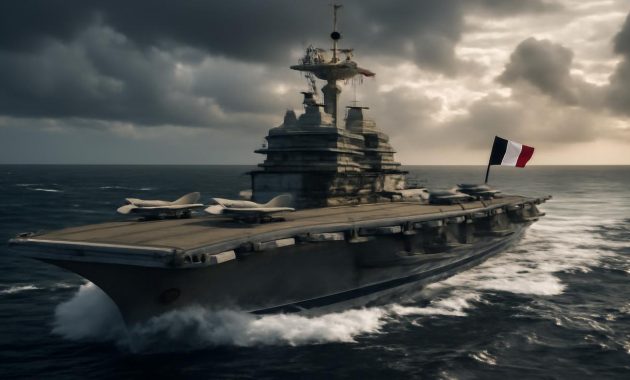
The morning she left Toulon, the light was all wrong. It had that thin, metallic sharpness that makes every edge gleam a little too bright, as if the day itself were polished for inspection. Down in the harbor, a low murmur rolled across the water—dockworkers calling, boots on steel, the distant throb of engines waking deep within a hull the size of a small town. And there she was: the French aircraft carrier Charles de Gaulle, hulking, self-contained, impossibly calm. A floating city turning her bow, very slowly, toward the open Atlantic—a direction she almost never takes.
When a Giant Changes Course
If you’ve spent any time around sailors, you learn to read their moods by the way they watch the horizon. That morning, as the Charles de Gaulle’s lines were slipped and the massive ship eased away from the quay, everyone’s gaze seemed glued to the same thin line beyond the breakwater. The carrier’s usual hunting grounds lie to the east, in the complicated chessboard of the Mediterranean and, beyond Suez, the warmer and more troubled waters of the Indian Ocean. Westward—to the Atlantic—is a much rarer story.
The French Navy doesn’t move its crown jewel lightly. Nuclear-powered and bristling with Rafale fighters and radar domes, the Charles de Gaulle is more than a warship: she is a message, a statement of presence. When she turns her nose into the long swells of the Atlantic, the maritime world takes notice, because it means something is shifting—operationally, politically, or quietly behind the scenes.
From the harbor walls, she looked almost slow, like a cliff drifting on the tide. Up close, the senses told a different story. The scent of hot metal and bunker fuel hung in the air. Somewhere within her armored hide, turbines wound themselves toward that steady, relentless vibration you feel through the soles of your feet. On the flight deck, the outlines of parked aircraft were lashed down and silent, like sleeping leviathans strapped to the back of a larger beast.
By the time she reached the outer harbor, tugs peeled away one by one, leaving the carrier alone with the open sea. Ahead, the Atlantic waited: broader, rougher, and less forgiving than the more familiar Mediterranean basin. Sailors along the rail leaned on paint-chipped lifelines, eyes flicking between the town receding astern and the faint, hazy promise of blue water ahead. They knew, even if the outside world only half-noticed, that this was not business as usual.
From the Quiet of Toulon to the Wide Atlantic
The French Mediterranean coast has its own soundtrack: cicadas in the garrigue, scooter engines rattling through narrow streets, the soft slap of water against sea walls. But as the Charles de Gaulle pushed west, all that bled away behind her stern, replaced by the steadier, older language of the open ocean.
She passed headlands that had watched ships leave for centuries—wooden caravels, steam-driven ironclads, gray destroyers hurrying to wars that left marks on every family tree along this coast. Each of them cast their own wake. But a modern aircraft carrier is something else entirely, a piece of moving sovereignty whose shadow reaches far beyond the blue arrow traced on any chart.
On the bridge, the air was cool and dry, conditioned against the humidity creeping up through the ship. Radar screens glowed in quiet constellations of contacts: fishing boats, merchant ships, lonely yachts cutting cautious paths. The Atlantic has a way of swallowing scale. On a chart, the ocean is gridlines and names. From the bridge of a warship, you feel its size in hours and days—how long until the next landfall, the next weather system, the next point where someone, somewhere, is expecting you.
A young officer of the watch, coffee cooling beside a stack of logbooks, called out course changes in a practiced, almost musical rhythm. Outside, the carrier answered with slow authority, adjusting her heading by degrees so small that a landsman would never notice, but that meant everything to those who think in vectors and miles. West-northwest. Deeper into that broad, restless space where the Atlantic rules.
The Rare Westward Path
Regular watchers of naval activity—those quiet enthusiasts tracking AIS dots on screens late into the night, or scanning defense news like birders scrolling rare-sighting alerts—know how unusual this course is. The Charles de Gaulle was built with a mission profile that leans toward the Mediterranean and beyond: crisis management in the Levant, deterrence near North Africa, task group deployments to the Indian Ocean and the Gulf. The Atlantic, though familiar, is not her playground of choice.
So when the French flagship bends her track toward the wide Western approaches, speculation flares. Is it a large-scale NATO exercise in the North Atlantic, a deep interoperability drill with allies who still whisper the language of the Cold War SOSUS lines and GIUK gaps? Is it a response to rising tensions in shipping lanes, a quiet reassurance to partners across the ocean that France’s nuclear heart still beats with transatlantic rhythm? Or perhaps a signal to newer, more silent competitors testing the patience of the seabed and the data cables that lace it?
For the crew, the reasons may be discussed in briefings, printed in bulletins, half-joked about over meals in steel-walled messes. But out on the weather decks, where the wind hits you unfiltered, those debates fall away under more immediate concerns: the height of the swell, the taste of the air, the way the horizon lifts itself into long, rolling shoulders that only the Atlantic seems able to raise.
The Atlantic’s Touch: Sound, Salt, and Motion
Beneath the ship, the water had changed color and mood. The Mediterranean’s blue tends to be tight and bright, squeezed between coasts, tempered by histories. The Atlantic wore deeper shades—indigo, slate, and steel—its surface restless even on a calm day. Swell marched in from storms born a thousand miles away, the kind of distant weather that never touches land yet leaves fingerprints on every ship crossing its path.
On deck, you could feel the pattern of that swell in your knees before you noticed it with your eyes. The Charles de Gaulle is vast, and her nuclear heart keeps her steady, but not even a carrier escapes the rhythm of the sea. There is always that almost-imperceptible rise and fall, the slow lift and settle like the breathing of some gigantic animal. Sailors adjust to it unconsciously—finding a wider stance at doorways, timing their steps with a dancer’s instinct.
Wind wrapped itself around radar masts and aircraft tails, teasing loose tarpaulins, moaning through gaps in metal like the low notes of an unseen organ. It smelled different now: less of land and vegetation, more of pure salt, cold and insistent. Every rail and stanchion grew tacky with a translucent film that left drying patterns on dark paint like fingerprints on glass.
In the hangar deck below, the Atlantic was a kind of rumor—a muffled thumping beneath the clang of tools and the hum of fluorescent lights. Technicians moved like surgeons around the planes, checking, tightening, wiping down panels that would soon be exposed to the harsh spray of open water operations. Above their heads, the entire ship creaked and sighed in slow conversation with the sea.
Life Aboard a Moving Island
To call the Charles de Gaulle a ship is accurate, but insufficient. She is a floating neighborhood, a metal labyrinth with its own rhythms and weather systems. When she sets course for the Atlantic, thousands of private worlds snap into a new alignment.
In one compartment, a cook cracks eggs into industrial mixers, the smell of onions and coffee fighting for dominance. In another, a young sailor leans over a letter, handwriting looping carefully between the rolls of the hull, trying to find words that make this life legible to someone warm and stationary ashore. Far forward, in operations rooms glowing like inverted aquariums, officers watch screens filled with symbols that stand for ships, aircraft, and threats that might never come close—but must always be imagined.
It is easy to think of an aircraft carrier purely in terms of the hardware: the fighters, the missiles, the reactors humming somewhere deep and shielded. But the real fuel is human: the mechanic who can identify a fault by the slight change in an engine’s whine, the radar operator who notices a blip that lingers a half-second too long, the deck crew who move with balletic precision among spinning rotors and jet exhaust, rain or shine, day or night.
On Atlantic deployments, routines stretch and tighten. The weather is more capricious; the swells broader, the storms more muscular. Flight operations must respect crosswinds and low ceilings that roll in like uninvited guests. Down below, the medical team runs drills: evacuations, triage, scenarios that everyone hopes remain theoretical. Out on the dark edges of the deck, sailors on watch stand wrapped in layers, eyes tracing the empty dark, ears pricking for any sound that doesn’t belong to wind and waves.
| Aspect | Mediterranean Routine | Rare Atlantic Deployment |
|---|---|---|
| Sea State | Generally calmer, enclosed basin | Long, heavy swells, more unpredictable weather |
| Primary Missions | Crisis response, Middle East access, regional deterrence | High-end exercises, NATO integration, oceanic security |
| Allied Presence | Regional partners, Mediterranean navies | Broad Atlantic coalition, transatlantic navies |
| Environmental Conditions | Warmer air, higher traffic density | Colder winds, fewer ships, larger storm systems |
| Symbolic Meaning | Regional presence and influence | Strategic reach and global commitment |
Old Routes, New Meanings
As the Charles de Gaulle presses deeper into the Atlantic, her wake braids briefly with those of all the ships that have gone before. The French Navy has known these waters for centuries—frigates and merchantmen riding winds toward the Americas and Africa, convoys dodging U-boats, submarines now moving in silence below the storm line. The carrier is a modern expression of a very old impulse: to push outward, to be present where the world’s arteries widen into open ocean.
In the age of satellite imagery and instantaneous tracking, nothing this large can truly slip away unnoticed. Yet there’s still something faintly secretive about a carrier at sea. On land, defense policies are discussed in microphones and press releases, in careful paragraphs trimmed to avoid sharp edges. Offshore, that same policy has weight and draft; it leaves a trail in white water and rising spray.
Allies read this movement as assurance. A carrier in the Atlantic tells partner nations that France is not confined to its warm-water comfort zone—that its navy, and by extension its politics, stretch across the same blue plains their own ships patrol. Adversaries read it, too, in subtler tones: a test of response times, a measurement of who shifts assets where and how quickly, a reminder that the surface of the ocean is never as empty as it appears.
Above, the sky changes character. Atlantic weather is an artist addicted to layers: low scudding clouds dragging behind them higher wisps, all of it illuminated in shifting palettes of silver and bruised purple. On some days, the horizon blurs into a seamless wash of gray, sea and sky fused into a single, indifferent plane. On others, the air is so clear it feels cut from glass, distances shrinking until distant escorts look close enough to touch.
The Language of Exercises and Signals
Official communiqués will describe much of what happens on such a voyage in neutral phrases: joint maneuvers, interoperability drills, coordinated patrols. But at sea, those abstractions become choreography. Rafales arc off the deck, hooking into holding patterns above the fleet. Early-warning aircraft circle like watchful seabirds. Supply ships slide into position for replenishment at sea, hulls almost shoulder to shoulder, hoses snaking across the gap like temporary umbilicals.
To the outside observer, these are just evolutions—scheduled, practiced, well-rehearsed. To the sailors threading cables, guiding aircraft, crunching sensor data in quiet rooms, each exercise is a living test. How quickly can a task group shift from routine cruising to full alert? How well do French systems talk to allied radars and command nets? Can this set of ships, from different nations and design philosophies, move as one organism in a sea that cares nothing for flags?
On the bridge, flags still matter. Signal halyards snap with bursts of color, the old language of naval flags layered atop radio calls and encrypted data streams. When the Charles de Gaulle steams in formation with allied destroyers and frigates, a careful geometry unfolds. Distances are measured not in miles but in cables, angles in degrees that translate into comfort or tension when a squall shifts wind and visibility without asking anyone’s permission.
The Emotional Geography of Departure
Back home in Toulon, the empty berth seems larger than the ship that occupied it. Families scroll through news photos, searching for familiar shapes: a silhouette on a rail, a distinct patch on a flight deck jersey, any proof that their person is there, somewhere inside that mass of gray steel and white wakes. Departure always has weight, but a rare deployment—to far waters, for uncertain durations—pushes that feeling into new terrain.
There’s a peculiar duality for those left ashore. The knowledge that their loved ones are aboard one of the most capable ships afloat, wrapped in layers of armor, training, and tradition. And the equally sharp awareness that the ocean recognizes none of that. To the Atlantic, the Charles de Gaulle is just displacement and draft, a hull subject to the same physics as any vessel that has ever trusted itself to deep water.
Aboard, sailors manage their own emotional cartography. Some tape photos inside lockers. Others carry nothing personal, reducing their world to the immediate: shifts, tasks, the next watch, the next inspection. Time at sea dilates strangely; days blur into routines, then snap into stark focus when something breaks that should not break, or when a drill feels a fraction too real.
There are small islands of humanity amid the steel: a corner where someone quietly tunes a guitar, a cramped gym where the thud of running shoes competes with the thrum of engines, a compartment where jokes—often terrible, always recycled—pass hand to hand like contraband. Out on the Atlantic, far from shore lights, these little constellations keep a different kind of navigation alive.
Night on the Open Ocean
At night, the Atlantic unfurls its full depth. Away from coastal light pollution, stars multiply until the sky looks crowded, galaxies smeared across the darkness like thumbprints. From the flight deck, leaning on a cold rail, you can see your own breath and, if the ship has gone to darkened conditions, almost feel the Milky Way pressing down.
Sometimes, the sea itself glows. Bioluminescent plankton ride the carrier’s wake, flaring into ghostly turquoise where the hull forces them to tumble and break. Viewed from the stern, it can look as if the Charles de Gaulle is dragging a comet tail through ink. Dolphins, if they come, carve bright parentheses through that glow, brief living punctuation in the long sentences of the ship’s track.
In those hours, the scale of things shifts. Politics, strategy, media narratives—all shrink a little under the weight of so much dark and so much water. Yet paradoxically, this is where decisions made in distant, brightly lit rooms take on their clearest shape. The simple fact of a French nuclear carrier moving through the Atlantic night is an act dense with intent. A story, told without words, in the language of tonnage, technology, and trained people holding their posts.
Return, and the Wake That Remains
Every deployment, no matter how unusual or far-flung, carries within it the idea of return. One day, perhaps under a sky less sharp than the one she left beneath, the Charles de Gaulle will bend her course back toward the familiar pinch of the Mediterranean. She will come home carrying invisible cargo: data from exercises, lessons from storms, wear in her systems that technicians will trace with curious fingers, stories that will spread quietly through mess decks and, eventually, into family kitchens.
The Atlantic will close over her passage as if she had never been there, waves knitting back together, wind unworried. But the wake of such a voyage doesn’t vanish so easily. It lingers in strategy documents, in regional balances recalculated by careful minds, in the confidence of allies who watched a French carrier appear on their horizon, and in the unease of others who noted the same silhouette from much further off.
For those of us watching from shore—whether through a camera lens on a harbor wall or a grainy satellite image shared online—the rarity of this westward journey gives it a particular charge. We are witnessing a moment when habit breaks, when a well-known ship redraws her usual map and writes a new line into the story of how nations move across the sea.
Somewhere out there right now, as you read this, the Charles de Gaulle may be cutting across long Atlantic swells, bow rising and falling in that inexorable rhythm, her lights pinpricks against the dusk. Inside, thousands of lives are braided into one purposeful motion. Outside, the wind and water pay her the respect they offer every vessel: no promises, no special treatment—only the honest, ancient terms of passage.
And perhaps that is why this rare voyage feels so compelling. At its heart, it is a familiar human tale wearing a steel hull: leaving the known for the wide open, testing oneself against bigger weather, and trusting that the path back will still be there when the work is done.
Frequently Asked Questions
Why is it considered rare for the Charles de Gaulle to sail into the Atlantic?
The Charles de Gaulle’s missions are usually focused on the Mediterranean, the Middle East, and the Indian Ocean. Deployments into the Atlantic are less frequent and often linked to major NATO exercises, strategic signaling, or high-end training, which makes each westward voyage stand out.
What makes the Atlantic different from the Mediterranean for a carrier deployment?
The Atlantic is larger, wilder, and more exposed. Swells are longer and heavier, weather systems are bigger and less predictable, and traffic is generally sparser. Operating there demands different planning for flight operations, logistics, and crew readiness compared to the more enclosed Mediterranean.
Does a deployment to the Atlantic change the carrier’s mission?
The core role—projecting air power and supporting national strategy—remains, but emphasis often shifts toward high-intensity training, interoperability with allied navies, and participation in larger, more complex exercises across wider distances.
How long can the Charles de Gaulle stay at sea?
Thanks to her nuclear propulsion, the ship’s endurance is limited more by supplies, maintenance, and crew fatigue than by fuel. In practice, deployments are structured around operational goals, logistics, and the need to rotate personnel and equipment, rather than any strict technical limit.
What does such a voyage mean for the sailors on board?
For the crew, a rare Atlantic deployment mixes professional challenge with personal sacrifice. It brings demanding conditions, intense training, and the pride of participating in a high-profile mission—alongside long separations from home and the need to adapt to a life defined by steel, schedules, and the changing moods of the open ocean.