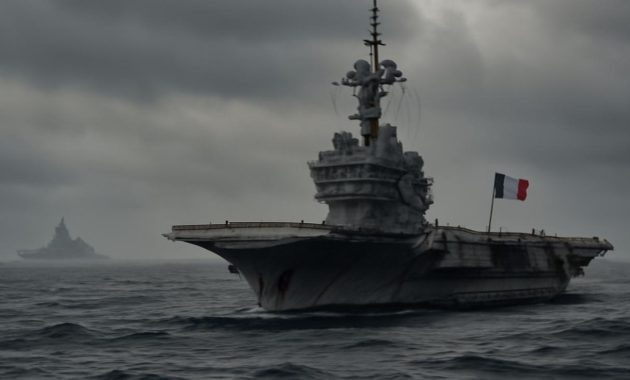
The sea that morning looked almost harmless—just a sheet of dull pewter under a low Atlantic sky—yet every person standing on the grey steel deck knew they were witnessing an ending. Sailors leaned on the railings, phones hidden in their palms, trying to capture one last shaky video. Officers watched in composed silence. Somewhere on the island superstructure, a French flag snapped in the wind, stubborn and bright. Below, the nuclear heart of France’s only aircraft carrier throbbed steadily, as if unaware that it would, in a few short years, fall quiet for good.
France had staked its pride and its place in the world on this ship. Over a billion euros of steel, electronics, and engineering genius, the Charles de Gaulle was more than hardware; she was a floating argument that France still mattered in the grand choreography of global power. And yet, as Russian missiles arc over the Black Sea and whistle low across Ukrainian cities, as hypersonic gliders and long-range cruise missiles redraft the rules at sea, France’s flagship feels less like the future and more like a monument to a vanishing era.
The Day the Ocean Stopped Listening
Walk the marina in Toulon on a grey afternoon and you can feel the contradiction. Fishing boats rock lazily near the quay. Tourists drift along the promenade with ice creams and cameras, unaware that just across the restricted harbor sits a symbol of a changing age. The Charles de Gaulle, with its hulking island and sloped bow, looks every bit the classic aircraft carrier, a cold-war dream hardened into steel. But quiet conversations in naval offices now circle a different truth: the ocean, in many ways, has stopped listening to these giants.
For decades, big-deck carriers were the pinnacle of power projection. They carried not only jets but stories: of intervention offshore, of crises smoothed over by the whisper of Rafale engines and the glow of arrestor cables at night. For France, the Charles de Gaulle fulfilled a deep cultural script—of independence, of “force de frappe,” of not having to ask anyone for permission. Nuclear-powered, bristling with technology, she let Paris say to Washington and Moscow alike: We are not spectators.
Yet the seas themselves have been quietly rewriting the rules. Radar waves are sharper. Satellites see more. Drones prowl at altitudes that used to be empty. Most of all, missiles—sleek, precisely guided, and terrifyingly fast—have extended the invisible reach of coastal defenses far beyond the horizon. Russia, in particular, has turned its near seas into layered domes of fire, extending hundreds of kilometers from its shores. Ships that once felt untouchable now find themselves moving through an unseen geometry of danger.
In that new geometry, an enormous, singular, billion-euro vessel can feel less like a sword and more like a target.
How One Carrier Became a Strategic Cage
To understand what France sacrificed, and why it now feels the pain so acutely, you have to step back into the planning rooms of the early 2000s. Sitting around polished tables in Paris, admirals and ministers debated whether France should double down on its carrier strategy. A second carrier had been sketched, studied, argued over. It would have shared the burden with the Charles de Gaulle, ensuring permanent availability—one ship at sea while the other refits. It would have made the French model sustainable.
The idea never fully made it off the drafting table. Costs ballooned. Political will wavered. Domestic budgets narrowed. Environmental debates around nuclear power grew louder. It was easier, in the moment, to postpone. A floating city cost billions, and its benefits were measured in hazy futures and theoretical crises—always somewhere else, always someday.
Modern Russia, meanwhile, was not postponing much of anything. Amid sanctions and budget strains, Moscow poured resources into something that delivered power at a fraction of a carrier’s price tag: long-range missiles. The Kalibr cruise missile, the Oniks anti-ship missile, the Kinzhal hypersonic missile—names that felt exotic in Western newspapers when first mentioned—have now become part of daily strategic vocabulary.
As the Black Sea conflict intensified, the world discovered what it really meant for a regional power to saturate its periphery with missiles. Ships operating too close to shore became vulnerable. Land-based launchers, hidden in forests or bunkers, could threaten targets hundreds of kilometers away. Sea-launched missiles turned modest corvettes into strategic assets. A carefully planted missile battery, with good intelligence and targeting networks, could reach out and touch ships that used to sit beyond punishment.
In this environment, the Charles de Gaulle—the embodiment of a certain 20th-century logic—was suddenly boxed in. It still carried deadly Rafale jets, still projected prestige when it cruised into the eastern Mediterranean or Indian Ocean. But the scenarios in which a carrier could sail near hostile coasts without unacceptable risk shrank. The beating nuclear heart of the ship became not just a symbol of independence, but a vivid reminder of vulnerability.
When a Billion Euros Meets a Thousand Missiles
Behind closed doors, French planners know the math. A single aircraft carrier can cost more than a billion euros to build, plus hundreds of millions each year to crew, maintain, and supply. Add an air wing, escorts, submarines, and support ships, and you are looking at a floating commitment that spans decades and multiple national budgets.
By contrast, a cruise missile—even a sophisticated one—costs in the low millions, sometimes less. A mobile launcher can hide among trees or in a warehouse. A satellite pass and a good data link can give it all the targeting information it needs. On a battlefield where swarms of cheaper, smarter munitions can converge on a handful of valuable targets, the balance sheet starts to look uncomfortably one-sided.
France did not ignore this. It invested in its own cruise missiles, in Rafale fighters, in submarines with stealth and teeth. But the gravitational pull of the carrier was immense. It absorbed budgets, attention, and imagination. Years later, as Russian missiles shape the war in Ukraine and the tempo of naval operations in the Black Sea, that gravitational choice looks narrower and more fragile.
At high tide, the Charles de Gaulle’s hull gleams under the Mediterranean sun. The deck crew works in color-coded vests, jets are chained down in precise lines. Yet each time the ship sails near contested waters, the question hangs quietly over the wake: can one very large, very visible symbol of power survive in a world designed to punish exactly that kind of visibility?
A Fleet Built for Yesterday’s Ocean
In the French naval tradition, carriers were never meant to stand alone. They were supposed to be the crown jewel of a balanced force: frigates screening ahead with radar and missiles, submarines skulking below as unseen guardians, tanker ships providing fuel and endurance. Together, they formed a mobile theater of operations, a piece of France afloat.
But modern missile warfare has hollowed out the comfort in that image. Russian operations in and around Ukraine have demonstrated how quickly a well-placed strike can disable high-value targets: airfields, depots, bridges—things that were once thought too critical to risk. Navies across Europe are quietly recalculating: what happens if the tempo and density of missile attacks seen on land are someday turned fully toward the sea?
The French Navy, like others, is now running hard to keep up with this shift. It is investing more heavily in integrated air and missile defense, in electronic warfare, in decoys and deception. Yet every new layer of protection strapped onto a carrier strike group adds cost, complexity, and operational constraints. The flagship looks less like a spearpoint and more like a pampered, escorted asset whose primary job is to avoid being placed in the wrong water at the wrong time.
And still, this is not just about hardware. It is about mentality. For much of the post–Cold War era, Europe’s security imagination turned inland—toward peacekeeping, stabilization, policing missions, and counter-terrorism. The ocean felt like a highway, not a battlefield. Carriers fit naturally into that narrative: symbols of humanitarian intervention, disaster response, air cover for operations ashore against weaker foes.
Russia’s missile-led resurgence at sea has inverted that mental picture. The water is no longer a quiet route to the crisis; in some theaters, it is the crisis. For France, that inversion cuts particularly deep. It built an exquisite instrument for last generation’s ocean, only to find that the new symphony is written in a harsher key.
Counting the Cost: Power, Pride, and Euros
It would be easy to frame this purely as a tactical shift, but the sacrifice of that flagship carrier model has deeper layers. At its heart lies a tension between national pride and strategic pragmatism. France has always measured itself not only against neighbors in Europe but against the great shadow of the United States—a nation whose power at sea still orbits around supercarriers.
Choosing to lean heavily on a single, immensely expensive carrier meant accepting fragility: when the Charles de Gaulle went into refit, France’s seaborne airpower shrank to almost nothing. When breakdowns occurred—famously, in the early years, they did—the gap yawned. A second carrier would have eased that, but it was never fully funded. Instead, France ended up with the worst of both worlds: a high-end tool without redundancy, ambitious yet perpetually stretched.
| Capability | Traditional Carrier Model | Missile-Dominated Model (Russia) |
|---|---|---|
| Core Investment | Few very large ships & air wings | Many dispersed launchers & missiles |
| Visibility | Highly visible, symbolic assets | Often hidden, mobile, hard to target |
| Flexibility | Broad-spectrum missions, but limited numbers | Focused missions, but scalable and numerous |
| Risk Profile | High consequence if lost or damaged | Losses tolerable; assets are cheaper |
| Political Impact | Strong signalling, status projection | Less visible, but shock effect in use |
France’s “sacrifice” is not that it scuttled its ship or walked away from carriers entirely. The deeper sacrifice was locking so much national capability and prestige into a structure increasingly exposed by technological change. Every euro sunk into refining the carrier model is a euro that cannot go elsewhere—to distributed systems, to new types of drones, to hardened coastal defenses, to the sprawling, resilient networks that define 21st-century warfare.
Today, when French officials watch Russian missiles reshape the battlespace in Ukraine, there is an uncomfortable recognition: for all its sophistication, the Charles de Gaulle cannot be everywhere, and in some of the places that matter most, it may not be able to be at all.
Searching for a New Ocean Story
Despite the unease, the story is not over. On drawing boards and digital mockups in naval yards and research labs, a different French ocean future is taking shape. The planned successor to the Charles de Gaulle—France’s next-generation carrier project—is meant to learn from these years of vulnerability. It will be larger, with more powerful catapults, better defenses, stronger integration into European networks. It is meant as an answer to doubt: a statement that France will not quietly abandon blue-water ambitions.
Yet even this new project sits in a crosscurrent of questions. Will hypersonic missiles outrun any reasonable defense? Can distributed fleets of smaller vessels, crewed and uncrewed, deliver similar effects with less risk? Will alliances—NATO above all—shift expectations such that the French need to be more nimble, less tied to a single great hull?
At sea, answers rarely come quickly. They emerge in the long wakes of exercises, in the data from wargames, in the nervous silence between launch and impact in warzones far away. France is running those games now, just as Russia, the United States, and China are. Each is trying to sketch the coastline of a future where geography blurs, where a launcher a thousand kilometers inland can still shape the fate of ships on the horizon.
In ports like Toulon and Brest, the human side of this transition is visible in smaller, quieter ways. Young officers talk as easily about data links and cyber intrusion as they do about torpedoes and deck landings. Sailors learn to work alongside autonomous systems, to trust the chatter of drones as much as the sweep of binoculars. The ocean’s story is being rewritten line by line, with France still holding the pen, but sharing the ink with technologies and threats it cannot fully control.
Lessons from a Sacrificed Flagship
The Charles de Gaulle will not vanish overnight. She will sail on for years yet, anchoring exercises, delivering airpower in lower-threat theaters, flying the flag in distant seas. But she now moves under the shadow of what the world has become: an era in which Russian missiles can redraw balances of power with a handful of salvoes, and where vulnerability is measured not just in thickness of armor but in gigabytes of targeting data and milliseconds of reaction time.
The lesson France is learning—sometimes painfully—is that prestige platforms are no longer enough on their own. Power at sea now demands dispersion as much as concentration, resilience as much as symbolism. A single carrier, no matter how advanced, cannot replace the dense webs of sensors, shooters, and decision-makers that define modern deterrence.
And yet there remains something undeniably human about the attachment to such a ship. On that grey morning in Toulon, as the breeze stiffens and the flag snaps, a sailor might still look out toward the hazy line of the horizon and feel pride, not regret. The Charles de Gaulle is a sacrifice, but it is also a teacher. It shows in steel what happens when technology, politics, and the sea collide—and how costly it can be when the future arrives a decade too soon.
France now stands at a difficult threshold. It can cling to its floating cathedral and hope the walls hold against the onslaught of missiles, or it can walk out into the storm and start building something new—less glorious, perhaps, but more suited to a world where power is scattered like spray on the wind. The choice will echo not just through shipyards and budgets, but through the stories the nation tells itself about who it is in the vast, restless theatre of the ocean.
Frequently Asked Questions
Why is the French aircraft carrier considered “sacrificed”?
It is “sacrificed” in the sense that France concentrated immense resources and strategic prestige into a single flagship that is increasingly exposed by modern missile threats. As Russian and other long-range missiles extend their lethal reach, the operating space for such a large, visible asset has shrunk, limiting its usefulness in high-intensity conflicts.
How have Russian missiles changed the balance of power at sea?
Russian cruise and ballistic missiles can threaten ships at far greater distances than in the past, often from land-based launchers. This undermines the traditional advantage of big-deck carriers, forcing navies to operate farther from hostile shores and to invest heavily in missile defense, dispersal, and electronic warfare.
Does this mean aircraft carriers are obsolete?
Not entirely, but their role is changing. Carriers still provide unmatched flexibility and political signaling, especially in lower-threat environments. However, in heavily contested regions, they face greater risk and may need to operate as part of more dispersed, networked forces rather than as the uncontested centerpiece.
Could France have avoided this vulnerability?
France might have mitigated it by diversifying earlier—investing more in distributed systems, drones, and robust missile networks instead of relying so heavily on a single carrier. Budget constraints and political choices, however, kept the focus on the Charles de Gaulle, limiting flexibility when missile threats matured.
What comes next for the French Navy?
France is developing a new generation carrier and investing in better missile defense, electronic warfare, and integration with allies. At the same time, it is exploring more distributed concepts: smaller combatants, advanced submarines, and unmanned systems designed to survive and fight in a missile-dominated environment.
Originally posted 2026-03-05 00:00:00.