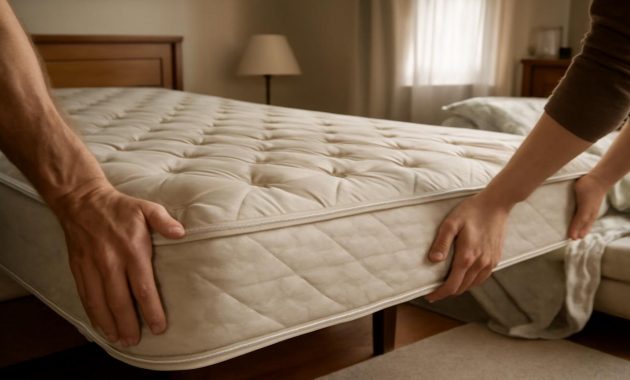
The first time you flip a mattress that’s been sitting in the same position for years, there’s a strange, quiet drama to it. The dusty fabric smell that rises up. The ghostly outline of your body, a soft valley where your weight has settled night after night. The shock of seeing the other side—untouched, almost new, like a part of your life you forgot to visit. You wrestle the thing around, the room goes momentarily chaotic—pillows on the floor, sheets tangled, bed frame exposed—and yet, when it finally lands with a soft, heavy thump, the room feels different. Lighter. More open. As if some invisible weight has been shifted, not just from the mattress, but from your mind.
The Quiet Story Your Mattress Has Been Telling
You probably don’t think of your mattress as a storyteller, but it is. Every night it records you—your posture, your habits, your anxieties—quietly taking notes in foam and springs and fabric. Over months and years, the story becomes visible in the sag near the middle, the faint ridge where one person tends to sleep, the dip at the edge where you roll toward the alarm clock at dawn.
We’re used to searching for big, dramatic reasons for poor sleep: stress, caffeine, blue light, an overactive mind. Yet one of the most overlooked culprits is completely silent, utterly patient, and sitting right under your sheets. A slowly warping surface can nudge your spine out of alignment by just a few millimeters, night after night. You don’t notice it at first. Maybe you wake with a tight neck, a fuzzy headache, a dull ache along the lower back that fades by mid-morning.
But your body remembers. The nervous system keeps a tally. The muscles start compensating. Your hips roll slightly inward, your shoulders curl forward, your jaw tightens just enough to alter your bite and disturb your breathing. You begin to toss more. You wake twice, then three times a night, not dramatically, just long enough for your sleep cycles to fragment around the fault lines of discomfort.
This is the hidden problem: sleep issues that don’t come with a clear villain. No insomnia, no nightmares, no anxious clock-watching. Just a slow erosion. A stiffness. A sense that sleep isn’t as deep as it used to be. Often, that erosion is shaped, quite literally, by the surface you lie on.
The Subtle Art of Rotating: A Small Ritual, Big Ripples
Rotating a mattress every six months sounds almost comically simple—a chore you’d assign to an afternoon when you’re already dealing with laundry or cleaning under the bed. But inside this humble act is a powerful principle: redistributing pressure before it has a chance to deform your sleep.
When you sleep in the same orientation on the same side of the mattress, your heaviest parts—hips, shoulders, ribcage—compress the same areas over and over. Springs fatigue. Foams lose resilience. It doesn’t happen evenly; it happens in slow-motion potholes, tiny sinkholes beneath the quilted top. Rotation interrupts that pattern.
By turning the mattress 180 degrees—head becomes foot, foot becomes head—you ask different sections of the materials to share the load. Areas that were bearing most of your weight get a season to rest and recover, while less-used sections step up. Over years, this spreads out the wear, keeping the landscape of your bed closer to its original, supportive shape.
The change can feel subtle at first. You may only notice that your body settles differently, or that your pillow feels like it has shifted in relation to your shoulders. But very often, the real magic reveals itself a week later: you wake one morning and realize your lower back isn’t complaining quite so loudly. Or that your partner hasn’t rolled toward the middle of the bed in a while. Sleep feels a touch deeper, dreams a little more continuous.
Rotating doesn’t just serve the mattress; it serves your spine. It keeps your head, shoulders, hips, and heels more aligned over time, minimizing the micro-strains that accumulate into actual pain—and the hidden arousals that disturb deep sleep stages.
The Six-Month Rhythm: Letting the Seasons Remind You
There’s something pleasing about syncing mattress rotation with the rhythm of the year. Twice annually is usually enough: once as the air warms, once as it cools. Think of it as a quiet seasonal ritual, like changing the batteries in a smoke detector or pruning the garden.
In spring, when windows open and fresh air carries in the smell of rain and soil, you strip the bed, pull the mattress around, and invite a slightly different geography into your sleep. In autumn, when the days shorten and blankets thicken, you turn it again, readying your body for longer nights and the particular heaviness of winter rest.
This rhythm isn’t just about memory; it’s about mindfulness. Those two small rotating moments in the year invite you to pause and ask: How has my sleep felt lately? What hurts when I wake? Am I paying attention to the landscape under me, or only to the chaos in my head? Very often, answers to sleep problems are both psychological and physical. Rotation gives you an excuse to tend to both.
The Invisible Sleep Issues Hiding in Plain Sight
Not all sleep issues announce themselves with drama. Some are more like background static, subtle enough that you adjust to them, the way you stop noticing the hum of a refrigerator. A mattress that hasn’t been rotated for years can quietly contribute to a surprising number of these.
Consider these under-the-radar effects:
- Micro-awakenings from pressure points: When a mattress sags, one shoulder may sink too far while your neck twists just slightly. Your brain senses discomfort long before you’re fully awake, nudging you to shift position. You don’t remember it, but the continuity of deep sleep is broken again and again.
- Subtle breathing changes: If your torso isn’t level—say, your midsection is slightly depressed while your head is relatively elevated—your airway angle shifts. For someone with even mild snoring or borderline sleep apnea, that few degrees of change can worsen nighttime breathing without you realizing why.
- Circulation quirks: A saggy surface can pinch at the hips or compress one side of the ribcage more than the other, affecting blood flow and leaving you with numbness in your arms or tingling in your legs upon waking.
- Muscle guarding: When the body doesn’t feel properly supported, deeper muscles hold tension through the night to stabilize the spine. You don’t consciously “feel” this happening, but you do feel the morning fatigue.
What’s striking is how often people blame age, stress, or random bad luck for these complaints—never suspecting that a simple rotation could soften, if not fully resolve, many of them. It won’t cure diagnosable medical conditions, but it can remove a quiet aggravator that keeps them humming in the background.
A Quick Look at Symptoms and How Rotation Helps
The connection between your mattress and your sleep quality can feel abstract, so it helps to make it tangible. Here’s a simple, mobile-friendly table that maps common hidden sleep issues to how rotating every six months can ease them:
| Hidden Sleep / Body Issue | How a Neglected Mattress Contributes | How 6-Month Rotation Can Help |
|---|---|---|
| Morning back or hip stiffness | Uneven support and sagging pull your spine out of alignment. | Redistributes body weight over fresher, firmer zones to support natural spinal curves. |
| Frequent tossing and turning | Developing dips and ridges increase pressure on shoulders and hips. | Smooths out wear patterns, reducing pressure points that spark micro-awakenings. |
| Midnight awakenings with no clear cause | Subtle discomfort triggers brief arousals you don’t fully recall. | Maintains a more even surface that lets your body fully relax into deeper sleep stages. |
| Neck and shoulder tension on waking | Unequal sinking changes the angle between your head, neck, and shoulders. | Helps keep torso and shoulders more level so your pillow can do its job correctly. |
| Feeling unrefreshed despite “enough” hours | Fragmented sleep from low-grade discomfort reduces time in deep, restorative stages. | By lowering discomfort-related arousals, it supports more continuous, restorative sleep. |
Making Rotation a Small, Beautiful Ritual
There’s a practical side to this, of course: rotating a mattress is physical work. You tug it away from the wall, maybe bump your shin, laugh as it leans too far and threatens to topple you. But there’s also a chance to turn it into a quiet act of care—for yourself, for whoever shares the bed, and for the space you sleep in.
Choose a day when you’re not rushing. Pull back the blankets and sheets until the mattress lies bare, its fabric exposed to the room. Let the daylight touch it. Open a window if the weather allows. Tap the corners; listen to the muffled firmness of the materials inside. This big, rectangular thing carries you every night—your sadness, your joy, your dreams, your illnesses, your bored late-night scrolling. It knows more of your unguarded self than almost anything else in the house.
Then, with a slow, deliberate movement, swivel it. Head end becomes foot end. The side that used to hold your worries gives way to a side that has been patiently waiting, untouched. When it lands, take a moment to notice how it looks, how it feels under your palms. Smoother, maybe. Less obviously “lived in.” You’ve just given your future self six months of better alignment with a single, thoughtful turn.
Once it’s set, take advantage of the moment. Vacuum the base or platform. Check for loose slats, squeaks, or uneven legs. Wipe down the headboard. Then remake the bed as if you’re preparing a guest room for someone you genuinely care about—because, in a way, you are. You are the guest you’re inviting into deeper rest.
Simple Tips to Make It Easier
- Mark your calendar: Use the equinoxes or the start of daylight saving time as natural reminders to rotate.
- Know your mattress type: Most one-sided modern mattresses are meant to be rotated, not flipped. Double-sided, older models can often be flipped and rotated—check the manufacturer’s guidance.
- Get help: Larger sizes like queen and king often need two people. That’s not weakness; it’s just smart body mechanics.
- Protect and refresh: While the mattress is bare, air it out for 20–30 minutes and, if you use one, wash the protector.
Listening to the Landscape of Your Sleep
There’s a quiet wisdom in paying attention to surfaces—the feel of the trail under your boots, the texture of bark under your fingers, the way sand shifts to accommodate your bare feet at the shore. Your mattress is another surface like that, just less visible. It holds the imprint of years, and it will shape the years ahead.
When you climb into bed tonight, pause for a breath and notice how the mattress receives you. Does it gently meet the curve of your lower back, or does your spine have to sag to reach it? Do your shoulders nestle in without protest, or does one side feel slightly higher, slightly more insistent? Does your body exhale with relief, or does it adjust, negotiate, make small compromises?
Rotating your mattress every six months won’t suddenly erase every tension in your life, but it will remove one quiet obstacle between you and deep rest. It’s a simple, physical way of saying: I am paying attention to the ground I sleep on. I am adjusting the world under me so that my body can unclench, my brain can soften its grip, my dreams can arrive without having to fight through layers of discomfort.
In a culture that celebrates big fixes and grand makeovers, it’s easy to overlook small, sustaining practices like this. But often, quality sleep is not rescued by a single dramatic solution. It’s rebuilt, gently, by cumulative gestures: dimmer lights, quieter evenings, a phone left out of reach—and a mattress that you remember to turn with the seasons, honoring the fact that wear and gravity are real, but so is your capacity to work with them.
Twice a year, give yourself that turning point. Rotate the mattress. Refresh the space. Then lie back down on a surface that has been literally reoriented in your favor. Let your body learn the new contours. Listen, over the weeks that follow, as some of those hidden sleep issues begin to soften, like a distant storm finally moving off the horizon.
Frequently Asked Questions
How often should I rotate my mattress?
For most modern mattresses, every six months is a good rule of thumb. Some manufacturers recommend every three months during the first year, when materials are settling. Check your mattress tag or care instructions, but twice a year works well for many people.
Do I rotate or flip my mattress?
Most newer mattresses are one-sided and should only be rotated 180 degrees, not flipped. Older, double-sided models can usually be both flipped and rotated. If you’re unsure, feel the underside—if it’s clearly not designed for sleeping, don’t flip it.
Can rotating really improve my sleep?
It can. Rotation helps keep the surface more even, which supports better spinal alignment and reduces pressure points. For many people, this means fewer micro-awakenings from discomfort, less morning stiffness, and more restful sleep over time.
What if my mattress is already sagging a lot?
If you see obvious dips or feel like you’re rolling into a valley, rotation may help a little but won’t fully fix it. Significant sagging often means the mattress is nearing the end of its useful life. Rotation is best as a preventative habit that starts early, not an emergency repair at the very end.
Does mattress rotation help with back pain?
It can be part of the solution. Back pain has many causes, but an uneven or worn mattress often makes it worse. Regular rotation helps maintain more even support so your spine can rest in a healthier position. If pain is severe or persistent, it’s important to talk with a healthcare professional as well.