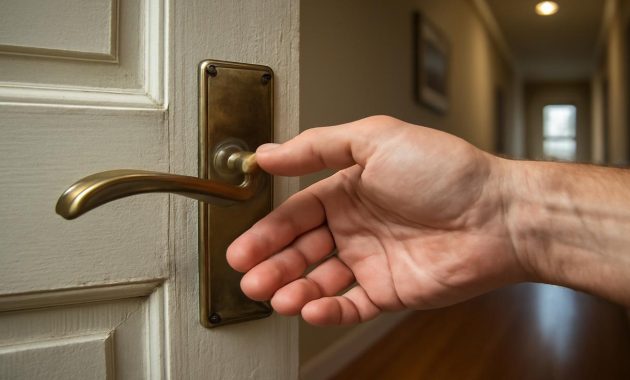
You only notice it when the house is quiet and the kettle has stopped rattling on the hob. That faint breath of cold around your wrist as you reach for a door. The way your fingers hesitate on the metal handle because, somehow, it feels wrong for a moment—too cool for a room you’ve been paying to keep warm all day. You stand there, hand hovering, and a strange thought slips in: where is all this heat actually going?
The winter evening that changed how I see doors
It was one of those January evenings when the sky folds down early and the streets smell faintly of woodsmoke. Inside, the radiators hummed with purpose, doing battle with the dark. I’d just made tea, the windows had misted at the edges, and the cat had draped herself on the warmest patch of carpet like she’d paid the heating bill herself.
For all intents and purposes, the house looked cosy. But as I walked down the hallway to check the back door, something kept pulling at the edge of my awareness. A sneaky thread of chill, a whisper of draught. You learn to ignore these things in older houses. You put on thicker socks. You tell yourself, It’s winter, what do you expect?
Then I touched the back door handle.
The metal bit like river water in early spring—cold with a sharpness that felt out of place in a heated home. Not ice cold, not the way the outside door handle feels in the garden, but definitely colder than the room, colder than the air I’d just walked through.
In that tiny, tangible contrast, something clicked. All at once, this hand-sized piece of metal stopped being just hardware and turned into a messenger. It was telling me a story about heat, loss, and the quiet highways between inside and out.
The door handle test: a 30-second conversation with your house
People talk about “reading the landscape” when they’re outdoors—how moss grows on one side of trees, how the wind shapes snowdrifts, how birds move before a storm. Indoors, our landscapes are just as talkative; we’ve simply forgotten how to listen. The “door handle test” is one way to start listening again.
At its simplest, the test is this: in winter or on a cold day, walk around your home and lightly touch each door handle that separates you from the outdoors or an unheated space. Pause long enough to really notice how it feels. Not just “cold” or “warm,” but cold compared to what? Your other hand? The room air? The handles inside the house?
Metal is an excellent conductor of heat. That’s why a steel spoon in hot soup quickly becomes almost untouchable, while the wooden one stays politely neutral. When part of a metal handle is close to the outside, and part of it lives indoors, it becomes a little bridge where warmth from your home silently escapes into the cold. Your fingers are exquisitely tuned instruments for detecting these differences—far more precise than we usually give them credit for.
The magic of the door handle test is not that it gives you lab-grade data. It’s that it gives you immediate, sensory feedback. In under 30 seconds, you can tell whether a door is quietly misbehaving, working against every degree your thermostat is fighting to hold.
How to do the door handle test (and actually feel what’s going on)
Wait for a truly cold day or an icy evening. You want a clear difference between indoors and outdoors for this to sing.
- Start in the warmest room of the house. Let your hands adjust to the indoor temperature for a minute or two.
- Touch an interior door handle first—one between two heated rooms. This is your baseline. Notice how neutral it feels.
- Now walk to an outside door: back door, front door, the door to the garage, even the door to a cold porch or conservatory.
- Lightly place your fingertips on the handle and wait. Don’t rush it. Feel the first shock of contact, then the way your skin and the metal negotiate a temperature truce.
- Ask yourself: does this feel noticeably colder than that interior handle? Does the chill linger longer in your fingertips?
If the answer is yes, that handle is hinting at something: your door is acting less like a barrier and more like a leak.
What your fingertips are actually measuring
We don’t think of our hands as scientific instruments, but on a cold day, they’re practically field sensors. When you touch a metal handle, heat moves from the warmer object (often you, or your indoor air) to the colder one (the part of the handle closer to outside). Metal does this exceptionally quickly, which is why it feels so dramatically cold or hot.
If an exterior door is well-insulated and properly sealed, less of that outdoor chill reaches the inside part of the handle. It might still feel cool, but not dramatically different from the rest of the room. If a door is poorly insulated, warped, or leaky around the frame, the handle becomes an express lane for temperature equalisation—the fancy way of saying “your heat is running away.”
In those few seconds of touch, you’re sensing:
- Thermal bridging – when a solid material like metal or poorly insulated framing lets heat flow through more easily than the surrounding materials.
- Air leakage – draughts sneaking around the door that cool surfaces nearby, including that handle.
- Surface temperature contrast – the difference between the handle and other objects in the same room.
Your body might not know the numbers, but it knows the story: heat is leaving here, more than it should.
A pocket-sized table for your own handle “readings”
As you wander from door to door, it can help to give your impressions some language. This isn’t about precision; it’s about noticing patterns. Here’s a simple way to think about what your fingers tell you:
| Handle sensation | What it usually means | What to check next |
|---|---|---|
| Feels almost like room temperature | Decent insulation, minor losses | Quick visual check of seals and frame |
| Noticeably cool, but not uncomfortable | Some heat loss; common in older doors | Inspect weather stripping, letterbox, threshold |
| Unpleasantly cold, shock on first touch | Significant thermal bridge or air leak nearby | Test for draughts, consider upgrading door or hardware |
| Varying temperature across the handle | Asymmetric exposure to cold, likely gaps on one side | Run hand around frame edges; use a candle or incense test |
Following the cold: a small investigation around the frame
Once you’ve found that one handle that makes you wince, curiosity usually takes over. You start noticing other clues. The thin stripe of frost that appears on the edge of the glass. The way the curtain near the door flutters slightly when the wind picks up. The small, stubborn chill that refuses to leave the hallway floor.
Heat loss is rarely a single, dramatic escape hatch; it’s a collection of small betrayals. The handle is just the part you touch first.
Stand near the suspect door for a moment. Feel the air with the back of your hand around:
- The bottom threshold.
- The vertical sides of the frame.
- The gap at the top where the door meets the frame.
- Any keyholes, letterboxes, or cat flaps.
If the wind is wild outside, you might feel a direct draught—a confident, unapologetic stream of cold. On calmer days, the air movement may be subtle, almost imagined. That’s when a candle or a stick of incense becomes useful. Hold the flame or the ribbon of smoke close to each edge and watch. Any wobble, flicker, or strange pulling motion means the air is moving there, too.
Some of this is old-house charm. Some of it is your heating bill climbing silently higher.
Small fixes that change the way your handle feels
One of the most satisfying parts of the door handle test is how quickly you can act on what you discover. You don’t need to be a carpenter or an engineer; you just need to be a little bit stubborn about keeping your warmth.
Once you’ve identified a cold, complaining handle, these small interventions can soften its voice:
- Renew weather stripping – Those tired rubber or foam strips around the door frame harden and shrink with time. Replacing them often brings an immediate difference you’ll feel on the handle within days.
- Seal the letterbox – Brush-style draught excluders or internal flaps tame the howling gap many of us have simply accepted.
- Add a door sweep – That row of bristles or flexible strip at the bottom of the door can muffle one of the biggest leaks in a house.
- Use heavier curtains or a door curtain – The old-fashioned hallway curtain across the front door exists for a reason; fabrics are quiet champions of comfort.
- Upgrade the handle or lock set – In some cases, older metal hardware acts as a direct thermal bridge. Modern designs or insulated backplates can interrupt that path.
Return to your “problem” handle a day or two after making changes. Touch it again on a cold morning. Notice if that cruel sting has softened into something more neutral. This sensory before-and-after becomes its own quiet reward, proof that the house is responding, that you’re in conversation with it now.
Why this tiny ritual matters more than it seems
There’s an unexpected intimacy in learning the temperature of your own door handles. It feels almost like getting to know the pulse points of your home. In a world of smart thermostats and energy meters, we forget that our bodies already come with built-in tools for noticing what’s happening.
When you tune into those tools, something else starts to shift: your relationship with energy stops being abstract. “Heat loss” is no longer a diagram or a bill; it’s the little bite of cold on your skin, the way one particular door refuses to ever really feel at peace with winter.
In many houses, the big jobs—insulating lofts, replacing windows, installing new systems—feel distant, expensive, and intimidating. The door handle test is the opposite of that. It’s small, tactile, and instantly available. Anyone can do it. Ten minutes, two hands, a cold evening.
Yet across hundreds or thousands of homes, these tiny rituals add up. Each time someone finds a leaky door and decides to fix it, they’re lowering their carbon footprint in a tangible, lived way. They’re choosing to keep heat where it was meant to stay: wrapped around people, not bleeding into the night.
There’s also a softer benefit, one that doesn’t show up on a bill: you begin to experience your home as a living environment, not just a box you occupy. You notice how it breathes. Where it sighs. Where it shivers. The door handle becomes not just a test, but a teacher.
Let the handles lead you outside, too
Once you’ve run your hands over the interior side of the doors, open one and step out. Feel the change in air density, the way the cold carries sound differently—crisper, sharper. Close the door behind you and touch the exterior handle.
It will likely be colder, of course. But comparing inside and outside tells you something powerful: that thin slice of wood, glass, and metal in between is all that stands between the warmth you’ve made and the world that wants to borrow it. The handle is simply where those two worlds meet.
On some evenings, once you’ve finished your little tour, you may find yourself doing something you haven’t done in years: rolling a towel along the foot of a particularly leaky door; pinning a heavier curtain across a draught; standing in the quiet after, feeling the house slowly equalise, the hard edges of chill begin to soften.
Then, the next time you reach for that handle, your fingers will confirm what you hoped: the metal is no longer startling. It simply sits there, a silent co-conspirator in your quest to keep the winter at bay.
Frequently Asked Questions
Does the door handle test work in warmer climates?
Yes, though you’ll notice it most when there’s a sharp contrast between indoors and outdoors. In hot climates, if you’re cooling your home, an unusually warm interior handle on a very hot day can signal heat sneaking in from outside.
Is this test a replacement for professional energy audits?
No. The door handle test is a quick, intuitive way to spot obvious weak points. A professional energy audit uses tools like thermal cameras and blower doors to give detailed measurements. Think of the test as a first step, not the final answer.
What if all my exterior door handles feel cold?
That’s common in older or lightly insulated homes. Start by comparing which handles feel coldest and focus on those doors first. Often, simple improvements to weather stripping and thresholds can make a noticeable difference.
Does the material of the handle matter?
Absolutely. Metal handles (especially solid ones) conduct heat much more efficiently than plastic or wood, so temperature differences show up more clearly. The test is most revealing on metal hardware.
Can I use this method with windows too?
You can’t “grab” a window the way you do a handle, but you can touch the frames and glass edges on a cold day. If the interior frame feels dramatically colder than the surrounding wall, that window may be losing more heat than it should.
When is the best time of day to do the door handle test?
Evenings or early mornings on the coldest days are ideal, especially after your heating has been on for a while. That’s when the contrast between indoor and outdoor temperatures is sharpest, and your fingers will pick up differences more easily.
How often should I repeat the test?
Once or twice each winter is usually enough, or after you’ve made changes like new seals or a replacement door. Over time, it becomes less of a chore and more of a quiet seasonal ritual—one more way of noticing the small, important stories your home is trying to tell you.