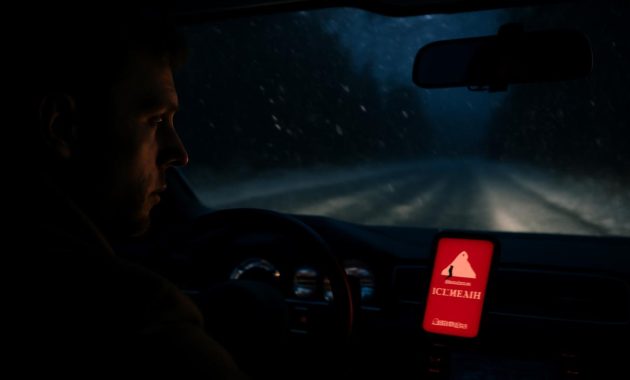
The first snowflake lands on the back of your hand as you fumble for your keys. It melts instantly, a cold pinprick that could almost be your imagination—except that the air smells like iron and ice, and there’s a hush settling over the street that wasn’t there an hour ago. Somewhere in the distance, a siren wails, already slightly muffled, as if the city is putting a pillow over its own mouth. Late tonight, the heavy snow that’s been talked about all week will finally arrive for real—officially confirmed, plotted, tracked—but for now, the neighborhood is still pretending this is just another winter evening. Dog walkers keep their usual pace, headlights glide past in steady lines, delivery scooters zigzag through traffic. And all the while the sky, that low, bruised lid hanging just above the rooftops, is preparing to drop.
The Night the Forecast Turned from “Maybe” to “This Is It”
By late afternoon, the language had shifted. The apps on our phones traded gentle snowflake icons for red bars and exclamation marks. “Major disruption likely.” “Non-essential travel not advised.” You could see the tone change in the way the meteorologists held themselves on screen—no more playful snow talk, no more “could be a bit of fun for the kids.” The maps behind them were smudged with heavy bands of white and purple, thick as spilled paint, creeping steadily across the country.
In the control rooms of local transport networks, route charts and delay scenarios were spread out like battle plans. Gritters were lined up in depot yards, orange beacons ready to spin through the night. At the airport, rows of de-icing trucks hissed and steamed like strange mechanical animals. Everyone whose job it is to think about the worst-case scenario had already made the mental switch.
And yet, down at street level, not everybody got the memo—or wanted to. Happy Hour signs still glowed outside bars. A couple at a café window argued politely about whether they should still drive two hours to tomorrow’s family party. “They always overreact,” he said, tapping his phone like a trump card. “We’ll leave early. It’ll be fine.”
Behind all this stubborn normality sat the uncomfortable truth: the snow was not hypothetical anymore. The weather services had done their part. The alerts were official, the thresholds crossed, the models aligned. The timing: late tonight, continuing through tomorrow, with the heaviest falls during the morning commute. The warnings: power cuts possible, roads treacherous, rail disruption “highly likely.” The tone: serious enough that the phrase “risk to life” was being used without flinching.
The Science Behind a Silent White Wall
Heavy snow has a way of feeling like magic, but its arrival is anything but mysterious. High above the city, cold, dry air has been sliding in all day, undercutting the last of the milder air mass that’s been keeping the week gray and damp but manageable. As the front approaches, temperatures shuffle downward, half a degree at a time, almost embarrassed by their own caution.
In that complex ballet of air masses, the atmosphere decides what falls: rain, sleet, or snow. Tonight the decision is clear. Forecasters have been watching it unfold on their screens for days—continental air locking horns with moist Atlantic systems, pressure gradients tightening, lines of isobars bending into telltale shapes that anyone who lives in these latitudes has learned to recognize with a subtle, secret thrill.
But this thrill comes with a heavy price. Heavy snow is not just “more snow.” It’s density, duration, and timing working together. Flakes stack faster than they melt. They’re driven by wind that sculpts them into drifts, blocks side roads, and hides ice beneath soft powder. A few centimeters can slow a city; twenty or more, falling on already frozen ground, can break it.
Forecasters talk about “impact-based” warnings now, not just centimeters and degrees. It’s not only about how much snow lands, but when. Tonight, the models agree on the worst possible answer: the heaviest band will sweep through just before dawn, when roads are at their coldest and drivers are at their sleepiest. The morning commute will collide with the storm like two trains on the same track.
Why Warnings Often Feel Like Background Noise
We’re living in an age of constant alerts: phones buzz, apps ping, banners crawl across the bottom of TV screens. Somewhere between the heatwaves and the flash floods, the “severe weather alert” has started to feel like another line of digital static—serious, but not quite real. We’ve seen maps glow orange before, only for the worst of it to slide north or dissolve in the night. There’s always that friend, that neighbor, that voice online: “They said the same thing last year and nothing happened.”
This is the paradox of modern forecasting. The better and more precise it becomes, the more often meteorologists will warn early, knowing they’ll occasionally overestimate rather than risk being too late. And when the worst doesn’t fully arrive, the public memory quietly files it away as “yet another overreaction.” The next time, those same people feel justified in shrugging it off.
Tonight, you can see that shrug everywhere: in the crowded restaurant bookings still firmly in place for tomorrow, in the colleague swearing they’ll “definitely drive in,” in the online comments dismissing the bulletins as “media hype.” We’ve all become minor experts, weather app warriors comparing model runs like sports stats, and somewhere in that illusion of expertise, humility has a way of disappearing.
On the Ground: A City Edging Toward Whiteout
Step outside again just after midnight, and the world has changed texture. The road surface looks soft, like it’s been sanded. Streetlights glow inside pale halos. You can hear the snow now: the faint hiss as it hits your coat, the wet whisper as it gathers on branches, the muffled thud of a bus moving slower than usual. The first tire tracks are already filling in behind passing cars, as if the road is quietly erasing the evidence of activity.
In an apartment block, a paramedic lays out their uniform for the early shift, double-checking their snow chains and extra blankets. Across town, a delivery driver debates whether that 5 a.m. start is worth it if half the addresses on the list will be unreachable. A small bakery owner sets an alarm for 3:30, torn between responsibility to staff and fear of losing a precious day’s trade.
Inside living rooms, the decisions feel smaller but no less fraught. Do you cancel the long-drive visit to your grandmother’s? Will your trains even run? Parents glance at school apps, waiting for a late-night notification that might save them from dawn uncertainty. Some roads have already turned into thin, glossy ribbons—somewhere between slush and ice—waiting for the temperature to drop just one more degree.
And beyond the glow of towns and suburbs, in the stretches of countryside in between, the snow is falling harder. Fields become blanketed voids, hedges reduced to wavering charcoal lines, roadside markers swallowed one by one. Here, the phrase “non-essential travel” takes on a more literal meaning. If your car slides into a ditch at 2 a.m. on an unlit road, whether your journey was really necessary may be all you can think about while you wait for help—if help can reach you at all.
Plans, Stubbornness, and the Psychology of “It Won’t Be That Bad”
Why do so many people refuse to change their plans, even when the warnings are loud and clear? Some of it is simple habit. We are creatures of routine, and snow is an insult to that rhythm. Our days are scheduled with scant slack: school drop-offs, critical meetings, long-booked events, commitments that feel, in the moment, more solid than any forecast map.
There’s pride, too. The quiet conviction that “I know what I’m doing,” forged from winters where we navigated icy roads and came home with only a story to show for it. Experience, paradoxically, can work against us. The more often we’ve “got away with it,” the more we downplay the risks. We compare this new storm to that big one years ago and decide, based on incomplete memories and emotional impressions, that this time surely can’t be worse.
And then there is the social pressure. The subtle fear of being the one who cancels first, of overreacting, of seeming fragile or dramatic. Offices that haven’t quite embraced flexible working send mixed messages: “Be safe, but we’re still open.” Family members insist they’ve “done that drive a hundred times,” guilt-tripping you into sticking to the plan. Nobody wants to be the person who pulls the plug and then watches the snow turn out lighter than expected.
Yet, when the roads finally clog with stranded vehicles and news channels pivot to live pictures of jackknifed trucks and abandoned cars, the narrative flips rapidly. People ask why more wasn’t done, why stronger language wasn’t used, why so many were still on the roads. We hold two conflicting expectations at once: we want our own lives to proceed as planned, but we also want the world around us to anticipate our safety better than we anticipate it ourselves.
Travel Chaos by Numbers: What the Warnings Actually Mean
Behind every weather alert are quiet, sobering estimates. Here is a simplified snapshot of how a heavy-snow event like tonight’s can ripple outward:
| Impact Area | What Officials Expect | What Many People Assume |
|---|---|---|
| Roads | Icy, reduced visibility, road closures, multi-car accidents likely. | “A bit slower than usual, but still drivable if I’m careful.” |
| Rail | Cancellations, shorter trains, major delays, stuck trains possible. | “Maybe a few delays. I’ll just catch a later train if I have to.” |
| Air Travel | De-icing delays, runway closures, missed connections. | “Airports can handle snow; planes fly in worse all the time.” |
| Power & Services | Local outages, slower emergency responses, supply chain disruption. | “Worst case, the Wi‑Fi drops for a bit.” |
| Health & Safety | Falls, hypothermia risks, delayed ambulances, higher accident rates. | “I’ll just put on better shoes and leave earlier.” |
What reads like a mild inconvenience on a phone screen—“travel disruption likely”—is, for the people managing roads, hospitals, and rail lines, a flashing red light. Yet our private interpretations downgrade that language. We translate “risk to life” into “risk to other people’s lives,” a tiny, dangerous semantic slip that keeps us hanging onto our plans.
How to Rethink Your Own Plan Without Panicking
Responding responsibly to a heavy snow warning doesn’t mean barricading the door at the first flurry. It means recalibrating your sense of what is truly necessary. Ask yourself, with brutal honesty: if the worst-case scenario happens and you do get stuck, stranded, or injured, will the reason you were out there still feel worth it?
Maybe that means shifting tomorrow’s meeting online, even if the office technically remains open. Maybe it’s calling the relatives and rescheduling the visit, even if they sound disappointed at first. It could be rearranging deliveries, stocking up on essentials today rather than rolling the dice tomorrow, or calling a neighbor to coordinate checking in on each other if power or heating fails.
“Flexibility” is the unglamorous superpower in moments like this. It asks you to bend so you don’t break. When weather services say “non-essential travel,” they’re not trying to define your priorities for you; they’re asking you to do that work yourself, with more honesty than we’re used to applying in our always-on lives.
The Strange, Stark Beauty Amid the Danger
By dawn, if the forecasts are right, the city will wake up inside a snow globe. The familiar edges will be softened. Cars will look like sleeping animals. Side streets will be unmarked, virgin pages just waiting for the first cautious footprints. For a while, before the slush, before the gridlock, before the inevitable impatience, it will be heartbreakingly beautiful.
Children will press their noses to windows, already bargaining over snowman designs and sledding locations. Dogs will bound in loops, learning all over again that the ground can vanish into softness. A quiet few—the ones who changed their plans in time—will step outside with flasks in their pockets and no urgent destination, simply to walk and listen to how snow makes even the loudest city sound like a library at closing time.
There’s a temptation to frame snow days as either catastrophe or carefree holiday, but they are neither. They are reminders of scale: of how small our infrastructures really are compared to the moods of the sky, and how fragile our schedules are when the world decides to slow down. Heavy snow strips life back to basics—warmth, food, connection, safety—and everything else, under that thick white blanket, is forced to prove its importance.
Some will ignore that test and push ahead regardless. The roads will tell their stories in bent guard rails, flashing hazard lights, and long, frustrated tailbacks. Others will learn that staying home isn’t weakness but wisdom; that there is courage, too, in being the one who cancels first, who listens to the quiet authority of an approaching storm.
Tonight, as the snow begins in earnest and weather alerts scroll across screens in stern, impersonal text, the question hanging in the air is neither dramatic nor philosophical. It’s practical, simple, and uncomfortably personal: when the world outside says clearly, “I am changing,” will you?
FAQ: Heavy Snow, Warnings, and Changing Your Plans
How seriously should I take tonight’s heavy snow alert?
If local authorities and national weather services have issued a heavy snow warning with mentions of “major disruption” or “risk to life,” it should be taken very seriously. These alerts are based on detailed models and past impacts, not guesses. Treat them as strong advice to rethink non-essential travel and to prepare for possible power, transport, and service interruptions.
What counts as “non-essential” travel in a snowstorm?
Non-essential travel is anything that can be postponed, moved online, or rescheduled without serious consequences to health, safety, or critical work. Social visits, leisure trips, many in-person meetings, and flexible errands often fall into this category. Medical appointments, emergency care, essential work, and critical caregiving responsibilities may not.
How can I prepare at home before the snow gets heavy?
Charge phones and power banks, have basic food and drinking water for a couple of days, keep extra layers and blankets handy, and know where flashlights and batteries are. If you rely on medication, make sure you have enough to get through potential delays. Check that you have a way to stay warm if heating is interrupted and consider checking on neighbors who might struggle.
Is it safer to drive if I have winter tires and experience?
Winter tires and experience both help, but they don’t cancel out the risks of severe conditions. Black ice, drifting snow, limited visibility, and other drivers losing control can still put you in danger. Even the best-equipped, most skilled drivers can get stuck if roads are blocked or closed. The safest journey is usually the one you don’t have to make.
What should I do if I absolutely must travel during the heavy snow?
First, check official travel updates and avoid routes with closures or severe warnings. Tell someone your route and expected arrival time. Pack warm clothing, blankets, water, snacks, a phone charger, and any necessary medication. Drive slowly and smoothly, keep extra distance from other vehicles, and be prepared to turn back if conditions worsen. If using public transport, allow for long delays and have a backup plan if services are suspended.