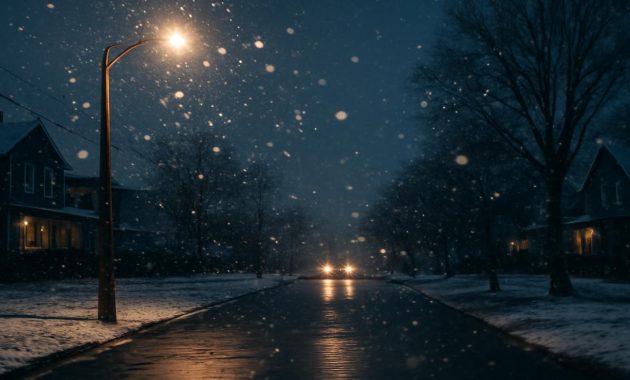
The first flakes always seem to fall in slow motion, as if the sky is taking a long, deep breath before it speaks. By the time you’re reading this, the air may already be sharpening, the clouds thickening into that familiar, muted gray that makes the world feel as if someone turned the volume down. The forecast is clear, almost stern: heavy snow expected starting late tonight. But weather is never just numbers and warnings. It’s the way your streetlights will bloom into halos through swirling flakes, the way your neighborhood will listen, all at once, to the quiet that follows.
The Long Pause Before the First Flake
All day, the town has been in that odd limbo that comes before a winter storm. You can feel it long before you can see it. The air feels different on your face when you step outside in the late afternoon—more purposeful, somehow. The cold has an edge, as if it knows it’s about to take center stage.
The grocery store aisles were probably packed earlier, carts rattling and squeaking in the rush, people grabbing bread and milk and whatever comforts they imagine they might crave when the snow piles up. In the parking lot, you might have watched someone load their trunk with firewood and bottled water, cheeks flushed from the wind, eyes flicking nervously at the sky.
Meteorologists have been tracking this system for days. On the radar, it looks like a slow-moving animal, coiling its muscles before it pounces. The models say it will arrive after midnight in most places, a thick band of precipitation sweeping in from the west or north, depending on where you are, turning from sleet to fat, heavy flakes as the temperature drops just a little more than anyone would prefer.
Inside, though, the world feels small and warm. There’s that soft, electric excitement that only a storm warning can bring. Lamps cast amber pools of light on the floor. You might have dug out blankets from the closet you don’t open often enough, their scent faintly musty and the memory of last winter still clinging to them. Maybe you’ve set a kettle on the stove, or laid a book on the coffee table, ready to be opened when the world outside disappears into white.
The Numbers Behind the Storm
For all its softness, snow is also about hard measurements and practical details. The phrases flying around—“heavy snow,” “winter storm warning,” “hazardous travel”—carry very real meaning. This isn’t the kind of dusting that powders the lawn and melts by lunchtime. This is the kind of weather that reshapes your plans, your schedule, even your sense of control, if only for a day or two.
Here is a quick look at what this kind of event usually means in simple terms, so you can see the scale that sits behind those gentle falling flakes:
| Aspect | Typical Range Tonight | What It Feels Like |
|---|---|---|
| Snowfall Amount | 6–12 inches (locally higher) | Plows working overnight, shovels working overtime, snowbanks growing taller than your boots. |
| Snowfall Rate | 1–2 inches per hour in heaviest bands | Roads re-cover between passes, visibility shrinking to a swirling white tunnel. |
| Wind Gusts | 20–35 mph, higher in open areas | Snow drifting across roads, howling around corners, sculpting strange shapes in the drifts. |
| Temperature | 20–30°F (-6 to -1°C) | Cold enough for snow to stick to everything; every exhale a pale ghost in the air. |
| Timing | Late tonight through tomorrow morning | A dark-to-dawn transformation; you sleep in one season, wake up in another. |
These numbers are approximations, of course, but they give shape to the feeling in the air. A heavy snow warning is a promise that waking up tomorrow will mean meeting a different world than the one you went to bed in. Cars will look like rounded, anonymous sculptures. Sidewalks will vanish. The familiar edges of your everyday life will soften and blur.
In some places, this might be the first true storm of the season—the one that announces, without apology, that winter is no longer just an idea on the calendar. In others, it might be one more in a long sequence, another layer over a landscape already shrunken and quiet beneath months of earlier storms. Either way, tonight marks a threshold.
How the Storm Builds Above You
High above your roof, beyond the reach of streetlights and the comforting glow from your windows, the atmosphere is already at work. A low-pressure system might be tugging moist air up from a distant sea or lake, colliding with colder, drier air sliding down from the north. Invisible at first, these masses twist and fold into each other, a turbulent dance across hundreds of miles.
As the air lifts, it cools. Moisture condenses into clouds, and those clouds thicken into something heavy enough to hold a storm. Far aloft, tiny ice crystals begin to form, clustering around microscopic particles—a bit of dust, a bit of salt, a shard of something you will never see. They grow and collide and rearrange themselves into the intricate six-pointed designs we all recognize, though no two are exactly alike. Billions upon billions of them float and drift and tumble in currents you can’t feel.
Eventually, they become too heavy to remain suspended. Gravity takes over. Snow begins to fall.
For a while, nothing may appear to be happening. The forecast will insist that heavy snow is imminent, but when you press your face to the window, the world outside still looks brown, or gray, or the dull, damp color of late winter earth. Then you notice one flake against the glass. Then another. Soon, the air is stippled with white.
This is how a snowstorm often arrives: not in a sudden dramatic curtain, but in a gradual thickening, the sky quietly lowering itself until ground and horizon and distance all dissolve.
The World as It Transforms Overnight
There’s a particular hour during a storm when most people are asleep and the snow is falling at its heaviest. The plows have not yet finished their routes, the last late-night commuter has given up and gone home, and everything living seems to have retreated indoors. The only light comes from porch bulbs, distant windows, the occasional flicker of a traffic signal cycling red to green for no one.
If you were to step outside then, you’d hear it: nothing. Or almost nothing. Just the faint hiss of flakes landing, an almost-imaginary sound like whispers you can’t quite translate. Fresh snow muffles everything—the drone of a distant highway, the hum of the town, even your own footsteps. Your boots sink with satisfying resistance, then squeak as you lift them free, leaving behind deep, clean impressions that feel almost rude to make.
By early morning, the storm may still be raging, or it may have already spent itself, leaving behind its layered evidence on roofs, branches, and mailboxes. Light arrives slowly, refracted through a white sky onto a white earth, creating that peculiar, bluish half-glow that makes early snow mornings feel like waking up inside a dream.
Look closely and you’ll notice the details. Tree limbs, once just lines of bark against the sky, now carry elegant ridges of snow, balanced with improbable precision. Fences become a series of smooth drifts and gentle curves. Cars shrink slightly under the weight of their new coats, as if bowing to the weather’s authority. Bird feeders turn into tiny islands, where impatient sparrows kick and fuss to uncover the seeds buried beneath the new layer.
It’s a kind of temporary amnesia for the landscape, a pause in which all the scars and clutter of daily life—muddy ruts, forgotten trash, half-finished projects—are tucked away beneath a clean, bright surface. The storm doesn’t erase anything, of course, but it lets you pretend, for a little while, that everything has been reset.
Human Rituals in a Heavy Snow
With heavy snow, people fall into familiar patterns, like animals following instinct trails worn by generations. You may find yourself doing things your parents did, and their parents before them, almost unconsciously.
There’s the ritual of the shovel: choosing it from the corner of the garage, testing the handle for splinters, bracing yourself for the first push. At first, the work feels almost fun, the air bright in your lungs, your breath puffing visibly each time you straighten and lean on the handle. Later, as the piles grow and your muscles protest, the work becomes something else—a slow, methodical negotiation with gravity and ice.
There is the ritual of the car: brushing off mirrors, scraping windshields, knocking packed snow from the wheel wells with the heel of your boot. You warm your hands on the steering wheel as the engine coughs to life, the heater groaning awake, the front defroster sketching odd, heart-shaped windows through which you glimpse the world.
Inside, new rituals are born. Children press their palms and noses to the glass, eager to be released into the transformed yard. Parents weigh the school closure announcement with a blend of relief and logistical dread. Someone digs out a board game that only appears on days like this. Someone else stirs a pot on the stove, the smell of soup or cocoa or spices beginning to push back the chill that sneaks in at the edges of the windows.
Even if you live alone, there is ritual in the way you move through heavy snow days: the extra socks you put on, the careful way you step down icy front stairs, the deliberate choice to make something warm for breakfast because outside, everything is so thoroughly cold.
Staying Safe When the Beauty Turns Harsh
For all its beauty, heavy snow doesn’t arrive as a harmless guest. It demands respect. The same flakes that soften the world can also make it treacherous. Roads glaze over. Visibility shrinks. The simple act of walking across a parking lot becomes an exercise in planning and balance.
The first and easiest choice is often the most important: if you don’t need to go out, stay in. Let the storm have the roads to itself and to the plows and salt trucks that must be there. If you have to drive, keep your movements slow and gentle—like the snow itself. Sudden acceleration, hard braking, sharp turns: these are the things that make cars slide and spin. Leave more space between vehicles than feels natural. Pretend the road is covered in invisible marbles, and you’re steering across them with care.
Shoveling, too, asks for caution. Heavy snow is aptly named; it’s dense and wet and stubborn. Take smaller loads on the shovel than you think you need. Start early, before the snow compacts into an icy slab. Give yourself rest breaks, even if the sidewalk isn’t finished. There’s a quiet heroism in pacing yourself in a storm, in choosing not to measure your worth in how quickly you can clear a driveway.
Inside your home, simple choices matter. Keep flashlights and extra batteries somewhere easy to find in case the weight of the snow and the gusts of wind bring down a line and the lights flicker out. Charge your phone early in the evening. If you have neighbors who are elderly or who live alone, consider checking in before the storm hits, and again after it passes. Weather becomes gentler when it’s shared.
Listening to the Storm’s Hidden Messages
Every storm, if you pay attention, tells you things about the place where you live. Heavy snow reveals the weak branches on overcrowded trees, the low dips in roads where slush and meltwater collect, the houses whose roofs shed snow quickly and the ones that hold onto it in thick, potentially troublesome layers. It shows you which corners of your yard are most exposed to wind, where drifts build up along fences, which paths hold ice long after the sun appears.
It also reveals patterns in human life that we usually overlook. Watch the path worn through fresh snow on a sidewalk and you can see which shortcuts people treasure, which driveways host the earliest risers, which houses are slowest to wake. Listen for the sounds that emerge and fade as the day goes on: the first tentative scrape of a shovel in the predawn dark, the throaty grumble of the plow making its maiden pass, the squeals of children testing the sledding potential of the nearest hill.
In towns where winter comes hard and often, there’s a quiet culture around snow. People greet each other with comments about totals and drift heights, with sympathetic looks and shared complaints about plows piling snow where it doesn’t belong. There’s a sense of temporary camaraderie—a recognition that, for a little while, everyone is dealing with the same stubborn layer that has settled over everything.
There’s something humbling about watching how effortlessly nature can rewrite the script of a day. Meetings are postponed, deliveries delayed, travel plans rewritten. The storm doesn’t negotiate. It simply is, and in its presence, we adjust.
After the Storm: What Remains
Heavy snow never stays pristine for long. The moment plows move through, they leave behind ridged walls of packed ice and slush along the edges of roads. Boots stamp down fresh paths. Snowbanks become speckled with road grit. The first car that drives down your street leaves two dark wounds cutting through the white center.
As the sky clears, the sun—weak and low though it may be this time of year—turns the landscape into a field of light. Ice crystals on the surface of the snow catch and scatter every ray, sparkling like a million tiny mirrors. The cold, for a short while, feels less oppressive and more like a crisp, bracing companion.
Birds return to the edges of feeders and hedges, hopping and fluttering, puffed up against the chill. Squirrels dig frantically where they remember (or think they remember) burying treasures months ago. The steam from chimneys rises straight up into the still air, an everyday signal that life continues in the houses below.
By afternoon or the next day, plowed piles will stand along driveways like strange monuments, their sides already beginning to gray as airborne dirt settles. Footpaths through yards will become unofficial routes, shortcuts memorialized in packed footprints. Children will leave behind lopsided snowmen, hastily poked-in stick arms, carrot noses slightly off-center, scarves fluttering stiffly in the air.
Heavy snow is both an event and a memory. The event is the storm itself—the warnings, the hours of falling flakes, the disruptions and cancellations, the work of digging out. The memory is quieter but lasts longer: the way your street looked under that first blue morning light, the particular hush that settled over your town, the feeling of being small but somehow safe while the sky remade your world.
By tonight, as you watch the first flakes finally appear under the cone of the streetlamp, you’ll be standing at the edge of that experience. Above you, miles of sky will be busy arranging ice and air into the story your town will live through for the next day or two. Inside, you can choose how you’ll meet it—ready with boots and gloves and caution, but also with a bit of wonder.
Heavy snow expected starting late tonight. The phrase looks simple on a forecast map, but it carries so much: inconvenience, yes, and risk, but also beauty, ritual, and a rare kind of stillness. As the storm moves in, you’ll feel it in the way the light changes, the way sounds soften, the way the world seems to lean in and listen.
And when you wake tomorrow to a world transformed, you’ll know the forecast has done all it could. The rest is up to your eyes, your footsteps, and the quiet, patient work of living inside the weather.
Frequently Asked Questions About Tonight’s Heavy Snow
How late tonight will the snow begin?
Most forecasts suggest snow will start in the late evening to around midnight, though exact timing can vary by location. Light flurries may appear first, with intensity increasing after midnight.
How much snow can I realistically expect?
Many areas are likely to see 6–12 inches, with localized higher amounts where heavier bands set up. The exact total depends on temperature, storm track, and how long the heaviest snow lingers over your area.
Will the morning commute be dangerous?
Yes, conditions may be hazardous. Roads could be snow-covered, visibility reduced, and plows may still be working. If you can delay travel until crews have time to clear main roads, it’s wise to do so.
What should I do to prepare before going to bed?
Charge your phone and essential devices, locate flashlights, set out warm clothing and boots, and move shovels or snow brushes where they’re easy to grab. If you rely on medication, make sure you have enough for a few days.
Is it safe to shovel heavy snow if I’m not very active?
Heavy, wet snow can be physically demanding to move. If you have heart issues or aren’t used to strenuous activity, take extra care: shovel in small sections, take frequent breaks, push rather than lift when possible, and consider asking for help or hiring someone if you’re unsure.
Will strong winds cause power outages?
Gusty winds combined with heavy, sticky snow on trees and lines increase the risk of outages. While not guaranteed, it’s smart to prepare for the possibility with backup lighting, extra blankets, and a plan to stay warm.
What’s the best way to enjoy the storm safely?
Stay inside while the snow is at its heaviest, watch the changing world from a warm window, and head out only when conditions improve. Take a slow walk once the snow eases, savoring the quiet and the transformed landscape, and return to something warm waiting at home.