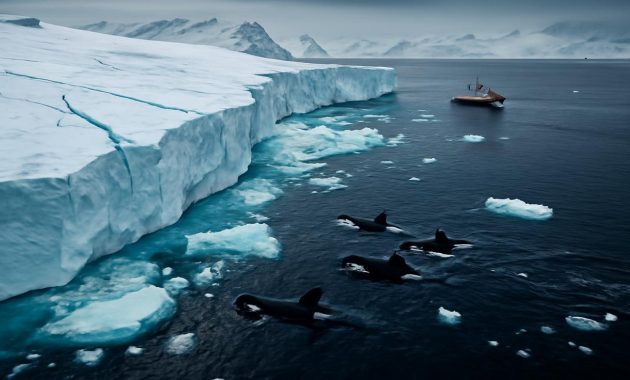
The first orca surfaced just after midnight, a slick black fin slicing through the steel-blue water beyond the village harbor. The light never really disappears here in summer, it only softens, and in that dim Arctic glow a fisherman standing on the quay watched the dorsal fin rise, cut a slow arc, and vanish. He thought, at first, that his tired eyes were playing tricks. Then another fin appeared—larger, closer—and behind it, the white flash of an eye patch like a sudden grin in the sea. By sunrise, there were more. By evening, the government would call it what it was: an emergency.
The Night the Whales Came Too Close
On Greenland’s southwestern coast, near a small community already accustomed to ice that groans and fractures in the night, the arrival of orcas has always been an event, not a crisis. People lean on railings to watch them. Children stand on rocky bluffs counting blows of mist. Hunters recite stories of the old days when orcas were rare visitors and the ice was thick, predictable, steady.
This time, the mood was different. The pods were not cruising the open fjord as usual. They were threading into narrow inlets, lingering near ice shelves that locals had learned to distrust. These shelves—once heavy and anchored, now honeycombed with meltwater and fractured like broken glass—loomed above the dark channels where the whales swam. Every thunderous crack of ice echoed over the water and through the village like a warning shot.
By the third sighting in as many days, the radio chatter had grown tense. Hunters spoke of seals abandoning their usual haul-out spots. Tour-boat captains compared notes about new crevasses in the ice, sudden calving events, and shifting floes. In a region where people are used to reading the subtle language of ice and water, something in the grammar had clearly changed.
When a video surfaced of orcas gliding beneath an overhanging ice shelf known locally as “the ledge”—a structure scientists have flagged for years as dangerously unstable—the call from the local council to the national authorities in Nuuk was unequivocal: this was no longer just a novelty of nature. It was a public safety threat, an ecological alarm bell, and a sign that the old rhythms of the Arctic had been disrupted once again.
Why Orcas Here, Why Orcas Now?
Greenland’s coast has always belonged to whales. Bowheads, narwhals, humpbacks—they are stitched into the fabric of stories, seasons, and survival. Orcas, or killer whales, have also been here, but not in such numbers, not so persistently, and not pressing themselves into labyrinths of ice where only smaller, more agile hunters used to roam.
Scientists point to an explanation as simple as it is unsettling: warmth. The surrounding waters are changing, stirred by shifting currents and a warming atmosphere that gnaws at the ice from above and below. As sea ice retreats and the ice shelves lose their hard, ancient edges, orcas find new pathways into fjords that were once locked in for much of the year.
For the orcas, this new accessibility opens up a buffet. They follow prey—seals, fish, sometimes smaller whales—into these watery cul-de-sacs beneath towering ice. For the ice shelves themselves, though, the orcas might as well be a fleet of battering rams. Their presence, their wake, their hunting patterns, all intersect with structures on the brink.
A Greenlandic marine biologist based in Nuuk described it bluntly in a recent briefing: “The ice is weaker, the shelves are fractured, and we now have large apex predators circulating in places that are structurally unstable. This is not about one whale or one calving event. It’s about a system under strain.”
Predators in a Crumbling Palace
Imagine a cathedral whose pillars are quietly dissolving from within. That is what some of Greenland’s ice shelves have become: grand, immense, but hollowed by meltwater channels, their undersides scalloped by warmer seas. Into this cold, dissolving palace swim black-and-white hunters that are built to test limits—of prey, of sound, of space.
As orcas circle beneath overhangs and along vertical walls of ice, they shake the water with their power. Their echolocation clicks bounce off jagged faces, finding weak points, perhaps even disturbing already fragile ice. Each breach, each coordinated attack on a seal resting too near the edge, sends ripples and pressure waves into the ice, which is already threaded with cracks.
None of this would matter much if the shelves were as solid as they were fifty years ago. But they are not. The ledge that appears in that now-famous video has thinned dramatically. In drone footage, the shelf looks like a lid barely resting on the sea, lots of mass above, but less anchoring structure below. When a chunk falls, it doesn’t drop cleanly; it shatters.
In these narrow fjords and inlets, people live and work close to the ice’s edge. Boats pass beneath overhangs, hunters navigate tight channels, and children play along rocky beaches that face directly toward the shelves. An unexpected collapse triggered by a passing pod of orcas is not just a spectacle—it is a crush of ice, a sudden wave, a spray of lethal shards.
When the Emergency Siren Echoes Over Ice
The emergency declaration did not sound like a siren at first. It sounded like a series of calls: from village councils to regional offices, from fishers to coast guards, from scientists at remote field stations to ministries in Nuuk. Each voice carried a piece of the puzzle: persistent orca sightings, new cracks in known ice fronts, reports of near misses where boats had to reverse as ice calved unexpectedly ahead.
When the official word came, it was careful and measured, but the weight behind it felt heavy. Greenland declared an emergency in the affected coastal zones, not because orcas themselves were an invasive threat, but because their unusual presence highlighted how unsafe the ice had become—how quickly the physical map of the coast was rewriting itself.
Fisheries were temporarily restricted in certain high-risk inlets. Local tour operators were told to pull back from their most dramatic routes. Hunters received updated advisories about where not to travel, even if those routes had been safe for generations. Aerial surveys were ordered to scan for new fractures. Specialized monitoring buoys, equipped with both acoustic and temperature sensors, were rushed into deployment.
The Quiet Panic of Changing Rules
This kind of emergency is not like a wildfire you can see from miles away, or a storm that roars against your windows. It is subtler, more insidious. The ice still gleams in the sunlight. The sea still looks calm on windless days. But under the surface—inside the ice, within the water column—rules are changing faster than communities can adjust.
In the harbor cafés and kitchen tables of coastal villages, the conversation has gained an edge of uncertainty. An elder might recount a winter when the sea froze solid enough to cross with a dog sled, pointing to areas that now remain black and open for most of the year. A younger hunter, who grew up already hearing about climate change, talks about the orcas as both marvel and omen. “They are beautiful,” he might say, staring out toward the dim shapes in the fjord. “But when they come here, it means something is wrong.”
Greenland’s emergency response teams, some more accustomed to storms and search-and-rescue missions than slow-moving climate upheaval, have had to improvise. How do you warn people about ice shelves that might collapse not tomorrow, not next week, but sometime soon, with no easy prediction beyond a rising probability? How do you evacuate a coastline that is also the lifeline for fishing, hunting, and travel?
The Data Beneath the Fear
Emotions—fear, awe, confusion—are powerful fuels for storytelling, but the backbone of this emergency is data. Temperature logs from ocean buoys show a steady creep upward. Satellite imagery, when layered year over year, reveals the ghost outlines of ice that once extended miles further into the sea. Acoustic records capture the growing presence of orcas: their calls, their clicks, their patterns of arrival and departure.
In conference calls that bridge from Nuuk to international research centers, analysts pull up visualizations that trace three intertwined trends: warming water, thinning ice, and orca movement. The lines do not lie. They converge on a new reality in which the traditional boundaries—between open water and ice, between human routes and whale routes—are blurring.
For local decision-makers, it helps to see this laid out plainly. Numbers do not replace the stories of elders or the snap of ice heard from a midnight doorway, but they give shape to what everyone already feels: this is not a fluke season. It is a pivot point.
| Indicator | Recent Observation | Implication |
|---|---|---|
| Sea surface temperature | Noticeable warming trend in coastal fjords | Creates access routes for orcas into new areas |
| Ice shelf thickness | Progressive thinning and increased fracturing | Higher risk of sudden collapse near settlements |
| Orca sightings | Repeated, prolonged presence near unstable shelves | Signals ecosystem shift and safety concerns |
| Seal distribution | Moving away from traditional haul-out sites | Alters hunting patterns for people and orcas alike |
Each cell in a table like this is the shortened version of someone’s long day in the field, someone’s boat run through icy rain, someone’s drone flight over jagged white plateaus. It is the distillation of human effort to read the new Arctic—an Arctic that no longer matches the mental maps inherited from grandparents.
Listening to Whales, Listening to Ice
There is a poetic symmetry to using orcas themselves as indicators. They are, in a way, messengers, carrying information about faraway currents and shifting prey lines right up to the doorstep of Greenland’s coastal communities. Their bodies are tuned to the water’s temperature, their travels guided by productive hunting grounds. When they appear where they rarely used to, they bring news of a warming world.
At the same time, the ice speaks its own language. A low groan might mean a deep internal readjustment. A sharp crack, then silence, might signal a new fracture racing unseen beneath the surface. Researchers are starting to integrate data from hydrophones—not just to record whales, but to eavesdrop on the ice itself, to catch the subtle symphony of a disintegrating shelf.
In the overlap between these sounds—orca calls, ice creaks, the hum of outboard motors—lies a new kind of Arctic story, one where humans are not simply observers, but participants and decision-makers amid rapid transformation.
Communities at the Edge of Two Worlds
For the people living along Greenland’s vulnerable coasts, this emergency is not abstract discourse about climate pathways. It is a rearrangement of daily life. A fisherman deciding whether to risk a favored route now must weigh not just the weather but the stability of the ice cliffs looming over his path—and the chance that an orca’s presence might trigger something unpredictable.
Parents find themselves telling their children to keep a little farther from the waterline than they once did, especially near the big shelves. The stories told at night have shifted, too. Where elders used to talk about the unchanging strength of the ice, now they speak of its moods—its bad days, its sudden tempers.
The emergency also exposes deeper layers of vulnerability and resilience. Many communities here rely intensely on a mixed economy of wage work, fishing, and hunting, tightly interwoven with cultural identity. When authorities restrict access to certain hunting grounds or advise against traveling particular fjords, they are not just rearranging logistics; they are touching the deep structure of how people relate to this place.
Old Knowledge, New Realities
One of the most powerful tools Greenland has in facing this emergency is not only satellite feeds or scientific modeling—it is indigenous knowledge. For generations, Inuit hunters have read micro-signals in the behavior of animals and ice: the glint of water along a snowline, the tilt of a floe, the way clouds stack over a glacier. These observations, shared around kitchen tables and hunting camps, can refine and challenge scientific models.
In workshops hastily convened after the emergency declaration, elders sit beside young researchers, trading maps and memories. An elder traces a finger along a paper chart, showing a channel that used to freeze solid, recalling winters when you could “feel the ice message through the dogs’ paws.” The scientist beside him scrolls on a tablet, overlaying old sea-ice records with modern satellite layers. The correspondence—and the gaps—tell a story both sobering and vital.
Out of this dialogue comes a new kind of guidance: not a rejection of tradition, not blind faith in technology, but a weaving of both. If orcas are showing up where they never did, what does that say about currents? If certain shelves are creaking at odd hours, how should travel routes be adjusted? The answers are still provisional, but they grow clearer with every conversation where knowledge moves in both directions.
What an Arctic Emergency Means for the Rest of Us
From far away, it might be tempting to view this emergency as a striking local story and nothing more: dramatic whales, collapsing ice, a remote government taking urgent action. But the same forces pushing orcas into Greenland’s fragile fjords are rearranging coastlines and climate patterns worldwide.
Ice shelves are more than scenic backdrops; they are slow-moving guardians that buttress glaciers, holding back vast stores of ice from flowing rapidly into the sea. When they weaken or collapse, the glaciers behind them can speed up, adding to global sea-level rise. What begins as a crack under the ghostly midnight light of a Greenland fjord can, over time, reach the doorsteps of cities thousands of kilometers away.
Orcas, for their part, are exquisitely sensitive barometers of marine change. Their shifting ranges tell a story about where food is and where it is not, about which waters are becoming more hospitable to large predators. Their repeated appearances off unstable shelves are part of a global pattern of marine animals being driven, drawn, or forced into new habitats by a changing climate.
So when Greenland declares an emergency after repeated orca sightings near unstable ice shelves, it is not simply handling a local hazard; it is sounding a warning into the wider world—a signal from the frontlines of planetary change.
A Future Written in Water and Light
The orcas are still there, some days. On other days, they vanish into the open sea, leaving behind quiet fjords where the only movement is the slow rolling breath of the tide against the ice. The emergency measures remain in place, recalibrated as new data comes in, adjusted as shelves crack, shift, or—sometimes—surprisingly hold.
What happens next depends on countless decisions, large and small. Decisions about global emissions and energy systems that seem, at first glance, far removed from a narrow Greenlandic fjord. Decisions by local councils about which routes to close and which to monitor. Decisions, too, by those who tell these stories—about whether to treat them as distant curiosities or as mirrors reflecting our shared future.
Standing at the edge of the harbor, watching the blue-white face of the ice shelf across the water, it’s hard to shake the feeling that we are all, in some way, like those orcas—moving into new territory, testing boundaries that used to be firm, discovering how fragile the old certainties have become.
The fin breaks the surface again. A streak of black, a flash of white. A plume of breath. For a moment, it is just beauty: a wild animal in cold, clear water under a sky that refuses to fully darken. Then the sound comes—the low, distant crack of ice. A reminder that in Greenland today, wonder and warning arrive in the same breath.
Frequently Asked Questions
Why did Greenland declare an emergency over orca sightings?
Greenland declared an emergency because repeated orca sightings were occurring very close to unstable ice shelves. The concern is not that orcas are inherently dangerous to people, but that their presence and movement in weakened, fracture-prone ice zones may trigger or coincide with ice collapses, putting nearby communities, boats, and infrastructure at risk.
Are orcas causing the ice shelves to collapse?
Orcas are not the root cause of ice shelf instability—that role belongs primarily to warming air and ocean temperatures driven by climate change. However, orcas moving through narrow inlets and beneath fragile overhangs can contribute to stress on already weakened ice, and their presence highlights places where the ice is no longer stable.
Have orcas always been seen around Greenland?
Yes, orcas have long been part of Greenland’s marine ecosystem, but historically they were less common in certain ice-filled fjords and near thick, stable shelves. In recent years, as sea ice has retreated and waters have warmed, orcas have been observed more frequently and deeper into previously ice-locked areas.
How does this emergency affect local communities?
The emergency has led to temporary restrictions on some fishing and hunting routes, increased monitoring of ice shelves, and new safety advisories for travel in high-risk fjords. For communities that rely on the sea for food, income, and cultural practices, these changes disrupt routines and demand rapid adaptation.
What does this situation tell us about climate change?
The overlap of repeated orca sightings and unstable ice shelves is a vivid example of how climate change reshapes ecosystems and daily life. Warming waters open new routes for predators while weakening the ice structures that protect coasts and regulate glacier flow. It is a local emergency that reflects broader planetary shifts already underway.