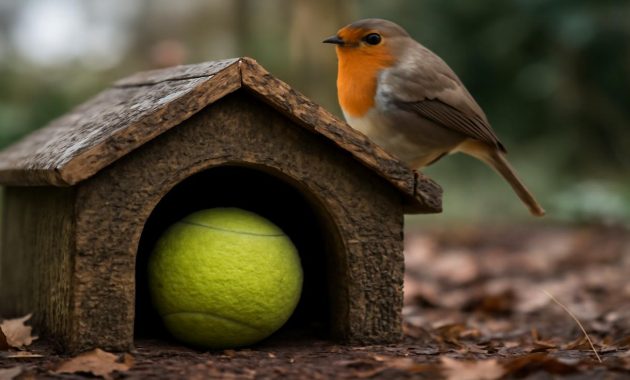
The tennis balls arrived in a netted bag that still smelled faintly of varnish and summer. They were bright, almost comically so, glowing against the muted browns and greys of a November garden already folding itself into winter. You might think of tennis balls as things that belong on courts and in the mouths of excitable dogs, not scattered among damp leaves and quiet flowerbeds. And yet, on this cold afternoon, those little spheres of neon fuzz were about to become something else entirely: life rafts, warning beacons, tiny yellow guardians for the hidden lives moving silently through the undergrowth.
A Quiet Emergency in the Garden
Winter has a way of softening sound. The whirr of bees fades, the chatter of sparrows thins out, the hedges fall quiet. It is easy, then, to believe that the garden is resting—that everything is sleeping, waiting, paused. But stillness is deceptive. Under the heaps of leaves tucked beside fences, beneath stacked logs and forgotten bags of compost, small hearts are beating hard, fast, and hungry.
This is the time of year when hedgehogs curl into tight, shivering balls and birds burn precious calories just staying warm through the long nights. Food is scarcer, daylight is shorter, and every bit of energy matters. A single disturbance, a panicked dash, a sudden awakening from hibernation can mean the difference between surviving winter and not.
Yet our gardens, which we often think of as safe spaces for wildlife, are full of hidden hazards. Netting droops into lethal snares, open drains gape like miniature pits, half-covered ponds become death traps for the unwary. Even the things we bring in to “tidy up” or “improve” the space—stacked pots, plastic tubs, bags of soil—can turn into deadly obstacles for a hedgehog or a songbird.
It’s not that we don’t care. On the contrary, most of us care deeply. We hang bird feeders, leave seed on frosty mornings, maybe even put out a saucer of cat food for the hedgehogs in autumn. We tell ourselves we’re doing enough. And then, every so often, you hear a story: a hedgehog trapped overnight in a drain, a blackbird tangled in netting, a wren drowned in a steep-sided bucket after seeking a drink.
That is where the tennis balls come in—odd, humble, almost silly. A small bright object that says: “Stop. There is danger here. Go around.” A bit of softness between our human mess and the fragile bodies that share our space.
Why Such a Small Thing Matters So Much
Imagine, for a moment, that you are the hedgehog. Night is your time. The garden transforms into a labyrinth of scents and sounds: the damp iron tang of soil, the faint sweetness of rotting apples, the rustle of leaves that might conceal a slug, a beetle, the remains of something edible. You are low to the ground, vision poor, but your nose is extraordinary. You do not see edges; you smell possibilities.
Across the lawn, beneath a leaning fence panel, something smells promising. The air is colder there, damp, edged with the faint smell of algae and old water. You shuffle forward. The ground suddenly falls away. Maybe it’s a pond, a drain, a bucket half-filled from last week’s rain. You slip, you scramble, tiny claws scraping smooth sides. You are not built for climbing. You are built for rooting, for foraging, for rolling into a prickly ball when danger comes from above—not below.
Many hedgehogs never climb back out.
Now picture a bird, light as a handful of leaves. It lands on the rim of a water butt, dips its beak toward the surface, shifts its weight, and slides. Wet feathers cling to skin. There is no grip on the slick sides, nowhere to perch, nowhere to dry. Exhaustion comes quickly in cold water.
Most of the dangers in our gardens are not malicious. They are oversights: the open drain, the uncovered pipe, the pond with vertical sides, the useless corner of netting we never quite get round to removing. We think “small risk” and forget that, for a creature the size of a paperback novel, “small” looks very different.
A tennis ball, dropped into that risk, changes the story. It becomes a floating island in a water butt or steep bucket, a visible barrier in a narrow drain, a wobbling obstruction that says, even to a half-sighted hedgehog, “this space is not safe to step into.” No lecture, no grand garden redesign—just a soft, round, impossibly bright little “no.”
How a Tennis Ball Becomes a Lifesaver
The magic of the tennis ball is not in what it is, but where you put it. The trick is to start looking at your garden from the ground up, from the viewpoint of something that weighs less than a bag of sugar and stands only a few centimetres tall.
Walk slowly, when the light is low and your own senses are dulled, the way they are in winter. Let your eyes soften. Where could you fall, slip, get stuck, if you were small and cold and tired?
1. In Water Butts and Buckets
Any container that can hold water and has steep, smooth sides is a risk. Hedgehogs are drawn to water sources, especially in dry autumns or mild winter spells. Birds, too, will drink from almost anything if their usual dishes are frozen.
Drop one or two tennis balls into each water butt, deep bucket, or open tub. They float, bobbing gently. To a bird, they can act as temporary perches or at least partial supports. To a hedgehog, they are something to cling to while it tries to haul itself out or keeps its head above water long enough to find a way to the edge. That tiny bit of buoyancy can buy the minutes that mean survival.
2. Over Narrow Drains and Open Pipes
Walk around your property and look for any narrow, open voids: drainage holes, uncovered pipes, small inspection chambers, gaps behind sheds, or where downpipes meet the ground. These are exactly the kind of places hedgehogs investigate—dark, sheltered, often rich with insects.
If the gap is just wide enough for a tennis ball to lodge in or partially cover, wedge one in place. The fuzzy surface provides grip, and its brightness warns daytime visitors like birds away. For night-time wanderers, the ball acts as a gentle physical barrier that redirects them along a safer route.
3. In Ponds with Steep Edges
Ideally, every wildlife pond should have a shallow beach or a ramp—a simple piece of wood, a brick staircase, or a planted shelf along one side. But sometimes, we inherit ponds with sheer edges, plastic liners, or vertical walls.
While you plan better long-term solutions, tossing a few tennis balls into the pond is a quick, temporary safeguard. Their movement on the surface can alert animals to the presence of water, and they can serve as emergency rafts for exhausted birds or hedgehogs that slip in. Combined with a log or a sloping stone partially submerged, the balls can mark the “exit point” where a trapped animal might find a way out.
4. Around Netting and Mesh
Garden netting—whether it’s for fruit, ponds, or climbing plants—is notorious for ensnaring birds and hedgehogs. One simple trick is to use tennis balls as soft anchors and markers. Thread them through the lower corners and edges of netting so it can’t sag into loose loops at ground level.
The bulk of the ball keeps the netting taut and visible, reducing the chance of a creature pushing its way underneath and becoming entangled. In winter, when light is low and animals are desperate for any remaining food, a strongly outlined edge can mean the difference between a safe detour and a deadly trap.
5. In Hidden Corners and “Trap Spaces”
Look for the awkward spots: the narrow space between a fence and a shed, gaps under decking, piles of stacked pots that create narrow funnels. These are the places where hedgehogs can wedge themselves and struggle to reverse.
Placing one or two tennis balls in these tight spaces can change the way a hedgehog moves through the area. The ball rolls, nudges, gently blocks, encouraging the animal to turn away rather than pressing further into a dead end. The soft resistance is enough to redirect without harming or frightening.
A Simple Guide: Where to Put Your Tennis Balls
To make it easy to visualise, here’s a simple overview you can skim while you walk around your garden, tennis ball in hand.
| Garden Area | Wildlife Risk | Tennis Ball Use |
|---|---|---|
| Water butts & deep buckets | Drowning risk for birds & hedgehogs | Drop 1–2 balls in each as floating rafts and visual markers |
| Open drains & vertical pipes | Falls, entrapment, injury | Wedge a ball into or over the opening as a soft plug |
| Steep-edged ponds | Slips, drowning, exhaustion | Float several balls near edges; pair with a log or ramp |
| Low garden netting | Tangling, trapped limbs, injury | Use balls as corner weights to keep netting taut & visible |
| Gaps behind sheds/fences | Becoming stuck in tight spaces | Place balls in narrow gaps to gently block or redirect paths |
The Winter Garden, Seen Anew
Once you start looking, your garden begins to feel different. What once was simply “messy” or “in need of a clear-up” becomes a delicate network of habitats. The untidy pile of leaves beneath your shrubs might conceal a hibernating hedgehog. The ivy tangled along your fence could be winter shelter for wrens. The long, unimpressive grass in the corner may hide the last few insects that hungry robins are relying on.
Placing tennis balls becomes less of a quirky trick and more of a quiet promise: I see you. I know you are here. I will try not to make surviving winter harder than it already is.
There is something almost childlike about walking around with a pocketful of tennis balls, dropping them gently into place. You feel a bit like you are leaving toys out for invisible guests. On frosty mornings, you’ll spot a lime-green sphere rimed with delicate ice crystals, caught in a pool of rainwater or wedged in a drain like a tiny, cheerful plug. It is an odd kind of beauty—an artificial colour against the subtle, disciplined palette of winter—but it speaks of care.
And when you see a blackbird hopping along the pond edge, or catch the faint shuffle of something prickly moving through the dark hedge, you’ll know that some of the invisible dangers have been softened, muted, padded with bright, harmless fuzz.
Beyond Tennis Balls: A Winter Safety Checklist
Tennis balls are a wonderfully simple starting point, but as you move through your garden with their neon glow in your hands, you may find yourself wanting to do more. Once you’re already looking from the perspective of a hedgehog or a small bird, other helpful tweaks suggest themselves.
Check for Hibernation Spots Before Tidying
That tempting pile of leaves or that log stack in the corner might be a hedgehog’s chosen winter refuge. Before you move, burn, or reorganise anything, gently lift the top layer and look for tell-tale signs: a compact, dome-like nest of leaves, often heavier and more structured than a random heap. If it looks like something has carefully arranged it, assume someone is sleeping inside and leave it be until spring.
Make Exits, Not Just Entrances
Hedgehogs roam through several gardens in a single night. Your lovely, secure fence might be an unintended barrier. A simple hedgehog highway—10–15 cm square gaps at the bottom of a couple of fence panels—allows them to move safely between spaces to find food and mates. When you block a route, ask yourself: could I be trapping something inside or outside this space?
Keep Bird Feeders Safe
Well-intentioned feeding can sometimes create new risks. Position feeders away from windows to reduce collision, and avoid placing them too close to dense cover where cats can lurk unseen. In icy weather, clean your feeders regularly; winter is when disease can spread rapidly through stressed bird populations. Fresh water, even just a shallow dish cleared of ice each morning, is as vital as food.
Avoid Unnecessary Chemicals
Slug pellets, strong pesticides, and certain weedkillers ripple harm through the food chain. That slug your pellets kill might have fed a hedgehog, a thrush, or a blackbird. In winter, when every meal counts, poisoning invertebrates can be doubly damaging. Try manual methods—traps, hand-picking, barriers—or accept a little nibbling in exchange for a healthier, more alive garden.
Leave a Little Mess
The tidy instinct is powerful, especially when the garden looks tired. But a perfectly clipped, bare winter garden is a tough place to survive. Leave seedheads on some plants for birds. Let a corner of leaves remain undisturbed. Resist cutting everything down to stubble. Mess, in winter, is shelter, food, and warmth.
The Power of a Tiny, Visible Choice
There is a certain kind of hope in actions that are obviously small. We know, of course, that tennis balls in gardens will not save every hedgehog or every bird. Winters are changing; weather patterns are wilder; habitats are shrinking. The challenges are huge and systemic, far beyond the reach of any single person scattering a handful of balls in their back yard.
And yet, small gestures matter precisely because they are not grand. They are immediate. Tactile. Within reach.
You can stand at your back door on a chilly afternoon, pull on a coat, and in ten minutes transform your garden from “accidentally dangerous” to “thoughtfully kind.” You do not need special tools or specialist knowledge. You need only curiosity and a willingness to see your space through other eyes.
The first night after you’ve made your rounds, nothing visible may happen. The tennis balls will float, wedge, and bob, unremarkable. You might wonder if it was worth the effort. But somewhere in the dark, a creature will move differently because of what you did. A hedgehog will nudge a ball instead of step into a drop. A bird will notice the bright orb in the water butt and veer away. You likely will never know. In some ways, that is the quiet beauty of it.
We share our gardens with lives that do not ask for much: a place to hide, a way to drink safely, a route through, an undisturbed corner to sleep. For them, winter is not a season of candles and blankets and warming stews. It is a season of narrow margins. When you place a tennis ball in your garden, you are placing your thumb gently on the scale, tipping it infinitesimally toward survival.
So, the next time you pass a sports shop, or unearth an old, battered ball from the back of a cupboard, pause before you throw it away. Out there, beyond the sliding door and the misted window, small hearts are beating on in the cold. A simple, fluorescent circle of rubber and felt might be one of the kindest gifts you ever give, even if the recipient never knows your name.
Frequently Asked Questions
Do tennis balls really make a difference for wildlife?
They do, especially when used to block or soften specific hazards. A tennis ball in a water butt, deep bucket, or open drain can prevent falls, provide a temporary raft, and act as a clear visual cue for birds. It’s not a complete solution to every risk, but it can significantly reduce avoidable accidents.
Are there any types of tennis balls I should avoid using?
Standard tennis balls are generally fine. Avoid balls that are heavily damaged, crumbling, or shedding large amounts of fluff, as loose material could potentially be ingested by curious animals. If the ball starts to deteriorate, replace it.
Can I leave tennis balls in my garden all year round?
Yes. While they’re especially useful in winter, when wildlife is stressed and light is low, the hazards they soften exist in every season. Just check them occasionally for wear and clean them if they become heavily soiled or algae-covered.
Will tennis balls attract or scare wildlife?
Most animals quickly accept tennis balls as part of the environment. Their main role is as barriers, rafts, or markers, not lures. Birds may land on or near them; hedgehogs may nudge them. They’re unlikely to scare wildlife away from your garden as a whole.
What else can I do to help hedgehogs and birds in winter?
Offer fresh water, keep some areas a bit wild for shelter, avoid using harmful chemicals, check for hibernating animals before tidying, and ensure ponds have escape routes. Simple measures—alongside your small neon guardians—create a safer, kinder winter landscape for the creatures sharing your patch of earth.