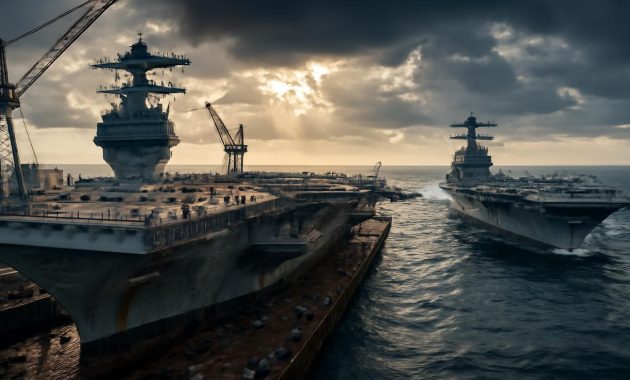
The sea is calm the morning the rumors begin. A silver horizon, a low wind combing the Atlantic, and somewhere out there a 100,000-ton question mark named USS Gerald R. Ford slices through the water on her way, for the first time, toward real combat duty. Farther north, in a cavernous dry dock in Newport News, Virginia, a second giant is slowly taking shape—USS John F. Kennedy, another Ford‑class aircraft carrier, steel ribs exposed like the skeleton of some rising industrial whale. One ship steaming out, one ship growing in, and between them a world trying to decide what kind of future it wants.
The Ship That Carries a Century
Stand on the pier next to USS Gerald R. Ford and the first thing you feel is small. The ship’s flanks climb high enough to blot out much of the sky. The black-and-gray hull rises like a cliff, bristling with antennas, sensors, and the quiet hum of power systems that never fully sleep. The carrier smells of heat and metal and faint jet fuel, the air textured by the whine of distant equipment and the barked orders of sailors moving in quick, practiced patterns.
The Ford is not just another aircraft carrier. She’s the first of a new class, the largest and most advanced warship ever built by the United States. Her heart beats with twin nuclear reactors that can power a small city. Instead of the iconic steam catapults that hissed and shrieked on older carriers, the Ford uses electromagnetic launch systems—sleek rails that fling aircraft into the sky with the kind of controlled violence only computers can choreograph. Elevators not only carry weapons from deep magazines to the deck; they do it faster, with fewer people, promising more sorties in less time.
In theory, she’s the future of American sea power. In practice, as she heads closer to potential combat operations, she is also a message. To allies. To rivals. To an uneasy public that can’t quite decide if this leviathan is a shield, a provocation, or something more complicated: a floating paradox of safety and risk.
Steel, Sparks, and the Making of USS Kennedy
Hundreds of miles away, inside the sprawling shipyard at Newport News, the soundscape is different but just as intense—welders’ torches hissing bright blue, cranes groaning under impossible-looking loads, steel plates ringing as they’re cut, lifted, and fused together. Here, USS John F. Kennedy is materializing from blueprints and politics and raw industrial will.
The Kennedy already looks like a ship, her island rising above the dry dock like a skyscraper under construction. Workers move along gantries, sparks raining down into the shadows below. The air is sharp with the scent of burned metal, paint, and oil. On some days, you can hear shipbuilders talk about her like a living thing: “She’s coming together fast.” “She’s gonna be something.” There is pride here, and good jobs, and the kind of steady work that keeps a town fed.
But outside the gates, beyond the security fences and the carefully controlled press tours, another conversation is taking place. Critics point to the staggering cost—tens of billions of dollars across the Ford class—and ask what else that money could buy. Hospitals. Schools. Renewable energy. Pandemic preparedness. Debt relief. Supporters counter with their own list: Deterrence. Stability. Jobs. A visible backbone to U.S. strategy in an increasingly unstable world.
The acceleration of Kennedy’s construction, even as the Ford steams toward its first real test far from home, makes the debate feel more urgent, more pointed. It’s no longer about abstract plans; it’s about choices already cast in steel.
Where Power Meets the Horizon
To understand why a single ship can stir up so many arguments, you have to picture the carrier not as a lone vessel, but as the center of a moving city—a carrier strike group. Destroyers and cruisers fan out around her, submarines glide silent below, supply ships ghost along in the distance. Overhead, fighter jets roar, early-warning planes circle like metal vultures, helicopters flutter from deck to sea and back again.
This is where the numbers crystalize into visible power. The Ford can carry more than 75 aircraft, launch and recover them at speeds older carriers could never dream of, and sustain operations for days, weeks, months. In a crisis, a carrier strike group arrives like an argument you can see from shore: bristling with radar, missiles, jets, and the implicit promise that the United States can project force deep into contested waters without asking anyone’s permission.
To some nations, that’s reassurance. To others, especially rivals or those clawing for more influence, it looks like a threat. The battle lines are not just drawn on maps; they’re traced in the wake of a ship like the Ford as she enters regions where ambitions overlap and patience runs thin.
Table: A Glimpse at the Ford-Class Footprint
| Feature | USS Gerald R. Ford (CVN-78) | USS John F. Kennedy (CVN-79) |
|---|---|---|
| Displacement | ~100,000 tons | ~100,000 tons (projected) |
| Powerplant | 2 nuclear reactors | 2 nuclear reactors |
| Aircraft Capacity | 75+ aircraft | 75+ aircraft (planned) |
| Launch System | Electromagnetic catapults (EMALS) | EMALS (same class) |
| Crew & Air Wing | Approx. 4,500–4,700 | Similar, with incremental improvements |
| Status | In service, heading toward combat operations | Under construction, schedule accelerated |
The numbers tell only part of the story, but they do underline one crucial fact: these carriers are not just ships; they are commitments encoded in hardware. They represent decades of strategy and trillions of dollars in long-term obligations when you count maintenance, upgrades, and the cost of keeping thousands of sailors and aviators trained and ready.
Debating the Price of Dominance
Ask a sailor who has spent nights on the flight deck during operations why carriers matter, and they might talk about the roar of jets punching into the dark, the thunder of arrested landings shaking their boots, the sense that what happens on this 1,100-foot runway of steel can ripple across continents. “We show up, things calm down,” some will say. Presence. Deterrence. A kind of grim peace enforced by the knowledge that the U.S. can strike if it must.
Ask an analyst who studies rising powers and military budgets, and you get a different angle. To them, the Ford heading toward a potential combat zone while Kennedy’s construction speeds up is a sign of strategic anxiety. It signals a world where old assumptions are fraying—about who controls critical sea lanes, whose ships can sail where, and how far a superpower must go to stay ahead.
Then ask a teacher whose school roof leaks, or a nurse in an understaffed hospital, or a climate scientist staring at another wildfire season. Their question is simpler: How many urgent problems at home stay unsolved while billions of dollars flow into more floating runways?
This is the tension at the heart of the current debate. Power and security are rarely free. They demand money, and attention, and the invisible emotional tax of living under constant talk of threats and rivals. The acceleration of USS Kennedy’s construction locks in another chapter of that story. It says, in effect, that the U.S. is doubling down on a vision of security centered on large, highly visible symbols of dominance.
Global Rifts, Local Ripples
Out at sea, where the Ford will soon roam, nations are watching. Some are quietly relieved. Allies who worry about expanding rival navies and territorial grabs in vital waterways see a U.S. carrier as a kind of insurance—expensive, yes, but not on their books. Others see the same ship as a provocation, a metal finger jabbed into disputed zones, daring anyone to push back.
The rifts are not just geopolitical. They are philosophical. Does security come from towering above everyone else, or from a more distributed network of smaller, less vulnerable assets? Is it safer to field one massive symbol of power, or many leaner, more agile tools that don’t paint such a target on themselves?
The argument spills into think tanks, news shows, street protests, and late-night conversations online. Each launch test, each budget vote, each new satellite photo of Kennedy’s expanding hull becomes more fuel for fire. To some, the scene of American workers in hard hats guiding gigantic steel modules into place is a stirring portrait of national strength. To others, it’s a sobering snapshot of where priorities lie when the planet is heating, economies are straining, and social trust is fragile.
Even at the shipyard itself, you can feel the contradiction. A welder might go home proud, paycheck in hand, but still wonder about a cousin struggling with medical bills, or a town downstream where the river is too polluted to fish. The carrier becomes both bread on the table and a lingering question about what kind of world that bread is buying.
On the Edge of Combat
As USS Gerald R. Ford steams toward potential combat operations, the atmosphere aboard changes. Training drills give way to alert watches. Corridors feel tighter, conversations more focused. You can almost taste the tension in the recycled air—metal, coffee, nervous laughter. Electronics hum behind bulkheads, radar screens glow in the dim light of operations rooms where officers chart courses through seas that look calm on the surface and volatile on every strategic map.
For the crew, the debate back home about cost and power feels distant and abstract. Their world narrows to the length of the carrier and the span of the flight deck. Safety checks. Maintenance logs. Weather patterns. Aircraft readiness. They think about getting jets off the deck and back again in one piece, about keeping systems running, about letters from home waiting in the next data burst.
Yet even here, in this steel island of routine and ritual, the larger questions seep in. Young sailors scrolling through news on their phones see headlines about budgets, protests, rival navies, contested islands, and shifting alliances. Some nod along with arguments that carriers keep the peace. Others wonder if they are part of a strategy that can’t last, a game of one‑upmanship in which every new ship triggers new responses, new rival programs, new risks.
The Ford’s journey into potential combat zones isn’t just the unfolding of a mission plan; it’s a live test of an idea: that massive, manned carriers will still define sea power in an age of hypersonic missiles, cyber attacks, and swarming drones. If that idea holds, the Kennedy’s steel bones in Virginia are a wise bet. If it fails—or even wobbles—the debate over dominance will turn sharper than ever.
The Future in the Dry Dock
Back at Newport News, winter rain sometimes taps softly on the scaffolding around Kennedy’s rising hull, beading on the steel and running in slow rivulets toward the dock floor. The ship doesn’t feel like a weapon yet. It feels like potential—raw, unfinished, humming with the energy of thousands of hands and minds.
Engineers hunch over plans in warm, bright trailers, arguing over systems integration and timelines. Out in the chill air, workers in heavy gloves guide enormous sections into place with practiced confidence. The shipyard smells of hot metal, wet concrete, lunch from food trucks that line up near the entrance. Over the loudspeakers, safety reminders cut through the clatter: watch your step, secure your gear, report hazards.
Somewhere in the middle of all this, the core question lingers, unspoken but present: By accelerating this ship, by investing this much into a second Ford‑class carrier even as the first heads toward danger, what story is the United States choosing to tell about itself?
Is it the story of a guardian, insisting that its size and reach keep the worst possibilities in check? Or the story of a giant unwilling—or unable—to imagine security built on anything but being bigger, louder, more heavily armed than anyone else?
The truth probably lies, as it so often does, in a gray area neither side of the debate finds fully satisfying. Carriers like Ford and Kennedy deter some conflicts and invite others. They support allies and unnerve rivals. They anchor economies in towns that build and supply them, even as they divert resources from other public needs. They can be both instruments of stability and symbols of a world order some believe is overdue for change.
Choosing What Floats
The sea, indifferent as ever, will accept USS Gerald R. Ford and USS John F. Kennedy without judgment. Salt water laps the same against a carrier’s hull as it does against a fishing boat, a refugee raft, a merchant ship bearing grain. The ocean’s surface reflects whatever we send across it—warships, research vessels, cable‑laying barges, cruise liners, submarines packed with nuclear warheads.
What makes this moment feel so charged is not just the technology or the price tag, but the sense that we are standing, collectively, at a crossroads. As global tensions sharpen, as new weapons change the calculations of risk, as climate and inequality fuel unrest, doubling down on a symbol of dominance feels to some like an anchor, to others like a weight pulling us toward deeper water.
When the Ford’s wake foams across contested seas, and when Kennedy finally slides from dry dock into the river with tugs straining at her sides, the waves they make won’t just be physical. They’ll be political, moral, generational. They will raise questions that young sailors, shipbuilders, taxpayers, and citizens everywhere will have to keep answering: How much power is enough? How much security can be bought with steel? And what else, in choosing this path, are we quietly deciding not to build?
In the glow of shipyard floodlights and the hard, bright sunlight on the open ocean, those questions may not have tidy answers. But as the second Ford‑class carrier rises and the first edges toward the sharp end of its purpose, they are impossible to ignore. The battle lines are drawn not only between nations, but within us—between fear and hope, between habit and imagination, between the comfort of dominance and the uneasy possibility of a different kind of strength.
Frequently Asked Questions (FAQ)
Why is the U.S. accelerating construction of USS John F. Kennedy?
The U.S. is speeding up Kennedy’s construction to maintain a robust carrier fleet as older ships age and global tensions rise. Accelerating the schedule supports long‑term planning for presence in key regions, while also sustaining industrial capacity and jobs in the shipbuilding sector.
What makes Ford‑class carriers different from older U.S. carriers?
Ford‑class carriers feature new nuclear reactors, electromagnetic catapults, advanced radar systems, redesigned flight decks, and more automated systems. Together, these changes are designed to launch more aircraft per day with fewer sailors over the ship’s lifetime, even though the upfront costs are higher.
Why are these carriers so controversial?
They are controversial because of their enormous cost, their role in projecting U.S. military power worldwide, and concerns about their vulnerability to new weapons like hypersonic missiles and long‑range precision strike systems. Critics question whether such concentrated power is the best or safest way to ensure security.
Do aircraft carriers actually prevent wars?
Many military planners argue that carriers deter potential adversaries by signaling that the U.S. can quickly project force into a region, making aggression less appealing. However, others counter that visible shows of force can also escalate tensions or fuel arms races, making the overall impact more ambiguous.
Could the money spent on carriers be used for other priorities?
Yes. The funds directed toward Ford‑class carriers could support domestic priorities like healthcare, education, infrastructure, and climate adaptation. Supporters argue that national defense is a prerequisite for addressing those issues safely; critics believe the balance has tipped too far toward military spending at the expense of other urgent needs.