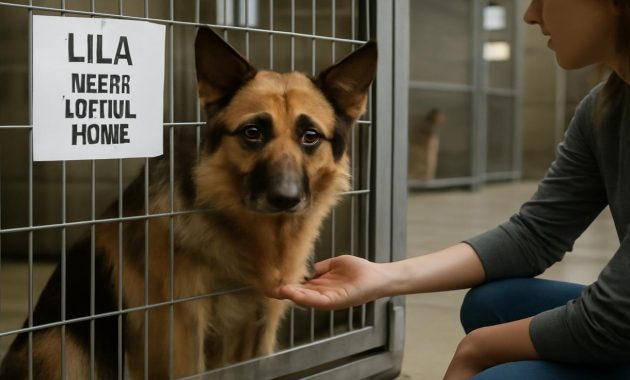
The first thing you notice about Lila is her eyes. Not the rich, burnt‑amber color that flashes when the sun hits her face, but the way they never stop moving. They flick to the door, the window, the shadow of your hand, the mug you set down a little too loudly on the kitchen counter. Her ears follow too, each sound cataloged, weighed, measured: safe, maybe safe, not safe. In the space of a heartbeat, she’s reading a room more closely than most humans ever will.
Lila is a German Shepherd rescue who arrived at the shelter with a thin body, a too-tight collar line in her fur, and a silence that felt like it belonged to someone who’d already given up. She is also, according to the intake card clipped to her kennel, “extremely loving, eager to bond, but anxious; needs experienced home—no small kids recommended.” Under that, in rushed handwriting: “Urgent: space needed.”
That’s how the story of “Adopt German shepherd rescue dog Lila – loving homes needed urgently – is saving one life worth risking your family’s safety?” really begins. Not with fear. Not with danger. But with a dog pressed against cold concrete, waiting for someone to decide if her life is worth the risk.
The Myth of the “Dangerous” German Shepherd
Now picture this: you’re scrolling through your phone at the end of a long week. Your fingers pause on Lila’s photo. She looks serious, almost stern, like she’s about to brief you before a mission. The caption says something about her being loyal and smart, about her needing out fast. And then, hovering just beneath the surface of your sympathy, another voice rises up inside you:
Is this safe? Is saving one life worth risking my family’s safety?
The question feels heavy because German Shepherds carry their own mythology. We know them as police dogs, military dogs, guard dogs—the silhouettes that haunt movie scenes with bared teeth and a deep, thundering bark. Somewhere along the way, those working images fused with fear. People stopped seeing the breed and started seeing a stereotype.
Yet, if you listen to the people who truly know them—handlers, rescue volunteers, trainers—you hear a different story. You hear about dogs who sleep with their head on a toddler’s lap, who learn the names of every toy in the house, who quietly place their body between their person and the world when anxiety spikes. You hear about sensitivity, devotion, and yes, a kind of fierce love that can feel almost human.
So where does the danger come from? Often, it’s not the dog at all. It’s the gap between what a German Shepherd is and what an unprepared household expects. A powerful, intelligent dog with a working brain and no guidance can become overwhelmed, reactive, and unpredictable. But placed in a thoughtful, structured, loving home, that same dog can be a once‑in‑a‑lifetime companion.
The question isn’t whether saving Lila’s life is worth “risking” your family’s safety. The real question is: can you build a home where Lila—and your family—feel safe together?
Meeting Lila: What a Rescue Dog Brings With Her
Imagine stepping into her kennel for the first time. Lila stands but doesn’t rush toward you like some of the others. Her tail hangs at half‑mast, unsure. She leans forward, nostrils working, pulling in as much information about you as possible. You smell like coffee, laundry detergent, and a faint trace of the park you walked through to get here. She can tell you hesitated outside her door. She can tell you’re a little afraid.
You crouch down, turn your shoulders slightly sideways—a dog’s language for I’m not here to push you. You say her name, soft and low. Lila’s ears flick at the sound. The shelter worker murmurs, “She’s slow to warm up, but once she chooses you, that’s it. That’s her person.”
Every rescue dog comes with a story, even if no one knows the details. Some stories are written in scars, others in flinches, others in the way a dog explodes with barking when they hear a man’s voice, or freezes at the sound of keys. When it comes to a German Shepherd like Lila, that story is amplified by her breed’s natural traits: her drive to protect, her need to work, her intense focus on her people.
Maybe she lived in a backyard, chained and forgotten, her job reduced to sounding an alarm no one answered. Maybe she bounced between homes that loved her looks but not her needs, her mind slowly filling with confusion every time expectations changed. Maybe she lost the one person she trusted and ended up here after grief made her act out in ways no one understood.
She doesn’t come empty-hearted, though. She brings an entire emotional landscape: the fear that you’ll leave, the hope that you won’t, the memory of hands that hurt and hands that offered treats. She brings the fierce instinct to notice every single change in your breathing and body language. She brings the capacity to learn your patterns so well she can predict your day better than you can.
Is that dangerous? It can be, if no one guides that sensitivity. But in the right hands, that sensitivity turns into something extraordinary: a dog who knows when you’ve had a hard day before you say a word, who leans into you on the couch and exhales like she’s been holding her breath her whole life waiting for this exact moment.
How to Read the Dog in Front of You
You’re not adopting a fantasy. You’re adopting this dog—this Lila, with her particular past and personality. Rescue staff and foster families are your translators. Ask them the real questions, the ones that scrape close to your deepest worry:
- How does she react to sudden noises?
- What does she do when overwhelmed—freeze, flee, or fight?
- Has she been around kids, other dogs, cats?
- What calms her? What sets her off?
- How does she handle touch—grooming, vet visits, being hugged?
When you listen carefully, you’re not just gathering data. You’re deciding if you can be the person she needs, not the person you wish she were.
Risk and Safety: A Honest Look for Families
Here is the raw truth: every dog is a risk. A five‑pound lapdog can bite a child’s face. A golden retriever can guard a food bowl. A mild-mannered mutt can panic when cornered. The question has never been “Is a German Shepherd safe?” but “What kind of safety can we build together?”
With Lila, and dogs like her, that work begins long before you bring her home. It starts at your kitchen table, where you and your family sit down and admit what’s really at stake.
- Are there very young children in the home who don’t yet understand boundaries with animals?
- Is everyone willing to follow consistent rules: no pulling tails, no hugging from behind, no startling a sleeping dog?
- Can you afford training classes, and do you have the time to practice daily?
- Is your home environment calm enough for a nervous dog, or do you live in a constant whirlwind of visitors and chaos?
Lila’s safety and your family’s safety are not opposing sides of a scale. They rise and fall together, depending on preparation, supervision, and respect.
Still, it can help to see things laid out clearly. Not as scare tactics. Just as the honest framework for a life you might build with her.
| Consideration | What It Can Look Like with Lila | How to Support Safety |
|---|---|---|
| Children | Curious kids wanting to hug or climb on the “big dog.” Lila stiffening when cornered. | Teach kids to give space, pet gently, and never disturb during sleep or meals. Supervise all interactions. |
| Other Animals | Interest that might tip into chasing cats or guarding toys from other dogs. | Slow, controlled introductions. Separate resources (bowls, beds, toys). Professional help if tension appears. |
| Strangers & Visitors | Barking at the door, standing between you and guests, unsure of unfamiliar hands. | Training a “go to your mat” cue. Letting her observe from a distance. Not forcing petting from visitors. |
| Energy & Exercise | Restlessness, pacing, chewing when bored or under-stimulated. | Daily walks, brain games, training sessions, puzzle feeders. A tired mind is a calmer mind. |
| History of Trauma | Startle responses, avoidance, or defensiveness around specific triggers (men, hats, loud voices). | Slow desensitization, predictable routines, gentle handling, possibly working with a behavior specialist. |
When you look at that table, the question shifts. It’s no longer “Is this dog inherently dangerous?” but “Am I prepared to meet this dog where she is?”
The Quiet Architecture of Safety
Safety doesn’t live in locks and fences alone. It lives in habits: closing doors, storing food out of reach, reading a stiff tail or a hard stare and knowing that’s the moment to intervene, not after a snap. It lives in teaching your children—firmly, lovingly—that Lila is not a toy or a test of bravery, but a living being with feelings and limits.
With a dog like Lila, you’re building an invisible architecture: routines that tell her the world is predictable, boundaries that reassure her you are in charge so she doesn’t have to be, and gentle exposure to new things that let her rewrite the rules she learned in her past life.
Worth the Work: The Other Side of Fear
No one tells you about the first time she chooses you. Not the way adoption brochures phrase it, anyway. They talk about “forever homes” and “second chances,” but they skip the moment you’re half-asleep on the couch, some late‑night movie murmuring in the background, when you feel the barely-there weight of her chin resting on your knee.
You glance down. Lila is watching you with those eyes that once ricocheted off every sound and shadow. Now they are locked on your face, question and answer carrying the same fragile hope: Are we really safe here?
You don’t need words to answer. Your hand slides into the fur behind her ears, gentle and slow. She exhales, the kind of long, shuddering sigh that sounds like something heavy leaving her body. You feel it too, that release. Maybe you were holding your breath right alongside her, without realizing it.
That is what the work is for. The early mornings when you take her out before anyone is awake, just so she can walk the quiet streets and learn that moving through the world doesn’t always come with pressure and threat. The training sessions where you repeat the same cue ten, twenty, thirty times until the light flickers on in her brain and she understands what you’re asking, and her tail starts to wag with pride. The careful introductions to friends and neighbors, each one a little step in teaching her that not every stranger is a danger.
The Hidden Gifts of a “Complicated” Dog
When people ask, “Is rescuing a dog like Lila worth the risk?” they often only picture the worst-case scenario: a bite, a growl, a heartbreaking return to the shelter. They rarely imagine the best-case scenario, the one that plays out in a thousand quiet, ordinary moments.
- The morning she decides the vacuum cleaner is no longer a monster, just background noise.
- The first time she lies on her side, belly exposed, too relaxed to monitor every doorway in the room.
- The day your anxious teenager sits on the floor, whispering secrets into her fur because Lila listens without judgment.
- The evening your partner comes home after a brutal day, and Lila greets them like they’ve been gone for years, reminding them they are desperately, wildly wanted in at least one beating heart’s universe.
These are not small things. They are the quiet reweaving of trust—for her and for you. In saving her life, you are not playing the hero in a one-way story. You are entering into a partnership where both of you learn, slowly, to live less afraid.
Choosing with Eyes Open: Is Lila Your Dog?
None of this is meant to romanticize rescue into a soft-focus montage. There will be hard days. Days when she barks at the neighbor and you feel the hot flush of embarrassment. Days when she forgets all her training because something—only she knows what—sent her spiraling back into old fear. Days when you wonder, honestly, if you made the right choice.
Those doubts are not a sign that you’ve failed. They’re a sign that you’re taking her seriously, that you understand the weight of what you’ve done: you took a life teetering on the edge of being disposable and said, “No. You matter. And now I am responsible for you.”
So how do you know if adopting a German Shepherd rescue like Lila is right for you?
- You’re willing to learn about body language and behavior, not just rely on what you “think” dogs feel.
- You understand that love alone is not enough; structure, training, and boundaries are love in action.
- You’re ready to ask for help—from trainers, behaviorists, rescue groups—before a small problem grows teeth.
- You can accept that your dog may never be the carefree, dog-park social butterfly you imagined, and love her fiercely anyway.
If that sounds like you, then maybe this is not a story about risk at all. Maybe it’s a story about responsibility—about the courage to step into uncertainty for the sake of a life that might otherwise end behind a metal door no one opens in time.
Lila is still waiting. Somewhere, right now, a dog who looks a lot like her—worried eyes, tense shoulders, heart held in a kind of limbo—is tracing the lines of their small kennel, nose pressed to the gap under the gate, listening for footsteps that sound different.
Maybe they are listening for yours.
Frequently Asked Questions About Adopting a German Shepherd Rescue Like Lila
Is a German Shepherd rescue safe around children?
It depends on the individual dog, the child, and the supervision. Some German Shepherd rescues do wonderfully with calm, respectful kids; others are too anxious or reactive for a busy household. Always introduce slowly, supervise every interaction, and teach children clear rules about giving the dog space. Ask the rescue for a dog with a known history around kids if that’s your situation.
Can a fearful or reactive German Shepherd ever become “normal”?
Many anxious or reactive dogs improve dramatically with training, structure, and a predictable routine. “Normal,” however, is different for every dog. Some may always need a bit more management—like avoiding crowded spaces or chaotic dog parks. Progress is measured less by perfection and more by how well you can navigate life together.
How much training does a German Shepherd rescue need?
A lot. German Shepherds are intelligent, working-bred dogs who thrive on mental and physical engagement. Expect to commit to basic obedience, ongoing training games, and clear household rules. Professional guidance is highly recommended, especially for dogs with a difficult past.
What are red flags to watch for before adopting?
Red flags can include unprovoked aggression, lack of bite inhibition, no ability to calm down after arousal, and a rescue or shelter unwilling to discuss the dog’s behavior honestly. It’s also a warning sign if your own lifestyle doesn’t allow time for exercise, training, and supervision, or if household members aren’t on the same page.
How long does it take a rescue dog to truly settle in?
Many people refer to the “3-3-3 rule”: roughly three days to start decompressing, three weeks to begin learning the routine, and three months to really settle into their new life. For sensitive dogs like Lila, this process can take longer. Patience, consistency, and realistic expectations are key.
Is adopting a dog like Lila really worth the effort?
Only you can answer that. For many families, the effort is repaid a hundredfold in loyalty, companionship, and the deep satisfaction of watching a once-frightened dog learn to feel safe. If you’re ready to work, to learn, and to commit—even when it’s not easy—then saving her life may transform yours in ways you never expected.