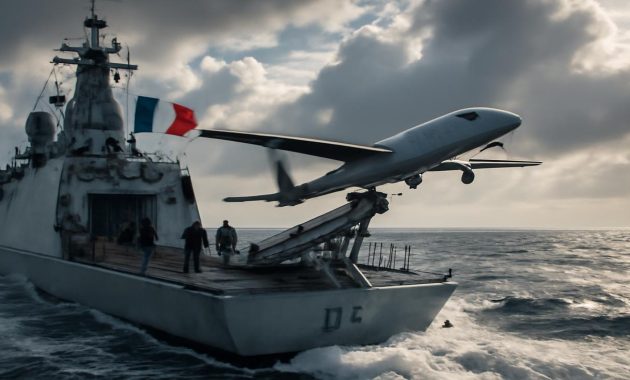
The wind over the Atlantic that morning felt different—sharper, somehow, as if it knew something significant was about to happen. On the horizon, a gray silhouette grew clearer: a French naval vessel cutting through the swell with the steady confidence of a ship that has seen storms and wars and long, quiet patrols. But what waited on its aft deck was new, almost otherworldly—a sleek, angular drone, its nose pointed toward the sky, its rotors still, its purpose unmistakable. France, a country often accused of dragging its feet on defense innovation, was about to press a button and, in the space of a heartbeat, leap from laggard to pioneer.
The Moment the Future Lifted Off
The crew on deck had rehearsed this dozens of times, but now the air felt tight with a different kind of electricity. Boots rang on steel. Voices rose, then dimmed to crackling radio chatter. The ocean sloshed and slapped the hull below, indifferent to the spectacle. A salty wind coiled around the drone’s graphite wings, nudging at its edges like a curious animal.
This was Airbus’s new ship-launched drone—an unmanned aircraft designed not for pristine runways and airbases, but for decks that pitch and roll, slick with seawater, framed by the chaos of the open sea. And France, after years of being criticized for moving too slowly on naval drones, had decided not just to catch up, but to lead.
From the bridge, a young operator watched a cluster of screens glow to life. Lines of data slid across black backgrounds: wind speed, pitch angle, fuel reserves, flight path predictions. His fingers hovered over the controls that would send this strange, mechanical bird skyward. Below, the deck crew stepped back, helmets glinting in the morning light. One last confirmation echoed across the ship. Then came the command that felt like a hinge in time:
“Drone ready for launch. Cleared for takeoff.”
No roar of afterburners. No thunderous quake of jet engines. Just a rising, mechanical hum as the drone’s systems came online, the subtle whine of turbines waking. It rolled forward along a compact launch rail and then—almost too smoothly—rose into the wind, the sea dropping away beneath it. There was a moment, barely a second, when it seemed to hang in the air between past and future. Then it climbed, the ship shrinking as France’s gamble took flight.
From Reluctant Adopter to First Mover
To really understand why that launch matters, you have to rewind to a time when France was not the one breaking ground in naval drones, but struggling to keep pace. In conversations inside military halls and defense conferences, the refrain was familiar: France, for all its advanced aerospace heritage, was oddly cautious at sea.
Other nations had started experimenting with small unmanned aerial vehicles on ships—quadcopters on destroyers, fixed-wing drones for coast guards, improvised systems strapped to deck plates with more hope than polish. France, by contrast, remained skeptical. Its ships were already dense ecosystems of radars, helicopters, missiles, and sailors. Adding drones—strange, data-hungry, maintenance-heavy newcomers—felt risky.
Yet, beneath that caution, something was shifting. The seas themselves were changing: more crowded, more contested, more unpredictable. Piracy and trafficking routes morphed like living things. Tensions in chokepoints like the Strait of Hormuz and Eastern Mediterranean flared and cooled, flared and cooled. Submarines became quieter; small boats faster; fishing fleets sometimes doubled as masks for illicit activity.
The French Navy, shaped by centuries of maritime experience, knew the old ways were no longer enough. Helicopters, while invaluable, were limited by crew fatigue, fuel, and maintenance. Patrols stretched thin across wide oceans. “Eyes over the horizon” was no longer a metaphor; it was a requirement. Unmanned systems, once seen as optional add-ons, became central to how future fleets would think, move, and survive.
That’s where Airbus stepped in with something that felt different: a drone engineered not as an afterthought bolted to a ship, but as a natural extension of the vessel itself.
The Drone That Grew Out of the Sea
On the outside, Airbus’s new ship-launched drone looks like a marriage between a glider and a stealth craft: slender wings, tucked sensors, an aerodynamic body honed for endurance, not spectacle. But its real magic lies in the details you don’t see when it arcs into the sky.
Every aspect of it has been shaped by the sea’s harsh demands. Salt air corrodes; waves slam; decks tilt unpredictably. The drone’s structure is built with marine-grade composites, sealed and hardened. Its launch and recovery systems are compact enough to fit on frigates and patrol vessels that weren’t originally designed with drones in mind. No sprawling catapults, no huge landing nets that dominate the deck—just a tightly integrated system that seems to belong there.
Inside the drone’s nose, high-resolution electro-optical and infrared cameras peer into the distance. Below, radar and communication antennas hum silently. It can scan a stretch of water dozens, even hundreds, of kilometers away, tracking vessels that might otherwise slip past unseen. It flies quietly, economically, staying aloft far longer than a helicopter ever could without needing to rotate crews or refuel mid-mission.
Yet what truly sets this drone apart is its brain. This isn’t just a camera in the sky; it’s a collaborator. The drone’s onboard processing uses advanced algorithms to filter the noise of the ocean—waves, weather, clutter—and pull out what matters: a boat moving just a bit too fast near a no-go zone, a radar signature that doesn’t match its declared identity, a strange convergence of signals where none should be.
When its data flows back to the ship, it doesn’t arrive as a chaotic stream of numbers and feeds. Instead, the drone’s software helps prioritize, flag, and categorize. The operator on the bridge isn’t drowning in information but surfing it, with the drone acting like a sharp-eyed scout that already knows what its captain cares about.
A Quick Look at What Sets It Apart
For a sense of how this new system compares to traditional naval assets, imagine the following overview, simplified for clarity:
| Capability | Ship-Launched Drone | Helicopter (Typical Naval) |
|---|---|---|
| Endurance | Several hours, continuous, unmanned | Shorter sorties, crew-limited |
| Risk to Personnel | None in the air; remote operation | High; crew on board every flight |
| Deck Footprint | Compact launch & recovery gear | Larger hangar, maintenance space |
| Best Use | Persistent surveillance, scouting | Transport, search & rescue, heavy lift |
France’s decision to be the first to field this kind of system at national scale isn’t just about checking a technological box. It’s about reshaping how a navy thinks about presence, perception, and power at sea.
Why France, Why Now?
There’s a temptation to see this as a pure technology story: new drone, new ship integration, new tactical playbook. But that misses something deeper unfolding in the French maritime story.
France isn’t just a European country with a coastline. It’s a global maritime power, guardian of vast exclusive economic zones scattered from the Caribbean to the Indian and Pacific Oceans. French frigates, patrol ships, and support vessels trace invisible threads between Réunion, New Caledonia, Polynesia, the Caribbean islands, and mainland Europe. They monitor fisheries, deter illegal trafficking, and fly the tricolor in distant seas where few European flags are regularly seen.
All those missions compete for time, budgets, and crews. The people aboard cannot multiply themselves. But their sensor range can. Their eyes and ears can stretch farther. Their presence can be felt in more places at once if a new kind of partner is flying overhead.
By being the first nation to operationalize Airbus’s ship-launched drone, France is doing more than buying hardware. It’s making a declarative statement about how it intends to act in this century’s oceans: more agile, more networked, more present, even when the nearest French shore is thousands of kilometers away.
Strategically, there is also a quiet competition underway. Other navies, large and small, are evaluating similar systems, testing prototypes, holding demonstrations. But moving from demonstration to doctrine is a far heavier lift. That’s where France is jumping ahead. It isn’t waiting for a global consensus on what a “drone-ready navy” should look like. It’s choosing to define one.
There is, too, a more human layer. In naval academies and training centers, a new generation of sailors and officers is learning to share their world with autonomous machines. They are discovering what it means to trust a drone to patrol a dark stretch of water while they rest, to lean on algorithms to flag threats they might have missed with the naked eye. France’s choice to go first isn’t just about steel and silicon; it’s about betting that its people can adapt faster than the old stereotypes suggest.
New Skills, New Culture at Sea
Onboard the ships that will host Airbus’s drone, roles are already shifting. The traditional silhouette of a naval job—navigator, weapons officer, helicopter pilot—is now joined by drone operators, data analysts, and systems integrators who knit signals from sea, sky, and space into one living picture.
These new specialists aren’t confined to dark rooms and glowing screens, either. They stand on the bridge, feel the wind, study the waves, and learn the rhythm of the ship’s movement, because a drone doesn’t really operate in isolation. It’s a limb of the vessel itself, and understanding how the ship breathes with the sea makes its unmanned extensions more effective.
From Rustling Paper Charts to Digital Seas
Decades ago, navigation on a French ship meant paper charts spread over wooden tables, pencils scratching arcs and bearings under red lamps. Radios crackled. Binoculars scanned the horizon. Today, though some of that persistence remains—a sailor is never far from a paper backup—the core of navigation has become deeply digital.
Airbus’s drone is another layer in that transformation. It doesn’t simply feed live video or radar echoes into a monitor. It plugs into a wider web of systems: satellite feeds overhead, intelligence databases ashore, signals from neighboring ships or aircraft. In the operations room, the sea is no longer just blue; it is annotated, overlaid, interpreted. Contacts glow with labels. Threat levels shift color. Patterns appear where once there was only guesswork.
When the drone flies a patrol, its path is shaped not just by the line of the wind, but by information—or the lack of it. A region where fishing vessels suddenly vanish from tracking systems. A patch of sea near an undersea cable. A freight route where a ship’s declared cargo doesn’t quite match its behavior. The drone glides through these uncertainties, turning them, bit by bit, into clarity.
This clarity, in turn, changes the tempo of decision-making. Commanders no longer have to rely purely on intermittent reports and gut feeling. They can watch in real time as a suspicious vessel is shadowed without a single human leaving the deck. They can choose to intercept, to hail, or simply to mark and monitor from afar.
In that sense, the drone is both a magnifying glass and a buffer. It allows France to act more precisely—and sometimes more cautiously—because it knows more. The days when the only way to be sure of a ship’s intent was to draw near and look a captain in the eye are fading. Now the first meeting might be a distant one, through a camera lens high in the sky.
Balancing Innovation with Responsibility
Yet, with that power comes the weight of responsibility. Having an unmanned platform that can watch without rest and range far from human oversight raises hard questions.
Where is the line between vigilant and intrusive? How do you ensure that algorithms trained to flag “unusual” behavior don’t simply replicate biases in the data they are fed? How do you secure the drone itself from hacking or interference in an age when cyberattacks can be as dangerous as missiles?
France’s move to the front of the pack means it faces those questions early. But it also means it gets to help shape the answers. In defense circles, ethics and law are increasingly part of the design conversation, not an afterthought. Rules of engagement are being updated to reflect the presence of unmanned systems, clarifying who is accountable and how decisions are made when machines are watching.
Behind each drone flight lies a chain of human choices—engineers who designed fail-safes, officers who approve mission plans, politicians who set boundaries. France, as the first full national adopter of Airbus’s system, will find itself under a spotlight, its practices observed by allies and critics alike. That scrutiny might feel uncomfortable at times, but it can also be a forcing function for rigor and transparency.
The Quiet Ripple Across the World’s Oceans
Out on the water, none of this debate is visible. A solitary frigate leans into a swell. The sky bruises toward dusk. The drone, a speck above the waves, loops in a wide arc hundreds of meters up, its camera eye unblinking. To a fisherman on a small boat, it may pass unseen, or as a faint, distant buzz swallowed by the wind.
But the consequences of that drone’s presence are wide. A smuggler, hearing rumors that French patrols now have eyes that don’t sleep, might think twice about a chosen route. An illegal fishing venture, once used to slipping just outside the sweep of manned patrols, finds the net closing in from above. A submarine captain, plotting a discreet surface transit, realizes that the old comfort of a visually empty horizon is no longer a guarantee of or invisibility.
All of this unfolds not in dramatic battles, but in daily, quiet adjustments—a ship’s course corrected here, a suspicious contact abandoned there. In the long game of maritime security, these small nudges can matter more than rare flashes of open confrontation.
In a sense, France’s adoption of Airbus’s ship-launched drone is less like unveiling a new weapon and more like installing a new kind of tide clock on the bridge of the ship. It doesn’t decide where the vessel will go, but it reveals more about the waters it sails through. That extra knowledge can shift an entire strategy, even if the shift is too gradual to see in one glance.
For Airbus, too, this moment is pivotal. A system proven across the varied environments of the French fleet—the cold Atlantic, the choppy Mediterranean, the calm, humid Indian Ocean—earns not just technical credibility, but narrative power. Other navies watch, compare, calculate. If France’s experiment succeeds, it could set a precedent: a template for how advanced navies can integrate drones deeply into their sea-going routines rather than bolting them on at the edges.
A Ship, a Drone, and a New Story of the Sea
As the first operational flights continue, something subtle is happening on board those French ships. The drone, at first a curiosity, becomes ordinary. The crew grows used to its comings and goings, to the soft alarm that announces its return, to the hum of its post-flight checks. The extraordinary, with repetition, slides into the everyday.
Yet, if you step back, the picture looks anything but ordinary. A state once accused of technological hesitation is now a testbed for a new genre of maritime operations. A manufacturer rooted in aerospace has successfully extended its reach from sky to ship, landing in the middle of an age-old human relationship with the sea and quietly rewriting parts of it.
Somewhere off a distant coast, under a sky streaked with fading contrails, a French vessel leans slightly as the drone comes home. Its silhouette grows larger, details sharpening—the bevel of its wings, the twist of its propeller as it slows, the faint sheen of salt already forming on its surfaces. Deck lights blink alive to guide it back.
For a second, as it settles onto the moving deck, the old and the new are perfectly aligned: centuries of seafaring craft and courage beneath, a fresh layer of autonomous intelligence above. The landing is smooth, almost too gentle for the weight of its symbolism.
In that moment, France is no longer catching up. It is writing a chapter others have yet to draft, one ship-launched drone flight at a time.
Frequently Asked Questions
Why is France considered a laggard-turned-pioneer with this drone?
France had been perceived as relatively slow to adopt naval drones compared to some other countries, focusing more on traditional assets like helicopters and manned patrols. By becoming the first nation to operationally deploy Airbus’s new ship-launched drone across its fleet, it has moved from a cautious adopter to a first mover, setting a benchmark for others.
What makes Airbus’s ship-launched drone different from regular drones?
This drone is specifically designed for harsh maritime environments. It can be launched and recovered from moving ships, withstand salt, wind, and constant motion, and integrate deeply with a vessel’s sensors and command systems. It’s built for endurance, wide-area surveillance, and smooth data integration rather than short-range, ad hoc use.
Will these drones replace naval helicopters?
No. They complement rather than replace helicopters. Drones offer long-endurance surveillance and low-risk scouting, while helicopters remain vital for tasks like search and rescue, heavy lift, and certain anti-submarine missions. Together, they expand a ship’s capabilities.
How do these drones change life for sailors on board?
Sailors now work alongside drone operators and data specialists, and decision-making is increasingly based on rich, real-time information. Daily routines adapt to include drone launch windows, data analysis, and system maintenance. The culture on board shifts toward more digital, networked operations.
Are there concerns about privacy or misuse with ship-launched drones?
Yes, there are ethical and legal questions about surveillance, data handling, and potential overreach. Because France is among the first to adopt such systems widely at sea, it faces pressure to establish clear rules of engagement, strong cybersecurity, and transparent practices to ensure drones are used responsibly and within international law.