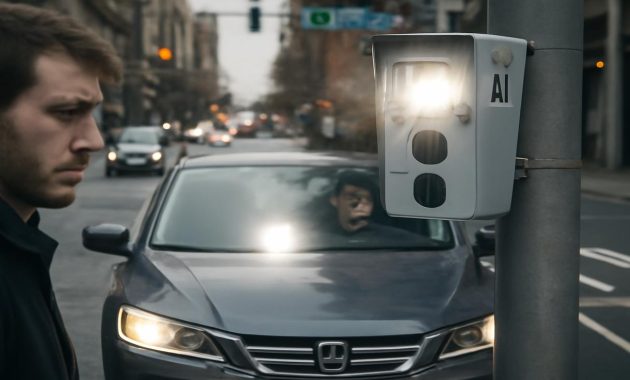
The flash arrives like a tiny lightning bolt, so quick you almost doubt it happened. One blink of white in the corner of your eye, and the quiet confidence of the open road suddenly feels like a courtroom. Somewhere above you, on a metal pole that no one notices until it’s too late, a black lens has watched, measured, decided—and fined. No human officer waved you down. No stern face explained your mistake. Just a machine, silently certain, capturing your license plate and sending your fate into a database.
The day the roadside eyes woke up
It was a gray, low-cloud kind of morning when the first of the new AI-powered cameras switched on in the city where this story begins. Commuters felt the difference before they could name it. The usual, casual choreography of traffic—the hurried lane changes, the rolling stops, that shared, unspoken agreement to “just this once” push five or ten above the limit—started to fray at the edges.
Drivers began noticing odd things: brake lights flaring in long synchronized ripples, like red dominoes. People actually stopping at the yellow lights instead of gunning it. The guy who always used the bus lane to jump the queue now lingered back, trapped in the same crawling line as everyone else.
The cameras didn’t look like much. Just slender gray boxes with dark glass eyes, perched above intersections, nestled along quiet suburban streets, stationed at the edge of school zones and sharp curves. But on the inside, they were hungry.
They could do what older systems never managed gracefully: read plate numbers at bad angles, in heavy rain, at night, under glaring sun. They could measure not just speed, but patterns—sudden lane weaving, dangerous overtaking, tailgating, the jerk of a phone slipping up into a driver’s hand. Some were tied into networks that could cross-check insurance, registration status, and even prior violations, all in a heartbeat.
In the first week, the city’s traffic office inbox filled with something new: not just fines, but arguments. People wanted to know why they’d been targeted. The AI camera said they were speeding. They swore they weren’t. The AI camera said they’d crossed that stop line. But from behind the wheel, it had felt like they’d safely slipped through.
Inside a traffic control room lined with screens, the cameras’ digital eyes watched everything at once. A map glowed with dots for each new violation, blinking briefly before turning solid red. To some officials, this pattern looked like progress. To others, it looked like a warning beacon for what might come next.
When safety stats meet human stories
Not far from one of those new AI cameras is a small café, squeezed between a pharmacy and a bakery, where traffic engineers, bus drivers, delivery couriers, and frustrated commuters sometimes end up sharing the same table when the lunch rush is bad. On one particular afternoon, that cramped, coffee-scented space became the stage for a quiet, uneasy debate.
A traffic safety officer, fleece jacket still zipped to the neck, sat with a stack of printouts. The graphs and bars were clear: in the first month after the AI cameras went live, speeding near schools dropped by nearly a quarter. Red-light running at dangerous intersections took a sharp dive. There were fewer near-miss reports from cyclists and pedestrians, and the shriek of emergency sirens had become a rarer sound at certain blackspots.
Across from the officer sat a delivery driver whose phone screen still glowed with a fresh notification: another fine. The second one this week. He had children to feed and a van payment that never seemed to shrink. The fines weren’t theoretical to him; they were the difference between a full fridge and a thin week.
As rain streaked down the café window, they talked in the halting, polite way strangers do when they discover they’re caught in the same story from opposite sides. The officer spoke about the families they had visited after fatal crashes, the photographs that never stopped replaying in their mind, the way one less knock on a door at midnight counted more than any complaint about tickets.
The driver spoke about the feeling of driving under constant digital judgment—how every route now felt like walking through a maze of invisible tripwires. He worried about a wrong calculation, an incorrect license plate read, a blurred frame that somehow still carried the weight of truth. He wasn’t against safety. But he was starting to feel like a suspect first and a citizen second.
Numbers might win policy arguments, but they don’t always win hearts. And this was where the AI cameras created a new kind of tension: both sides could be right at the same time.
More than a ticket: the quiet rise of roadside surveillance
The genius—and danger—of AI cameras lies in what they notice and what they remember. Old-style cameras were like static traps: hit a certain speed at a certain point and you were caught. Step outside that narrow trigger, and you slipped by, invisible.
AI systems, though, are different. They don’t just capture; they interpret. A car doesn’t just “go past camera 14.” It follows a pattern. It accelerates here, brakes there, lingers in this lane, cuts across that one. Feed this information into connected systems, and soon a city can map not just traffic flows, but behaviors. Risk profiles. Tendencies.
Think of a typical day on a busy urban road. Morning sun glints off windshields, buses exhale streams of passengers into crosswalks, cyclists trace narrow paths between mirrors and doors. Above it all, cameras watch: some mounted on traffic lights, some stitched into lamp posts, some buried in the dark glass of overhead gantries.
In some regions, the AI doesn’t stop at detecting speeding. It learns to recognize phone use, seat belt violations, tailgating distance. It can count the number of people in a car with startling accuracy. It might note your car entering a congestion zone at 08:13, leaving at 08:47, and correlate that with plate reads at toll points, parking lots, or other intersections miles away.
To city planners, this is a goldmine—a way to make roads safer, optimize routing, and design better infrastructure. To privacy advocates, it’s the start of something far more unnerving: a stitched-together portrait of daily life, painted in license plates and time stamps.
At the edge of this system is a simple, hard question: if the camera can see more than just your speed, what else will it be allowed to notice?
The uneasy comfort of being watched
We live, already, in a world sprinkled with lenses. Storefronts, doorbells, dashcams, overhead domes in train stations and bus depots. In many cities, the idea of not being recorded in public feels almost quaint.
AI road cameras are different partly because they carry sharp teeth—fines, license points, and in extreme cases, court dates. But they’re also different because their stated mission is so difficult to argue against: saving lives.
Ask almost anyone who has lost a loved one to a speeding driver, and they’ll tell you: if a camera could have stopped that car, they would have accepted any amount of watching. Safety, in that light, becomes sacred enough to justify almost anything.
Yet a strange paradox lurks here. The safer a system claims to make us by watching, the harder it becomes to say where safety ends and control begins. A camera that can detect a speeding vehicle can also, in theory, be turned toward different targets: unauthorized protests that spill onto roads, gatherings authorities dislike, patterns of movement seen as “suspicious.”
It’s not a prediction; it’s a possibility. And it’s the nature of infrastructure that once it exists, pressure builds to repurpose it. A city wired for perfect road safety is also a city halfway wired for perfect monitoring.
Fines, fairness, and the feeling of being singled out
In the glow of dashboard lights at night, a fine always feels personal. It doesn’t matter that the camera would have done the same to any other car in your place; the envelope in your hand has your name on it, your plate, your supposed misbehavior frozen in high-resolution clarity.
For the people managing these systems, fines are framed as an unfortunate but necessary tool. They prefer to talk about deterrence: how, after a burst of initial penalties, drivers learn fast, and violations fall. In some cities where AI cameras have rolled out, repeat offenders really do shrink as a group over time.
But not everyone adapts at the same pace—or has the same ability to bear the financial hit. A wealthy driver might shrug off three or four fines as a frustrating cost of convenience. A shift worker, gig driver, or rural commuter scraping by on thin margins can feel each ticket like a body blow.
In one internal report, a researcher illustrated the imbalance with a simple comparison chart, not meant for public eyes but too revealing to ignore:
| Driver Type | Annual Income (Approx.) | Fine Amount | Impact of 3 Fines in a Month |
|---|---|---|---|
| High-earning professional | High | Fixed, same for all | Annoying, but manageable |
| Average commuter | Moderate | Fixed, same for all | Budget strain; cut back on extras |
| Low-income / gig driver | Low | Fixed, same for all | Serious hardship; bills at risk |
Same fine, very different pain. As AI cameras ramp up enforcement, this disparity becomes more visible. The system is technically neutral—it doesn’t know your paycheck. But the consequences are anything but equal.
Some legal scholars and ethicists have started whispering a difficult suggestion: if enforcement becomes this precise and unavoidable, should fines scale with income, as they do in some countries? Should the price of breaking the rules feel equally persuasive to everyone?
It’s an unsettling thought for those who see law as something that should be flat and simple. Yet the alternative is what we already have: a world where the flash of an AI camera lands like a mild sting for some and a crushing blow for others.
The problem of the perfect witness
AI cameras arrive wrapped in the language of certainty. They don’t get tired, biased, distracted; they don’t forget to turn on the recorder. But this vision of digital perfection hides a quieter truth: every camera and algorithm carries the assumptions of the people who designed and deployed it.
What looks like a clean, objective ticket is really a series of choices: how fast the system decides is too fast, how close is too close, how clear a license plate must be before it becomes evidence instead of noise. Many of those decisions happen out of public view, inside contracts, technical documentation, and vendor demos.
When mistakes happen—as they inevitably do—they can be painfully hard to challenge. A driver who insists they weren’t speeding finds themselves up against a printout declaring a precise number, backed by a device whose workings they can’t examine. A blurred frame might misread one character of a plate, sending a fine to the wrong mailbox, and the burden of disproving it falls on the bewildered recipient.
Some cities have begun requiring human review for certain types of AI-detected violations, especially those based on pattern recognition like phone use or seat belt detection. Others, eager to reduce staffing costs, lean heavily on automation, trusting the system’s advertised accuracy rates.
In that café by the busy road, the delivery driver from earlier eventually asked the traffic officer a simple, piercing question: “If the camera says I did something and I say I didn’t, who does the city believe first?” The officer didn’t answer right away. Outside, a bus rumbled past, and somewhere just beyond the condensation on the glass, a camera quietly watched it go.
Democracy at the speed of data
Public roads are some of the most democratic spaces we have. They belong to everyone and no one at once, stitched through cities and fields and small towns like open veins. For generations, rules of the road were enforced by people in uniforms, with all the flaws and biases that entailed but also with something AI still lacks: situational mercy.
An officer can decide not to ticket the panicked parent rushing a child to the hospital, the driver who rolled five kilometers over the limit on an empty road in pouring rain because they were simply trying to get home. An AI camera, fixed on its narrow task, has no context. It cannot see fear in a driver’s eyes or exhaustion in their posture. It records one fact only: at this time, in this place, this vehicle broke this rule.
When the power to enforce laws shifts from human discretion to algorithmic certainty, something subtle but profound changes in the social contract. We move from a world where enforcement is inconsistent but flexible to one where it is rigid, omnipresent, and often invisible until it’s too late.
Some citizens welcome this: fewer chances for corruption, favoritism, or prejudice at the roadside. Others recoil, sensing that a state which can see every minor infraction is a state tempted, eventually, to punish every minor infraction.
Traffic might be the testing ground. If we accept AI monitoring here, in the name of safety, where do we stop? Noise levels in neighborhoods? Curfews in tense times? Automated crowd-counting at rallies and marches? The slide from “helpful data” to “quiet control” rarely announces itself.
Drawing the lines in public view
Despite the futuristic sheen, the fate of AI cameras is not destined by technology alone. It’ll be decided in council meetings, court challenges, citizen assemblies, and late-night conversations at kitchen tables where fresh fines sit beside grocery lists.
Some communities will demand strict guardrails: clear limits on what cameras can record, how long data can be stored, who can access it, and for what purposes. They’ll push for transparent audits, public reporting, easy ways to contest mistakes, and independent oversight that can actually say no.
Others may be more resigned, trading their concerns for the immediate comfort of fewer crashes, calmer intersections, and that fragile but real sense of safety when a child crosses the street.
Either way, the decision should feel deliberate, not accidental. The worst outcome is to sleepwalk into a future where every journey writes a detailed report about us, and no one remembers exactly when that became normal.
The road ahead: between fear and responsibility
So, is the bad news for drivers fined by AI cameras a victory for safety or the beginning of total surveillance? The honest answer is uncomfortable: it’s both a warning and a promise, and which side grows stronger depends on what we demand next.
Those cameras on the roadside can be guardians, slowing cars near playgrounds, taming lethal curves, teaching us to treat a yellow light as a pause instead of a dare. They can quietly save lives we’ll never hear about, erase collisions from futures that now go on unchanged. Every driver who eases their foot off the accelerator because they know a camera is watching is also responding, however grudgingly, to a call for shared responsibility.
But the same lenses, fed into unchecked systems, can turn us into lines in a spreadsheet—movements tracked, habits profiled, patterns of life mapped in granular detail. In that version of the story, safety becomes the story we tell ourselves to explain why we stopped noticing how closely we were being watched.
Out on a highway at dusk, the sky fades from blue to ink as headlights trace white arcs along the asphalt. Somewhere just ahead, another camera waits in its quiet metal shell, its sensor already alive, ready to judge your speed, your choices, your brief, human fallibility. You might not see it. But it will see you.
The real question isn’t whether the camera is good or bad. It’s whether we, together, will insist that the power it represents remains bent toward genuine safety, honest fairness, and the smallest footprint of surveillance needed—rather than quietly expanding into every corner of our public lives.
Because in the end, the road belongs to all of us. So does the decision about how much of ourselves we’re willing to surrender, in the name of coming home alive.
FAQ
Do AI traffic cameras actually reduce accidents?
Evidence from early deployments in several regions suggests that AI-enhanced cameras can significantly reduce speeding, red-light running, and dangerous behaviors like phone use, particularly near high-risk areas such as schools and busy intersections. These changes often correlate with fewer collisions and injuries, especially over time as drivers adjust their habits.
Are AI camera fines always accurate?
No system is perfect. While AI cameras can be extremely precise, they can still misread plates, misinterpret tricky scenarios, or produce errors due to poor visibility or hardware faults. This is why transparent appeal processes, human review for borderline cases, and independent audits are essential to maintain fairness and trust.
What kind of data do these cameras collect?
At a minimum, AI traffic cameras record images or video of vehicles, license plates, time, and location of potential violations. More advanced systems can also infer speed, distance to other vehicles, lane position, and behaviors such as phone use or seat belt status. How long this data is stored and who can access it varies by jurisdiction and should be clearly regulated.
Can AI traffic cameras be used for purposes other than road safety?
Technically, yes. The same infrastructure could be repurposed for broader surveillance, such as tracking specific vehicles over time, monitoring gatherings, or enforcing non-traffic-related rules. Whether this happens depends on laws, policies, and public oversight. Strong legal limits and transparency are crucial to prevent mission creep.
What can citizens do if they’re concerned about AI camera surveillance?
Citizens can engage with local representatives, attend public consultations, and push for clear regulations on data collection, retention, and usage. They can demand independent oversight, regular impact reports, and easy mechanisms to challenge fines. The shape of AI enforcement is not fixed; it’s influenced by public pressure and democratic debate.