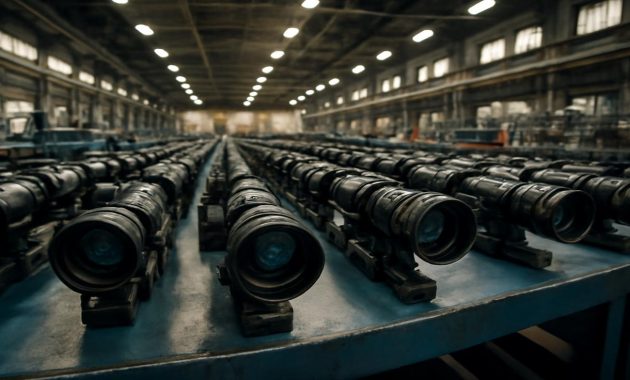
The first time you stand in a truly dark forest, away from cities and highways and porch lights, you start to understand what “night” really used to mean. The trees stop being shapes and become a single black wall. The path ahead dissolves. Your ears lean forward, trying to do the work your eyes can’t. For most of human history, this was normal: night as a curtain, not a backdrop. But that curtain is being pulled back, and nowhere is that more evident right now than in France—where a massive new defense contract, for 200,000 image intensifier tubes, is quietly reshaping not only how soldiers see the battlefield, but how Europe sees its own industrial future.
A Night That Isn’t Dark Anymore
Imagine standing on a ridge in eastern France on a moonless night. To the naked eye, the world is mostly suggestion: a darker patch where the forest begins, a faint shimmer where a river might be. Then someone lowers a pair of night-vision goggles over your eyes, and the scene explodes into a ghostly green clarity. Every rock, every tree branch, the thin white line of a trail, the distant movement of a person you never knew was there. It feels less like seeing in the dark and more like cheating.
This is the power of image intensifier tubes—the small, delicate, vacuum-sealed cores inside many night-vision systems. These tubes take the few stray photons bouncing around in the dark and amplify them thousands of times over, turning near-blackness into an image bright enough for the human eye to read. They are, in a very real sense, factories of artificial twilight.
So when France signed what many in the defense world are calling the largest night vision contract of the modern era—roughly 200,000 of these tubes—it wasn’t just about buying equipment. It was a declaration: in the race to own the night, France intends not just to participate, but to build the track, the stadium lights, and perhaps even the scoreboard.
The Deal That Turned Heads Across Europe
Defense deals are often buried in acronyms and budget lines, but sometimes a single number cuts through the noise. Two hundred thousand. That figure alone turned a quiet procurement process into a milestone moment. For scale, it’s enough to equip entire armies, replenish stockpiles, modernize aging fleets of goggles, and still have a strategic buffer for future needs.
Inside French ministries and industrial corridors, this contract was described as “structuring”—the kind of order that doesn’t just keep the factory lights on, but demands new factories, new talent, new supply chains. In European capitals watching from a distance, it sounded like something else: a starting gun.
Countries across Europe have been rethinking their defense posture in recent years. As the security environment has grown more uncertain, one theme has emerged clearly: whoever sees first, wins first. Night vision is no longer a specialized luxury for elite units; it is becoming as fundamental as radios or armored vests. If war has a soundtrack, it is changing; if it has a color, it is increasingly that spectral, phosphorescent green.
The Strategic Weight of a Single Line Item
On paper, France is buying hardware. In practice, it’s buying time—years, perhaps a decade—of industrial momentum. The contract anchors domestic production, justifies investment in new generations of tubes, and sends a strong signal to European allies: if you want advanced image intensification, you might not have to look across oceans. You could look next door.
For European policymakers, that matters. Defense isn’t just about gear; it’s about autonomy. When a crisis hits, who controls the manufacturing lines that feed your soldiers? Who decides the export licenses? Who gets priority when there’s a global shortage of critical components? With this deal, France is quietly positioning itself as Europe’s night-vision foundry.
How a Tiny Tube Turns Darkness Inside Out
It’s easy to treat this as a story of policy and strategy, but the heart of it all is an object you can hold in one hand: the image intensifier tube. It looks almost unimpressive—metal, glass, wiring. But what happens inside is alchemy of the most modern kind.
Light, even in almost total darkness, never truly disappears. Starlight, distant city glow, the faint shimmer of the horizon—photons are still there, just too few for the human eye to assemble into an image. The tube’s job is to catch those sparse photons and multiply them into a visible picture.
Here’s the simplified magic trick:
- Incoming photons strike a photocathode and get converted into electrons.
- Those electrons are accelerated and multiplied as they race through a microchannel plate—imagine tens of thousands of microscopic tunnels, each boosting the signal.
- The amplified spray of electrons slams into a phosphor screen, which glows to form the familiar green image.
Every improvement in those steps—more sensitive photocathodes, smarter microchannel designs, better phosphor—means clearer images, longer range, and fewer illusions in the dark. It also means a huge edge in combat, search and rescue, border surveillance, and even anti-drone operations at night.
Why the Tube Still Matters in a Digital Age
In an era obsessed with “digital everything,” image intensifier tubes are a reminder that analog physics still has teeth. While thermal cameras dominate in certain roles—like detecting heat signatures through smoke—a well-made intensifier tube offers higher resolution, more natural scene detail, and often superior depth perception.
Soldiers talk about it in simple terms: with good tubes, you don’t just see shapes; you read the landscape. You distinguish a bush from a crouching figure, a trench line from a shadow. You trust what you’re looking at. That trust is worth a fortune on a night when mistakes get people killed.
And so, for France and for Europe, the tube isn’t a nostalgic throwback. It’s a battleground of innovation—a focal point where materials science, optics, and electronics converge. The new mega-contract guarantees those disciplines have a long, well-funded runway to push further.
The Industrial Race: Europe Looks Inward
To understand why this contract feels like a race, you have to step back from the battlefield glow and look at the factory floor. The global market for night vision has long been shaped by a small number of heavyweight producers, many of them outside Europe. For years, European forces often relied on imports or limited local capacity.
Now the equation is flipping. France’s bet on 200,000 tubes isn’t just about national pride; it’s about crafting leverage inside a Europe that wants to be less dependent on distant suppliers. This is industrial strategy, written in green light.
From Single Orders to Ecosystems
A contract of this size doesn’t live alone. It pulls an ecosystem into orbit: subcontractors who polish glass and grow crystals, small firms that machine housings with impossible tolerances, electronics companies that build power supplies and smart mounts, labs refining new coatings and photocathodes.
There’s also something less visible but just as crucial: talent. Skilled technicians who understand vacuum systems. Engineers who can coax better performance out of delicate analog-digital hybrids. Optical designers who can thread the needle between robustness, clarity, and weight. When work is guaranteed for years, these people stay, multiply, and teach.
The result is something Europe has craved for years: resilient, sovereign competence in a critical technology. While other nations may still lead in certain night-vision niches, Europe now has a much stronger hand—and France, in particular, holds many of the cards.
A Quick Look at What This Means in Practice
The impact of such a contract can be glimpsed by considering, in simplified form, how the commitment might ripple across domains:
| Area | Change Driven by the Contract |
|---|---|
| Military Readiness | Mass deployment of modern night-vision gear, improved training realism, and standardized equipment across units. |
| Industrial Capacity | Expansion and modernization of manufacturing lines, new suppliers, and long-term R&D funding. |
| European Autonomy | Reduced dependence on non-European providers for a critical battlefield technology. |
| Export Potential | Stronger position for future European collaborative projects and allied procurement. |
| Innovation Cycle | Incentive to develop next-generation tubes and hybrid digital-intensifier systems. |
Each cell in that simple table contains years of work, debates in ministries, arguments in boardrooms, and hours on the factory floor. The race, in other words, is not only between France and other countries; it’s between different versions of Europe’s own future.
Soldiers, Shadows, and the Human Side of Green Light
Numbers and strategy can obscure the simple reality that this story ends, ultimately, on the ground with a person wearing heavy gear and trying not to trip over a root in the dark. Night vision isn’t an abstract capability; it is a visceral change in how a human body experiences a landscape.
Ask anyone who has worn modern night-vision goggles for the first time. The world becomes suddenly flatter, colors draining into monochrome green. Your depth perception shifts. Sounds feel detached from the shapes you see. The stars look closer. Movement draws your eye in a way that daylight never quite does.
For soldiers, the promise is straightforward: to move, see, and act in hours once reserved for rest. Patrols stretch further into the night. Ambushes are foiled before they form. Convoys pick their way through forests and broken towns without headlights. The darkness stops being an ally of chance and becomes a canvas of intention.
But Night Vision Changes the Rules for Everyone
The catch is that this advantage doesn’t stay asymmetric forever. When one side invests heavily, other actors start to respond. They change tactics. They experiment with camouflage that fools intensifiers, with lighting that dazzles tubes, with drones that hunt back in kind.
So the industrial race is attached to a tactical spiral: better tubes lead to better countermeasures, which demand better tubes, and so on. The 200,000-unit contract is not a finish line; it is a starting point for a new phase of adaptation.
Yet on a human level, it still boils down to something grounded and immediate. A French soldier kneeling in a wet field at two in the morning, listening for the faint clink of gear, scanning a treeline that no longer looks like an opaque wall—that is where policy cashes out. The ability to see that one extra figure stepping from behind a tree might define the night.
Locking In the Future: Why This Contract Will Be Remembered
Years from now, when analysts write timelines of Europe’s push for more defense autonomy, they may not start with tanks or fighter jets. They may point instead to niche but critical technologies like image intensifier tubes—small cylinders that forced nations to think seriously about where, and with whom, they wanted to build their most sensitive tools.
France’s enormous bet on night vision does three things that are easy to overlook in the glare of raw numbers.
First, it normalizes scale. Once 200,000 tubes no longer sounds shocking, future orders across Europe—perhaps collaborative ones—begin from a higher baseline of ambition. The bar is raised for what “serious” investment looks like.
Second, it binds industry and policy together. With so much capital and planning committed, governments and companies both know they are in a shared vessel. That tends to generate more candid dialogue, more long-term planning, and more resistance to short-term budget panic.
Third, it sends a quiet message abroad: Europe is not content to be a perpetual buyer in this field. It wants to be a maker, a designer, a standard-setter. The night may be global, but the way it is seen need not depend solely on distant suppliers.
In the gentle irony of it, the consequence of making night transparent is that certain political and industrial choices become more visible too. Whose factories hum at three in the morning? Whose engineers are perfecting new ways to turn “almost dark” into “clear enough”? Whose policies keep those skills alive between crises? France, with this contract, has made its answer clear.
Somewhere, tonight, in a training ground far from city lights, a group of young recruits will slip night-vision goggles over their helmets for the first time. They will murmur—because everyone does when the dark suddenly blooms into detail—and they will start walking into a landscape that looks nothing like the one they knew five seconds before. That moment of astonished silence is connected, by a long, invisible chain, to factory floors, ministerial signatures, and industrial strategies.
This is how a continent changes the way it inhabits the night: not with a single flash, but with millions of amplified photons, multiplied inside 200,000 tiny tubes, and a decision that the darkness over Europe will increasingly be a choice, not a limit.
Frequently Asked Questions
Why is this night vision contract considered the largest of the modern era?
It stands out primarily because of scale—around 200,000 image intensifier tubes. That’s an exceptionally large number for such a specialized component, enough to outfit extensive forces, renew aging stock, and build a strategic reserve. In recent decades, few, if any, comparable contracts have approached this volume for high-performance tubes in a single national framework.
What exactly are image intensifier tubes used for?
They are the heart of many night-vision devices, such as goggles, weapon sights, and observation systems. The tube converts very low levels of light into a visible image, allowing users to navigate, observe, and engage in near-total darkness using residual light from stars, the moon, or distant artificial sources.
How does this contract affect Europe’s defense autonomy?
By anchoring large-scale production inside Europe—particularly in France—the contract reduces reliance on non-European suppliers for a critical technology. It strengthens local industrial capacity, nurtures specialized skills, and provides a foundation for future European collaborative programs built on homegrown hardware.
Will this technology be used only by the military?
The primary driver is military need, but the industrial base and R&D it supports can spill over into other domains. Border security, law enforcement, search and rescue units, and certain civil protection missions often use related night-vision technologies. As production scales and innovation continues, civilian and dual-use applications tend to benefit indirectly.
How is night vision evolving beyond traditional green-tinted images?
Modern systems increasingly blend image intensification with digital processing and, in some cases, thermal imaging. This can mean colorized night views, better contrast in complex environments, and smarter fusion of multiple sensor inputs. The contract’s scale helps finance the transition toward these hybrid, more intelligent night-vision solutions.