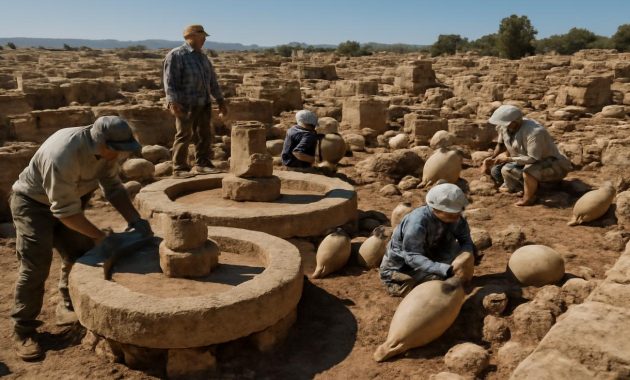
The first thing you notice is the smell—or rather, the ghost of a smell. The Tunisian sun hangs low over the fields as you step into the ruins, and for a fleeting second, your mind fills in what the stones can no longer provide: the sharp, green sweetness of freshly crushed olives, the warm, fatty perfume of oil warming in clay jars. Wind snakes through roofless walls, humming softly across shattered columns and circular stone basins. Here, on the edge of a quiet village near Sidi Ghrib in northern Tunisia, archaeologists say they have walked into a place that rewrites what we thought we knew about the Roman world: the second‑largest olive oil factory ever found from the Roman Empire.
The Day the Ground Opened Up
On a morning that began like any other dig day—dusty boots, humming generators, the clink of trowels against stone—the team wasn’t expecting a revolution in Roman history. They were following a line of masonry first spotted in an aerial survey: a suspiciously regular pattern in the soil, near a known Roman settlement. The coordinates looked promising but not spectacular—this region is littered with the bones of ancient farms and villas.
Then the courtyard appeared.
What began as a narrow trench widened into a grand open space paved with worn stones, their surfaces smoothed by centuries of footsteps and work. At one end, the outline of a massive press emerged; at the other, the curves of a series of circular basins—trapeta, the stone crushers used to break the olive flesh. These were not the modest installations of a family farm. This was industrial. This was monumental.
As the days went by and the dust fell away, the site revealed itself like a slow, unfolding story. Huge stone blocks, carved with precision, marked out places where presses once stood, anchored deep into the ground to withstand the torque of wooden beams and winding ropes. Channels cut with almost mathematical care sloped gently, guiding the precious green-gold liquid into collection tanks. Archaeologists began to count, measure, sketch. Their voices took on a different tone: quiet, intent, edged with disbelief.
It wasn’t just big. It was enormous. Bigger than anything they had expected to find in North Africa—big enough to stand alongside the most famous production centers of the Roman Mediterranean. When calculations began to suggest that this installation might be the second‑largest olive oil factory ever unearthed from the Roman period, the dig became something else: not just a window into a farm, but into an empire’s beating economic heart.
How Tunisia Became Rome’s Liquid Goldmine
To understand why this remote spot in modern‑day Tunisia matters, you need to picture the Roman Empire not as a map of marble cities and marching legions, but as a living, hungry organism. Millions of people needed to eat, cook, trade, light their homes, and an unexpected hero fueled a good portion of that daily life: olive oil.
In Rome, oil wasn’t a luxury extra; it was a foundation. It sizzled in cooking pots, glazed bread, nourished soldiers, and preserved food. It anointed bodies in baths and gymnasiums, stood in lamps to push back the dark, and even played a role in religious rituals. Where there were Romans, there was olive oil—by the amphora, by the ton.
North Africa—especially the broad, fertile plains of what is now Tunisia—became one of the empire’s great suppliers. The soil here is generous, the climate dry but forgiving. Under Roman rule, local farmers and estate owners transformed these landscapes into agricultural powerhouses: wheat fields, vineyards, and above all, endless rows of olive trees marching across the hills like green regiments.
The empire didn’t just stumble into this abundance; it planned for it. Roads linked estates to ports. Taxation systems ensured that African oil flowed steadily toward Rome and its armies. The famous Monte Testaccio in Rome—a hill made almost entirely of broken amphorae—has long told the story of olive oil imports from Hispania (modern Spain) and Africa. But finds like this Tunisian factory reveal the sheer ambition of production on the ground: the scale, the planning, the near‑industrial mindset that drove it.
This was not subsistence farming. This was strategy. And in that strategy, the newly unearthed factory from Tunisia takes center stage.
Inside a Roman Olive Oil Giant
Standing within the ruins, you begin to appreciate the choreography that once powered this place. Imagine the harvest season: late autumn, early winter. Carts creak under the weight of baskets heaped with ripe, glossy olives, dark green and purple‑black. Workers shout over one another, voices echoing off plastered walls now long gone. Somewhere a foreman barks orders. A millstone begins to turn.
The layout of the newly discovered complex reveals a logic as clear as any modern production line. Rows of circular crushing basins mark where stone rollers once moved in endless loops, powered by animal or human strength. Here the olives were first broken, their skins ruptured, their flesh transformed into a fragrant paste.
Beyond the crushers lie the press bases—massive stone blocks, rectangular sockets where vertical supports were anchored. Each press would have carried a heavy wooden beam, likely several meters long, tightened down with twisted ropes or screw mechanisms to squeeze the oil from layers of woven mats laden with olive paste. Archaeologists have counted so many of these press bases and crushing stations that early capacity estimates for the site are staggering.
You can almost hear the rhythm: the shuffle of sandaled feet, the splash of liquid into clay jars, the steady creak of beams under tension. Channels cut into the stone floor slope just enough to carry the first, best olive oil—bright, fragrant, and almost neon green in the right light—into carefully placed collection basins. Lesser grades, squeezed from re‑pressed pulp, would have followed, destined perhaps for lamps and soap rather than the dinner table.
Evidence of storage areas suggests vast quantities of oil were kept on site before being shipped out, likely in amphorae sealed with lids and stamped with marks declaring their origin. Somewhere nearby, perhaps, stood accounting rooms, where scribes tracked output in wax tablets, each number a testament to the empire’s appetite for this shimmering commodity.
Rewriting the Map of Roman Power
For decades, historians and archaeologists have known that North Africa was crucial to Rome’s grain supply—Tunisia, particularly, was thought of as a breadbasket. Olive oil production was recognized but often overshadowed by the legend of Spanish oil flooding imperial markets. This factory challenges that comfortingly simple story.
By ranking as the second‑largest olive oil production facility found from the Roman era, the Tunisian site forces a subtle but significant shift in how we picture the empire’s economic geography. It suggests that North Africa’s oil contribution was not peripheral or secondary but central, organized at a scale that could rival the famed estates of Baetica (southern Spain).
It also reframes the relationship between Rome and its African provinces. Instead of seeing Tunisia merely as a passive supplier, we begin to see an active, entrepreneurial region, where local elites and Roman administrators worked together—or competed—to harness land, labor, and technology. This was a frontier of opportunity as much as of control.
Consider the infrastructure implied by such a factory. To support this kind of output, you need more than just olive trees. You need a labor force—slaves, tenant farmers, seasonal workers. You need carpenters to build and maintain presses, potters to craft amphorae, smiths to forge tools, merchants to negotiate shipments by road and sea. You need a road network reliable enough to carry full jars to ports and empty jars back again. This one complex suggests an entire ecosystem of production and trade humming around it.
In other words, this dusty stretch of land in Tunisia was once plugged into the empire’s nervous system: a node in a supply chain stretching from rural groves to urban taverns, barracks, and bathhouses thousands of kilometers away.
Reading the Stones: What the Archaeologists See
To most visitors, the site may look like an elegant tangle of ruins. To the archaeologists, every chip of stone and curve of a channel holds a clue. Measuring the size and number of crushers and presses, comparing them with similar finds across the Mediterranean, they can estimate how much oil this factory could have produced in a good year. They study residues in the basins, microscopic traces clinging stubbornly to porous stone, confirming that yes—this was olive oil, not wine or grain processing.
Fragments of amphorae scattered around the site are equally eloquent. The shape of a handle, the thickness of the clay, even the style of a potter’s mark can tell scholars where vessels were made, how they traveled, and sometimes who oversaw the estate. If stamped names of landowners or imperial officials emerge from the soil here, they could tie this factory to specific families or state operations.
Radiocarbon dating of organic remains—perhaps charcoal from old furnaces or seeds caught in floor cracks—will help pin down the active period of the factory. Was this a short‑lived boom site, operating at full tilt for only a few decades? Or did it churn quietly but steadily across generations, surviving changes in emperor, climate, or market demand?
Architectural details offer more texture. Drainage systems suggest concern about waste and hygiene. Reinforced foundations speak to the forces generated by heavy presses. Nearby living quarters, if confirmed, might show whether workers slept on site during harvest season. Silence has defined this place for centuries, but the evidence the team is gathering is beginning to give it back its voice.
A Factory at the Edge of Climate and Empire
Beyond the romance of ruins and machinery, the Tunisian discovery has something urgent to say about adaptation—both ancient and modern. The Romans built this great engine of agriculture in a region of semi‑arid climate, much like today. They knew drought. They felt the edge of the desert at their doorstep. Yet they invested in long‑term crops like olive trees, which take years to mature but can thrive on poor soil and limited water once established.
Archaeobotanical studies across North Africa have shown how Roman farmers chose hardy varietals, managed groves for resilience, and sometimes mixed their plantings to hedge against bad years. The sheer scale of this new factory suggests confidence in that system, a bet that the land—and the climate—would keep cooperating, most of the time.
But the empire did not last forever. Economic patterns shifted; political stability cracked. Trade routes that had once carried Tunisian oil to distant provinces faltered. Olive trees outlasted emperors, but not all estates survived the long unspooling of Roman power. At some point, presses here fell silent. Beams rotted, roofs collapsed, and the desert wind began its slow, patient work of burial.
In the 21st century, Tunisia stands again at the intersection of environment and agriculture, still one of the world’s important olive oil producers, still negotiating water scarcity and climatic uncertainty. The newly uncovered factory becomes more than an archaeological curiosity; it is a mirror held up across time. It asks how societies scale up food systems, how they manage risk, and what happens when the wider structures holding those systems together begin to fray.
From Empire to Everyday Tables
It’s easy to talk about amphorae and exports and markets, but olive oil begins at a very human scale. Picture a Roman household somewhere far from Tunisia—say, a cramped apartment in Ostia, Rome’s port city. In a small kitchen corner, beside the fire, stands a jar of African oil. A woman dips her fingers into it to coat a baking pan; a soldier home on leave tears bread and drags it through a shallow dish; a lamp wick drinks it, flaring softly against plaster walls.
Every one of those everyday gestures is tethered, invisibly, to places like this factory. To the stooped backs of harvesters in Tunisian groves, to the grunts of men turning millstones, to the careful hands of workers decanting oil into transport jars. When we walk among the ruins, we’re not only tracing lines of trade; we’re tracing lines of taste, of habit, of quiet comfort.
In modern Tunisia, olive oil still plays a similar role. It’s drizzled into spicy harissa, folded into couscous, shared across family tables. Between the present and the ancient ruins, there’s not just continuity of crop, but continuity of culture—of how people relate to land, to food, to one another.
What This Discovery Means for the Future
The story of the second‑largest Roman olive oil factory in Tunisia is still being written. Conservation work must now keep pace with excavation, as exposure to air and sunlight can quickly degrade delicate remains. Heritage officials face thorny questions: Should the site be partially reconstructed for visitors, or left in dignified ruin? How can local communities be involved so that this ancient factory becomes not just a remote research project, but a living asset?
There is also the matter of context. Archaeologists will be looking closely at satellite sites—smaller presses, villages, cemeteries, and roads—to understand how this giant fit into the regional web. Was it the flagship of a network of smaller facilities? Did it belong to an imperial estate, or was it run by a powerful local family with one foot in Rome and one in Africa?
For historians, the discovery fuels debates about the nature of ancient economies. Was Roman agriculture closer to our idea of capitalism than we once thought, with specialization, long‑distance trade, and large‑scale investments? Or did it operate under a logic so deeply rooted in status, obligation, and political power that our modern categories still miss the point?
What’s certain is that this Tunisian complex pushes scholars to refine their models, to redraw maps of production and influence. It reminds us that Rome’s greatness was not carved only in marble forums and triumphal arches; it was pressed, season after season, out of humble fruits in places far from the capital’s glow.
As late afternoon light turns the stones honey‑colored, and the wind moves softly through the empty press rooms, the site feels strangely alive. You can almost hear the clamor of a harvest two thousand years gone, smell the bitterness of crushed leaves, see the sheen of fresh oil pooling in stone channels. Beneath your feet lies proof that history is never truly fixed. With each trowel of earth, new stories rise to the surface—stories of labor and land, of power and taste, of an empire that once reached deep into the Tunisian soil and, for a while, turned olives into the lifeblood of a world.
Key Facts About the Tunisian Roman Olive Oil Factory
| Location | Near Sidi Ghrib, northern Tunisia |
| Period | Roman Empire (exact centuries under study) |
| Significance | Second‑largest known Roman olive oil production complex |
| Features | Multiple large presses, crushing basins, channels, and storage areas |
| Main Product | Olive oil for food, lighting, and trade across the empire |
Frequently Asked Questions
Why is this olive oil factory considered “history‑rewriting”?
Because its immense scale shows that Roman North Africa—especially Tunisia—played a far larger, more organized role in olive oil production than many scholars previously assumed. It shifts our understanding of how crucial African provinces were to feeding and fueling the empire.
How do archaeologists know it was used for olive oil?
They identify characteristic installations: circular stone crushers, press bases, drainage channels, and storage basins that match known olive oil facilities. In addition, chemical and microscopic analysis of residues on the stones can detect traces of olive oil and olive remains.
Was olive oil really that important in the Roman world?
Yes. Olive oil was central to daily life: used in cooking, bathing, lighting, medicine, and religious rituals. It was one of the most traded staples of the Mediterranean economy, comparable to how we view key fuels or food staples today.
How does this site compare with Spanish Roman oil factories?
Spanish provinces, especially Baetica, were long seen as the dominant suppliers of Rome’s olive oil. This Tunisian factory, being the second‑largest known, suggests that North Africa could match Spanish production in scale and sophistication, making the economic map of the empire more balanced than once thought.
Can visitors see the site today?
Access depends on ongoing excavation and conservation work, as well as local heritage policies. Many such sites eventually open to visitors with pathways and informational panels, but preservation and research typically come first. Travelers interested in Roman Tunisia can already visit numerous nearby sites, and this complex may one day join that circuit.
What does this discovery tell us about ancient climate and agriculture?
It shows that Romans were willing to invest heavily in long‑term crops like olives in semi‑arid regions, trusting both the resilience of the trees and their own water‑management skills. It highlights how ancient societies adapted to challenging environments to build large‑scale food and fuel systems.
How might this change future research in North Africa?
The find will likely spark new surveys, digs, and re‑examinations of known sites across Tunisia and neighboring countries. Scholars may look more closely for evidence of large‑scale, coordinated production and trade, redefining North Africa’s role from peripheral supplier to central engine in the Roman economic machine.